June 20, 2026
The Supply Side Is Broken: Why Copper Sits at the Heart of the Next Commodity Supercycle
Commodity markets operate on long, slow cycles that most investors only recognise in hindsight. The challenge is not identifying that a commodity super cycle and copper supply shortage exist, but understanding where within that cycle the market currently sits and what structural forces are sustaining it. Today, that conversation begins and ends with copper, a metal whose supply fundamentals are deteriorating at precisely the moment demand is accelerating across multiple independent vectors.
When big ASX news breaks, our subscribers know first
What Exactly Is a Commodity Supercycle — and Are We in One?
Defining the Supercycle: More Than a Bull Market
A commodity supercycle is not simply an extended period of rising prices. It is a multi-decade phenomenon characterised by fundamental economic transformation overwhelming the supply system's capacity to respond. Most analytical frameworks require three concurrent conditions: a structural and durable shift in demand, persistent underinvestment in supply capacity, and decade-long price elevation above long-run averages.
The distinction matters enormously for positioning. Standard bull markets are driven by short-term imbalances and speculative momentum, and they correct sharply once equilibrium is restored. Supercycles are different. They persist because the economic transformation driving demand is too large and too fast for supply infrastructure, which takes a decade or more to build, to keep pace.
Historical Supercycles: The Precedents Worth Studying
Each prior supercycle has been anchored in a specific civilisational transformation:
| Supercycle Era | Primary Demand Driver | Key Commodity Winners |
|---|---|---|
| 1900s–1910s | U.S. industrialisation | Steel, coal, copper |
| 1950s–1960s | Post-WWII reconstruction | Iron ore, aluminium |
| 2000s–2011 | China's urbanisation boom | Iron ore, copper, coal |
| 2020s–present? | Energy transition, AI, defence | Copper, silver, aluminium |
Key Structural Distinction: The 2000s supercycle was overwhelmingly demand-driven. China's rapid entry into the global industrial economy overwhelmed years of supply underinvestment almost simultaneously. The cycle now forming appears to be originating from the supply side first, with years of capex restraint having already created structural deficits before demand peaks. Historically, supply-led cycles produce more sustained price floors and longer-duration bull markets.
What Is Driving the Current Commodity Supercycle Narrative?
Four Structural Pillars Reshaping Commodity Demand
1. The Electrification and Energy Transition Imperative
Global copper demand is projected to rise more than 40% by 2040, according to UNCTAD's May 2025 analysis, driven overwhelmingly by clean energy infrastructure buildout. Every solar panel array, offshore wind turbine, EV charging network, and high-voltage transmission upgrade requires copper at volumes that dwarf previous industrial transitions.
A critical and underappreciated nuance: renewables are not replacing fossil fuel energy consumption in the near term. They are being added on top of it. Total energy demand is rising, and clean energy infrastructure is expanding the overall system, not simply substituting within it. This additive dynamic has direct implications for both the copper supply crunch and energy commodity pricing.
2. Artificial Intelligence and the Data Centre Buildout
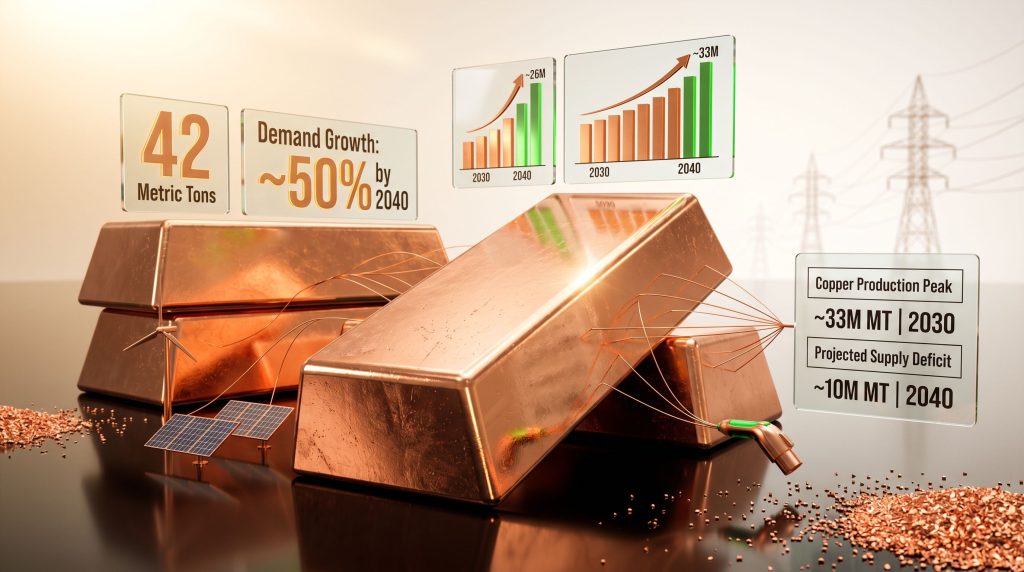
The computational infrastructure underpinning the global AI expansion is copper-intensive in ways that were not part of prior demand forecasting models. Data centres require extensive copper wiring, aluminium-based cooling architecture, and silver-based conductive components. According to S&P Global's January 2026 study, the combined effect of accelerating electrification and AI infrastructure investment could push total copper demand to 42 million metric tons by 2040, approximately 50% above current consumption levels.
The energy demand required to power these facilities simultaneously supports thermal coal and natural gas as baseload power sources, creating a compounding demand environment across multiple commodity classes.
3. Geopolitical Stockpiling and Defence Manufacturing
Elevated geopolitical tension across Eastern Europe, the Middle East, and the Taiwan Strait is generating a demand vector largely absent from the 2000s supercycle: strategic mineral stockpiling. Governments are increasingly treating critical mineral supply chains as national security infrastructure rather than purely commercial matters. Defence manufacturing is copper, aluminium, and steel-intensive at scale, and this demand is not cyclical in the traditional sense as it is driven by threat assessment rather than economic growth rates.
4. Oil Demand: The Structural Reality Investors Underestimate
One of the most revealing statistics in energy economics is the near-unbroken record of oil demand growth since petroleum was first commercially extracted in 1859. In that entire span of history, global oil demand has declined on only four occasions, including the 2008–09 financial crisis and the COVID-19 pandemic. The other two instances were similarly tied to extraordinary global disruptions.
This record makes a crucial point: energy demand is structurally persistent, and what keeps prices suppressed is not demand destruction but technological breakthroughs on the supply side. The U.S. shale revolution is the defining modern example, where sustained oil prices above $100 per barrel incentivised the development of extraction techniques that transformed America into the world's largest oil producer. Understanding this dynamic reframes the entire commodity cycle debate: the question is almost never about demand durability, it is always about whether supply can keep up.
Why Copper Is the Defining Commodity of This Cycle
The Scale of the Coming Supply Deficit
S&P Global's 2026 modelling projects that global copper production will peak at approximately 33 million metric tons around 2030, before beginning a structural decline driven by ageing mine grades, depleting ore bodies, and the long lead times required to bring new supply online. Against a projected demand figure of 42 million metric tons by 2040, this creates a potential structural deficit of approximately 10 million metric tons, a gap with no credible short-term resolution.
| Metric | Projected Figure | Timeframe |
|---|---|---|
| Copper demand (S&P Global) | 42 million metric tons | 2040 |
| Projected production peak | ~33 million metric tons | ~2030 |
| Structural supply deficit | ~10 million metric tons | 2040 |
| Demand growth from current levels | ~50% increase | By 2040 |
Why New Mines Cannot Solve This Problem Quickly
The most commonly misunderstood aspect of copper supply economics is the lead time between investment decision and first production. From initial discovery through exploration drilling, resource definition, feasibility studies, environmental impact assessment, community consultation, permitting in mining, project financing, and construction, a major copper project typically requires 10 to 20 years before it produces a single tonne of refined metal.
Even BHP, the world's largest copper producer, is committing significant capital to projects in South America with production timelines measured in years. Even if every major miner dramatically accelerated capital expenditure today, meaningful new supply would not reach the market before the early-to-mid 2030s at the earliest. The arithmetic of mine development means the supply deficit is not a forecast risk, it is a near-mathematical certainty unless demand collapses independently.
Hidden Constraints: Beyond Geology and Financing
The supply challenge extends beyond geology. A frequently overlooked bottleneck is the availability of sulfuric acid in the copper smelting process. According to J.P. Morgan analysis, approximately 15% of global copper production depends on sulfuric acid supply chains, and China's export restrictions on this input represent a meaningful but underappreciated constraint on global copper processing capacity.
Furthermore, definitive feasibility studies, permitting delays, social licence challenges, and sovereign risk in key mining jurisdictions are extending project timelines well beyond what geology or financing alone would dictate. These institutional frictions compound the geological lead-time problem, creating a supply response ceiling that cannot be raised quickly regardless of price signals.
An Important Clarification: Scarcity vs. Timing
The copper supply argument is frequently mischaracterised as a resource depletion story. It is not. Copper reserves and resources remain geologically abundant, and copper is one of the most recyclable metals in industrial use. The structural investment thesis is built entirely on timing, investment velocity, permitting speed, and mine development lead times. The metal exists; the infrastructure to extract and deliver it at the required pace does not yet exist. For investors, this distinction is critical because it defines the nature of the opportunity and its duration.
How Commodity Prices Signal Supercycle Conditions
Reading Across the Commodity Complex
Looking at current price performance across major commodities reveals a broad-based bull signal, though interpreting it requires nuance:
| Commodity | Recent Price Performance | Trend Signal |
|---|---|---|
| Copper | +30% year-on-year | Strong bull signal |
| Silver | +100%+ year-on-year | Speculative momentum |
| Aluminium | ~+100% year-on-year | Industrial demand surge |
| Thermal coal | +40% year-on-year | Energy security premium |
| Nickel | ~+20% year-on-year | Recovery from bear phase |
Critical Nuance: Price performance alone does not confirm a supercycle. The definitive structural signal is the combination of rising commodity prices alongside still-subdued capital expenditure. When prices rise but investment in new supply lags significantly, it indicates the market is tightening without a supply response being triggered, which historically precedes the most sustained and durable commodity bull markets.
The Capex Gap: The Most Compelling Structural Indicator
Exploration and mining development spending is rising, but it remains well below the levels recorded during the 2007–2011 resource cycle peak. This gap between price signals and capital deployment is one of the strongest available indicators that the commodity cycle has further to run. When capital expenditure begins accelerating aggressively toward large-scale greenfield projects across multiple mining majors simultaneously, that is when investors should start monitoring late-cycle warning signals. Analysts at Sprott have noted that this capex restraint is one of the clearest signals that the current cycle remains in its early-to-mid phase.
What a Commodity Cycle Peak Actually Looks Like
Lessons from the 2007–2011 Resource Boom
The prior resource cycle peak offers a clear set of behavioural and structural markers that distinguished a cycle top from continued mid-cycle expansion. Rio Tinto's acquisition of Alcan in 2007 using an all-debt structure is a frequently cited example of late-cycle excess, where competitive pressure and narrative-driven optimism overrode fundamental valuation discipline.
BHP's then-CEO famously communicated extreme bullishness about Chinese demand to institutional investors, contributing to a sentiment environment where virtually every major resource company was simultaneously positioned for indefinite continuation. Copper's price peak arrived in 2011, coinciding with the zenith of China's apartment construction boom and the widespread acceptance of a "this time is different" narrative around Chinese industrial demand. The defining psychological marker was not simply optimism, it was universal, unchallenged bullishness shared simultaneously across mining executives, institutional investors, and retail participants.
Distinguishing Smart M&A from Late-Cycle Excess
Not all merger and acquisition activity signals a cycle top. The distinction between early-cycle and late-cycle M&A is subtle but important:
- Early-cycle acquisitions are strategically disciplined, valuation-conscious, and focused on securing long-term resource positions at prices that reflect residual pessimism in the market.
- Late-cycle acquisitions are characterised by valuation indifference, competitive bidding wars among multiple majors simultaneously, and narrative-driven justifications that override financial discipline.
BHP's acquisition of OZ Minerals is cited as an example of relatively disciplined, strategically motivated M&A. By contrast, the wave of mega-deals that occurred across Rio Tinto, BHP, and Glencore simultaneously during 2010–2011, with no apparent concern for price paid, was a clear late-cycle signal. The current M&A environment does not yet exhibit that indiscriminate character. Indeed, the evolving dynamic between majors and juniors in copper remains strategically focused rather than indiscriminate.
A Cycle Peak Checklist: What to Watch For
Cycle Top Warning Signals:
- Aggressive, valuation-blind M&A activity occurring across multiple mining majors simultaneously
- Universal investor bullishness with no credible mainstream bear case
- Rapid acceleration of greenfield capex commitments across the sector
- "This time is different" narratives dominating mainstream financial media coverage of mining
- New mine supply from the prior investment cycle beginning to reach markets in meaningful volume
Current Assessment: Capital expenditure is rising but not yet at boom-time levels. M&A is present but strategically selective. Investor sentiment is constructive, not euphoric. The supply response remains years away from meaningful market impact. The structural evidence, taken together, places the current copper and commodity cycle in a mid-cycle expansion phase, not an approaching peak.
The next major ASX story will hit our subscribers first
Commodity-by-Commodity Outlook: 6 to 12 Month Horizon
Iron Ore: More Resilient Than Consensus Expected
The convergence of China's Evergrande collapse, broader Chinese property sector stress, and new supply arriving from the Simandou project in West Africa created what appeared to be a perfect bearish storm for iron ore through much of 2024. Consensus price forecasts moved toward $40–60 per tonne in some circles. However, iron ore has instead demonstrated unexpected resilience, supported by the emergence of a new demand variable: India's accelerating steel consumption tied to its own infrastructure expansion phase.
If Chinese demand holds roughly flat while Indian steel demand continues building, iron ore's medium-term outlook is more robust than most mainstream forecasts currently reflect.
Thermal Coal: The Energy Security Premium
Thermal coal continues to function as the global energy system's gap-filler, stepping in when oil and gas supply is disrupted by geopolitical events, including tensions in the Strait of Hormuz. The Aussie coal producers tracking this thesis share several characteristics worth noting: clean balance sheets, long-life asset portfolios, and strong cash flow generation at current pricing environments.
A critical investment-specific insight is that cost curve positioning is the determining factor for coal investment viability. Higher-cost operators face existential stress during price downturns, as illustrated by the near-collapse of Coronado Resources during the 2025 down-cycle. Lower-cost Australian producers with strong balance sheets generate substantial free cash flow that translates directly into dividends, creating a genuinely attractive yield investment when purchased at the right point in the cycle.
Metallurgical Coal: Following the India Growth Story
Met coal demand is increasingly being driven by Indian steel production growth as China's construction-driven steel demand moderates from its prior highs. The demand narrative closely mirrors iron ore, with both commodities tied to the pace and scale of Indian industrialisation. For medium-term positioning, the India demand variable is the primary factor to monitor for both met coal and iron ore simultaneously.
Copper: Highest-Conviction Long-Term Thesis, Evolving Risk-Reward
The long-term structural case for copper is among the strongest available across any commodity, but the risk-reward profile has shifted as significant price appreciation has already occurred in large-cap copper producers. BHP's share price movement from below A$40 to above A$60 illustrates how much of the large-cap copper thesis has already been captured by the market.
From a technical analysis perspective, the copper price chart currently exhibits extremely strong characteristics, suggesting potential for further speculative momentum over a 3–6 month horizon. However, a material correction in technology sector valuations represents a specific and significant risk for copper that would not affect traditional energy commodities to the same degree.
For investors seeking asymmetric exposure to the copper bull case, the better opportunity may now lie in mid-cap and junior copper miners, where the price appreciation that has already occurred in the majors has not yet been fully reflected. Exploring copper investment strategies at this level of the market remains one of the most compelling risk-adjusted opportunities available. Companies developing the copper assets that will supply the 2030s and 2040s market remain the most speculative but potentially highest-returning part of the copper investment universe.
How Investors Should Think About Commodity Supercycle Positioning
The Investment Implications of a Prolonged Supply Deficit
The copper supply gap is not a speculative forecast. It is an arithmetic consequence of known mine development timelines and current capital allocation rates. That structural reality creates a framework for positioning:
- Large-cap miners offer copper exposure with lower volatility but may have already priced in significant upside in the current cycle.
- Mid-cap and junior copper explorers offer higher speculative upside if the copper bull case continues to develop, with commensurate higher risk and liquidity considerations.
- Diversified commodity exposure across copper, coal, and iron ore provides a portfolio-level hedge against geopolitical disruption and energy supply volatility simultaneously.
Key Indicators for Monitoring the Commodity Cycle
| Indicator | What It Signals |
|---|---|
| Mining capex acceleration | Cycle maturing; supply response beginning |
| Indiscriminate large-cap M&A | Late-cycle warning signal |
| Copper price sustained above $5/lb | Structural bull market confirmation |
| New mine permitting approvals at scale | Supply pipeline actually building |
| Emerging market industrial demand data | Demand durability beyond China |
| AI data centre construction rates | Technology-driven copper demand validation |
Frequently Asked Questions: Commodity Supercycle and Copper Supply Shortage
What is a commodity supercycle?
A commodity supercycle is an extended period, typically spanning 10 to 35 years, during which commodity prices remain broadly elevated above long-run averages. Unlike standard cyclical upswings, supercycles are anchored in structural economic transformation, such as industrialisation, urbanisation, or major energy system transitions, that drives demand beyond the supply system's capacity to respond within normal market timeframes.
Why is copper central to the current commodity supercycle?
Copper is electrically conductive, durable, recyclable, and currently irreplaceable in virtually every clean energy technology, from EV motors and charging infrastructure to solar inverters, wind turbine generators, and high-voltage transmission grids. No commercially viable substitute currently exists at scale for most of these applications. Combined with a projected 10 million metric ton supply deficit by 2040, this makes copper the highest-conviction structural commodity thesis in the current cycle.
How long does it take to bring a new copper mine into production?
From initial discovery to first commercial production, copper mine development typically requires between 10 and 20 years, depending on jurisdiction, deposit complexity, permitting requirements, and financing conditions. This extended lead time is the primary reason current supply cannot respond quickly to rising prices, and it is why the deficit projected for 2040 is largely already locked in. Mining.com has outlined several structural reasons why this timeline is unlikely to compress meaningfully in the near term.
What would cause copper prices to fall significantly?
The most plausible scenarios for a sustained copper price decline include: a sharp global recession reducing industrial and construction demand, a major technological breakthrough enabling copper substitution at scale, a faster-than-expected supply response from accelerated permitting and investment, or a significant correction in technology sector valuations reducing the AI-driven demand narrative.
Are we currently at the peak of the commodity supercycle?
Available structural evidence does not support a cycle peak interpretation. Mining capital expenditure remains below boom-time levels relative to price signals. M&A activity is strategically selective rather than indiscriminate. Investor sentiment is constructive but not euphoric. The commodity super cycle and copper supply shortage dynamic will not be resolved before the 2030s. Most indicators suggest the cycle remains in an expansion phase, not approaching a top.
The Structural Case for a Sustained Commodity Cycle
Why the Supply Side Makes This Cycle Different
Unlike the 2000s supercycle, which was powered overwhelmingly by China's demand surge, the current cycle is being defined by a supply system that has chronically underinvested relative to the scale of demand transformation already underway. The copper deficit projected for the 2030s and 2040s is not a speculative scenario. It is an arithmetic consequence of known mine development timelines and existing capital allocation decisions.
Even a dramatic acceleration in mining investment today would not meaningfully close that gap before the early 2030s. This creates an unusual investment environment: rising prices, constrained supply response, and a structural deficit that is years from resolution. That combination historically represents the most sustained and rewarding phase of a commodity super cycle and copper supply shortage environment.
The Long Game: Patience, Positioning, and Cycle Awareness
The most productive investor posture in this environment is one that distinguishes between early-cycle opportunity, mid-cycle expansion, and late-cycle excess. The markers of a genuine cycle peak are not yet present in sufficient combination. Indiscriminate M&A, universal bullishness, and an accelerating greenfield investment wave have not yet arrived.
For investors who understand the commodity supercycle framework, the copper supply shortage thesis, and the asymmetric opportunity that remains in mid-tier and junior miners developing the assets the world will need in the 2030s, the structural case for sustained engagement with the commodity sector remains compelling. The clock is running on the supply deficit. The investment window for capturing the most asymmetric returns typically closes well before the deficit becomes front-page news.
This article is intended for informational and educational purposes only. It does not constitute financial advice. Commodity markets involve substantial risk, including the potential loss of capital. Past price performance and historical cycle patterns do not guarantee future results. Readers should conduct their own independent research and consult qualified financial professionals before making investment decisions.
Ready to Capitalise on the Next Major Copper Discovery Before the Market Does?
Discovery Alert's proprietary Discovery IQ model scans ASX announcements in real time, instantly identifying significant mineral discoveries across copper and 30+ other commodities — turning complex data into actionable investment insights before the broader market catches on. Explore how historic discoveries have generated substantial returns on Discovery Alert's dedicated discoveries page, then begin your 14-day free trial to position yourself ahead of the coming supply crunch.