
May 18, 2026
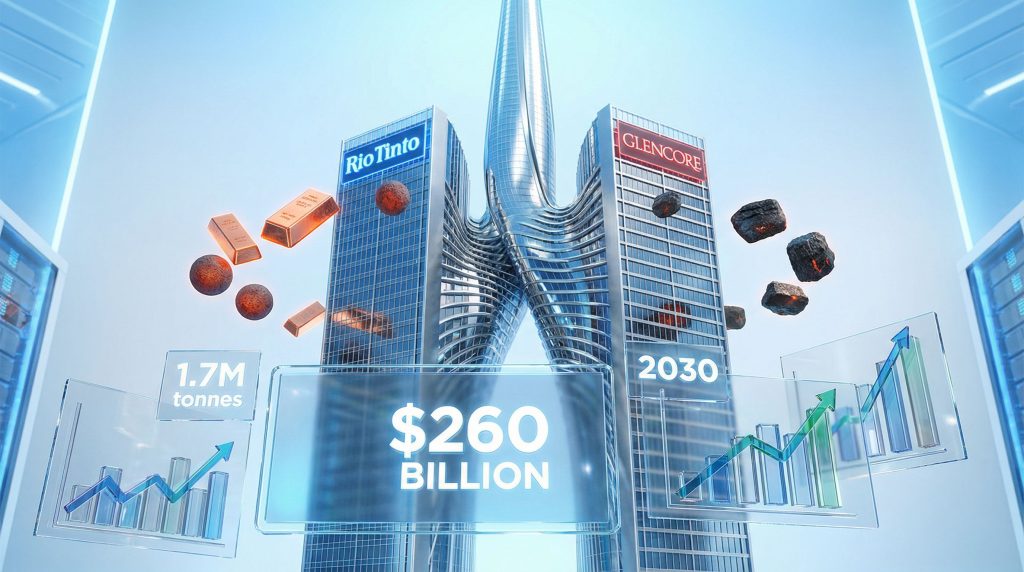
Strategic Copper Concentration Drives Mining Mega-Merger Dynamics
Global mining consolidation strategies have reached an inflection point as commodity producers seek operational scale advantages and portfolio diversification beyond traditional iron ore dependency. The Rio Tinto Glencore merger represents a pivotal moment in industry consolidation trends, where energy transition demands for critical minerals have fundamentally altered strategic planning frameworks across major mining corporations.
Current Market Context:
• Copper prices reached US$13,199 per tonne as of late January 2026, representing a 47% increase over the preceding 12-month period
• Combined transaction values in mining sector consolidation have increased substantially, with potential deals approaching $260 billion in total consideration
• Strategic rebalancing toward renewable energy metals has intensified across all major mining corporations
• Regulatory approval timelines for cross-border transactions have compressed to accommodate market volatility
When big ASX news breaks, our subscribers know first
Asset Acquisition Economics Versus Greenfield Development Timelines
The fundamental strategic question confronting mining executives centres on acquisition-based growth versus organic project development. Established copper production facilities offer immediate capacity expansion without the regulatory uncertainties and capital deployment risks associated with greenfield exploration and mine construction.
Production Capacity Analysis:
| Commodity Segment | Current Combined Potential | Expansion Timeline | Capital Requirements |
|---|---|---|---|
| Copper Production | 1.7 million tonnes annually | Immediate integration | Integration costs only |
| Iron Ore Operations | 320+ million tonnes | Existing capacity | Minimal additional capex |
| Coal Portfolio Integration | 100+ million tonnes | Legacy operations | ESG compliance costs |
This strategic framework enables immediate market positioning changes without the 18-36 month development timelines typical of greenfield copper projects. Traditional mine development requires extensive permitting, environmental assessments, and infrastructure construction before achieving commercial production status.
According to Jacki Neumann, Head of Capital Markets at Sharesies, the strategy represents a fundamental pivot: "By integrating copper portfolio assets, major mining companies would significantly reduce exposure to the cyclical volatility of iron ore markets while positioning to capitalise on projected demand growth from energy transition and AI infrastructure development."
Market Concentration Implications for Global Commodity Dynamics
Consolidation at this scale would fundamentally alter competitive dynamics across multiple commodity sectors, creating enhanced supply management capabilities and potentially displacing current market leadership positions. Furthermore, global copper supply considerations become increasingly critical as renewable energy adoption accelerates worldwide.
Competitive Landscape Transformation:
• The combined entity would control approximately 5-7% of global copper production capacity
• Iron ore market share would remain concentrated among top three producers
• Coal operations would provide transitional cash flows during renewable energy infrastructure development
• Geographic diversification across six continents would reduce political and operational risks
Supply chain control mechanisms become increasingly critical as renewable energy adoption accelerates globally. The combined operations would span jurisdictions including Australia, Democratic Republic of Congo, Peru, Chile, and various African territories, providing strategic flexibility for commodity export management.
Risk Concentration Factors:
Enhanced market concentration could influence pricing dynamics across copper, iron ore, and coal markets through improved supply management capabilities, though regulatory authorities typically scrutinise such consolidation effects carefully.
Regulatory Approval Complexities and Timeline Constraints
Multiple jurisdiction requirements create substantial execution risks, with each regulatory body potentially imposing different conditions or operational restrictions. The compressed timeline adds significant pressure to strategic decision-making processes for any Rio Tinto Glencore merger negotiations.
Critical Deadline Management:
UK Takeover Code requirements mandate clarification of merger intentions by February 5, 2026, creating non-negotiable timeline constraints for due diligence completion and board approval processes, as outlined in Rio Tinto's official statement.
Regulatory Authority Requirements:
• UK Financial Conduct Authority: Primary merger approval for London-listed entities
• Australian ACCC: Competition assessment for domestic mining operations
• US Department of Justice: Antitrust review for North American operations
• Various jurisdictional approvals: Country-specific requirements for operational assets
Historical precedent from the 2019 merger discussions between major mining corporations suggests regulatory authorities focus particularly on market concentration effects and competitive dynamics within specific commodity segments.
ESG Investment Positioning and Coal Asset Integration
The reintroduction of coal assets into a previously diversified commodity portfolio presents significant challenges for institutional investor retention, particularly among ESG-focused investment funds. However, effective copper investment strategies often require managing legacy assets whilst transitioning toward cleaner commodities.
Neumann addressed this strategic tension: "A return to coal operations would test market appetite for responsible stewardship approaches over simple asset divestiture. However, the market increasingly recognises the bridge theory – that maintaining legacy cash flows often proves necessary for financing renewable infrastructure development."
ESG Impact Assessment:
• Potential institutional investor withdrawals from strict ESG-compliant funds
• Coal assets providing high-margin funding for copper and lithium expansion projects
• Bridge strategy enabling self-financing of capital-intensive renewable energy mineral development
• Long-term portfolio transition toward cleaner commodity focus
Financial Metrics and Synergy Realisation Potential
Acquisition premium calculations suggest valuations ranging from 15% to 30% above early January 2026 trading levels would be necessary to secure shareholder approval across both entities. In addition, analysts have suggested that the potential deal could be viewed as a strategic response to broader market pressures facing major mining companies.
Synergy Categories and Estimates:
• Procurement Optimisation: Combined purchasing power for equipment, supplies, and services
• Operational Efficiency: Mine optimisation, equipment utilisation improvements, and technology integration
• Corporate Overhead Elimination: Duplicate management structures, redundant facilities, and administrative functions
Combined synergy targets for transactions of this scale typically range from $500 million to $1.5 billion annually, with realisation timelines extending 24-36 months post-completion.
Capital Structure Optimisation:
Current debt consolidation opportunities exist through refinancing existing obligations under improved credit profiles. The combined entity would likely achieve investment-grade credit ratings and reduced borrowing costs compared to standalone financing structures.
The next major ASX story will hit our subscribers first
Alternative Strategic Pathways and Opportunity Costs
Rather than pursuing full corporate integration, several alternative approaches could deliver similar strategic benefits while minimising execution complexity and integration risks. For instance, the mining industry evolution continues to present new operational models and partnership structures.
Selective Asset Acquisition Model:
Targeted acquisition of specific copper assets would enable portfolio enhancement without assuming coal-related ESG complications. This approach typically requires 12-18 months for completion and focuses on specific geographic regions or commodity types.
Joint Venture Partnership Structures:
Strategic partnerships for project-specific development could provide operational benefits without full corporate integration requirements. Joint ventures enable:
• Risk sharing for major capital projects
• Technology and expertise combination
• Geographic market access
• Regulatory compliance coordination
Organic Greenfield Development:
Traditional expansion through new project development requires longer timeframes but offers greater operational control. Typical timelines include:
• Exploration phase: 3-5 years for resource definition
• Feasibility studies: 18-24 months for economic assessment
• Permitting and construction: 4-6 years depending on jurisdiction
• Commercial production: 8-12 years total from initial exploration
Geopolitical Considerations and Supply Chain Security
Resource security has become increasingly important as Western mining companies prioritise asset diversification across politically stable jurisdictions. The combined operations would enhance supply chain resilience for critical minerals essential to renewable energy infrastructure.
Strategic Geographic Distribution:
• South American operations: Peru and Chile copper production facilities
• African assets: Democratic Republic of Congo and Zambian copper mines
• Australian operations: Iron ore and coal production capacity
• North American presence: Limited but strategically positioned assets
Trade policy adaptation becomes more manageable through diverse operational footprints, providing flexibility to navigate evolving international commodity export restrictions and trade agreements.
Market Timing and Commodity Price Cycle Optimisation
Current copper price cycles create favourable conditions for asset valuations and merger economics. The 47% price appreciation over 12 months reflects structural demand growth from renewable energy adoption and electric vehicle production scaling.
Price Performance Context:
Combined entity shares have demonstrated strong market performance, with 29.4% appreciation over the 12-month period preceding late January 2026, excluding dividend distributions.
Integration planning requirements would benefit from current market conditions, enabling more aggressive synergy targets and shorter realisation timelines due to favourable commodity pricing environments.
Technology Integration and Operational Efficiency Synergies
Combined research and development capabilities could accelerate mining technology advancement and operational efficiency improvements across both organisations' asset portfolios. Furthermore, AI-driven drilling innovation represents a key area where consolidated operations could achieve significant competitive advantages.
Technology Synergy Opportunities:
• Autonomous vehicle fleet optimisation: Standardised equipment across operations
• Data analytics and AI implementation: Combined expertise for predictive maintenance and operational optimisation
• Environmental monitoring systems: Integrated approaches to emissions reduction and water management
• Safety technology deployment: Best practice sharing across all operational sites
Success Measurement Framework and Performance Indicators
Successful integration would be evaluated across multiple performance dimensions, balancing operational excellence with strategic positioning achievements. Consequently, any Rio Tinto Glencore merger would require robust measurement frameworks to track performance improvements.
Operational Performance Metrics:
• Copper production capacity expansion achievement within 24-month integration timeline
• Cost synergy realisation meeting 85% of initial estimates
• Safety performance maintenance at current industry-leading levels
• Environmental compliance across all jurisdictional requirements
Financial Performance Indicators:
• Return on Invested Capital (ROIC) improvements of 200-300 basis points within three years
• Dividend sustainability and potential 5-10% annual growth trajectory
• Debt-to-equity ratio optimisation below 35% within 18 months
• Share price performance exceeding commodity benchmark indices by 10-15% annually
Industry Consolidation Acceleration and Broader Market Implications
This potential transaction could catalyse additional consolidation activity across the global mining sector as companies seek similar scale advantages and portfolio optimisation benefits. However, the outcome of this Rio Tinto Glencore merger discussion will likely influence strategic planning across the entire industry.
Consolidation Trend Implications:
• Mid-tier mining companies becoming acquisition targets for remaining major producers
• Private equity involvement increasing in mineral asset acquisitions
• Government involvement in strategic mineral supply chains through national champion policies
• Technology companies forming strategic partnerships with mining operators for critical mineral security
The combined research and development capabilities would accelerate mining technology advancement, potentially creating competitive advantages that smaller operators cannot replicate independently.
Future Market Structure:
Successful completion could establish a framework where three to four mega-miners control significant portions of global critical mineral production, fundamentally altering supply chain dynamics and customer relationship management across the renewable energy sector.
This consolidation pattern reflects broader industrial trends where scale, technology integration, and capital deployment capabilities determine long-term competitive positioning in capital-intensive commodity sectors.
Ready to Capitalise on the Next Major Mining Consolidation?
Whilst mega-mergers reshape the global mining landscape, Discovery Alert's proprietary Discovery IQ model helps investors identify emerging opportunities among smaller ASX-listed mineral companies before major consolidation events occur. Begin your 30-day free trial today and discover why historic mineral discoveries continue to deliver substantial returns to early investors.