June 12, 2026
When Maritime Chokepoints Become Geopolitical Weapons
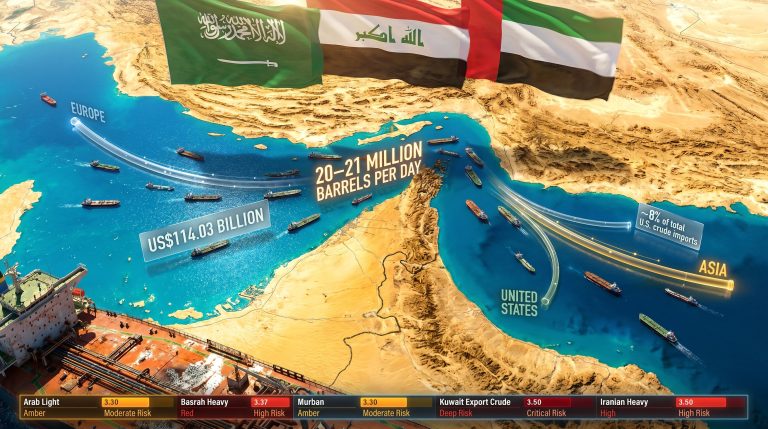
The world's most consequential energy corridor is not a pipeline, a refinery, or a terminal. It is a narrow strip of open water, barely 33 kilometres wide at its tightest point, through which roughly one-fifth of the planet's entire energy supply moves every year. The Strait of Hormuz has long been understood as a structural vulnerability in the global energy system, but understanding that vulnerability in the abstract is very different from confronting it when a vessel sinks and 14 sailors find themselves adrift in contested waters.
The events of May 2026 transformed that abstract vulnerability into an immediate operational reality for India, one of the world's largest energy-importing nations. Examining the India-flagged vessel attack in the Strait of Hormuz through the lens of maritime security, energy economics, and international law reveals not just a single incident, but a deepening systemic crisis unfolding in real time. Furthermore, the incident sits within a broader pattern of crude oil geopolitics that has been reshaping maritime risk calculations for commercial operators worldwide.
When big ASX news breaks, our subscribers know first
The Incident: What the Attack on the India-Flagged Vessel Actually Tells Us
A Structured Account of the May 13 Attack
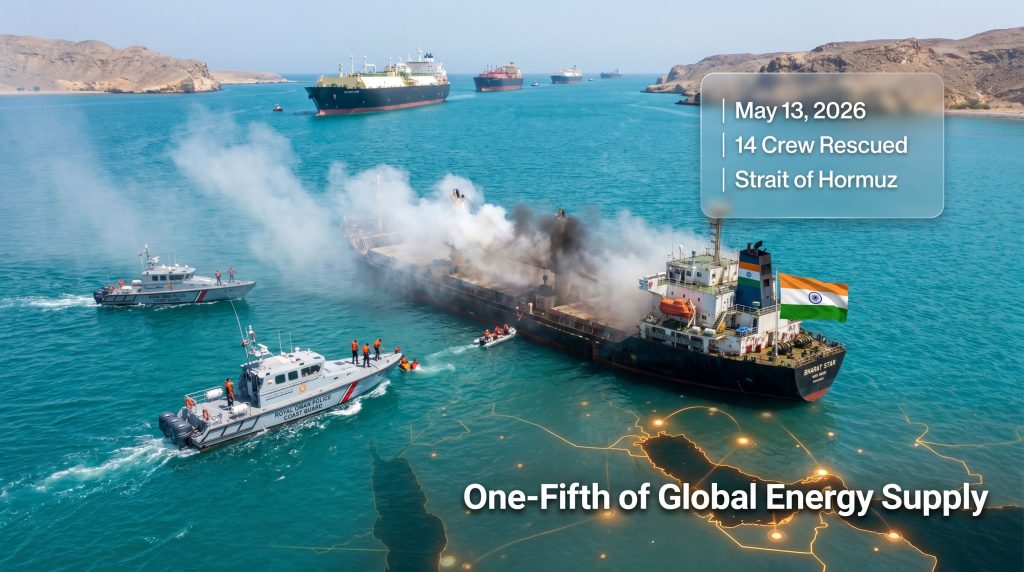
On May 13, 2026, an India-flagged commercial cargo vessel was struck by an unknown projectile while transiting waters off the coast of Oman, near the broader Strait of Hormuz maritime corridor. The vessel, which had been sailing from Somalia, was hit with sufficient force to trigger an explosion and fire that ultimately caused the ship to sink entirely.
Despite the severity of the strike, Omani maritime authorities conducted a swift rescue operation, recovering all 14 crew members alive. No fatalities were reported. No group or state actor publicly claimed responsibility for the attack in the immediate aftermath. India's foreign ministry condemned the attack, describing it as wholly unacceptable and calling for crew safety to be prioritised.
The key facts of the incident are summarised below:
| Detail | Information |
|---|---|
| Date of Attack | May 13, 2026 |
| Vessel Type | India-flagged commercial cargo vessel |
| Vessel Origin | Sailing from Somalia |
| Location | Off the coast of Oman, near the Strait of Hormuz |
| Crew Rescued | All 14 crew members |
| Rescue Authority | Omani maritime authorities |
| Vessel Fate | Sank following explosion and fire |
| Responsibility Claimed | None publicly confirmed |
| India-flagged vessels attacked since conflict began | At least 3, including this vessel |
What makes this incident analytically significant is not just the loss of the vessel, but the context surrounding it. The May 13 attack was the third confirmed strike against an India-flagged commercial ship since the broader West Asia conflict began escalating on February 28, 2026, following joint US-Israel military operations against Iran and the retaliatory strikes that followed. Three incidents in roughly ten weeks is not coincidence. It is a pattern.
The Strait of Hormuz: Why This 33-Kilometre Channel Holds the World to Ransom
The Geography of Energy Dependence
To understand why a single vessel sinking in the waters off Oman generates concern across capital cities from New Delhi to Brussels, it is necessary to appreciate what the Strait of Hormuz actually is in functional terms. It is not merely a geographic feature. It is the world's single most critical energy export corridor, through which crude oil, liquefied natural gas, and refined petroleum products from Saudi Arabia, the UAE, Kuwait, Iraq, and Qatar all flow toward global markets.
At its narrowest navigable point, vessels transiting in each direction are confined to shipping lanes that are only about three kilometres wide, within a broader strait spanning roughly 33 kilometres. The consequence of this geography is stark: there is no viable deepwater alternative for Gulf oil exporters, and any meaningful disruption to Hormuz transit translates almost immediately into global energy price volatility. Indeed, the oil price shock potential of a prolonged Hormuz disruption has been a central concern for energy executives across multiple producing nations.
Key structural features of the strait's strategic importance include:
- Approximately one-fifth of the world's total energy supply transits through the strait annually
- The corridor handles the bulk of crude oil exports from five of the world's top oil-producing nations simultaneously
- The LNG supply outlook for Asian markets depends critically on unimpeded Qatari exports through this route
- Downstream price effects from Hormuz disruptions reach Asian, European, and North American energy markets within days, not weeks
How the West Asia Conflict Changed the Threat Calculus
Before February 28, 2026, the Strait of Hormuz was already considered the world's highest-risk maritime chokepoint by most security analysts. The escalation of hostilities in West Asia transformed that theoretical risk into an active operational threat for commercial shipping operators.
Iran's retaliatory posture following the joint US-Israel military operations introduced a new dimension of uncertainty. Rather than confronting Western naval assets directly, the conflict dynamic produced a pattern of commercial vessel interdictions that security analysts have characterised as a deliberate strategy of economic coercion through maritime disruption.
By targeting the commercial shipping that sustains the economies of adversary-aligned or strategically ambiguous states, actors in the conflict found a cost-effective mechanism for applying pressure without triggering a direct military escalation with Western powers. Adding further complexity, Iran officially announced the formation of a new administrative body specifically to manage Strait of Hormuz operations, a development carrying significant implications for navigational authority and commercial compliance requirements in the waterway.
Situating the May 2026 Attack Within a Pattern of Commercial Shipping Disruption
The Chronology of India-Flagged Vessel Incidents
The targeting of India-flagged vessels did not emerge without precedent. The three attacks between late February and mid-May 2026 represent an accelerating sequence that maritime security analysts have characterised as systematic rather than opportunistic.
- February to March 2026 – Conflict escalation begins; initial disruptions to commercial shipping lanes near the Strait of Hormuz emerge almost immediately as Iran responds to military strikes
- First and second India-flagged vessel incidents – Two separate attacks on India-registered commercial ships occur in the weeks following the escalation, establishing early evidence of a targeting pattern
- May 13, 2026 – Third confirmed attack; the India-flagged cargo vessel is struck off the Oman coast, sustains catastrophic damage, and sinks. All 14 crew rescued by Omani authorities
- May 18, 2026 – India's Permanent Representative to the UN, Parvathaneni Harish, addresses a special session of UNECOSOC, elevating the matter to the multilateral level
Why India-Flagged Vessels Face Elevated Exposure
The concentration of attacks on Indian-registered vessels reflects a combination of factors that extend beyond simple statistical probability.
- India is among the world's largest importers of crude oil and LNG, with a substantial share of those energy imports sourced from Gulf Cooperation Council member states whose exports transit Hormuz
- Indian shipping operators maintain a significant commercial fleet operating in the Persian Gulf, creating greater exposure to regional conflict spillover
- As of mid-May 2026, approximately 13 India-flagged vessels were reported to be holding position in the Persian Gulf, effectively anchored in place while their operators assessed whether Hormuz transit conditions had improved sufficiently to proceed
- India's carefully maintained position of strategic non-alignment in the West Asia conflict may paradoxically increase its vulnerability, as New Delhi's deliberate avoidance of formal alliance commitments reduces the deterrent effect of any implicit great-power protection
India's Official Response: Condemnation, Diplomacy, and Strategic Restraint
How New Delhi Navigated the Diplomatic Aftermath
India's response to the attacks on its commercial fleet demonstrates the considered balancing act required of a major power that depends heavily on energy imports from a conflict zone while simultaneously maintaining independent foreign policy relationships with multiple antagonistic parties in that same region.
India's Permanent Representative to the UN, Parvathaneni Harish, stated at a special UNECOSOC session that attacks on commercial vessels, the endangerment of civilian crew members, and interference with freedom of navigation in the Strait of Hormuz are completely unacceptable, and that international law governing safe passage must be upheld without exception. The framing was firm but deliberately unattributed.
India's multi-channel response strategy deployed several distinct instruments simultaneously:
- Ministry of External Affairs (MEA): Issued a formal condemnation of the attack, confirmed the safe recovery of all crew members, and formally acknowledged Oman's role in conducting the rescue operation
- UN Multilateral Platform: India's UNECOSOC address elevated the incident beyond a bilateral dispute, positioning it within the broader context of global energy supply disruption and international humanitarian obligations toward civilian maritime workers
- Policy Framing: India's UN Representative articulated the need for both immediate crisis response measures and longer-term structural solutions through international cooperation to address energy and fertiliser supply disruptions caused by the West Asia conflict
- Attribution Stance: Official statements consistently condemned the act without naming a perpetrator, preserving diplomatic flexibility while maintaining a principled public position
The Strategic Significance of the UNECOSOC Forum Choice
India's deliberate decision to raise this matter at UNECOSOC rather than the UN Security Council carries significant strategic meaning that rewards closer analysis.
The Security Council is the appropriate body for matters framed as threats to international peace and security. It is also where geopolitical vetoes most directly obstruct consensus, particularly on issues involving the major powers that have backed opposing sides in the West Asia conflict. By bringing the matter to UNECOSOC instead, India framed the issue in economic and humanitarian terms rather than security terms.
This framing reflects a sophisticated understanding of multilateral institution selection. India simultaneously signalled alignment with international maritime law norms shared by Western democracies while avoiding the kind of direct geopolitical confrontation that would compromise New Delhi's independent foreign policy posture.
This approach is consistent with India's longstanding preference for strategic autonomy in its foreign policy, a doctrine that has become increasingly difficult to sustain as the energy consequences of the West Asia conflict intensify. However, the global supply chain disruption caused by regional conflicts of this nature is ultimately forcing all major economies to reconsider their dependency on single-corridor transit routes.
The Energy Supply Dimension: What This Means for India's Economy
Quantifying India's Exposure Through the Strait of Hormuz
The strategic stakes for India extend well beyond the diplomatic realm. The country's energy security architecture is built on a foundation that runs directly through the world's most contested maritime chokepoint.
India imports a substantial proportion of its LPG and crude oil from Gulf producers, the majority of which export exclusively through the Strait of Hormuz. Disruptions to that transit corridor cascade through the Indian economy in several distinct ways:
| Risk Category | Short-Term Impact | Structural Long-Term Impact |
|---|---|---|
| LPG Supply | Delayed shipments, spot price increases | Pressure to diversify import sourcing |
| Crude Oil | Route uncertainty, insurance cost escalation | Investment in strategic petroleum reserves |
| Fertiliser Inputs | Supply chain disruption affecting agriculture | Policy focus on domestic production capacity |
| Shipping Insurance | War-risk premium escalation across all operators | Long-term renegotiation of maritime insurance frameworks |
| Crew Safety | Immediate welfare and evacuation protocols | Bilateral maritime security agreements |
Despite the deteriorating security environment, reporting confirmed that India-bound LPG tankers continued transiting the strait during the period following the May 13 attack. This reflects a commercial calculation that the cost of indefinite delays, compounded by insurance and demurrage expenses for vessels waiting at anchor, exceeded the risk premium of proceeding through a hostile but not fully blocked waterway.
The approximately 13 India-flagged vessels reported to be holding position in the Persian Gulf during mid-May 2026 illustrate the operational reality for shipping operators: remaining stationary is not a costless alternative. Every day at anchor incurs costs in crew wages, fuel for auxiliary systems, demurrage charges, and the cascading delivery delays that affect the downstream buyers of the cargo.
The next major ASX story will hit our subscribers first
International Law and Commercial Shipping: The Legal Framework in a Conflict Zone
UNCLOS and the Right of Transit Passage
The attacks on commercial vessels in the Strait of Hormuz occur within a well-established legal framework that unambiguously prohibits such actions, yet offers limited enforcement mechanisms in a contested geopolitical environment.
The United Nations Convention on the Law of the Sea (UNCLOS) establishes the right of transit passage through international straits used for international navigation. Under this framework, all vessels regardless of flag state are entitled to transit the Strait of Hormuz without interference. Attacks on commercial vessels in international waters violate both UNCLOS provisions and customary international law, and may trigger obligations under the UN Charter depending on the identity of the perpetrating party.
Key legal dimensions of the current situation include:
- Deliberate targeting of civilian crew members raises potential international humanitarian law considerations, particularly where non-state armed actors may be involved
- Without confirmed attribution, the pathways for pursuing state responsibility claims through international legal mechanisms remain severely constrained
- The absence of a claimed perpetrator prevents India from pursuing specific UN Security Council resolutions targeting the responsible party, even if political will existed among permanent members
- Legal analysts have noted that pattern-based attribution, establishing a consistent operational signature across multiple incidents, may eventually support formal accountability proceedings even without explicit claims of responsibility
Why Attribution Matters and Why It Remains Elusive
The absence of any publicly confirmed claim of responsibility for the May 13 attack is itself analytically significant. In modern maritime conflict, the ambiguity surrounding attribution serves strategic functions for the attacking party: it allows deniability in diplomatic contexts, complicates the legal basis for retaliatory action, and forces the targeted nation to absorb economic costs without a clear mechanism for formal redress.
For India specifically, the absence of attribution creates a peculiar diplomatic position. New Delhi can condemn the act without being compelled to take a position on the responsible party, which aligns with India's interest in preserving relationships across the conflict's multiple stakeholders. However, it also limits India's ability to demand specific accountability through international institutions. Reporting from The Hindu confirmed the MEA's carefully worded response reflected precisely this diplomatic constraint.
Iran's New Strait of Hormuz Management Body: What It Signals
Unpacking the Institutional Announcement
Among the most consequential developments to emerge from the West Asia conflict's maritime dimension is Iran's official announcement of a new administrative body specifically tasked with managing Strait of Hormuz operations. The significance of this announcement extends beyond its immediate operational implications.
For international shipping operators, the establishment of such a body creates layered uncertainty:
- Vessel operators transiting the strait may face new compliance demands, inspection protocols, or transit authorisation requirements from Iranian authorities whose legal standing under UNCLOS remains disputed by the international community
- War-risk insurance underwriters are likely to factor the formalisation of Iranian administrative control claims into premium reassessments, adding further cost pressure to already elevated war-risk rates
- The announcement may function simultaneously as a domestic political signal demonstrating assertiveness toward Iranian audiences and as a strategic deterrent designed to complicate adversary naval logistics in the waterway
- Shipping companies with India-flagged or India-bound vessels will need to monitor diplomatic developments between New Delhi and Tehran closely, as any formal engagement on Hormuz navigation protocols could have direct commercial implications
Furthermore, the geopolitical mining landscape of the broader region is already being reshaped by the same conflict dynamics, suggesting that the maritime and resource dimensions of this crisis are deeply interconnected.
The creation of a dedicated Hormuz management body represents a significant institutional escalation. It transforms what was previously an implicit assertion of influence over the waterway into an explicit administrative claim, creating a new point of potential confrontation between Iranian authority and the UNCLOS-based international maritime order.
Scenario Analysis: Three Possible Trajectories for the Strait of Hormuz
A Framework for Understanding the Range of Outcomes
The following scenarios are constructed from the available geopolitical and energy market context and are intended as analytical frameworks for understanding possible trajectories, not as predictions. The situation remains fluid and heavily dependent on diplomatic developments that cannot be forecast with confidence.
Scenario One: Gradual De-escalation
Diplomatic back-channels produce a partial ceasefire or operational pause. Commercial shipping risk premiums begin declining as the pattern of attacks breaks. Iran's new Hormuz management body assumes a limited administrative function with minimal active enforcement. India-flagged vessel incidents cease, and the 13 vessels holding position in the Persian Gulf resume transit.
Scenario Two: Sustained Low-Intensity Disruption
Attacks on commercial vessels continue at reduced but regular frequency. Insurance costs remain materially elevated, effectively functioning as an informal tax on Gulf energy trade. India accelerates its strategic petroleum reserve expansion programme and begins systematically diversifying LPG import sources toward non-Gulf suppliers, including the United States and Australia. Multilateral pressure builds for a UN-mandated maritime security framework, though Security Council deadlock prevents formal action.
Scenario Three: Escalatory Spiral
A high-profile attack on a major vessel or critical energy infrastructure triggers a significant global market response. Crude oil prices spike materially above existing elevated levels. India faces acute short-term energy supply pressure. Emergency diplomatic engagement intensifies between New Delhi, Washington, and Gulf capitals. The structural inadequacy of existing multilateral maritime security frameworks becomes the subject of urgent international policy debate.
Key Takeaways: Reading the Hormuz Shipping Crisis Through India's Strategic Lens
The India-flagged vessel attack in the Strait of Hormuz on May 13, 2026 is not a standalone incident that can be understood in isolation from the broader geopolitical and energy security context. Taken together with the two earlier attacks on India-registered vessels since February 2026, it establishes a pattern that poses fundamental questions for New Delhi's foreign policy, energy strategy, and commercial maritime operations.
The most critical points for a comprehensive understanding of the situation are:
- The May 13 attack was the third confirmed incident targeting India-flagged vessels in roughly ten weeks, indicating deliberate pattern rather than random risk exposure
- All 14 crew members were rescued by Omani authorities, but the complete loss of the vessel represents a significant commercial and symbolic cost
- India responded through diplomatic condemnation and multilateral engagement at UNECOSOC, deliberately avoiding direct attribution while maintaining a principled public stance grounded in international maritime law
- The Strait of Hormuz carries approximately one-fifth of global energy supply, making disruptions there a systemic risk for energy-importing economies, with India facing particularly acute exposure given its dependence on Gulf crude and LPG
- Iran's announcement of a new body to manage Strait of Hormuz operations adds a novel institutional dimension to an already volatile maritime environment, creating compliance uncertainty for commercial shipping operators
- The 13 India-flagged vessels holding position in the Persian Gulf during mid-May 2026 illustrate the operational reality of elevated risk, where remaining at anchor is costly but transiting involves genuine physical danger
- Resolution of the current crisis will require a combination of bilateral diplomacy, multilateral maritime security coordination, legal attribution efforts, and structural diversification of India's energy import base over the medium term
The analysis above is based on publicly available reporting and confirmed factual information. Scenario projections and analytical assessments represent interpretive frameworks only and should not be construed as predictions of specific outcomes. Readers are encouraged to consult primary reporting from ET EnergyWorld, The Wire, and the Times of India for the latest developments on this evolving situation.
Want to Stay Ahead of the Next Major Resource Discovery Driven by Shifting Global Supply Chains?
As maritime disruptions reshape energy markets and accelerate the search for alternative resource corridors, Discovery Alert's proprietary Discovery IQ model delivers real-time alerts on significant ASX mineral discoveries — instantly translating complex market shifts into actionable investment opportunities. Explore how historic discoveries have generated extraordinary returns on Discovery Alert's dedicated discoveries page, and begin your 14-day free trial today to position yourself ahead of the market.