August 7, 2026
What Will Drive Global Copper Consumption to 42 Million Tonnes by 2040?
Long-term structural forces are reshaping global metal markets in ways not seen since the industrial revolution. Traditional supply-demand models that governed commodity cycles for decades now face unprecedented disruption from technological acceleration, geopolitical realignment, and energy system transformation. Understanding these dynamics becomes critical as economies worldwide navigate toward electrified, digitised, and increasingly militarised futures, particularly as the demand for copper in 2040 reaches unprecedented levels.
Understanding the 50% Demand Surge from Current Baseline
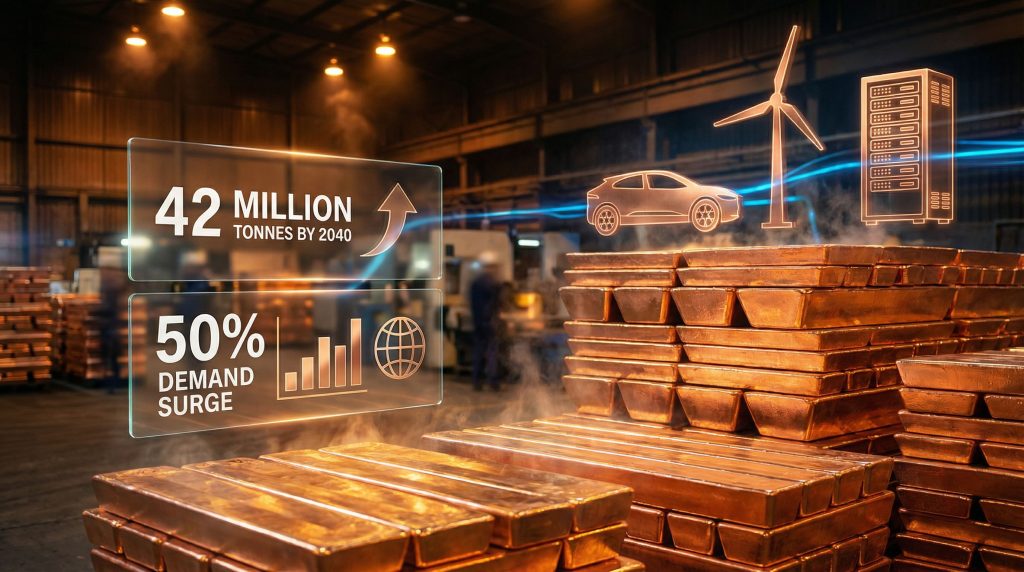
The trajectory toward 42 million tonnes of annual copper consumption by 2040 represents more than statistical projection; it reflects fundamental economic restructuring across multiple sectors simultaneously. Current global demand stands at approximately 28 million tonnes annually, indicating a 50% expansion requirement over the next fifteen years.
This surge originates from converging technological and economic forces that operate independently yet reinforce each other. Unlike previous commodity cycles driven primarily by construction and manufacturing growth, the emerging demand for copper in 2040 stems from infrastructure transformation, digital economy expansion, and energy system electrification occurring across developed and developing economies simultaneously.
| Demand Category | 2025 (Million Tonnes) | 2040 Projected (Million Tonnes) | Growth Rate |
|---|---|---|---|
| Basic Economic Demand | 15.2 | 21.8 | 43% |
| Energy Transition | 8.1 | 13.5 | 67% |
| Digital Infrastructure | 2.9 | 4.2 | 45% |
| Defense Applications | 1.8 | 2.5 | 39% |
Four Macro-Economic Forces Reshaping Metal Requirements
Electrification Acceleration: Global electricity consumption patterns are experiencing their most dramatic shift in decades. The United States, where electrical demand remained essentially flat for 25 years, now projects annual growth rates of 2.5%. China's electrical market, already exceeding American consumption levels, anticipates 3.2% annual expansion, while India's demand trajectory suggests 4.2% yearly increases.
Urbanisation and Income Growth: Developing economies continue transitioning populations from biomass heating and cooking toward commercial energy sources. This shift encompasses not merely fuel substitution but comprehensive infrastructure development including electrical distribution networks, appliance manufacturing, and building electrification systems.
Digital Economy Infrastructure: Data centre electricity consumption represents the fastest-growing demand segment, potentially increasing from 5% of total American electrical consumption to 14% by 2030. Furthermore, each megawatt of data centre capacity requires approximately 2.8 tonnes of copper for power distribution, cooling systems, and communications infrastructure.
Defence Modernisation: Military spending commitments across NATO member states toward 5% of GDP create sustained demand for copper-intensive technologies including communications systems, radar installations, and electromagnetic warfare equipment. The latest global copper supply forecast indicates that these diverse demand vectors will significantly challenge existing production capabilities.
Geographic Distribution of Future Consumption Growth
Asia-Pacific regions drive approximately 65% of projected demand increases, reflecting continued industrialisation and urbanisation trends. China maintains the largest absolute consumption levels while India demonstrates the highest growth rates. North American consumption growth concentrates in data centre development and defence applications, while European demand emphasises renewable energy infrastructure and grid modernisation.
Latin American consumption patterns reflect mining sector development and urban infrastructure expansion. African demand growth correlates with electrification projects and resource extraction industry development.
When big ASX news breaks, our subscribers know first
How Will Electrification Infrastructure Transform Copper Markets?
Grid Modernisation Requirements Across Developing Economies
Global electrical grid investment requirements exceed $7.5 trillion through 2040, representing infrastructure deployment unprecedented in scale and timeline compression. Developing economies face dual challenges: expanding grid access to unserved populations while simultaneously modernising existing systems for renewable energy integration.
Traditional grid infrastructure designed for centralised thermal generation proves inadequate for distributed renewable sources requiring bidirectional power flow capabilities. Modernisation demands sophisticated control systems, energy storage integration, and transmission capacity expansion—each component significantly copper-intensive.
Grid expansion mechanisms differ substantially between developed and developing economies. Developed nations focus on aging infrastructure replacement and renewable energy accommodation, while developing economies construct entirely new transmission networks. Both approaches require extensive copper deployment but in different applications and timelines.
Renewable Energy Installation Copper Intensity Analysis
More than 90% of global electrical generation capacity installed in 2025 consisted of solar and wind technologies. This renewable energy dominance creates sustained copper demand patterns distinct from traditional thermal generation replacement cycles.
| Technology Type | Copper Intensity (kg per MW) | Global Installation Rate (GW annually) | Annual Copper Demand (Thousand Tonnes) |
|---|---|---|---|
| Wind Turbines | 3,600 | 120 | 432 |
| Solar Installations | 4,200 | 180 | 756 |
| Energy Storage (BESS) | 2,800 | 45 | 126 |
| Grid Integration | 1,500 | 345 | 518 |
Wind turbine copper requirements encompass generator windings, power electronics, transformer systems, and grid connection equipment. Solar installations incorporate copper in inverters, mounting systems, electrical connections, and monitoring equipment. Battery energy storage systems require copper for power conversion, thermal management, and electrical distribution components.
Electric Vehicle Fleet Expansion Impact Calculations
Electric vehicle copper consumption patterns create demand multiplication effects beyond direct automotive applications. Battery electric vehicles require approximately 67 kilograms of copper compared to 23 kilograms in traditional internal combustion vehicles—representing nearly three times the material requirement.
However, vehicle electrification impacts extend beyond automotive manufacturing. Charging infrastructure development requires substantial copper deployment in power distribution equipment, transformers, and electrical connections. Home and commercial charging installations increase building electrical system copper requirements.
Fleet electrification timeline acceleration compounds these effects. Commercial vehicle electrification—including delivery trucks, buses, and freight transportation—incorporates even higher copper intensities due to larger battery systems and more sophisticated power management requirements.
Electric vehicle adoption rates in 2025 exceeded 25% of global automotive sales, representing copper demand equivalent to the entire automotive market of the world's second-largest car market.
What Role Will Artificial Intelligence Play in Metal Demand Acceleration?
Data Centre Proliferation and Infrastructure Requirements
Artificial intelligence infrastructure development represents the most recent and potentially most disruptive vector for copper demand acceleration. Since December 2022, global investment in AI capabilities has fundamentally altered technology infrastructure priorities, creating new demand categories that barely existed five years prior. According to recent analysis, AI could boost copper demand by 50% by 2040, significantly outpacing traditional growth projections.
Data centre copper demand growth trajectories exceed all other infrastructure sectors. Projected increases from 1.1 million tonnes in 2025 to 2.5 million tonnes by 2040 represent more than 125% expansion in fifteen years—significantly outpacing overall copper demand growth rates.
Each hyperscale data centre facility typically requires 50-100 metric tonnes of copper for complete installation. This figure encompasses server room infrastructure, power distribution systems, cooling equipment, and telecommunications connections. Advanced cooling methodologies increase rather than decrease copper requirements as liquid cooling systems demand specialised copper-based thermal management infrastructure.
Semiconductor Manufacturing Copper Dependencies
Advanced semiconductor manufacturing processes require increasingly sophisticated copper integration. Sub-5 nanometer process nodes incorporate higher copper density for interconnect layers, power distribution networks, and electromagnetic shielding applications.
Semiconductor fabrication facilities themselves represent substantial copper consumption through power distribution systems, process equipment, and cleanroom infrastructure. Each new fabrication facility requires hundreds of tonnes of copper for construction and equipment installation.
The global semiconductor capacity expansion, driven by AI chip demand, automotive electronics, and consumer device requirements, creates sustained copper demand independent of traditional economic cycles. Consequently, global copper demand could see unprecedented growth as these technologies mature.
Humanoid Robotics as Emerging Consumption Vector
Humanoid robotics represents a speculative but potentially significant future demand vector. These systems incorporate dense copper wiring for motor control, sensor networks, power distribution, and communications systems. Industry projections for humanoid robot deployment by 2040 range from millions to billions of units, creating substantial uncertainty but notable upside potential for copper consumption.
AI-driven electricity consumption could increase global power demand by 15-20% by 2040, with each new data centre requiring approximately 2.8 tonnes of copper per megawatt of capacity.
Can Global Mining Supply Meet Projected 2040 Requirements?
Current Production Capacity vs Future Demand Projections
Global copper supply analysis reveals structural constraints that price increases alone cannot overcome. Current production capacity generates approximately 22.5 million tonnes annually from mining operations, supplemented by 5.5 million tonnes from recycling activities, matching current demand of 28 million tonnes.
However, projected 2040 supply capacity faces fundamental limitations. Mining production estimates suggest maximum output of 33 million tonnes annually, while recycling optimisation might achieve 10 million tonnes. Combined supply of 43 million tonnes falls short of projected demand by approximately 9 million tonnes—representing 21% of total requirements.
| Supply Source | 2025 Actual | 2040 Projected | Growth Potential |
|---|---|---|---|
| Mine Production | 22.5 MT | 33.0 MT | 47% |
| Recycled Supply | 5.5 MT | 10.0 MT | 82% |
| Total Supply | 28.0 MT | 43.0 MT | 54% |
| Projected Demand | 28.0 MT | 42.0 MT | 50% |
| Supply Deficit | 0.0 MT | 9.0 MT | 21% of demand |
Geological Constraints and Ore Grade Decline Trends
Mining industry constraints extend beyond economic factors into geological realities. Ore grade decline represents a fundamental challenge as higher-grade deposits become exhausted and operations expand into lower-grade terrain. This decline directly increases production costs, energy requirements, and waste generation per unit of copper output.
Historical ore grade trends demonstrate steady deterioration across major mining regions. Lower grades necessitate proportionally greater mining and processing activity to achieve equivalent copper production, increasing operational complexity and environmental impacts.
Geological surveys indicate that accessible high-grade copper deposits are becoming increasingly rare. New discoveries typically feature lower grades, more complex mineralogy, and challenging extraction conditions compared to historical mines.
Investment Timeline Challenges for New Mine Development
Mine development timelines represent the most significant constraint on supply response capabilities. The average period from mineral discovery to commercial production spans approximately 17 years, encompassing exploration, permitting, infrastructure development, and production ramp-up phases.
This timeline reflects multiple sequential requirements:
- Exploration and Resource Definition (3-5 years)
- Environmental Assessment and Permitting (3-7 years)
- Infrastructure Development and Construction (2-3 years)
- Production Ramp-up to Full Capacity (2-4 years)
Each development phase involves regulatory compliance, community engagement, infrastructure investment, and technical problem-solving that cannot be substantially accelerated regardless of available financial resources. Even at historically high copper prices, these structural limitations persist.
To close a 9-million-tonne deficit through mining alone would require developing capacity equivalent to three projects the size of the world's largest copper mines, all achieving full production simultaneously—a scenario that supply chain analysis indicates is not achievable within current development frameworks.
Which Industries Will Experience the Greatest Copper Intensity Growth?
Defence Sector Modernisation and Metal Requirements
Defence sector copper demand faces unprecedented acceleration, with projected requirements tripling by 2040. NATO member state commitments to increase defence spending to 5% of GDP, combined with military equipment electrification, create sustained demand patterns independent of traditional economic cycles.
Modern military systems incorporate substantially more copper than legacy equipment. Network-centric warfare capabilities require sophisticated communications systems, radar installations, electronic warfare equipment, and directed energy weapons—each significantly copper-intensive in construction and operation.
Military infrastructure modernisation encompasses base electrical systems, communications networks, and specialised facilities. Naval vessels incorporate hundreds of tonnes of copper in electrical systems, weapons platforms, and shipboard infrastructure. Aircraft systems require copper-intensive avionics, power distribution, and electromagnetic shielding applications.
Construction and Urban Development in Emerging Markets
Global projections indicate installation of approximately 2 billion new air conditioning units by 2040, representing massive copper demand in motors, compressors, wiring, and heat exchange systems. This equipment proliferation reflects rising incomes and changing consumption patterns in developing nations.
Urbanisation trends create comprehensive copper demand through electrical infrastructure, plumbing systems, and building automation. The transition from biomass and traditional fuels to commercial energy sources drives electrical system installation and appliance adoption across emerging economies.
Construction copper intensity varies significantly between developed and developing economies, with emerging markets showing higher per-capita growth rates but lower absolute consumption levels. Infrastructure development in Asia-Pacific and African regions drives substantial aggregate demand despite lower per-project requirements.
Energy Storage System Deployment Acceleration
Battery energy storage systems represent an emerging and rapidly growing copper consumption vector. These installations require substantial copper quantities for electrical connections, power conversion equipment, inverters, and energy management systems.
Grid-scale storage deployment accelerates as renewable energy penetration increases. Each battery installation requires sophisticated power electronics incorporating copper conductors, electromagnetic shielding, and thermal management systems.
Distributed energy storage—including residential and commercial installations—multiplies copper requirements across thousands of smaller systems rather than concentrating demand in utility-scale projects. This trend aligns with broader copper price trends reflecting fundamental supply-demand imbalances.
How Will Geopolitical Factors Influence Copper Supply Chains?
Processing Concentration Risks in Key Regions
China controls approximately 40-50% of global copper smelting and refining capacity, creating significant supply chain vulnerability to trade disruptions, policy changes, or geopolitical tensions. This concentration exists despite copper mining being geographically distributed across multiple continents.
Processing capacity concentration differs from mining concentration, as smelting and refining operations require substantial capital investment, technical expertise, and environmental compliance systems. China's dominance reflects decades of industrial policy prioritising metal processing capabilities.
Alternative processing capacity development requires significant time and capital investment. New smelting facilities typically require 3-5 years for construction and commissioning, limiting rapid supply chain diversification options.
Strategic Metal Reserve Policies by Major Economies
The United States officially classified copper as a "critical mineral" in 2025, reflecting growing recognition of supply security importance. This classification enables government stockpiling, domestic production incentives, and research funding for alternative materials.
Strategic reserve policies among major economies create additional demand pressures independent of industrial consumption. Government stockpiling programmes can temporarily distort market dynamics and create price volatility during reserve accumulation periods.
Other major economies are developing similar strategic mineral policies, potentially creating competitive stockpiling behaviours that compound supply-demand imbalances. Furthermore, Chile's copper supply gap adds additional complexity to global supply security considerations.
Trade Route Security and Alternative Sourcing Strategies
Global copper trade relies heavily on maritime transportation routes potentially vulnerable to geopolitical disruption. Alternative transportation methods exist but typically involve higher costs and longer transit times.
Supply chain diversification strategies focus on developing alternative processing capacity, establishing regional supply relationships, and creating redundant sourcing arrangements. However, these strategies require substantial time and investment to implement effectively.
Regional trade agreements and bilateral relationships increasingly incorporate critical mineral provisions, reflecting growing recognition of supply security importance in international commerce.
The next major ASX story will hit our subscribers first
What Investment Opportunities Emerge from Structural Copper Deficits?
Mining Company Valuation Implications
Structural copper supply deficits create favourable conditions for mining company valuations, particularly for operators with:
- High-grade ore reserves
- Established production capacity
- Development pipeline projects
- Favourable regulatory environments
Mining company investment analysis must consider development timelines, capital requirements, and operational complexity alongside resource quality. Companies with near-term production capacity face less execution risk than early-stage exploration projects. Those seeking detailed copper investment insights should evaluate companies across multiple jurisdictions to diversify risk.
Copper mining investment opportunities extend beyond traditional mining companies to include:
- Mineral exploration companies with promising prospects
- Mining equipment and services providers
- Specialised logistics and transportation companies
- Mining technology and automation developers
Recycling Technology Innovation Potential
Recycling supply limitations create opportunities for technology innovation in collection, processing, and purification systems. Advanced recycling technologies could potentially increase recovery rates and expand recyclable material categories.
Investment opportunities in recycling include:
- Automated sorting and separation technologies
- Hydrometallurgical processing improvements
- Urban mining and waste stream optimisation
- Quality enhancement for recycled materials
However, recycling expansion faces practical limitations. Even optimised recycling systems can only process copper from products reaching end-of-life, limiting supply growth potential.
Substitution Material Research and Development
Copper substitution research focuses on materials offering comparable electrical conductivity, thermal properties, and durability characteristics. Current alternatives include aluminium for some electrical applications and advanced composite materials for specialised uses.
Substitution opportunities exist in:
- Lower-performance electrical applications
- Structural and mechanical components
- Heat exchange systems
- Telecommunications infrastructure
However, copper's unique combination of properties makes complete substitution challenging in many applications, particularly high-performance electrical and thermal management systems. Consequently, successful copper investment strategies must account for limited substitution potential in critical applications.
How Can Economies Prepare for Copper Supply Constraints?
Strategic Reserve Accumulation Strategies
National strategic reserve programmes can provide buffer capacity against supply disruptions, though large-scale stockpiling impacts market dynamics and requires substantial financial commitment.
Effective reserve strategies consider:
- Target inventory levels relative to consumption
- Storage and handling infrastructure requirements
- Market impact of acquisition and release timing
- Coordination with private sector inventory management
Strategic reserve policies must balance supply security objectives against market distortion effects and fiscal resource allocation priorities.
Domestic Mining Capacity Development Programmes
Government policies can incentivise domestic mining development through tax incentives, regulatory streamlining, and infrastructure investment. However, geological constraints limit development potential in many regions.
Domestic capacity development requires:
- Geological assessment and resource identification
- Regulatory framework optimisation
- Infrastructure investment for remote mining areas
- Workforce development and technical training
International Partnership Framework Design
Bilateral and multilateral agreements can enhance supply security through diversified sourcing relationships, joint development projects, and coordinated strategic reserve policies.
Partnership frameworks typically include:
- Long-term supply agreements
- Joint venture development projects
- Technology transfer and technical cooperation
- Trade finance and investment facilitation
FAQ: Understanding the 2040 Copper Demand Transformation
Why is copper demand expected to grow so dramatically?
The demand for copper in 2040 stems from four converging factors: global electrification acceleration, renewable energy deployment, artificial intelligence infrastructure development, and defence sector modernisation. Unlike previous demand cycles driven primarily by construction growth, these vectors operate simultaneously across multiple industries and geographic regions.
Which countries will drive the highest consumption increases?
China maintains the largest absolute consumption levels while India demonstrates the highest growth rates. The United States shows significant demand acceleration in data centres and defence applications. Developing economies across Asia-Pacific, Africa, and Latin America contribute substantially to growth through electrification and urbanisation programmes.
How do electric vehicles compare to traditional cars in copper usage?
Battery electric vehicles require approximately 67 kilograms of copper compared to 23 kilograms in traditional internal combustion vehicles—nearly three times the material requirement. This differential includes copper in electric motors, battery systems, charging infrastructure, and power electronics.
What happens if mining production cannot meet demand?
Supply shortfalls would likely trigger significant price increases, accelerated recycling development, substitution material research, and potential demand destruction in price-sensitive applications. However, copper's essential role in electrical systems limits substitution possibilities in many critical applications.
Are there viable alternatives to copper in electrical applications?
Aluminium offers a partial alternative for some electrical applications, though with inferior conductivity and different mechanical properties. Advanced materials research continues investigating graphene, carbon nanotubes, and other innovative conductors, but none currently match copper's combination of properties, availability, and cost-effectiveness.
Disclaimer: This analysis presents projections and scenarios based on current industry data and trends. Actual market developments may vary significantly due to technological advances, policy changes, economic fluctuations, and unforeseen events. Investment decisions should consider multiple information sources and professional consultation.
Looking for Exposure to the Next Major Copper Discovery?
With copper demand set to surge 50% by 2040, Discovery Alert's proprietary Discovery IQ model delivers instant notifications on significant ASX mineral discoveries, empowering subscribers to identify actionable copper opportunities ahead of the broader market. Explore why historic mineral discoveries can generate substantial returns by visiting Discovery Alert's dedicated discoveries page, then begin your 30-day free trial to position yourself strategically before the copper supply crunch intensifies.