August 8, 2026
The surge in copper demand in AI data centres represents one of the most significant infrastructure shifts affecting global commodity markets today. Furthermore, artificial intelligence operations create unprecedented mineral demands through their fundamental computational architecture, requiring sustained maximum performance across thousands of interconnected processors.
Understanding the Computational Architecture Behind Copper Intensive Infrastructure
Modern artificial intelligence operations create unprecedented mineral demands through their fundamental computational architecture. Unlike traditional computing environments that process data in manageable cycles, AI systems require sustained maximum performance across thousands of interconnected processors, fundamentally altering the physical infrastructure supporting these operations.
The relationship between AI workloads and copper consumption operates through multiple technical pathways that extend far beyond traditional server deployments. In addition, hyperscale facilities supporting AI operations demonstrate copper intensity ratios of approximately 27 tonnes per megawatt of installed capacity, representing a 3-4x increase over conventional enterprise data centers.
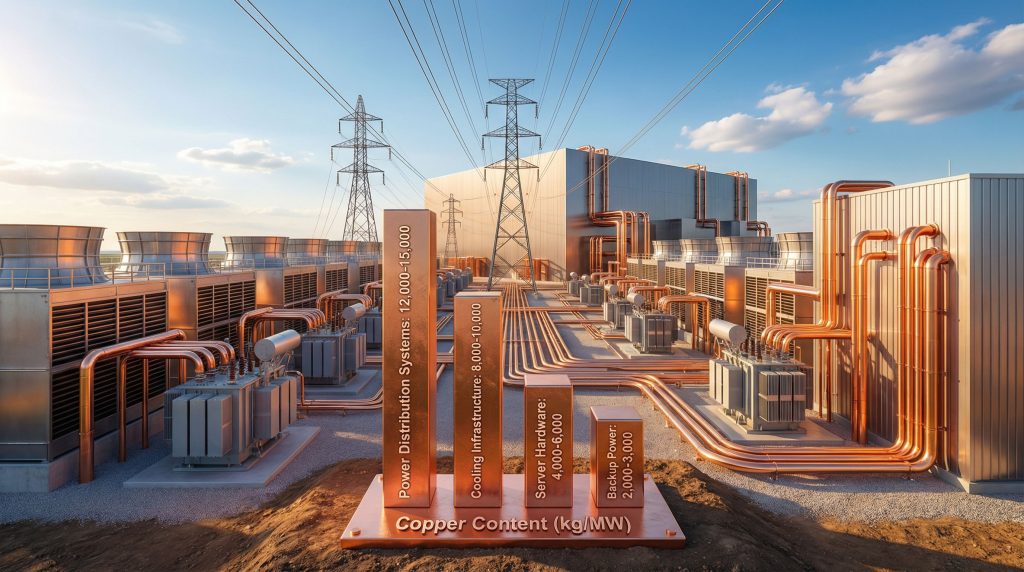
Table: Copper Consumption by Infrastructure Component
| Infrastructure Layer | Copper Content (kg/MW) | Primary Function |
|---|---|---|
| Power Distribution Systems | 12,000-15,000 | Grid connectivity, transformers |
| Cooling Infrastructure | 8,000-10,000 | Heat exchangers, piping networks |
| Server Hardware & Interconnects | 4,000-6,000 | Motherboards, networking cables |
| Backup Power Systems | 2,000-3,000 | UPS units, battery connections |
Power Density Transformation in AI Computing
AI training operations require sustained power densities that fundamentally alter facility design parameters. Where traditional cloud computing might utilise 5-10 MW across entire campuses, individual AI clusters now demand 100-500 MW of continuous power delivery.
This transformation creates cascading copper requirements across three critical systems. For instance, primary power infrastructure includes high-voltage transmission lines, step-down transformers, and switchgear assemblies that manage grid-scale power delivery to computing clusters operating at maximum capacity for extended periods.
Primary Power Infrastructure: High-voltage transmission lines, step-down transformers, and switchgear assemblies that manage grid-scale power delivery to computing clusters operating at maximum capacity for extended periods.
Thermal Management Networks: Sophisticated cooling loops utilising copper's thermal conductivity properties (approximately 400 W/mK at room temperature) to extract heat from densely packed processor arrays operating continuously at peak performance levels.
High-Speed Interconnect Fabrics: Advanced networking topologies that enable distributed AI training across thousands of specialised processors, requiring extensive copper cabling for low-latency data transmission at speeds exceeding 400 Gbps per interconnect.
When big ASX news breaks, our subscribers know first
Regional Infrastructure Development and Material Flow Analysis
Current hyperscale construction across primary markets (Northern Virginia, Dallas, Phoenix, Silicon Valley) represents approximately 6.3 GW of capacity under development, translating to immediate copper demand of 170,000-190,000 tonnes for facility construction alone.
Geographic Concentration Effects on Supply Chains
The concentration of copper demand in AI data centres within specific geographic corridors creates unique supply chain challenges. However, unlike distributed manufacturing sectors, hyperscale data center construction occurs in clusters, creating temporary regional shortages of specialised copper products.
Critical Material Categories:
- High-grade electrical copper: 99.9% purity requirements for power distribution systems
- Specialised thermal alloys: Heat sink applications requiring specific thermal properties for processor cooling
- Precision-manufactured components: Custom transformers and switchgear assemblies designed for high-capacity operations
- Communication-grade copper: Low-impedance cabling for high-frequency data transmission
What Does Global Demand Modelling Through 2035 Indicate?
Forecasting models indicate copper consumption will follow a stepped growth pattern rather than linear progression. Consequently, the global copper supply forecast must account for these dramatic changes:
- 2025-2027: 400,000-450,000 tonnes annually (driven by current construction pipeline)
- 2028-2030: Peak demand reaching 572,000 tonnes (as major technology platforms scale AI infrastructure)
- 2031-2035: Stabilisation around 500,000 tonnes annually (as efficiency improvements offset continued growth)
By 2035, global data centres could cumulatively lock up more than 4.3 million tonnes of copper, equivalent to the annual production of the world's top five mining operations combined.
Advanced Cooling Technologies and Their Copper Requirements
Liquid cooling adoption rates are accelerating beyond industry projections, with immersion cooling systems requiring 40-60% more copper per MW than traditional air-cooled configurations. Furthermore, this shift toward direct-contact cooling methods represents an additional demand multiplier not captured in current forecasting models.
Technical Specifications of Cooling Infrastructure
Modern AI processors generate substantially higher heat loads than general-purpose computing hardware. AI and data centres copper demand is amplified as each generation of AI-specific silicon shows 15-25% higher copper content compared to general-purpose processors due to enhanced thermal management solutions integrated at the component level.
Cooling System Components:
- Heat exchangers: Require high-purity copper for optimal thermal transfer efficiency
- Distribution manifolds: Custom-manufactured copper assemblies for coolant routing
- Cold plates: Direct-contact cooling surfaces requiring precision copper machining
- Pump assemblies: Motor windings and fluid handling components utilising specialised copper alloys
Supply Chain Bottlenecks and Material Flow Constraints
Traditional copper mining operations face challenges responding to AI-driven demand spikes due to several structural factors. In addition, these constraints significantly impact the US copper production overview and global supply chains:
- Long lead times for capacity expansion (5-7 years for new mines)
- Regulatory approval processes for mining permits
- Infrastructure development requirements in remote locations
- Processing capability limitations for high-purity copper production
Market Concentration Risks in Technology Infrastructure
The dominance of a small number of hyperscale operators (Amazon, Microsoft, Google, Meta) in driving copper demand in AI data centres creates concentration risk for mining operations. However, changes in capital allocation strategies or technology roadmaps by these companies could significantly impact demand projections.
According to industry analysis, copper can represent up to 6% of total data centre capital expenditure, indicating the material's significance within capital budgeting frameworks for hyperscale operators.
Technology Evolution and Future Demand Scenarios
Battery Infrastructure and Energy Storage Requirements
While lithium iron phosphate (LFP) dominates data centre UPS installations today, alternatives like sodium-ion, zinc-based, and redox-flow batteries are advancing rapidly. Consequently, this diversification creates opportunities for various mineral suppliers while reducing dependence on concentrated supply chains.
Energy Storage Copper Requirements:
- UPS systems: Transformer windings and power conversion equipment
- Battery connection infrastructure: High-current carrying capacity wiring
- Power conditioning equipment: Inverters and voltage regulation systems
- Backup generator systems: Motor windings and electrical distribution panels
Semiconductor Material Dependencies
AI chips require diverse mineral inputs beyond copper, including silicon, germanium, gallium, indium, and arsenic for processor fabrication. Furthermore, server boards and circuitry incorporate copper, silver, gold, tin, palladium, platinum, and tantalum, creating complex supply chain interdependencies.
Storage systems and magnetic components utilise barite and rare earth elements, while cooling and heat sink applications rely heavily on copper uranium investment opportunities and copper-aluminium combinations optimised for thermal performance.
Investment Implications for Copper Markets
What Are the Price Volatility Factors?
The concentration of AI infrastructure investment within specific time windows creates unique price dynamics. Unlike steady-state industrial demand, copper demand in AI data centres follows capital expenditure cycles of major technology companies, introducing new volatility patterns to commodity markets.
Global copper output projections indicate supply reaching only 29 million tonnes by 2035, substantially below the 35 million tonnes required under current demand scenarios. This supply deficit represents a critical constraint within broader market analysis.
Supply Response Mechanisms
The surge in AI-driven mineral demand offers powerful tailwinds for mining operations, but it also introduces new layers of complexity in supply chain management and operational planning.
Operational Excellence Requirements:
- Just-in-time delivery systems coordinated with construction project schedules
- Quality assurance protocols for high-purity copper products meeting electrical specifications
- Logistics coordination supporting multiple simultaneous construction sites
- Technical support teams with expertise in end-use applications
The next major ASX story will hit our subscribers first
Risk Assessment Framework for Mining Operations
Demand Sustainability Analysis
While current AI infrastructure buildout drives substantial copper demand in AI data centres, long-term sustainability depends on several technical factors. In addition, copper investment strategies must account for these variables:
- Efficiency improvements in power delivery systems reducing overall copper requirements
- Alternative cooling technologies potentially decreasing copper intensity per megawatt
- Material substitution research exploring alternatives for specific applications
- Geographic distribution patterns of future data center development
Strategic Positioning for Market Volatility
Commodity markets linked to AI infrastructure, particularly copper, are likely to experience sharper cycles as forecasts tighten and new supply struggles to maintain pace with demand growth. However, these dynamics underscore the need for agile planning frameworks combining rigorous long-range forecasting with rapid market adjustment capabilities.
Risk Management Priorities:
- Advanced price volatility modelling incorporating technology sector capital expenditure cycles
- Flexible capital allocation systems enabling rapid project sequencing adjustments
- Supply chain resilience strategies addressing concentration risks in key geographic markets
- Technology monitoring systems tracking potential substitution threats or efficiency improvements
Product Specification Management and Quality Requirements
AI data center applications demand increasingly specific copper product characteristics, requiring mining operations to invest in advanced processing capabilities. Furthermore, copper price growth drivers include high-purity production, quality control systems ensuring consistent electrical properties, and technical support teams understanding complex end-use applications.
Processing Technology Requirements
High-Purity Copper Production:
- Electrolytic refining systems achieving 99.9% purity levels
- Continuous casting operations producing consistent grain structures
- Quality testing protocols verifying electrical conductivity specifications
- Contamination control systems preventing trace element inclusion
Strategic Considerations for Long-Term Value Creation
Portfolio Diversification and Market Balance
While AI-driven copper demand presents significant opportunities, successful mining operations maintain balanced exposure across multiple end-use markets. Consequently, the cyclical nature of technology infrastructure investment requires strategic planning around demand variability and market concentration risks.
Forward-looking mining operations are investing in processing technologies for specialised copper alloys, sustainability initiatives addressing ESG requirements of technology customers, and digital systems enabling supply chain transparency and traceability throughout the production process.
Innovation Investment Priorities
The rapid evolution of AI hardware architectures and cooling technologies means mining operations must remain closely attuned to technological pathways. Furthermore, today's dominant system designs may not define tomorrow's demand profile, requiring diversified commodity portfolios and continuous monitoring of AI hardware design evolution.
Technology Monitoring Framework:
- Processor architecture evolution tracking thermal management requirements
- Cooling system advancement monitoring copper intensity implications
- Power delivery efficiency improvements affecting infrastructure copper needs
- Alternative material research potentially impacting specific application areas
This analysis is based on industry research and forecasting models. Commodity demand projections involve inherent uncertainty, and actual consumption patterns may vary based on technological developments, economic conditions, and regulatory changes. Investors should conduct independent research and consider multiple scenarios when evaluating mining sector opportunities.
Ready to Position Your Portfolio for the AI Infrastructure Boom?
Discovery Alert's proprietary Discovery IQ model delivers instant alerts on significant ASX copper and mineral discoveries, helping subscribers capitalise on the unprecedented demand surge from AI data centres before broader market recognition. Explore why major mineral discoveries have historically generated substantial returns, then begin your 14-day free trial today to secure your competitive edge in this rapidly evolving market.