June 10, 2026
Industrial electrification across multiple sectors is reshaping global commodity demand patterns, with copper emerging as the critical bottleneck constraining technological advancement and economic growth. The convergence of electric vehicle adoption, renewable energy infrastructure deployment, and data center expansion has created unprecedented metal consumption requirements that existing production capacity cannot satisfy.
This structural imbalance extends far beyond traditional supply-demand cycles, representing a fundamental shift in how modern economies consume raw materials. Understanding the depth and persistence of these copper demand and supply constraints is essential for investors, policymakers, and industry leaders navigating an increasingly copper-constrained global economy.
Understanding Copper's Central Role in Economic Transformation
Industrial Electrification Creating Unprecedented Metal Requirements
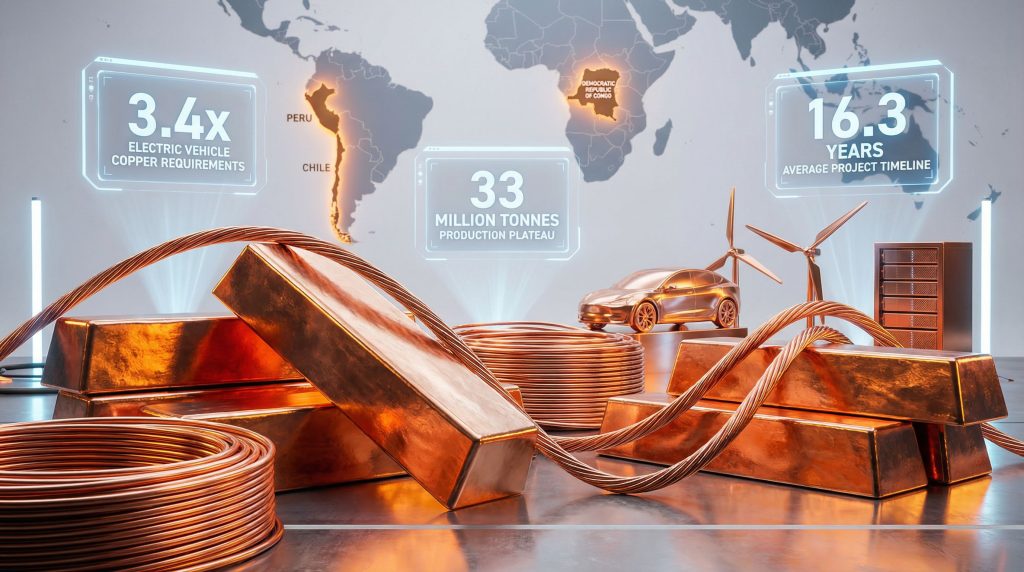
The transition from fossil fuel-based systems to electric alternatives has created exponential increases in copper consumption across multiple industries. Electric vehicle manufacturing requires approximately 85 kilograms of copper per vehicle, compared to 25 kilograms in traditional internal combustion engines, representing a 3.4x multiplier effect that scales with global EV adoption targets.
Data center infrastructure supporting artificial intelligence and cloud computing expansion demands substantial copper wiring for power distribution and cooling systems. Each server rack requires approximately 450 kilograms of copper, nearly double the 200 kilograms required in traditional data centers, as hyperscale operators deploy more powerful processing equipment.
Renewable energy infrastructure presents particularly copper-intensive requirements. Wind turbines and solar installations require 4,200 kilograms of copper per megawatt of generation capacity, compared to 1,100 kilograms per megawatt for conventional power plants. This 3.8x multiplier becomes critical as nations pursue aggressive renewable energy targets, aligning with record copper prices driven by unprecedented demand.
Copper Intensity Across Electrified Systems:
| Sector | Traditional Usage | Electrified Usage | Intensity Multiplier |
|---|---|---|---|
| Automotive | 25 kg/vehicle | 85 kg/vehicle | 3.4x |
| Power Generation | 1,100 kg/MW | 4,200 kg/MW | 3.8x |
| Data Centers | 200 kg/rack | 450 kg/rack | 2.3x |
| 5G Networks | 150 kg/tower | 350 kg/tower | 2.3x |
Defense and Critical Infrastructure Modernization Programs
Military electrification initiatives across NATO countries are driving additional copper consumption as defense contractors integrate electric propulsion systems, advanced radar arrays, and electronic warfare capabilities. Modern military vehicles require 60% more copper than conventional systems due to sophisticated electronics and power management requirements.
Smart city development projects globally are installing copper-intensive infrastructure including intelligent traffic systems, municipal broadband networks, and automated utility management. Each smart city installation requires approximately 2.8 tonnes of copper per 1,000 residents for comprehensive digital infrastructure deployment.
Industrial automation and robotics expansion in manufacturing facilities demands extensive copper wiring for sensor networks, motor controls, and communication systems. Factory automation projects typically require 45-65% more copper than traditional manufacturing installations due to increased electronic integration.
When big ASX news breaks, our subscribers know first
Quantifying the Emerging Supply Deficit Challenge
Production Capacity Constraints and Geological Realities
Global copper production faces a structural plateau as existing mines reach maturity while new project development encounters increasingly complex technical and regulatory challenges. According to analysts studying global copper demand outstripping supply, current production capacity of approximately 21.8 million tonnes annually falls short of projected demand exceeding 28.5 million tonnes by 2030, creating a persistent deficit exceeding 6.7 million tonnes.
Ore grade deterioration represents a fundamental constraint on production scalability. Average copper grades across major deposits have declined from 1.6% in 1990 to 0.81% in 2024, requiring mining companies to process nearly double the ore volume to maintain equivalent metal output. This grade decline accelerates processing costs and energy consumption while limiting production expansion potential.
Global Supply-Demand Projection Analysis:
| Year | Projected Demand | Supply Capacity | Deficit/Surplus |
|---|---|---|---|
| 2025 | 26.2 Mt | 22.4 Mt | -3.8 Mt deficit |
| 2027 | 27.8 Mt | 23.1 Mt | -4.7 Mt deficit |
| 2030 | 30.4 Mt | 24.2 Mt | -6.2 Mt deficit |
| 2033 | 33.1 Mt | 25.8 Mt | -7.3 Mt deficit |
Geographic Production Concentration Creating Systemic Risk
The top six copper-producing countries control approximately 67% of global output, creating significant supply chain vulnerability to geopolitical disruption, natural disasters, and policy changes. Chile leads production at 5.6 million tonnes annually but faces declining output from aging mines and water scarcity challenges.
Peru maintains production of 2.4 million tonnes annually with expansion potential in unexplored Andean regions, though infrastructure limitations and community relations complexity constrain development timelines. The Democratic Republic of Congo produces 1.9 million tonnes annually from the Copperbelt region but faces ongoing political instability and infrastructure challenges.
Zambia's government has committed to increasing production to 3 million metric tonnes per annum by 2031 through policy reforms and fiscal regime stability, representing one of the most ambitious supply-side expansion programs globally. However, achieving these targets requires substantial foreign investment and infrastructure development across multiple mining districts.
Furthermore, emerging opportunities in regions like Argentina are gaining attention, particularly through innovative argentinian copper projects that demonstrate potential for diversifying global supply sources.
The concentration of copper production in politically unstable regions creates a strategic vulnerability that cannot be resolved through market mechanisms alone. Diversification of supply sources requires decade-long development timelines that exceed current deficit projections.
Operational Bottlenecks Constraining Production Scalability
Project Development Timeline and Capital Requirements
Modern copper mining projects require an average of 16.3 years from discovery to commercial production, with permitting processes alone consuming 7-10 years in developed jurisdictions. This extended timeline reflects increased environmental scrutiny, community consultation requirements, and technical complexity of accessing lower-grade deposits at greater depths.
Capital requirements for major copper projects range from $2-8 billion depending on deposit size and location. The Quellaveco mine in Peru required $5.3 billion in development capital, while the Kamoa-Kakula project in the Democratic Republic of Congo invested $1.8 billion for initial production phases. These capital intensities limit the number of companies capable of financing large-scale development.
Project Development Phase Analysis:
| Development Phase | Average Duration | Primary Bottlenecks | Capital Intensity |
|---|---|---|---|
| Exploration | 3-5 years | Geological complexity | $50-150 million |
| Permitting | 7-10 years | Regulatory approval | $100-300 million |
| Construction | 4-6 years | Capital availability | $2-8 billion |
| Ramp-up | 1-2 years | Operational optimisation | $200-500 million |
Technical and Environmental Operating Challenges
Declining ore grades require increased processing volumes and energy consumption to maintain metal output. Processing 0.8% copper ore requires 25% more energy per pound of metal produced compared to 1.2% ore, directly impacting operational costs and carbon footprint. Energy costs represent 15-25% of total production expenses for most copper operations.
Water scarcity affects copper mining operations across Chile, Peru, and southwestern United States, where desert locations with significant deposits lack adequate water resources for processing. Modern copper mills require 3.2 cubic metres of water per tonne of ore processed, creating competition with agricultural and municipal users in arid regions.
Skilled labour shortages in remote mining locations limit operational efficiency and expansion potential. Mining engineering schools globally graduate fewer than 2,800 qualified professionals annually, while industry demand exceeds 4,200 new hires per year to replace retiring workers and support expansion projects.
Environmental Compliance and Community Integration Requirements
Environmental impact assessments for copper projects typically require 18-36 months to complete and must address air quality, water usage, waste management, and biodiversity protection across mine lifecycles spanning 25-50 years. These assessments often identify mitigation requirements that increase capital costs by 12-18% for major projects.
Indigenous land rights negotiations in key deposit areas can extend project timelines by 3-7 years whilst companies negotiate benefit-sharing agreements, employment targets, and cultural preservation requirements. These negotiations are increasingly complex as communities demand greater participation in project economics and decision-making processes.
Carbon footprint reduction requirements are increasing operational costs as mining companies invest in renewable energy systems, electric mining equipment, and emissions monitoring technology. Meeting net-zero commitments typically increases operational expenses by 8-15% whilst requiring additional capital investment in clean energy infrastructure.
Regional Supply Dynamics and Development Potential
Africa's Expanding Copper Production Corridor
The Democratic Republic of Congo maintains production of 1.9 million tonnes annually from the Katanga province, with expansion potential limited by infrastructure capacity and political stability concerns. Chinese investment through companies like China Molybdenum and Zijin Mining has provided capital for expansion but creates dependency on single-market demand.
Zambia's strategic positioning along the Copperbelt offers significant expansion potential with government support for production targets of 3 million tonnes by 2031. The country's policy reforms include streamlined permitting processes, fiscal incentives for new investment, and infrastructure development commitments to support increased output.
African Copper Production Capacity Analysis:
| Country | Current Production | 2030 Target | Infrastructure Status | Investment Required |
|---|---|---|---|---|
| DRC | 1.9 Mt | 2.8 Mt | Limited rail/port | $4.2 billion |
| Zambia | 0.85 Mt | 3.0 Mt | Developing transport | $6.8 billion |
| Morocco | 0.23 Mt | 0.4 Mt | Established | $1.1 billion |
South American Production Evolution and Constraints
Chile faces declining production capacity from mature deposits including Chuquicamata and Escondida, where ore grades have fallen below 0.7% and require increased processing volumes to maintain output. Water scarcity in the Atacama Desert limits expansion potential despite Chile holding the world's largest copper reserves.
Peru offers expansion potential in unexplored Andean regions, particularly in the central and southern highlands where geological surveys indicate significant undiscovered deposits. However, community relations challenges and infrastructure limitations require 8-12 year development timelines for new projects.
Argentina's lithium-copper hybrid projects in the Puna region offer diversified revenue streams but face similar infrastructure and community challenges as neighbouring countries. The integration of lithium and copper extraction from the same geological formations provides operational synergies but requires specialised processing technology.
Alternative Supply Sources and Technological Solutions
Secondary copper recovery from electronic waste represents approximately 35% of current supply but cannot scale sufficiently to address projected deficits. Urban mining initiatives in developed economies recover copper from telecommunications infrastructure, construction materials, and consumer electronics but face collection and processing challenges.
Ocean floor mining exploration for polymetallic nodules containing copper offers long-term supply potential but remains commercially unproven. Environmental concerns regarding deep-sea ecosystem impacts and technological challenges in underwater extraction limit near-term viability for commercial copper production.
Recycling technology improvements could increase recovery rates from current 85% efficiency to 95% through advanced sorting, smelting, and refining processes. However, even optimised recycling cannot fully address demand growth from electrification trends requiring primary copper production expansion.
Economic Implications of Persistent Supply Shortages
Price Volatility and Inflation Transmission Effects
Copper demand and supply constraints are driving price volatility that transmits inflationary pressure across multiple economic sectors. Copper price projections reaching $12,500 per tonne by Q2 2026 reflect structural supply limitations rather than cyclical demand fluctuations, indicating persistent price pressure through the current decade.
Manufacturing cost pressures from copper shortages affect electrical equipment producers, construction materials suppliers, and automotive manufacturers. Input cost increases of 15-25% for copper-intensive products translate to consumer price inflation across appliances, building materials, and vehicles.
Economic Impact Assessment by Supply Scenario:
| Supply Scenario | Copper Price | GDP Impact | Consumer Inflation | Industrial Impact |
|---|---|---|---|---|
| Baseline | $10,000/t | +0.1% | +0.3% | Manageable |
| Moderate Shortage | $12,500/t | -0.2% | +0.8% | Significant |
| Severe Shortage | $15,000/t | -0.5% | +1.4% | Critical |
Currency and Trade Balance Effects
Copper-importing economies face increased current account pressures as import costs rise faster than export revenues. Countries like Germany, Japan, and South Korea, which import over 80% of copper consumption, face trade balance deterioration and currency pressure during supply shortage periods.
Copper-exporting economies benefit from increased export revenues but face resource curse risks as economic growth becomes increasingly dependent on single commodity performance. Chile derives 18% of export revenues from copper, creating economic vulnerability to price volatility and production disruptions.
Strategic resource security concerns are prompting major economies to develop national stockpiling programmes and secure long-term supply agreements. The United States maintains strategic copper reserves equivalent to 90 days of consumption, whilst China has expanded stockpiles to 120 days of consumption to ensure supply security.
Investment Strategies for Copper-Constrained Markets
Direct Exposure Investment Approaches
Major mining company equity positions offer exposure to copper price appreciation whilst providing operational diversification across multiple commodities and geographic regions. Companies like Freeport-McMoRan, BHP, and Rio Tinto provide copper exposure with reduced single-asset risk compared to pure-play copper miners.
Copper futures and exchange-traded funds enable direct commodity exposure without operational risks associated with mining companies. The Copper ETF (CPER) and futures contracts provide price exposure but require active management to address contango and storage costs affecting long-term returns.
Junior mining companies with advanced-stage copper projects offer higher risk-return profiles but require careful evaluation of management quality, financing capacity, and project development timelines. Success rates for junior miners advancing projects to production remain below 15% due to financing and operational challenges.
In addition to traditional copper investments, some investors are exploring copper-uranium investments that offer dual exposure to critical energy transition metals.
Indirect Beneficiaries and Value Chain Opportunities
Recycling technology companies benefit from increased copper values making previously uneconomical recovery processes commercially viable. Companies developing automated sorting, advanced smelting, and urban mining technologies represent growth opportunities in copper-constrained markets.
Mining equipment and services providers experience increased demand as producers invest in efficiency improvements and capacity expansion. Companies supplying processing equipment, automation systems, and specialised mining services benefit from increased capital expenditure across the copper industry.
Alternative materials research and development firms developing copper substitutes for specific applications offer diversification opportunities. However, copper's unique combination of conductivity, corrosion resistance, and mechanical properties limits substitution potential in most applications.
Risk Management and Portfolio Construction
Geopolitical exposure assessment requires evaluation of mining asset locations, government stability, and regulatory environments affecting production continuity. Diversification across multiple jurisdictions reduces single-country risk but may limit access to highest-grade deposits concentrated in specific regions.
Currency hedging for international copper investments protects against exchange rate volatility affecting returns from foreign mining companies and commodity exposure. Copper prices denominated in US dollars require currency risk management for non-US investors seeking copper exposure.
Environmental liability evaluation becomes increasingly important as regulatory requirements tighten and climate change impacts affect mining operations. Companies with strong environmental management practices and closure planning reduce long-term liability risks.
The next major ASX story will hit our subscribers first
Policy Interventions and Strategic Responses
Regulatory Reform and Permitting Efficiency
Streamlined permitting processes for strategic mineral projects could reduce development timelines by 3-5 years through coordinated environmental reviews, standardised assessment criteria, and defined decision-making timelines. Australia's "one-stop shop" approach for mining approvals provides a model for regulatory efficiency improvements.
Tax incentives for domestic copper production development including accelerated depreciation, exploration tax credits, and reduced corporate tax rates for mining operations could attract investment to jurisdictions with underdeveloped copper resources. Canada's mineral exploration tax credit programme demonstrates effective policy design for encouraging resource development.
International cooperation frameworks for critical mineral security could reduce supply chain vulnerabilities through shared strategic reserves, coordinated investment policies, and trade agreement provisions protecting resource access during supply disruptions.
Technology Innovation and Research Support
Research funding for ore processing efficiency improvements could increase metal recovery rates and reduce energy consumption per unit of copper produced. Advanced processing technologies including bioleaching, electrowinning optimisation, and automated mineral sorting offer potential for operational improvements.
Automation technology deployment in existing operations could increase productivity and reduce labour requirements in remote locations where skilled worker shortages limit production capacity. Autonomous drilling, driverless trucks, and remote-controlled processing systems represent scalable productivity improvements.
Alternative material development for copper-intensive applications requires sustained research investment but offers limited near-term impact due to copper's unique properties. Aluminium, graphene, and advanced composites may substitute copper in specific applications but cannot replace copper's broad industrial utility.
Understanding Long-term Supply-Demand Balance
Timeline for Supply Response and Market Rebalancing
Current projections suggest copper demand and supply constraints will persist through 2035, requiring successful development of over 80 new mining projects currently in various planning stages. The extended development timelines for copper projects mean supply responses lag demand growth by 10-15 years.
However, detailed analysis of global copper supply forecast scenarios indicates that meaningful supply balance restoration requires coordinated development across multiple regions and mining companies, with estimated total investment requirements exceeding $200 billion for projects needed to meet 2035 demand projections. This capital requirement exceeds current industry investment capacity without significant policy support and financing innovation.
Critical Success Factors for Supply Adequacy
Regulatory efficiency improvements reducing permitting timelines from current averages of 8-10 years to 4-6 years could accelerate supply responses and reduce deficit duration. Standardised environmental assessment processes and coordinated government approvals represent achievable policy reforms with material impact.
Infrastructure development supporting mining regions including transportation networks, power systems, and water resources enables multiple project development and reduces per-project infrastructure costs. Shared infrastructure reduces individual project risks and improves development economics.
Community engagement and benefit-sharing arrangements that provide local employment, revenue sharing, and environmental protection create sustainable development frameworks supporting long-term mining operations. Successful community integration reduces operational disruption risks and supports expansion potential.
Furthermore, comprehensive copper exploration insights highlight the critical importance of sustained exploration activities in discovering new deposits that could help alleviate future supply constraints. According to market research on copper supply constraints intensifying, the supply gap is expected to widen significantly by 2040 as electrification accelerates across global economies.
The convergence of industrial electrification, declining ore grades, and regulatory complexity creates a structural copper shortage requiring coordinated responses from mining companies, governments, and financial markets. Understanding these dynamics enables informed investment decisions and strategic planning for copper-constrained economic environments.
Success in navigating copper market constraints requires sophisticated analysis of supply chain dependencies, geographic exposure assessment, and long-term demand trend evaluation. The companies, countries, and investors best positioned for these challenges will shape global economic development patterns throughout the current decade.
Investment decisions should consider individual risk tolerance and seek professional financial advice. Commodity markets involve significant volatility and loss potential. This analysis is for educational purposes and does not constitute investment recommendations.
Ready to invest in the next major copper discovery?
Discovery Alert instantly alerts investors to significant ASX mineral discoveries using its proprietary Discovery IQ model, turning complex mining data into actionable copper investment insights during this unprecedented supply shortage. Explore Discovery Alert's dedicated discoveries page to understand how historic mineral discoveries have generated substantial returns, then begin your 14-day free trial today to position yourself ahead of the copper supply crisis.