June 9, 2026
The Capital Efficiency Argument Reshaping Copper Mine Investment
In mining, the most consequential capital decisions rarely involve starting something new. They involve committing to what already works. As copper demand forecasts climb steadily upward, driven by electric vehicles, renewable energy infrastructure, and grid modernisation, the industry faces a fundamental tension: greenfield development pipelines are too slow, too expensive, and too risky to meet near-term supply requirements. The brownfield reinvestment thesis has consequently moved from a niche capital allocation preference to a mainstream strategic priority.
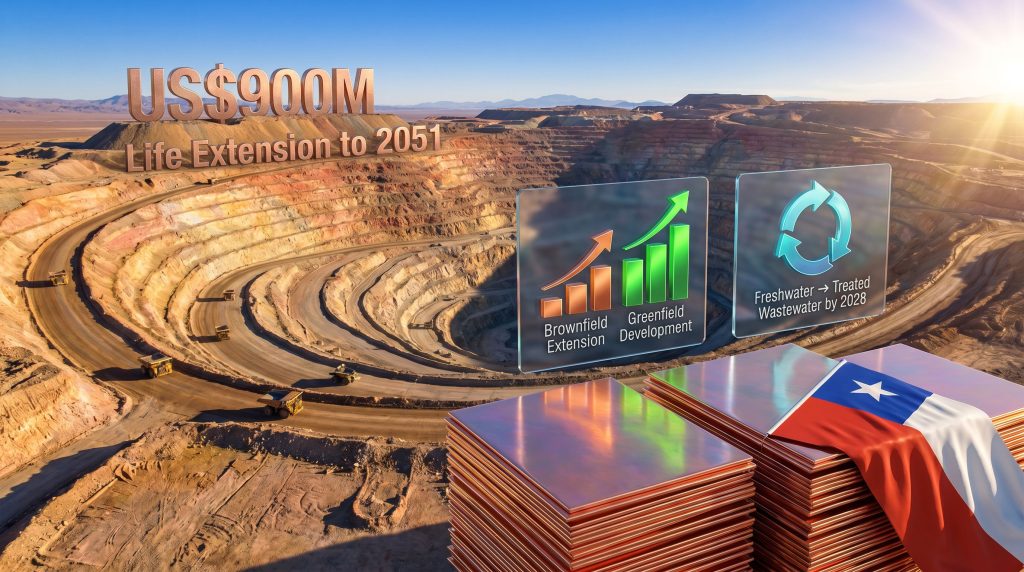
Against this backdrop, Antofagasta to invest US$900M in Zaldívar represents far more than a single mine-life extension. It reflects a deliberate and calculated bet on proven asset productivity, long-duration copper demand, and the growing importance of environmental stewardship as a precondition for operational continuity. Furthermore, it signals where the broader industry is heading as the copper supply crunch intensifies.
When big ASX news breaks, our subscribers know first
What Is the Zaldívar Mine and Why Does It Matter?
Zaldívar sits within Chile's Antofagasta region, widely regarded as one of the highest-density copper mining jurisdictions on the planet. The broader region hosts some of the world's most significant porphyry copper systems, a geological classification referring to large-tonnage, low-to-medium grade copper deposits typically amenable to bulk open-pit mining and heap leach or conventional flotation processing.
The mine operates as a 50:50 joint venture, a structure that distributes both capital burden and operational upside equally between partners. This ownership model has meaningful implications for how large investment decisions are structured, requiring alignment between two equal parties before any major capital commitment can proceed. The fact that both parties have agreed to the US$900 million programme signals strong shared conviction in the long-term economics of the asset.
Zaldívar's copper-gold classification also carries financial significance. Polymetallic profiles, where a primary commodity like copper is accompanied by recoverable gold credits, strengthen per-tonne economics by generating additional revenue streams that partially offset operating costs. Gold by-product credits effectively reduce the net cost of copper production, improving the operation's resilience across different copper price environments.
Chile's Position in the Global Copper Supply Picture
Chile consistently produces roughly 25 to 27 percent of the world's mined copper, making it by far the dominant single-country contributor to global supply. According to the United States Geological Survey, Chile held an estimated 190 million tonnes of copper reserves as of recent assessments, representing the largest national reserve base globally. Consequently, understanding the Chile copper price outlook is essential for any serious copper market analysis.
Within this context, individual mine-life decisions at major Chilean operations carry disproportionate weight in supply forecasting models. Extending Zaldívar's productive life through to 2051 secures multiple decades of output continuity at a time when greenfield alternatives face 10 to 20-year development lead times, escalating permitting complexity, and significantly higher capital intensity per tonne of copper produced.
The structural copper supply deficit narrative is not speculative. The International Energy Agency has projected that copper demand could more than double by 2040 under accelerated energy transition scenarios, with existing and committed mine supply falling materially short of that requirement.
Breaking Down the US$900 Million Capital Programme
The investment envelope covers three interconnected priorities, each addressing a distinct dimension of long-term operational viability.
| Investment Component | Strategic Purpose | Target Timeline |
|---|---|---|
| Mine-life extension infrastructure | Extend productive operations to 2051 | Medium to long term |
| Wastewater treatment and reuse systems | Replace freshwater dependency with treated wastewater | By 2028 |
| Processing and operational upgrades | Sustain throughput efficiency across extended horizon | Ongoing |
Freshwater to Treated Wastewater: A Material Operational Transition
Perhaps the most technically significant element of the investment programme is the commitment to transition Zaldívar's water supply from freshwater to treated wastewater by 2028. This is not a peripheral ESG gesture. It is a direct response to one of the most pressing physical constraints facing copper mining in northern Chile.
The Atacama Desert, within which the Antofagasta mining district sits, is classified as the driest non-polar desert on Earth. Annual rainfall in some zones measures less than one millimetre. Freshwater availability is severely limited, and Chile's regulatory framework governing water rights in arid mining regions has tightened considerably over the past decade. The country's reformed water code, updated in 2022, strengthened protections for existing water allocations and increased scrutiny of new industrial water use applications.
The transition to treated wastewater requires substantial upfront infrastructure investment in treatment facilities, distribution pipelines, and water quality management systems. However, the long-term operational benefit is considerable. Treated wastewater sourced from municipal or industrial sources provides a more reliable, less regulated, and increasingly cost-competitive alternative to freshwater extraction in constrained desert environments.
Other major Chilean copper producers have pursued similar strategies. Codelco production leadership, BHP's Escondida operation, and Collahuasi have all invested in seawater desalination and wastewater reuse infrastructure as freshwater alternatives. Escondida, the world's largest copper mine, has invested billions in desalination capacity over the past decade, making non-freshwater supply a sector-wide norm rather than a competitive differentiator.
Why a 2051 Mine-Life Extension Is Strategically Rational
Extending an operating mine's productive life by more than 25 years requires far more than capital expenditure. It demands a resource base capable of sustaining decades of extraction, processing infrastructure that can be maintained and upgraded across multiple economic cycles, and a social and regulatory licence that remains intact over the long term.
From a net present value perspective, extending an existing operation's life compresses the capital cost per additional tonne of copper produced relative to a greenfield alternative. Brownfield expansions benefit from existing infrastructure, established workforce capability, functional processing circuits, and prior regulatory approvals. These embedded advantages translate directly into lower execution risk and faster time-to-production for incremental capital deployed.
The economics of long-duration mine life extensions are also sensitive to copper price assumptions. A 2051 endpoint means the project will span multiple commodity price cycles, requiring confidence that long-run copper prices will support positive returns across various scenarios. Current consensus forecasts from major commodity analysts generally place long-run copper prices in the range of US$3.80 to US$4.50 per pound, levels at which well-run, low-to-medium cost brownfield operations in Chile remain strongly economic. In addition, Antofagasta's $900M investment has been closely observed as a benchmark for how major producers are approaching long-horizon capital commitments.
How the Decision Reflects Antofagasta's Broader Strategic Logic
Antofagasta Minerals operates one of the most concentrated portfolios of copper assets in the world, with operations clustered in Chile's northern mining districts. The Zaldívar reinvestment must be understood within this portfolio context. Rather than diversifying capital into higher-risk exploration or pre-production development assets, the company is deepening its position in proven, producing infrastructure.
This approach aligns with what experienced mining investors sometimes describe as the capital cycle discipline principle: in periods of strong commodity pricing, companies that reinvest in proven brownfield assets rather than chasing marginal greenfield growth tend to generate superior long-run returns per share.
The 50:50 JV structure adds an important governance layer. Joint venture capital decisions of this scale typically require formal technical studies, independent valuations, and unanimous or super-majority approval from both partners. The fact that this commitment has been formalised suggests that detailed mine planning, resource modelling, and financial analysis have been completed to a level that satisfies both parties' investment criteria.
Large-scale mine-life extensions in established copper jurisdictions are increasingly viewed as defensive capital, securing future production volumes at known costs rather than speculating on undeveloped resources in higher-risk geographies.
For investors assessing exposure to this sector, understanding copper investment strategies tailored to the current supply environment is increasingly important, particularly given the structural dynamics reshaping Chilean production.
ESG Dimensions: Water, Community, and Regulatory Compliance
The Financial Materiality of Water Risk in Arid-Zone Mining
Water risk in arid mining regions has moved from an environmental footnote to a financially material operational variable. Insurance markets, debt financing conditions, and institutional equity mandates increasingly price water scarcity risk into the cost of capital for mining companies operating in water-stressed jurisdictions.
The 2028 wastewater transition target creates a verifiable, time-bound ESG milestone that Antofagasta can report against in its annual sustainability disclosures. For major institutional shareholders subject to climate and water risk disclosure frameworks such as TCFD and CDP, measurable water reduction commitments at individual operating assets translate into improved portfolio-level ESG scoring.
Community and Indigenous Stakeholder Considerations
Northern Chile's mining regions are home to indigenous communities, particularly the Atacameño people, whose ancestral relationship with water resources in the Atacama is both culturally significant and legally recognised under Chilean law. Operations that continue drawing from freshwater sources in these regions face heightened scrutiny from community groups and regulatory bodies alike.
The shift to treated wastewater directly reduces the surface and groundwater extraction footprint of the Zaldívar operation, which strengthens the social licence framework that underpins long-term operational continuity. In practical terms, a mine that demonstrably reduces its freshwater consumption faces lower community opposition risk, which translates into reduced probability of permitting delays or operational disruptions over a multi-decade investment horizon.
Carbon and Environmental Compliance
Extending an existing operation rather than constructing a new one carries a lower embedded carbon footprint on a per-tonne-of-copper basis. Greenfield development requires land clearing, new road construction, tailings facility development from scratch, and full infrastructure build-out, all of which carry significant embodied carbon and environmental impact. Brownfield reinvestment leverages existing footprint, reducing the marginal environmental cost of incremental copper production.
Brownfield Versus Greenfield: The Industry's Reinvestment Calculus
The Antofagasta to invest US$900M in Zaldívar decision exemplifies a broader structural preference shift across the copper sector. However, it also illuminates Chile's copper supply gap and why brownfield capital is increasingly viewed as the most pragmatic response to closing it.
| Metric | Brownfield Extension (Zaldívar Model) | Greenfield Development |
|---|---|---|
| Typical lead time to production | 2 to 5 years | 10 to 20 years |
| Capital intensity per tonne Cu | Lower | Significantly higher |
| Permitting complexity | Moderate (existing approvals) | High (new EIA processes) |
| Community relations baseline | Established | To be built |
| Execution risk | Lower | Higher |
| Water and environmental footprint | Incremental increase | Full new footprint |
The data above illustrates why, in a demand environment where supply shortfalls are projected to emerge within the current decade, brownfield capital is strategically superior to greenfield allocation for near and medium-term supply contributions.
What Copper Market Fundamentals Underpin This Decision?
Several converging structural forces support the long-run economics of the Zaldívar extension. Furthermore, each of these factors reinforces the case for long-duration brownfield investment over speculative greenfield development:
- Electric vehicle production is forecast to require exponentially more copper per unit than internal combustion engine vehicles, with estimates suggesting EVs use two to four times the copper content of conventional cars
- Offshore wind turbines require up to eight tonnes of copper per megawatt of installed capacity, compared to less than one tonne for equivalent gas-fired generation
- Grid infrastructure upgrades required to accommodate renewable energy penetration are estimated to require copper investment running into the trillions of dollars globally over the next two decades
- Ore grade decline at ageing copper mines is compressing available supply from existing operations, creating a structural wedge between demand growth and supply capacity that new project development alone cannot close in the relevant timeframe
For broader context on how new capital is being deployed across Chilean copper projects, Tintina's recent Domeyko Sulfuros raise illustrates how investor appetite for Chilean copper exposure extends well beyond existing producers.
The next major ASX story will hit our subscribers first
Key Takeaways: What the Zaldívar Investment Tells Us About the Future of Copper
- US$900 million committed to extend Zaldívar's operational life to 2051, positioning it as one of the more significant brownfield copper reinvestment decisions in Chile in recent years
- The freshwater-to-wastewater transition targeted by 2028 addresses one of the most material ESG and operational risks facing arid-zone copper mining
- The decision reflects a broader industry preference for brownfield capital efficiency over higher-risk, longer-lead greenfield development in the current copper demand cycle
- Chile's regulatory and community stakeholder environment is shaping how capital is deployed, with water management emerging as a central compliance and reputational variable
- Long-duration mine-life extensions signal structural copper market confidence, with producers positioning for sustained demand growth through the energy transition era and beyond
- The 50:50 joint venture structure means this commitment reflects the aligned conviction of two equal partners, not unilateral corporate ambition
Disclaimer: This article contains forward-looking analysis, including references to copper price forecasts, demand projections, and investment return assumptions. These involve inherent uncertainty and should not be construed as financial advice. Readers should conduct independent due diligence before making any investment decisions.
Want to Capitalise on the Next Major Copper Discovery Before the Broader Market?
As brownfield reinvestment reshapes the copper sector and structural demand continues to build, Discovery Alert's proprietary Discovery IQ model delivers real-time ASX alerts on significant mineral discoveries — instantly translating complex data into actionable opportunities for traders and long-term investors alike. Explore historic discoveries and the returns they generated, then begin your 14-day free trial to position yourself ahead of the market.