
June 9, 2026
The Structural Forces Reshaping Global Copper Supply
Few commodity markets reveal the tension between long-term industrial necessity and short-term financial volatility as clearly as copper. For decades, the metal traded in relatively predictable cycles tied to construction booms and manufacturing output. That dynamic is now fundamentally broken. The forces currently bearing down on copper supply are not cyclical disruptions that self-correct over a quarter or two. They are the accumulated consequence of two decades of underinvestment in new discoveries, compounded by surging demand from electrification, digital infrastructure, and the energy transition. Understanding this distinction is essential to evaluating any undeveloped copper asset, including the Mocoa copper deposit in Colombia, which sits at the intersection of geological scale, infrastructure advantage, and a structurally tightening market.
When big ASX news breaks, our subscribers know first
The Geological Architecture of the Mocoa Copper-Molybdenum System
What Type of Deposit Is Mocoa?
The Mocoa copper deposit in Colombia is classified as a Jurassic-age porphyry copper-molybdenum system hosted within intrusive rocks at the geological transition zone between the Eastern Cordillera and the upper Amazon basin in Putumayo Department, southern Colombia. Porphyry systems of this type are the world's primary source of copper, characterised by large tonnage, moderate grades, and mineralisation styles that include stockwork veining, hydrothermal breccias, and disseminated sulphide assemblages.
Primary ore minerals at Mocoa include copper sulphides and molybdenite, with minor bornite contributing to the overall copper-equivalent grade profile. The system exhibits characteristics consistent with deep-rooted magmatic-hydrothermal activity, a feature that geologists interpret as indicative of strong continuity at depth and significant potential for resource expansion beyond current estimates. Furthermore, geological exploration of molybdenum-rich porphyry systems of this type has historically demonstrated that such deposits can extend considerably beyond initial resource boundaries.
Where Exactly Is the Mocoa Deposit Located?
The deposit sits approximately 10 kilometres north of the city of Mocoa, the departmental capital of Putumayo. This geographic positioning carries practical engineering significance that is frequently underappreciated in resource-stage assessments. Unlike many comparable Andean copper systems in Chile and Peru that are situated at extreme elevations requiring desalination infrastructure and high-altitude logistics solutions, Mocoa operates at significantly lower elevation.
Existing road networks and power transmission lines already service the broader region, and the nearest significant settlement is approximately 10 kilometres away, eliminating the community relocation requirements that have added cost and timeline complexity to comparable projects elsewhere in the Andes. These infrastructure advantages are not incidental. They represent a meaningful reduction in the capital expenditure required to bring a project of this scale into production.
How Large Is the Mocoa Mineralised Footprint?
The updated resource estimate released in late 2024 reported a 60% increase in total resource tonnes, crossing a strategically significant threshold that fundamentally changes how the project is assessed by major mining companies and institutional investors.
| Resource Parameter | Reported Figure |
|---|---|
| Inferred Resource (2025 estimate) | ~636 million tonnes |
| Copper Grade | ~0.33% Cu |
| Molybdenum Grade | ~0.036% Mo |
| Copper Equivalent Grade | ~0.45% CuEq |
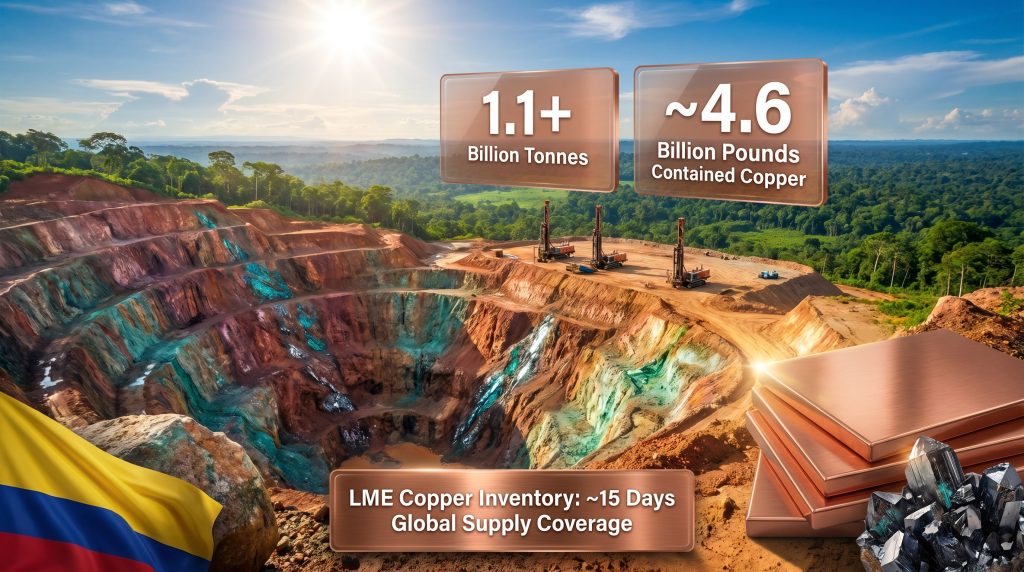
| Contained Copper | ~4.6 billion pounds |
| Contained Molybdenum | ~511 million pounds |
| Total Resource (company-reported) | 1.1+ billion tonnes |
The system remains open at depth and along strike. A useful rule of thumb applied by mine planners is that a billion-tonne resource supports roughly a 20-year mine life at standard large-scale processing throughputs. A two-billion-tonne system extends that to approximately 40 years. The fact that Mocoa has already exceeded the one-billion-tonne threshold while drilling continues means the project's mine life potential is already sufficient to attract major copper producers whose acquisition criteria typically begin at this scale.
Approximately 20% of the total resource reports at significantly elevated grades, with copper equivalent grades of around 0.94% CuEq at a 0.75% cutoff. This high-grade core, situated near surface, is the basis for a potential starter pit design that could deliver superior early-stage project economics before the bulk of the lower-grade resource is processed. When compared against some of the largest copper mines currently in operation globally, Mocoa's resource scale and grade profile are genuinely competitive.
Why the Global Copper Supply Crisis Is Structural, Not Cyclical
What Is Driving the Demand Acceleration?
Copper demand is being pulled simultaneously by multiple independent vectors, each of which would be significant on its own. Together, they are creating a demand acceleration that the existing supply base cannot match.
- Energy transition infrastructure requires massive expansion of electricity grids, renewable generation capacity, and transmission networks, all of which are copper-intensive
- Electric vehicle manufacturing demands approximately three to four times the copper content of a conventional internal combustion vehicle, and EV adoption is accelerating across major economies
- AI data centre construction represents an emerging demand category that was largely absent from copper demand models even five years ago. Large-scale digital infrastructure requires substantial copper for wiring, power distribution, and cooling systems
- Urbanisation in emerging markets across Asia, Africa, and Latin America continues to drive construction activity and appliance penetration, both structurally copper-intensive activities
Why Can't the Supply Side Respond?
Chile, the world's largest copper-producing nation, recorded its lowest April copper output in more than two decades in 2025, with year-to-date production running approximately 400,000 tonnes below the prior year's pace. To contextualise that figure, 400,000 tonnes is roughly equivalent to the annual output of the world's second-largest copper mine vanishing from the market. The ongoing copper supply crunch is therefore not a temporary blip but a structural reality reshaping the global metals landscape.
The underlying cause is structural degradation rather than temporary operational disruption. Ore grades at major Chilean operations have declined by approximately 50% over the past 20 years as operators chose the path of lower risk and lower capital by expanding existing pits rather than investing in new greenfield discoveries. The result is a larger industry processing much lower-grade material, generating diminishing returns per tonne of rock moved.
The mining industry's historical preference for brownfield reinvestment over greenfield exploration has created a discovery pipeline that is structurally incapable of replacing depleting reserves at current consumption rates. This is not a problem that resolves itself when copper prices rise. New mines take a decade or more to develop.
Compounding this is the absence of meaningful inventory buffers. Unlike many industrial metals that maintain months of supply in exchange warehouses, copper sits at approximately 15 days of global supply coverage on LME inventories. This structural thinness means any supply disruption or demand acceleration event transmits immediately into price.
| Metal | Approximate Exchange Inventory Coverage |
|---|---|
| Copper | ~15 days |
| Aluminium | Several weeks to months |
| Nickel | Multiple months |
| Silver (historical peak) | 12 months+ |
Major financial institutions have progressively revised their copper supply-demand models, with the consensus shifting from a balanced outlook toward a sustained deficit beginning in 2026. When it is not possible to build lines into new construction, manufacture electric vehicles, or complete large-scale AI data centre buildouts because copper is unavailable, the economic consequences extend well beyond the mining sector itself.
How Mocoa Scores Against Global Porphyry Copper Viability Benchmarks
What Makes a Large-Scale Porphyry Project Economically Viable?
Not all large-scale copper resources translate into economically viable mines. The criteria that separate genuinely developable projects from stranded assets are well understood by major producers evaluating acquisition targets.
- Resource scale exceeding 500 million tonnes to justify major infrastructure investment
- Near-surface high-grade core to support low strip-ratio starter pit economics
- Favourable metallurgical characteristics including oxide and sulphide recovery rates and manageable deleterious element profiles
- Infrastructure accessibility covering power, water, roads, and port access
- Permitting pathway clarity with demonstrated precedent for the approval process
- Jurisdictional stability with regulatory predictability and workable fiscal terms
How Does Mocoa Perform Against These Criteria?
| Viability Criterion | Mocoa Assessment |
|---|---|
| Resource Scale | ✅ 1.1+ billion tonnes, exceeds major project threshold |
| High-Grade Core | ✅ ~20% of deposit at ~0.94% CuEq at 0.75% cutoff |
| Near-Surface Starter Pit | ✅ High-grade zone identified at shallow depth |
| Power Infrastructure | ✅ Existing transmission lines in place |
| Road Access | ✅ Existing road network, no remote logistics required |
| Desalination Requirement | ✅ None, lower elevation eliminates this cost category |
| Community Displacement | ✅ Minimal, nearest settlement ~10 km |
| Permitting Precedent | ✅ Comparable Colombian open-pit copper project received environmental licence |
A particularly notable development on the permitting front is that a comparable Colombian copper project recently received its environmental licence for open-pit mining operations, representing the first such approval of this type in the country. This precedent is significant because it demonstrates that the regulatory pathway for open-pit copper mining in Colombia is navigable, removing a major uncertainty that had previously weighed on market sentiment toward Colombian copper projects. In addition, Colombia's major copper potential is increasingly being recognised by institutional investors and major producers alike.
The PEA Milestone and What It Means for Project Valuation
Why the Preliminary Economic Assessment Is a Valuation Inflection Point
A Preliminary Economic Assessment, also referred to as a Scoping Study, is the first stage at which project economics are formally quantified. Prior to a PEA, copper projects are typically valued on a resource-per-tonne basis, a metric that captures geological scale but not economic potential. After a PEA establishes a formal Net Present Value, the market shifts to a Price-to-Net Asset Value (P/NAV) framework, which typically assigns a significantly higher valuation multiple to projects with credible economics.
For investors, this transition represents a reclassification event. A project advancing from resource-stage to development-stage with a formally established NPV is no longer competing for capital on geological merit alone. It is competing against other development-stage assets where the economic case has been made and risk-adjusted returns can be estimated. Consequently, understanding copper investment strategies that account for this valuation transition is essential for positioning ahead of these inflection points.
The PEA for Mocoa is targeted for completion by the end of 2025/2026 and is designed to deliver several specific outputs:
- Conceptual mine design including pit geometry, processing plant configuration, and tailings management approach
- Infrastructure cost modelling that formally captures the capital advantage of existing road and power access
- Strip ratio optimisation incorporating newly reclassified tonnes within the planned pit shell
- Economic sensitivity analysis modelling project returns across a range of copper and molybdenum price assumptions
- Identification of the critical path toward an Environmental Impact Assessment submission
The Directional Drilling Advantage in Resource Conversion
One technically significant development in Mocoa's current drilling programme is the deployment of directional drilling technology, which enables multiple daughter holes to be drilled from a single parent collar. This approach substantially improves metres-drilled efficiency without proportional increases in cost, accelerating the conversion of inferred resources to measured and indicated classification.
This conversion is not merely a technical formality. Under international reporting standards, ore reserves can only be declared from measured and indicated resources, not inferred resources. A PFS and any subsequent definitive feasibility study requires a reserve base, making this conversion work a prerequisite for advancing toward a construction decision.
An additional and somewhat unexpected benefit emerging from the current drill programme is that holes drilled within the planned pit shell are confirming that material previously modelled as waste rock is being reclassified as ore. This improves the strip ratio, directly enhancing the project's projected operating economics. Furthermore, a careful review of cut-off grades at various price assumptions may further expand the economically mineable resource envelope as the copper price outlook strengthens.
Colombia's Regulatory Environment and the Political Dimension
What the Policy Landscape Means for Transition Metal Projects
Under its current national administration, Colombia has adopted an explicit policy position of deprioritising hydrocarbon extraction while actively promoting transition metal development, with copper identified as a priority category. This orientation has created a regulatory environment that, while requiring careful navigation, is directionally aligned with large-scale copper project development.
Projects of sufficient economic scale — those capable of materially influencing national GDP and generating substantial employment and fiscal revenue — are structurally insulated from the political discontinuity that characterises electoral transitions. A project of Mocoa's magnitude would represent a significant contribution to the Colombian economy regardless of which administration holds office.
What Colombia's 2025 Presidential Election Signals for Mining
| Electoral Scenario | Policy Implications for Copper Development |
|---|---|
| Continuation of current policy direction | Maintenance of transition metals framework, continued regulatory progression |
| Shift toward market-oriented administration | Explicit incentivisation of large-scale strategic mining projects, potentially stronger market sentiment response |
The important distinction here is between what happens on the ground and how the market perceives the political environment. Drilling has continued for 18 consecutive months without operational interruption. Forestry reserve reclassification has been completed. Mining titles have been maintained and reset. These are tangible regulatory milestones achieved under the existing framework.
A shift toward a more explicitly pro-mining administration would likely improve market sentiment around Colombian copper more than it would change the underlying operational reality for a project already making demonstrable progress.
The next major ASX story will hit our subscribers first
How Investors Should Think About Mocoa in the Broader Copper Opportunity
The M&A Scarcity Premium on Billion-Tonne Copper Assets
Recent consolidation activity in the global copper sector has progressively reduced the inventory of available large-scale undeveloped copper systems. When major copper producers acquire billion-tonne-plus assets, those projects are removed from the pool of available development-stage opportunities. The removal of multiple significant undeveloped copper projects from the available asset pool through acquisition in recent years has increased the strategic scarcity premium attached to the remaining systems of comparable scale.
This dynamic creates a dual value driver for projects like Mocoa. Intrinsic project economics are one component. Strategic optionality value as a potential acquisition target for major producers seeking to replenish depleting reserve bases is another, and in a supply-constrained market with a thin development pipeline, that optionality premium can be substantial.
Key Macro Indicators Copper Investors Should Monitor
| Indicator | Relevance |
|---|---|
| LME copper spot price and forward curve | Reflects current supply-demand balance and market expectations |
| Chilean and Peruvian monthly production data | Leading indicator of supply-side response capacity |
| LME and COMEX copper warehouse inventory levels | 15-day coverage signals structural tightness |
| Major mining company M&A activity | Signals institutional confidence in long-term copper price outlook |
| Central bank interest rate trajectory | Influences cost of capital for project development financing |
| AI infrastructure capex announcements | Emerging demand vector with significant copper intensity |
A key insight often overlooked by generalist investors is that market corrections in broad equity indices frequently cause mining equities to sell off disproportionately relative to the underlying commodity. This disconnection between a stock's short-term price movement and its long-term fundamental value can create concentrated entry opportunities for investors with conviction in the structural thesis.
Frequently Asked Questions About the Mocoa Copper Deposit
What is the Mocoa deposit's copper equivalent grade?
The deposit reports an inferred resource grade of approximately 0.45% copper equivalent, comprising roughly 0.33% copper and 0.036% molybdenum. A high-grade core representing approximately 20% of the total resource reports copper equivalent grades of around 0.94% CuEq at a 0.75% cutoff, significantly above the whole-deposit average.
Is Mocoa an open-pit or underground copper project?
Based on current geological modelling, Mocoa is being advanced as a large-scale open-pit operation. The near-surface high-grade zone is being evaluated as a potential starter pit configuration to optimise early-stage economics before transitioning to bulk-scale processing of the broader resource.
What is the significance of the molybdenum content at Mocoa?
Molybdenum is a high-value industrial metal used primarily in steel alloys and increasingly in clean energy applications. At Mocoa's reported grades, the molybdenum component represents approximately 511 million contained pounds, a meaningful economic co-product credit that enhances project NPV and effectively reduces the net cost of copper production.
What are the primary technical risks associated with the Mocoa project?
Key technical risk factors include:
- Metallurgical recovery rates, to be formally assessed through PEA and PFS testwork programmes
- Tailings management design, particularly relevant given proximity to the Amazon drainage system
- Water management requirements balanced against environmental protection obligations
- Continued resource conversion from inferred to measured and indicated classification to support reserve declaration
Disclaimer: This article is intended for educational and informational purposes only and does not constitute financial or investment advice. Forward-looking statements, forecasts, and valuations discussed herein involve assumptions and uncertainties. Resource estimates and project economics are subject to change as additional data becomes available. Readers should conduct their own due diligence and consult a qualified financial adviser before making any investment decisions.
Want to Know When the Next Major Copper Discovery Hits the ASX?
Discovery Alert's proprietary Discovery IQ model delivers real-time alerts the moment significant mineral discoveries are announced on the ASX, giving subscribers an immediate edge in identifying actionable opportunities in copper and beyond — explore historic discoveries and their remarkable returns to understand what's at stake, then begin your 14-day free trial at Discovery Alert to position yourself ahead of the market.