August 6, 2026
When the Ground Shifts: How a Canadian Copper-Zinc Mine Rewrites a Gold Company's Story
There is a particular moment in the lifecycle of a mining company when a single operational milestone changes the entire investment thesis. It does not happen often, and when it does, the significance can be lost in the technical language of commissioning reports and ramp-up schedules. But beneath the engineering detail, something structurally important is taking place at a remote site in east-central Saskatchewan, where Eldorado Gold McIlvenna Bay first concentrate has shifted this TSX- and NYSE-listed company from gold-centric producer to genuine multi-metal, multi-jurisdiction critical minerals operator.
Understanding why this matters requires stepping back from the single event and examining the broader forces that make a copper-zinc polymetallic project in Canada so consequential in 2026.
When big ASX news breaks, our subscribers know first
The Geology Behind the Milestone
McIlvenna Bay sits within a polymetallic belt stretching more than 225 kilometres across east-central Saskatchewan. This is not new ground. The belt has supported base metal production for over a century, which means the mineralisation has been repeatedly validated across multiple geological campaigns and production cycles. The long operational history of the district is one of the most underappreciated facts about McIlvenna Bay: it reduces the geological uncertainty that typically weighs on early-stage mining projects.
The deposit itself is a volcanogenic massive sulphide deposits (VMS) system, a deposit type known for its capacity to host high grades of copper, zinc, lead, gold, and silver in relatively compact, well-defined orebodies. VMS deposits form at or near ancient seafloor hydrothermal vents, and the eastern Saskatchewan belt contains a number of such systems, many of which remain largely undrilled. This geological architecture is critical for investors to understand: the known resource at McIlvenna Bay is not the ceiling of what the district can offer.
The processing plant is designed to handle 4,900 tonnes of ore per day at nameplate capacity, with flotation as the primary concentration method. Flotation circuits separate copper and zinc minerals from waste rock using chemical reagents and air bubbles, and the calibration of reagent addition rates is one of the most important variables in achieving target concentrate grades and recovery percentages. The operating team's near-term focus on optimising both flotation performance and reagent dosing reflects standard practice during ramp-up, but the precision with which these parameters are tuned will directly influence the revenue quality of the first concentrate shipments.
From Wet Commissioning to First Copper Concentrate: The Technical Pathway
Commissioning a processing plant follows a structured sequence that mining engineers describe in two phases. Wet commissioning involves running water through the circuit to test mechanical function, pump performance, and pipe integrity without introducing ore. Hot commissioning introduces actual ore into the system for the first time, exposing the circuit to real mineralogy and revealing any process bottlenecks that water trials cannot replicate.
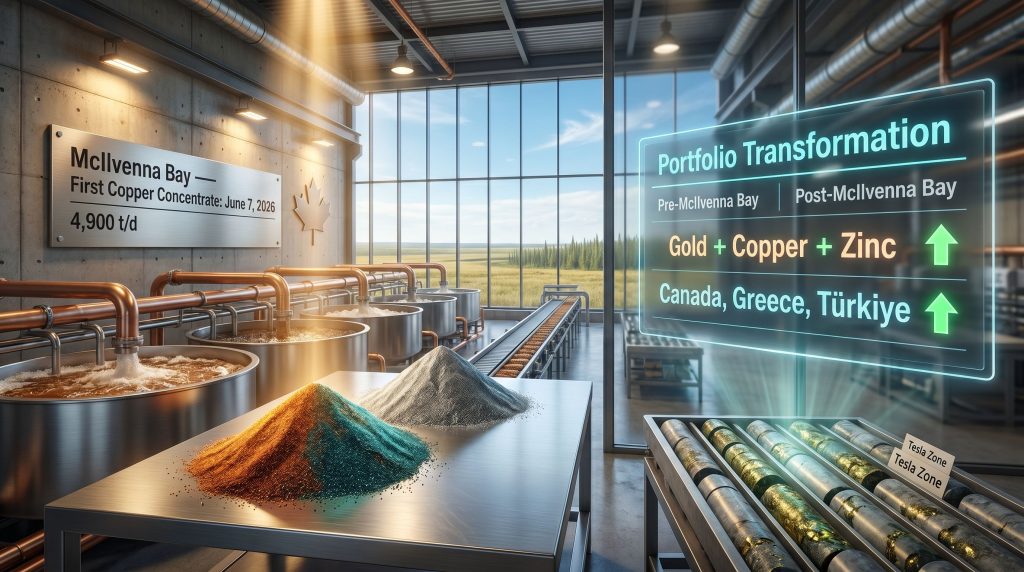
At McIlvenna Bay, wet commissioning was completed ahead of first production, and hot commissioning followed immediately. First copper concentrate was produced on June 7, 2026, a result that came within weeks of Eldorado Gold completing its acquisition of Foran Mining Corporation on April 14, 2026. The speed of progression from acquisition close to first production speaks to the advanced state of construction that Foran Mining had achieved before the transaction was finalised.
The transition from commissioning to commercial production is rarely linear. Flotation circuits in particular require iterative adjustment as the mill processes different ore domains with varying mineral textures, grain sizes, and sulphide associations.
Commercial production is targeted for Q3 2026, meaning the ramp-up window is narrow and the operating team will need to resolve any process instability quickly. Furthermore, understanding mining methods reliability during this phase is essential for investors assessing the credibility of production targets.
Key Milestone Timeline
| Event | Date / Target |
|---|---|
| Foran Mining acquisition completed | April 14, 2026 |
| Wet commissioning completed | Pre-June 2026 |
| First copper concentrate produced | June 7, 2026 |
| Commercial production target | Q3 2026 |
| Nameplate processing capacity | 4,900 t/d |
Infrastructure Completion: The Paste Plant Factor
One element of the McIlvenna Bay ramp-up that deserves closer attention is the paste plant construction and underground paste reticulation system. Paste tailings technology involves dewatering mill tailings into a thick, paste-like consistency and pumping them back underground to fill mined-out stopes. This approach serves two critical functions: it reduces the volume of surface tailings requiring long-term management, and it provides structural support to the underground working environment, allowing for more aggressive mining geometries and potentially improving ore recovery.
The fact that paste plant completion is a parallel workstream during ramp-up rather than a pre-production requirement suggests the underground mining sequence has been designed with some flexibility. However, until the paste reticulation infrastructure is fully operational, the mine's production rate may be constrained by the rate at which mined voids can be safely managed. Completion of this infrastructure is therefore a secondary catalyst for production rate improvement beyond the initial flotation circuit optimisation.
Portfolio Transformation: What Copper and Zinc Add to Eldorado's Revenue Base
Prior to the McIlvenna Bay acquisition, Eldorado Gold's production profile was anchored in gold, with operations in Greece and Türkiye. The addition of copper and zinc concentrate production represents a fundamental change in the company's commodity exposure.
Portfolio Comparison: Before and After McIlvenna Bay
| Dimension | Pre-McIlvenna Bay | Post-McIlvenna Bay |
|---|---|---|
| Primary revenue driver | Gold | Gold + Copper + Zinc |
| Operating jurisdictions | Greece, Türkiye | Canada, Greece, Türkiye |
| Critical minerals exposure | Limited | Significant |
| Jurisdictional risk profile | Moderate | Diversified |
| Institutional investor appeal | Gold-focused funds | Broader critical minerals mandates |
Copper is foundational to the clean energy transition. Every electric vehicle contains roughly 83 kilograms of copper, compared to approximately 23 kilograms in a conventional internal combustion engine vehicle, according to the Copper Development Association. Grid-scale battery storage, offshore wind turbines, and solar panel installations all consume copper at rates that existing mine supply pipelines are struggling to match.
Zinc, while less discussed in clean energy narratives, is essential for galvanising steel used in renewable energy infrastructure and is gaining attention as a cathode material in next-generation zinc-ion battery chemistries. The copper supply crunch facing global markets makes McIlvenna Bay's production timing particularly advantageous, and both metals carry critical mineral designations under Canadian federal frameworks, which shapes how institutional capital views Canadian projects producing these commodities.
The Two-Pillar Growth Architecture: McIlvenna Bay and Skouries
Eldorado's strategic positioning rests on two anchor projects reaching full production in relatively close timeframes. Skouries, the high-grade gold-copper project in northern Greece, is advancing through its own development schedule, while McIlvenna Bay now enters the production phase in Canada. Together, these two assets are designed to generate a meaningful step-change in free cash flow for the company.
The combination is not accidental. A gold-copper project in Europe and a copper-zinc project in Canada create a portfolio that is:
- Diversified across three metals with distinct demand drivers
- Spread across three politically stable jurisdictions valued by institutional investors
- Positioned to supply critical minerals to both European and North American end markets
- Structured to reduce single-asset operational risk
For equity investors, the re-rating argument is straightforward: Eldorado is no longer a mid-tier gold producer competing for attention in a crowded peer group. It is evolving into a diversified critical minerals company with Canadian and European operational exposure, a profile that commands a different valuation framework entirely. In addition, the broader critical minerals demand surge driven by the energy transition reinforces the strategic logic of this portfolio shift.
The next major ASX story will hit our subscribers first
District-Scale Exploration: The $17-Million Optionality Play
Beyond the current mine footprint, Eldorado has committed approximately $17-million in exploration expenditure across McIlvenna Bay and its surrounding mineral claims during 2026. This is not incremental exploration spending; it is a district-scale commitment targeting multiple deposit types and geological scenarios simultaneously.
2026 Exploration Program Targets
| Target | Primary Objective |
|---|---|
| Tesla Zone | Test copper-rich extensions of this high-grade polymetallic discovery |
| Bigstone Deposit | Resource expansion drilling to grow the existing inventory |
| Advanced-stage targets | Follow-up drilling on known priority targets |
| Early-stage targets | Greenfields testing across the broader district land package |
| Airborne geophysical surveys | Large-scale mapping to identify new drill targets |
| Orebody characterisation studies | Improve exploration vectoring and support resource development decisions |
The Tesla Zone deserves particular attention. Located in close proximity to existing McIlvenna Bay infrastructure, it is characterised as a high-grade polymetallic discovery with copper-rich extensions that have not yet been fully defined. In exploration parlance, the proximity to established infrastructure is enormously significant because it compresses the capital intensity of any future development decision.
If the Tesla Zone can be delineated into a mineable resource, the incremental capital required to bring it into production would be a fraction of what a greenfields development would demand. Furthermore, the mineral exploration importance of district-scale programs like this one cannot be overstated, particularly when infrastructure is already in place.
The broader implication of the exploration program is that management views McIlvenna Bay not merely as a single mine but as a district-scale platform. Given that much of the 225-kilometre belt remains largely untested, this is a defensible strategic view rooted in geological precedent from over a century of regional base metal production.
Saskatchewan as a Mining Jurisdiction: What the Record Shows
Saskatchewan is one of the most geologically and regulatorily consistent mining jurisdictions in the world. The province has a long institutional memory for resource development, having hosted potash, uranium, and base metal production across multiple commodity cycles. This history translates into a regulatory environment that, while rigorous, operates with predictability — which is what mining investors value above almost everything else.
The Indigenous partnership frameworks embedded in the McIlvenna Bay approvals process reflect a broader shift in how Canadian mining projects are advanced. Co-management arrangements, benefit sharing agreements, and community employment commitments are now structural features of project development in Saskatchewan rather than optional additions. Saskatchewan Premier Scott Moe described McIlvenna Bay as a demonstration of what becomes possible when responsible resource development, strong Indigenous partnerships, and committed capital converge in a world-class mining jurisdiction.
Federal Energy and Natural Resources Minister Tim Hodgson pointed to the McIlvenna Bay project as evidence that Canada is capable of moving quickly and responsibly to establish itself as a supplier of critical minerals to allied nations, framing copper and zinc as foundational to clean energy systems, national security, and industrial supply chains.
Frequently Asked Questions: Eldorado Gold McIlvenna Bay First Concentrate
When was first copper concentrate produced at McIlvenna Bay?
First copper concentrate was produced on June 7, 2026, following the completion of hot commissioning of the processing plant. This Eldorado Gold McIlvenna Bay first concentrate milestone marks the beginning of the commercial ramp-up phase.
What is the processing plant's nameplate capacity?
The facility is designed to process 4,900 tonnes of ore per day at nameplate throughput.
When is commercial production expected?
Eldorado Gold has targeted Q3 2026 for commercial production status at McIlvenna Bay.
What metals does McIlvenna Bay produce?
McIlvenna Bay is a polymetallic operation producing copper and zinc concentrates, within a broader base metal mineralised district.
How much is Eldorado Gold investing in exploration at McIlvenna Bay in 2026?
The company has committed approximately $17-million in exploration expenditure across the McIlvenna Bay project and surrounding mineral claims during 2026.
How did Eldorado Gold acquire McIlvenna Bay?
Eldorado Gold completed the acquisition of Foran Mining Corporation on April 14, 2026, gaining 100% ownership of the McIlvenna Bay project through that transaction.
Key Takeaways for Investors and Industry Watchers
- The Eldorado Gold McIlvenna Bay first concentrate milestone marks a structural shift from gold-focused producer to diversified critical minerals operator
- McIlvenna Bay adds copper and zinc, two metals central to clean energy transition and industrial supply chains, to Eldorado's production portfolio
- The VMS geological setting and 225-kilometre mineralised belt provide substantial exploration optionality beyond the current mine plan
- Paste plant completion and flotation circuit optimisation are the two near-term technical catalysts that will determine the pace of ramp-up toward nameplate capacity
- A $17-million exploration program targeting the Tesla Zone, Bigstone deposit, and district-scale targets creates multiple pathways to mine life extension
- The McIlvenna Bay and Skouries two-pillar strategy is designed to position Eldorado for a meaningful valuation re-rating as free cash flow generation scales across three jurisdictions
This article contains forward-looking statements and analysis based on publicly available information. Readers should conduct their own due diligence and seek independent financial advice before making any investment decisions. Mining project timelines, production targets, and exploration outcomes are inherently uncertain and subject to change.
Want to Catch the Next Major Mineral Discovery Before the Market Does?
Discovery Alert's proprietary Discovery IQ model scans ASX announcements in real time, instantly identifying significant mineral discoveries across copper, zinc, gold, and more than 30 other commodities — delivering actionable insights to subscribers before the broader market has had a chance to react. Explore how historic discoveries have generated extraordinary returns on Discovery Alert's dedicated discoveries page, and begin your 14-day free trial today to position yourself ahead of the next major find.