May 15, 2026
The Hidden Economics of Copper Exploration: Why Infrastructure Is the New Grade
For decades, the copper mining industry evaluated projects almost exclusively through the lens of grade and tonnage. A deposit with 0.8% copper and 600 million pounds in resource was a 0.8% copper deposit, full stop. What surrounded it, how far it sat from a road, whether a power line ran within reach — these considerations were footnotes in scoping studies rather than primary valuation drivers.
That calculus has shifted fundamentally. As the global copper supply crunch struggles to keep pace with electrification demand, the industry is discovering that the most technically impressive deposits in remote or politically unstable jurisdictions are increasingly difficult to finance, permit, and build. Capital is gravitating toward assets where the logistical groundwork already exists, where drilling costs $400 per metre rather than $500,000 per helicopter-accessed hole, and where a major mining partner can walk onto site without chartering a flight.
The Cascadia Minerals Carmacks copper project in central Yukon sits precisely at this intersection.
When big ASX news breaks, our subscribers know first
What the Carmacks Copper-Gold Project Actually Represents
Understanding what distinguishes the Cascadia Minerals Carmacks copper project requires separating it from the broader category of "Canadian copper exploration," a label that encompasses everything from true grassroots plays to advanced development assets with defined resources, existing baseline studies, and strategic partners already on the register.
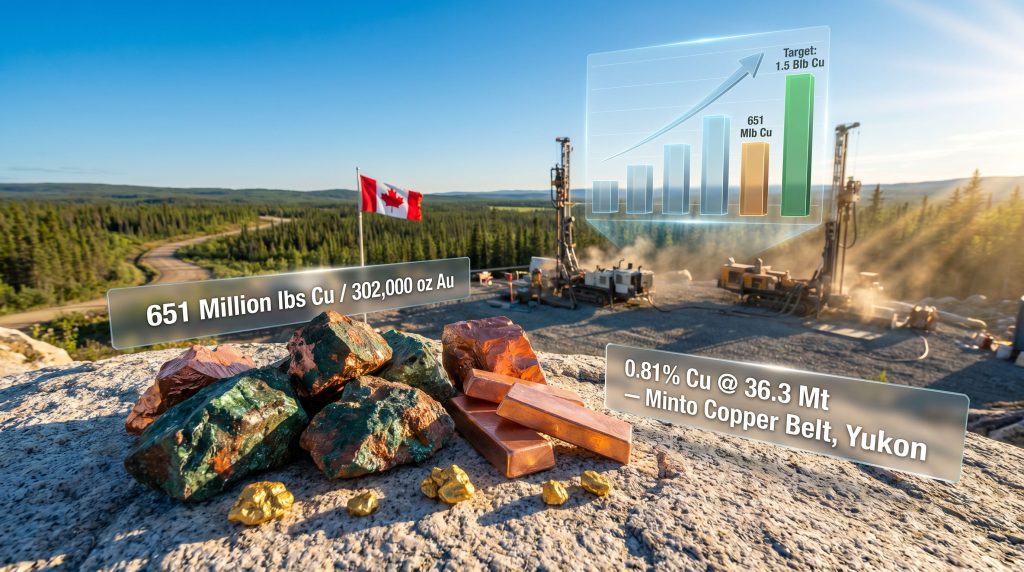
Carmacks is firmly in the latter category. The deposit holds 651 million pounds of copper and 302,000 ounces of gold in Measured and Indicated resource categories, grading 36.3 million tonnes at 0.81% copper and 0.26 grams per tonne gold, with a copper equivalent grade exceeding 1% CuEq. These are not inferred ounces waiting to be converted. The dominant Measured and Indicated classification is significant because it reduces the infill drilling burden required before entering feasibility-stage studies, a distinction that directly affects both cost and timeline.
Project Snapshot: Key Metrics at a Glance
| Attribute | Detail |
|---|---|
| Location | Central Yukon, Canada |
| Commodity Focus | Copper-Gold |
| Current M&I Resource | 651 million lbs Cu / 302,000 oz Au |
| Resource Grade | 36.3 Mt @ 0.81% Cu and 0.26 g/t Au |
| Copper Equivalent Grade | Over 1% CuEq |
| Road Access | Yes, fully road-accessible |
| Distance to Grid Power | ~10 kilometres |
| Drilling Cost Advantage | ~$400/metre vs. $500,000+ per hole at helicopter-accessed peers |
| Geological Belt | Stikine Terrane, Minto Copper Belt |
What the metrics above do not immediately convey is the cost structure behind them. Road access and proximity to grid power are not merely conveniences. They fundamentally reshape the economics of every phase of development, from initial exploration through to eventual production. Drilling at $400 per metre on a year-round road-accessible basis, compared to the $500,000-plus per hole common at remote northern projects, means that Cascadia can execute nearly half of all historic drilling on the property in a single 2026 season while spending a fraction of what peers would pay for equivalent meterage.
How Cascadia Came to Own the Deposit
Cascadia Minerals originated as a spin-out from ATAC Resources when that company was acquired by Hecla Mining in 2023. The subsequent merger with Granite Creek Copper was a deliberate capital efficiency decision rather than opportunistic deal-making. Helicopter-accessed greenfield exploration had become prohibitively expensive under prevailing market conditions, and Granite Creek had already identified the fundamental value case for Carmacks: an existing resource with infrastructure access, prior baseline environmental work, and a geological upside thesis that previous operators had systematically avoided exploring.
Those previous operators, focused on near-surface oxide material suited to heap leaching, routinely terminated drill holes when they encountered sulphide mineralisation at depth. The irony is that the sulphide zone, which they treated as a boundary rather than an opportunity, now represents the primary growth vector for resource expansion. Granite Creek recognised this mispricing but lacked the capital to fully exploit it. Cascadia, with Agnico Eagle now on the register, has both the mandate and the funding to close that gap.
The Geology That Sets Carmacks Apart From Typical North American Porphyries
The geological distinction at the heart of the Carmacks thesis is not immediately obvious from the grade-and-tonnage summary. To appreciate why the deposit trades differently from a standard disseminated porphyry, it is necessary to understand what actually controls the mineralisation.
Management describes the Carmacks deposit as a "magmatised porphyry," a system where copper-bearing fluids were concentrated, upgraded, and then injected along structural corridors rather than dispersed broadly through a large rock mass. The behaviour, management notes, is more analogous to a volcanogenic massive sulphide (VMS) system than a conventional low-grade porphyry blanket. This distinction has several practical consequences:
- Grade concentration: Zones average approximately 50 metres wide at close to 1.5% copper, materially above the main resource average of 0.81% Cu
- Structural predictability: Mineralisation follows defined structural controls, making step-out drilling more directionally precise than in disseminated systems
- Contact clarity: The boundaries between mineralised zones and barren granite wall rock are typically resolved within one metre, simplifying mine planning and reducing dilution risk
- Mining selectivity: High-grade pods within a moderate-grade envelope allow for selective extraction strategies that can enhance mill feed quality
The deposit comprises three distinct mineralised zones, with oxide mineralisation extending to approximately 150 metres below surface before transitioning into the sulphide domain. The sulphide zone, systematically avoided by prior operators, is now understood to extend both at depth and along strike, forming the core of the 2026 expansion thesis.
Zone A: The Satellite Target 11 Kilometres North
Perhaps the least appreciated component of the Carmacks story is Zone A, a satellite target located 11 kilometres north of the main deposit. Historic drilling conducted in the 1980s returned intercepts that, by any standard, would attract attention in the current copper market:
| Intercept | Copper Grade | Gold Grade |
|---|---|---|
| 22 metres | 2.0% Cu | 2.0 g/t Au |
| 25 metres | >2.0% Cu | Not recorded |
| 13 metres | 3.0% Cu | Not recorded |
The gold grades at Zone A are particularly noteworthy. The main deposit averages 0.26 grams per tonne gold across the resource. Zone A's 1980s intercepts include 2.0 g/t Au alongside 2.0% Cu, a combined grade profile that would place it in the upper tier of copper-gold satellite targets in accessible Canadian jurisdictions. The 2026 program allocates 3,000 to 4,000 metres specifically to Zone A, with the objective of determining whether a standalone resource case can be constructed for this high-grade northern extension.
The potential for Zone A to carry substantially higher gold grades than the main deposit means that successful definition drilling could materially alter the project's precious metals profile and overall economic sensitivity to gold price movements.
The 2026 Drill Program: Context, Scale, and Target Allocation
The significance of the 2026 drill program becomes clearest when framed against the property's exploration history. All previous operators combined drilled approximately 44,000 metres at Carmacks across several decades. The 2026 program alone targets 15,000 to 20,000 metres, meaning a single season could add the equivalent of roughly 45% of all prior drilling to the geological database. Management describes it as the largest drill program on the property since 2007.
How the Metres Are Allocated
| Target Area | Planned Metres | Objective |
|---|---|---|
| Main Deposit step-outs | ~10,000 m | Down-dip and along-strike resource expansion |
| Parallel Zones | ~5,000 m | Testing proximal mineralised corridors |
| Zone A | 3,000-4,000 m | High-grade satellite resource definition |
| Gap Zone / Sourtoe | Included above | Untested targets from 2025 results |
Two drills are currently operating, with additional capacity available if discovery of significant new zones warrants simultaneous programs. The season window extends through October to November depending on weather conditions, providing a meaningful programme of work before year-end results. Furthermore, well-structured exploration drilling programs such as this one are increasingly recognised as a key differentiator between exploration-stage companies that advance and those that stall.
A notable methodological advancement for the 2026 program is the introduction of oriented core at Carmacks for the first time in the project's history. Oriented core drilling preserves the rotational position of core samples relative to their in-ground orientation, allowing geologists to measure the precise dip and azimuth of structural features, veins, and fractures. This structural data is essential for understanding the controls on high-grade zones and predicting where mineralisation continues beyond current drill coverage.
The exploration philosophy extends beyond the drill bit. Management has adopted a systematic sequencing approach that prioritises surface trenching and geophysical surveys to refine structural targets before committing metres. This capital discipline — testing the geological model before drilling rather than drilling to test it — is the methodology that distinguishes well-managed junior exploration programs from those that generate metres without advancing understanding.
Recent Results Validating the Expansion Thesis
| Zone | Intercept | Cu Grade | Au Grade | High-Grade Sub-Interval |
|---|---|---|---|---|
| Zone 147 | 83.52 m | 0.89% Cu | 0.26 g/t Au | 26.33 m @ 1.53% Cu |
| Zone 2000S | 87.44 m | 0.63% Cu | 0.15 g/t Au | 21.27 m @ 1.25% Cu |
The internal high-grade sub-intervals within broader intercepts are the geological signature of structurally controlled mineralisation. Widths exceeding 20 metres at grades approaching or exceeding 1.5% copper, sitting within envelopes of 80-plus metre intercepts averaging around 0.8 to 0.9% copper, reflect exactly the kind of deposit architecture that supports selective mining scenarios and above-average mill feed economics.
The Case for Bypassing the PEA: An Accelerated Development Logic
The conventional junior mining development pathway runs in sequential stages: resource definition, then Preliminary Economic Assessment (PEA), then Pre-Feasibility Study (PFS), then Feasibility Study, then permitting and construction. Each stage has associated costs, timelines, and de-risking milestones. For most exploration-stage companies, skipping any stage would be considered imprudent.
Carmacks, however, presents a specific combination of characteristics that makes the PEA bypass argument genuinely credible rather than merely aspirational. In addition, mining feasibility studies at this level of resource confidence and infrastructure readiness are typically more straightforward to advance than those built on predominantly inferred resources:
- The resource is predominantly Measured and Indicated, which reduces the infill drilling required to satisfy PFS-grade resource confidence thresholds
- Previous operators completed baseline environmental studies that can be reactivated rather than initiated from scratch, compressing the environmental data collection timeline
- The deposit's compact, high-grade geometry reduces the metallurgical complexity of processing flow sheet design
- Clean granite wall rock contacts simplify geotechnical and mine planning assumptions
- A prior PEA framework referencing a 7,000 tonne-per-day open-pit, flotation-based operation already exists as an analytical reference point
Management's stated objective before advancing to PFS is reaching approximately 1.5 billion pounds of copper and approaching 1 million ounces of gold, representing roughly a 2.3-fold expansion of the current copper resource base. These targets are not arbitrary round numbers. They reflect the resource scale that, combined with the project's grade and infrastructure positioning, would likely support a PFS of sufficient economic robustness to attract institutional financing on reasonable terms.
Disclaimer: The potential to bypass a PEA and proceed directly to PFS is subject to successful resource expansion drilling, regulatory requirements, and technical study outcomes. There is no certainty that resource growth targets will be achieved or that feasibility study timelines will proceed as described. This article does not constitute financial advice.
Agnico Eagle's Strategic Investment: What Major Validation Actually Means
When a senior producer takes a near-20% fully diluted position in a junior copper developer, the market typically interprets it as a quality signal. However, the structure of Agnico Eagle's involvement at Cascadia goes beyond a passive equity stake.
| Investment Component | Detail |
|---|---|
| Equity Stake Acquired | 14% ownership |
| Fully Diluted Position | 19.9% |
| Funding Coverage | Through 2026-2027 drill programs at Carmacks |
| Stikine Terrain Earn-In | Up to 80% via $12 million in exploration expenditures |
| Post Earn-In Structure | 80/20 joint venture; Cascadia carried through earn-in phase |
The Stikine Terrain earn-in agreement is particularly significant. Agnico has the option to earn up to 80% of Cascadia's broader Stikine terrain exploration portfolio through $12 million in exploration expenditures, targeting early-stage grassroots opportunities across a large, underexplored portion of the terrain extending from British Columbia into Yukon. The post-earn-in structure carries Cascadia's 20% interest through the earn-in phase, meaning Cascadia participates in exploration upside without bearing the associated capital cost during that period.
Agnico Eagle has an established operational presence in Yukon, giving the company a level of regional geological knowledge, community relationships, and regulatory familiarity that a purely financial investor would not bring. That context matters when evaluating why Agnico chose the Cascadia Minerals Carmacks copper project specifically. The investment reflects a considered view on both the geological thesis and the broader jurisdictional framework — factors a regional operator is uniquely positioned to assess.
For Cascadia, the partnership provides financial stability through 2026 and 2027 while freeing management to focus operational resources on advancing Carmacks toward feasibility-stage studies.
The next major ASX story will hit our subscribers first
Infrastructure Economics: The Cost Differential That Changes Everything
The infrastructure advantage at Carmacks is discussed frequently but rarely quantified in terms of its downstream impact on the full project economic model. The comparison is more dramatic than headline numbers suggest.
| Cost Category | Carmacks | Helicopter-Accessed Peers |
|---|---|---|
| Drilling Cost | ~$400/metre | $500,000+ per hole |
| Power Access | ~10 km to grid | Diesel generation required |
| Logistics | Year-round road access | Seasonal/weather-dependent |
| Environmental Baseline | Pre-existing studies available | Greenfield baseline required |
Diesel power generation for remote projects in northern Canada typically runs at capital costs several times higher than grid connection costs, and operating costs that can represent a substantial portion of total site operating expenses. Grid power access at 10 kilometres is not merely a capital cost advantage at construction — it is a permanent operating cost advantage through the life of the mine.
Road access similarly affects not just drilling economics but the cost of every consumable, every piece of equipment, every staff rotation, and every concentrate shipment throughout the project lifecycle. The difference between year-round road access and seasonal helicopter logistics compounds across a multi-decade mine life into hundreds of millions of dollars in cumulative cost differential.
The Minto copper belt context adds another layer of regional infrastructure logic. With Selkirk Copper's Minto mine to the north working toward production restart, Carmacks sits within an increasingly active corridor with shared infrastructure interests. Management characterises the company as controlling much of the belt between the two operations, a positioning that could have significance for regional processing or logistics partnerships as the district matures.
Capital Structure, Shareholder Stability, and the Market Awareness Gap
Two shareholders define much of Cascadia's institutional ownership profile. Agnico Eagle holds 14% of the issued shares (19.9% fully diluted) following its strategic financing. Michael Gentile, a well-regarded figure in Canadian junior mining investment circles, holds approximately 7.1% and has participated in multiple financing rounds including the Granite Creek acquisition, demonstrating sustained conviction rather than opportunistic entry.
The ATAC Resources spin-out origin story is worth understanding for context. ATAC was a Yukon-focused exploration company whose acquisition by Hecla Mining created the corporate structure from which Cascadia emerged. That lineage gave Cascadia an initial asset base with established Yukon relationships, community context, and technical familiarity with the terrain that a newly formed company would lack.
Management has identified market awareness as a near-term priority, acknowledging that many investors who track copper exploration remain unfamiliar with the Carmacks project and its infrastructure advantages. This awareness gap, if closed through successful drilling results and conference attendance, could represent a meaningful re-rating catalyst independent of commodity price movements. In the junior mining sector, valuation often lags asset quality until a series of visible catalysts forces market attention.
The Broader Copper Supply Picture and Why Carmacks Fits It
The copper supply-demand narrative requires no elaborate construction. Electrification is structurally copper-intensive. Electric vehicles use approximately three to four times more copper than internal combustion equivalents. Grid modernisation, renewable energy infrastructure, and battery storage systems each add incremental copper demand that mining supply has struggled to match in terms of new project delivery. Consequently, understanding the copper price growth drivers at play is essential context for evaluating where Carmacks sits within this landscape.
The supply side problem is not a shortage of copper in the ground. It is a shortage of copper that can be financed, permitted, built, and operated within acceptable risk parameters. Projects in jurisdictions with unstable permitting frameworks, politically sensitive operating environments, or infrastructure deficits require risk premiums that push their hurdle rates above what current copper prices can always support.
North American copper assets in stable jurisdictions with infrastructure access are therefore not just geographically convenient. They represent a structurally differentiated risk category that institutional capital has begun pricing distinctly from the broader copper development universe. Management at Cascadia has noted that major mining companies are increasingly expressing interest in assets where jurisdictional and logistical risk is minimised — a trend that Carmacks is well positioned to benefit from as the 2026 drill program generates newsflow. For investors exploring copper investment strategies suited to the current environment, assets with this combination of infrastructure access and resource scale are increasingly rare.
Key Risks Investors Should Understand
No analysis of the Cascadia Minerals Carmacks copper project is complete without acknowledging the risk factors that apply at this stage of development:
- Exploration-stage uncertainty: Resource expansion targets are objectives, not guarantees. Drilling programs can return results inconsistent with geological models
- Commodity price sensitivity: The project's economics are sensitive to copper and gold prices, which are subject to macroeconomic forces beyond management's control
- Permitting and regulatory timelines: Even well-positioned projects encounter regulatory delays that extend development timelines
- Financing risk: Junior developers operate in capital markets that can be highly volatile, particularly for non-producing companies
- Execution complexity: Managing a 15,000 to 20,000 metre program across multiple targets simultaneously introduces operational risk
All forward-looking statements in this article, including resource growth targets, development timelines, and feasibility study pathways, are subject to material risks and uncertainties. Investors should conduct their own due diligence and consult a qualified financial adviser before making investment decisions.
Summary: Five Dimensions of the Carmacks Investment Thesis
| Dimension | Assessment |
|---|---|
| Resource Quality | 651 Mlb Cu / 302 koz Au in M&I categories; high-grade zones at ~1.5% Cu |
| Infrastructure Position | Road-accessible; 10 km to grid power; $400/m drilling costs |
| Growth Potential | Targeting 1.5 Blb Cu through systematic 15-20,000 m drill program |
| Strategic Validation | Agnico Eagle 14% equity stake; $12M earn-in on Stikine exploration portfolio |
| Development Pathway | Potential direct PEA bypass to Pre-Feasibility Study in coming years |
The Cascadia Minerals Carmacks copper project does not fit neatly into the standard junior explorer narrative of speculative ground with a geological concept. It sits further along the development curve than that framing suggests, with a substantial existing resource, a strategic major partner, infrastructure advantages that materially reduce cost across all development phases, and a geological model that previous operators never fully tested.
Whether the 2026 drill program delivers the resource growth required to advance toward pre-feasibility studies is the central near-term question. Furthermore, the Carmacks project overview on Cascadia's own site provides additional technical detail on the geological framework underpinning the expansion thesis. The infrastructure, the partner, and the geological framework are already in place. The drilling will determine how the story develops from here.
Further institutional-grade analysis on the Carmacks copper-gold project and Cascadia Minerals is available through the Analyst's Notes series at cruxinvestor.com.
Want To Be First When The Next Major Copper Discovery Hits The ASX?
Discovery Alert's proprietary Discovery IQ model delivers real-time alerts on significant mineral discoveries the moment they're announced on the ASX, turning complex data across 30-plus commodities into clear, actionable insights for both short-term traders and long-term investors. Explore why major mineral discoveries have historically generated exceptional returns and start your 14-day free trial at Discovery Alert to position yourself ahead of the market.