July 17, 2026
The Copper Supply Crunch That Is Redirecting Billions Toward Africa's Frontier Mines
The global mining industry is experiencing a quiet but consequential transformation. As the electrification of transportation, energy, and industrial infrastructure accelerates, the metals underpinning that shift are becoming the subject of intense institutional scrutiny. Among them, copper occupies a uniquely central position. It is irreplaceable in motor windings, transmission cables, solar panel wiring, and the dense circuitry of AI data centres. The copper supply crunch has been intensifying for years, and the capital required to reverse that trend is now flowing in directions that would have seemed unlikely a decade ago.
Africa's underexplored copper belts are increasingly where that capital is landing, and Namibia is emerging as one of the continent's most compelling destinations for serious mining investment.
When big ASX news breaks, our subscribers know first
Appian Capital Advisory's Namibia Copper Mine Bet: What Is Actually Being Built
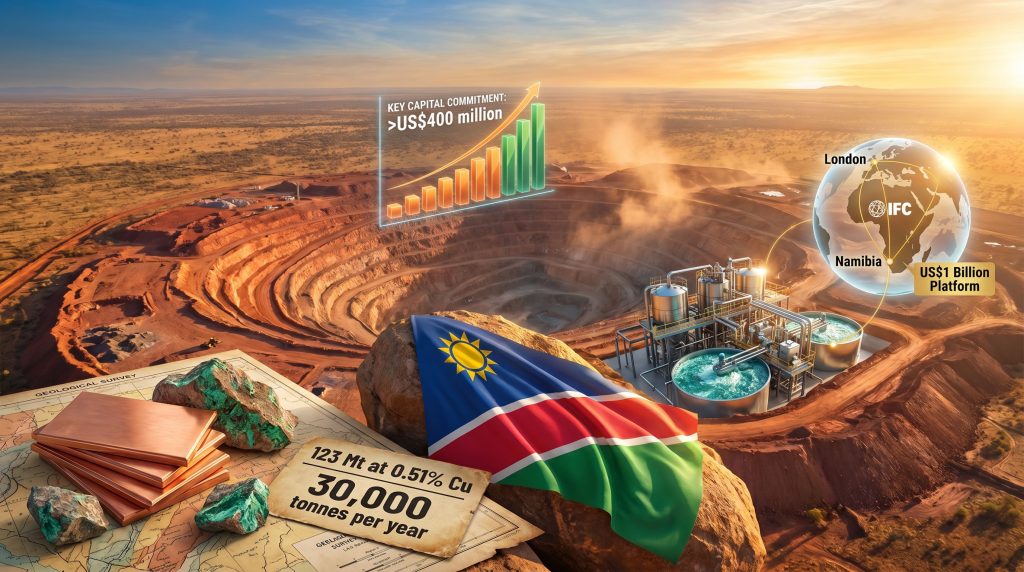
UK-based mining-focused private equity firm Appian Capital Advisory has formalised the acquisition of a 95% controlling stake in the Omitiomire copper project, located in Namibia's Otjozondjupa Region approximately 140 kilometres northeast of Windhoek. The transaction was completed through Appian's Omico Copper vehicle, and while the acquisition price was not publicly disclosed, the firm has confirmed a development capital commitment exceeding US$400 million.
The asset was previously held by Greenstone Resources and International Base Metals Ltd., an Australian-listed mining company, according to reporting by Bloomberg.
The Resource Base and Production Blueprint
Omitiomire is not a speculative exploration play. It carries a measured and indicated mineral resource of 123 million tonnes at a grade of 0.51% copper, with a mineable inventory of 102 million tonnes at the same grade. That resource underpins a production profile targeting approximately 30,000 tonnes of copper annually over an estimated 15-year mine life.
First production is targeted within roughly three years of the acquisition being completed, placing the project on a trajectory toward output at a point when copper supply constraints are widely expected to be most acute.
| Project Parameter | Detail |
|---|---|
| Total Resource (M&I) | 123 Mt at 0.51% Cu |
| Mineable Inventory | 102 Mt at 0.51% Cu |
| Annual Production Target | ~30,000 tonnes copper |
| Estimated Mine Life | ~15 years |
| Capital Commitment | >US$400 million |
| Target First Production | ~3 years from acquisition |
| Acquirer Stake | 95% via Omico Copper |
| Previous Owners | Greenstone Resources / International Base Metals Ltd. |
A note on copper grades: A grade of 0.51% copper is broadly representative of many operating open-pit copper mines globally, where cut-off grades have trended lower over decades as higher-grade deposits have been progressively depleted. For context, the world's largest copper producers in Chile and Peru frequently operate at grades between 0.4% and 0.8%, making Omitiomire's resource geologically credible within that peer group.
Why Processing Technology Could Define the Project's Profitability
One of the less-discussed but potentially significant aspects of Omitiomire's development path involves the choice of metallurgical processing route. Appian's technical review has identified an opportunity to evaluate a shift away from leach-based processing toward a flotation circuit approach.
Understanding the Leach-to-Flotation Distinction
This distinction matters considerably to the project's economics and is worth unpacking for those less familiar with copper processing:
-
Heap leach processing involves stacking crushed ore onto lined pads and applying an acidic solution to dissolve copper, which is then recovered through electrowinning. It typically requires lower upfront capital but can deliver reduced overall copper recovery, particularly for sulphide-dominant ore bodies where leaching is less effective.
-
Flotation processing uses physical and chemical techniques to separate copper-bearing minerals from waste rock, producing a concentrate that is then smelted. For sulphide copper ores, flotation generally achieves substantially higher recovery rates, meaning more payable copper is extracted from each tonne of ore mined.
-
The recovery rate differential between these two approaches for sulphide ores can be material, sometimes ranging from 75–80% recovery via leaching up to 85–92% via flotation, depending on ore characteristics.
-
A higher recovery rate translates directly into greater revenue per tonne processed, potentially improving the project's net present value and reducing the effective cost per pound of copper produced.
Speculative point worth monitoring: If metallurgical testwork at Omitiomire confirms sulphide ore dominance and flotation viability, the economics underpinning the current US$400 million capital commitment could shift meaningfully. Flotation circuits typically carry higher capital costs than heap leach infrastructure, but the improved recovery and revenue profile often justifies the additional investment across a 15-year mine life. This technical decision could be one of the most consequential yet to be made about the project.
Appian Capital Advisory's Investment Architecture: Mid-Tier Aggregation as a Strategy
To understand why Omitiomire is significant beyond its own metrics, it is necessary to understand how Appian Capital Advisory operates as an investment platform. Furthermore, examining the firm's broader strategic logic reveals why the Appian Capital Advisory Namibia copper mine development fits into a much larger thesis about mid-tier asset aggregation.
Appian is a mining-focused private equity firm headquartered in the United Kingdom that has built its model around a concept that sits outside the mainstream of both generalist PE and major mining company strategy: the deliberate aggregation of mid-sized mining assets. Rather than competing for single Tier 1 mega-mines alongside the world's largest diversified mining groups, Appian identifies assets in the 20,000 to 50,000 tonne-per-year production range and constructs portfolios from them.
CEO Michael Scherb has described this approach as one that allows the firm to achieve scale through a portfolio of assets while keeping individual project complexity at manageable levels. The logic is straightforward: a portfolio of four assets each producing 25,000 tonnes per year delivers 100,000 tonnes annually with diversified operational risk, whereas a single 100,000-tonne mine concentrates all risk in one jurisdiction, one ore body, and one management structure.
The Namibian Platform Takes Shape
Omitiomire is Appian's second material asset in Namibia. The firm acquired the Rosh Pinah Zinc operation in 2023, establishing an in-country operational foundation before adding copper exposure through Omitiomire. This sequencing reflects a deliberate country-level platform strategy rather than opportunistic deal-making.
Holding complementary assets within a single jurisdiction generates compounding operational benefits:
- Shared regulatory relationships and institutional knowledge reduce compliance overhead for each new project
- Established in-country teams can support multiple operations without duplicating management infrastructure
- Logistics, supply chain, and community engagement frameworks built for one asset benefit others
- The credibility of being an existing operator with a track record in-country strengthens positioning when pursuing future acquisitions
The IFC Partnership and What It Signals to the Market
The Omitiomire acquisition does not sit in isolation. It is part of a substantially larger capital deployment framework anchored by a US$1 billion co-investment partnership between Appian Capital Advisory and the International Finance Corporation (IFC), the private-sector lending arm of the World Bank Group.
This partnership is specifically structured to support mining project development across Africa and Latin America. The significance of IFC involvement extends well beyond the capital it provides.
For institutional investors evaluating frontier market mining assets, IFC participation carries a specific risk signal: the World Bank Group's environmental and social governance standards are among the most rigorous applied to infrastructure and extractive industry projects globally. IFC involvement implies that a project has passed, or is committed to meeting, a demanding due diligence threshold. This functions as a de facto credibility endorsement that can lower the perceived risk premium other institutional investors apply when considering co-investment or debt financing.
Investor psychology note: In frontier market mining, the presence of a multilateral development finance institution as a project partner tends to compress the political risk discount that private capital would otherwise demand. This is not merely symbolic. It affects the cost of capital, the terms on which project finance debt is structured, and the willingness of offtake counterparties to enter long-term concentrate purchase agreements.
With US$1 billion in committed partnership capital and Omitiomire as an anchor asset, Appian has indicated it may announce two additional copper-related acquisitions before year-end, with prospective targets being evaluated in South America, North Africa, and southeastern Europe. The implication is that a global copper portfolio is actively being assembled, with Omitiomire serving as a foundational piece. Considering broader copper investment strategies, this kind of platform-building approach represents one of the more disciplined frameworks currently operating in the sector.
Namibia's Mining Sector: Understanding What Is Driving the Surge
Namibia has long been recognised for its uranium sector, home to the Rössing and Husab operations, which rank among the world's largest uranium mines by output. However, the country is now experiencing a broader minerals investment surge that extends well beyond uranium. Indeed, the critical minerals demand dynamic is reshaping how international capital views the entirety of Namibia's resource endowment.
The Licensing Data Tells a Story
Namibia's mining regulatory authority has received more than 800 new exploration licence applications, according to Mining Commissioner Isabella Chirchir. That number is a striking indicator of the intensity of global competition to secure access to the country's mineral endowment. In response, Namibia is overhauling its licensing administration through the introduction of digital processing platforms designed to reduce administrative backlogs and accelerate approval timelines.
| Factor | Namibia's Comparative Position |
|---|---|
| Political Stability | Consistently rated among Africa's most stable democracies |
| Mining Regulatory Framework | Established, internationally recognised legal structures |
| Infrastructure Access | Functional road, rail, and port connectivity to export markets |
| Uranium Sector Track Record | Decades of experience hosting major international operators |
| Critical Minerals Diversification | Active strategic pivot toward copper, lithium, zinc, and REEs |
| New Exploration Licence Applications | 800+ received, digital system being introduced to manage volume |
Why Geological Context Matters for Investor Confidence
Namibia's geological endowment is not uniformly understood by investors, and this knowledge gap itself represents a commercial opportunity for firms with deep technical capabilities. The country's geology encompasses portions of the Central African Copperbelt's southern extensions, Damara Belt metamorphic sequences, and coastal basin structures with different mineralisation styles to those found in the more heavily explored Zambian and Congolese copper districts.
This means Namibia's copper potential is geologically distinct from what the market typically associates with African copper, offering exploration upside that has been less systematically drilled than competing regions. For private equity investors with in-house geological capacity, this kind of underexplored terrain is precisely the environment in which strong acquisition economics are achievable.
The next major ASX story will hit our subscribers first
Copper's Structural Demand Drivers: Why This Cycle Feels Different
Understanding why firms like Appian are committing hundreds of millions of dollars to copper development projects requires an appreciation of what is different about the current demand environment compared to previous commodity cycles.
Past copper price cycles were largely driven by Chinese infrastructure construction activity, which could expand and contract with government stimulus programmes. The current demand trajectory is, however, structurally different because it is driven by permanent physical requirements embedded in the energy transition:
- Electric vehicles require roughly three to four times more copper per vehicle than an equivalent internal combustion engine vehicle, primarily in motor windings, battery systems, and charging infrastructure
- Utility-scale wind and solar installations are copper-intensive in their cabling, inverters, and grid connection infrastructure
- Power grid modernisation and expansion requires substantial copper volumes as transmission networks are upgraded to handle distributed renewable generation
- AI data centre construction has emerged as an unexpected but significant copper demand driver, given the density of electrical infrastructure required per square metre of computing capacity
These demand vectors do not switch off with a change in government spending priorities. They are embedded in the capital expenditure programmes of utilities, automotive manufacturers, and technology companies with multi-decade investment horizons, creating a demand floor beneath copper prices that is qualitatively different from previous cycles.
Disclaimer: Copper price projections and supply-demand forecasts involve inherent uncertainty. The analysis above reflects widely cited structural arguments but should not be construed as investment advice. Commodity markets are subject to volatility, geopolitical disruption, and demand-side variables that are difficult to forecast with precision.
The Broader Significance of Private Equity in Critical Minerals Development
One of the less-examined dynamics in the critical minerals conversation is the structural shift in who is financing new mine development. Major diversified mining companies have progressively concentrated their capital allocation toward existing Tier 1 operations in established, low-risk jurisdictions. This is partly a shareholder returns discipline and partly a function of balance sheet constraints following the capital destruction of the previous decade's expansion era.
The result is a funding gap at the mid-tier development level, particularly in African and Latin American jurisdictions where perceived political risk has historically deterred conventional institutional capital. Furthermore, the geopolitical mining landscape is adding fresh urgency to the question of which jurisdictions can reliably host new production over the coming decade.
Mining industry consolidation is accelerating as specialist private equity firms fill the funding gap, doing so with longer investment horizons, deeper project-level technical expertise, and a higher tolerance for development-stage risk than generalist capital markets can typically accommodate.
The Appian Capital Advisory Namibia copper mine development at Omitiomire is a clear example of this dynamic in action. It represents a commitment by specialist private capital to bring a well-defined, resource-backed copper project into production through the very period when supply constraints are expected to be most pronounced.
Whether the project delivers on its timeline, processing optimisation potential, and production targets will be closely watched by a market that is increasingly looking to Africa's frontier mining jurisdictions to fill the gap that conventional supply pipelines cannot close.
Further coverage of Namibia's evolving role in Africa's critical minerals sector and related investment developments can be found via Business Insider Africa at africa.businessinsider.com.
Want to Capitalise on the Next Major Copper Discovery Before the Market Does?
Discovery Alert's proprietary Discovery IQ model scans ASX announcements in real time, instantly identifying significant mineral discoveries across copper and 30+ other commodities — transforming complex data into actionable investment opportunities the moment they emerge. Explore historic discoveries and their returns to understand what early positioning in major finds has delivered, then begin your 14-day free trial to secure your edge in the market.