August 1, 2026
The Geopolitics of Copper: Why a 37-Year-Old Dormant Mine Is Back at the Centre of Global Resource Competition
Frontier resource assets rarely get second chances. The combination of political instability, environmental liability, and community opposition that shuts a mine down once tends to create a self-reinforcing cycle that keeps capital away for generations. Yet something is shifting in the calculus of global copper supply, and it is forcing investors, governments, and industrial firms to revisit assets that were once considered untouchable.
The Lloyds Metals Panguna mine reopening story is not simply a corporate development update. It is a signal about where the global copper supply chain is heading, how frontier-market risk is being repriced, and why Pacific geopolitics has become a battleground for industrial strategy between two of Asia's largest economies. Understanding this requires examining the copper supply crunch that is reshaping investment decisions worldwide.
When big ASX news breaks, our subscribers know first
What Makes Panguna One of the Most Consequential Undeveloped Copper Assets on Earth?
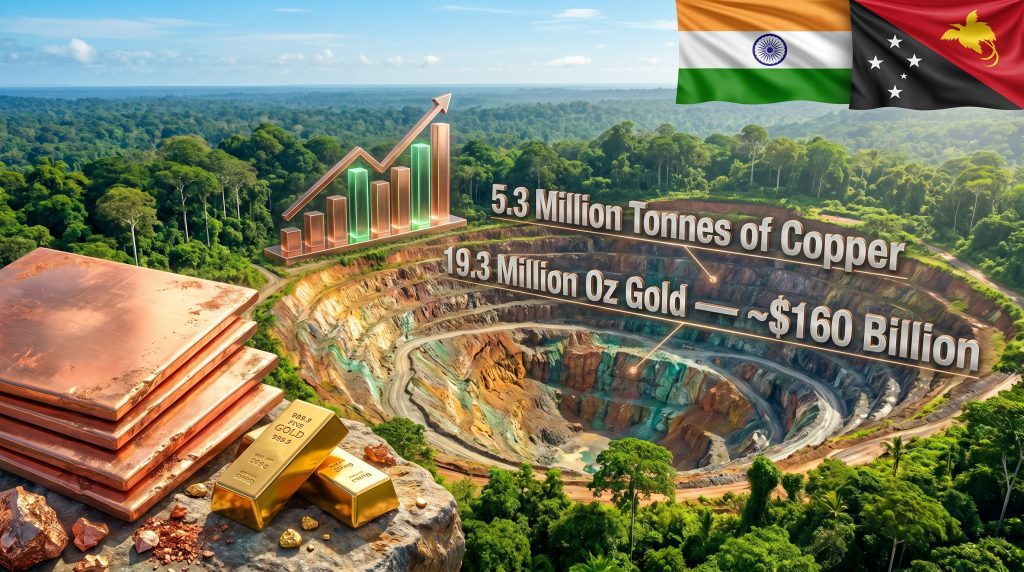
Understanding why the Lloyds Metals Panguna mine reopening has attracted significant attention requires placing the asset in context of the broader copper supply landscape. Panguna sits on Bougainville Island within Papua New Guinea's autonomous region and contains estimated remaining reserves of 5.3 million tonnes of copper and 19.3 million ounces of gold, with a combined value of approximately $160 billion at current commodity prices, including copper trading at $5.6358 per pound as of early May 2026.
These are not marginal figures. To appreciate their scale, consider that CMOC Group, currently among the world's largest copper producers, extracted nearly 750,000 tonnes of copper in 2025, representing approximately 3.3% of total global output. Doing the arithmetic, that implies global copper production of roughly 22.7 million tonnes annually. Panguna's remaining copper inventory alone represents more than 23% of a full year of global copper supply sitting in a single undeveloped deposit.
Tier-one copper discoveries at this scale have become genuinely scarce. The industry consensus among major copper analysts holds that the era of easily accessible, high-grade copper discoveries is largely over, with new resources tending to be deeper, lower grade, and more technically complex to bring into production. Panguna does not fit that profile. It operated as an open-pit mine from 1972 to 1989, meaning its orebody geometry and processing characteristics are well understood relative to a greenfield discovery.
Why 37 Years of Dormancy Is Actually Strategically Significant
A mine that has been idle for nearly four decades presents both a liability and an opportunity. The liability side is straightforward: infrastructure degrades, institutional knowledge dissipates, community grievances calcify, and environmental conditions worsen without active management. Pit walls become unstable, water tables shift, and legacy contamination spreads.
The opportunity side is less obvious. Four decades of inflation, technology improvements, and commodity price appreciation mean that deposits which were marginal under 1989 economics can become highly attractive under 2026 conditions. The copper price has moved dramatically since closure. Processing technologies have improved recovery rates for porphyry copper systems like Panguna. And perhaps most importantly, the ownership structure has fundamentally changed, removing one of the core grievances that triggered the original conflict.
Furthermore, Panguna sits within a broader geological province containing copper-gold giant deposits that have attracted sustained institutional interest, lending additional credibility to the resource narrative.
Panguna's dormancy period is not simply a gap in production history. It is the residue of a political and social breakdown that killed an estimated 20,000 people and fundamentally reshaped the governance architecture of the entire island. Any commercial analysis that ignores this context is analytically incomplete.
The Ownership Architecture: How Control of Bougainville Copper Ltd. Shapes Every Negotiation
Bougainville Copper Ltd. (BCL) holds the mining licences covering the Panguna site, and the Autonomous Bougainville Government (ABG) controls approximately 73% of BCL. This ownership concentration is the most important structural fact in any assessment of the project's investability.
The ABG's dominant stake means that community and government interests are formally embedded in the asset's ownership structure rather than existing as external stakeholders who must be consulted. This is a materially different arrangement from a standard private concession model. In practice, it means commercial negotiations are simultaneously political negotiations, and any return on investment calculation must accommodate the ABG's parallel objective of generating fiscal capacity for a potentially independent Bougainville state.
In 2019, a UN-observed independence referendum produced a striking result: 98% of Bougainvilleans voted for independence from Papua New Guinea. That outcome has created a constitutional imperative for economic development. PNG Prime Minister James Marape has publicly tied the formal independence pathway to demonstrated economic self-sufficiency, meaning Panguna is not merely a commercial asset but functionally a component of Bougainville's state-building architecture.
The mine closed under the ownership of Rio Tinto Group, which held a 54% stake in BCL at the time. Rio ultimately divested its entire interest in 2016, effectively walking away from both the asset and the legacy liabilities. The shift in BCL ownership from a foreign-listed mining major to local government majority control represents the single most significant structural change in the project's investability profile since 1989.
Why India's Lloyds Metals Beat China's CMOC for a Strategic Pacific Asset
The competitive dynamics behind the Lloyds Metals Panguna mine reopening bid reveal something important about how Pacific island governments are recalibrating their foreign investment relationships. BCL's initial preferred partner was CMOC Group, the Henan-based mining conglomerate that dominates global cobalt supply and ranks among the world's largest copper producers. CMOC's operational scale and financial capacity would appear to make it the obvious frontrunner for a project of this complexity.
President Ishmael Toroama, who has led Bougainville since 2020, and his cabinet made a different call. Their formal endorsement of Lloyds Metals over CMOC was not a minor procedural decision. It was a deliberate geopolitical signal.
The comparison between the two competing parties highlights the asymmetry of the choice:
| Factor | Lloyds Metals (India) | CMOC Group (China) |
|---|---|---|
| Copper production scale | Emerging via DRC JVs (target: 100,000 tpa) | |
| Iron ore production | ~22 million tpa (India) | Not a primary focus |
| Bougainville Government endorsement | Endorsed by President Toroama | Rejected |
| MOU signed with Bougainville | November 2025 | Not progressed |
| PNG subsidiary established | April 20, 2026 | Not applicable |
| 90-day exclusivity period (BCL) | Granted | Not applicable |
BCL initially pushed back, characterising Lloyds' approach as bypassing the company's formal partner selection process. By February 2026, BCL had acknowledged the ABG's decision and terminated its own search. The PNG-incorporated entity, Lloyds Panguna Metals and Energy Ltd., was formally registered on April 20, 2026, with an explicit mandate to execute cooperation agreements, memoranda of understanding, and joint venture arrangements with BCL, while holding any resulting rights, licences, or equity interests from the engagement.
Lloyds Metals: Industrial Capability and Strategic Expansion
Lloyds Metals and Energy Ltd. is an Indian industrial firm whose primary base has been iron ore production, with annual output of approximately 22 million tonnes from Indian operations. The company has demonstrated a pattern of strategic expansion into copper through two joint ventures in the Democratic Republic of Congo, which the company projects could eventually reach combined annual copper output of up to 100,000 tonnes.
The Panguna engagement, if successful, would represent a significant step-change in both the scale and geographic diversity of its copper ambitions. Investors considering copper investment strategies in frontier markets will find the Lloyds approach instructive as a case study in navigating complex political and social consent frameworks.
Lloyds confirmed on an earnings call that its new PNG subsidiary is actively engaged, describing Panguna as a copper and gold deposit of exceptional quality, while emphasising that formal acquisition discussions with the government are ongoing and investors should not expect immediate resolution.
For investors tracking Indian industrial conglomerates, this pattern of simultaneous DRC copper JVs and PNG copper development pursuit suggests a deliberate upstream resource diversification strategy designed to align with India's accelerating domestic manufacturing demand, particularly in electronics and emerging EV infrastructure.
The $6 Billion Question: What It Actually Takes to Restart a Mine That's Been Dark for Four Decades
A BCL feasibility study completed in 2021 estimated that bringing Panguna back into production would require a minimum capital outlay of $6 billion and at least seven years of development work. A phased development approach has been flagged as a potentially more capital-efficient pathway, though no specific capex reduction figures have been publicly quantified.
It is worth noting that the 2021 study is now five years old. Capital cost inflation in remote Pacific resource jurisdictions has been substantial across the past several years, driven by logistics constraints, labour market tightening, and materials cost escalation. A revised estimate anchored in 2026 conditions would likely produce a materially higher figure. Investors should treat the $6 billion as a directional floor rather than a current planning estimate.
The infrastructure deficit at Panguna is comprehensive:
- Road network rehabilitation connecting the mine site to coastal logistics infrastructure, including a road upgrade partnership between Buka and the mine area identified as a priority precursor step
- Port and export logistics capable of handling copper concentrate volumes consistent with a major porphyry operation
- Power generation systems in a jurisdiction where grid infrastructure is limited
- Water management and pit dewatering given decades of unmanaged groundwater ingress into the open pit
- Environmental remediation of legacy contamination from operations that ceased without modern closure planning protocols
- Processing plant reconstruction or replacement, with the original plant now beyond economic refurbishment after four decades of inactivity
- Community resettlement and social infrastructure as part of the consent framework required to re-engage affected landowners
- Workforce recruitment and skills development, including local training programmes as part of community engagement commitments
The Phased Development Question: What It Means in Practice
The concept of phased development for a large porphyry copper-gold system like Panguna typically involves sequencing production from the most accessible and highest-grade portions of the orebody first, deferring lower-grade or deeper zones to later development stages. This approach reduces initial capital requirements and can accelerate the timeline to first cashflow, but it also introduces technical risk around later-stage ore body continuity and processing plant expansion requirements.
For an asset of Panguna's scale and complexity, a phased approach would likely still require billions of dollars in initial capital before any revenue is generated, given the infrastructure baseline that must be established regardless of production scale.
The 1989 Civil War and Why Historical Context Defines Every Commercial Conversation
The Bougainville Civil War is not simply background history. It is the foundational constraint that shapes every aspect of how Panguna can and cannot be developed. The conflict that followed the mine's 1989 closure lasted approximately a decade and resulted in an estimated 20,000 deaths in a population that at the time numbered only around 150,000 to 200,000 people. These are not abstract statistics. They represent a generational trauma embedded in Bougainville's social fabric.
The two core grievances that triggered the original protests were environmental damage from mine operations and the inequitable distribution of revenue between Rio Tinto, BCL shareholders, and the local communities who lived with the environmental consequences. Neither grievance was minor, and neither was resolved before the situation deteriorated into conflict.
However, what has changed structurally since 1989 is significant:
- The ABG now controls approximately 73% of BCL, fundamentally shifting ownership from foreign corporations toward local government
- Community consent frameworks, including free, prior, and informed consent (FPIC) standards, have become embedded in international mining best practice and PNG regulatory requirements
- Lloyds' publicly stated engagement model explicitly emphasises local partnership, skills development, and community-led development as core components
- The independence referendum outcome has created political pressure to resolve the Panguna question in a way that serves Bougainvillean interests
What has not changed, however, remains equally significant:
- Landowner compensation disputes from the original closure remain unresolved for many affected families and communities
- Environmental monitoring capacity within Bougainville remains limited, creating challenges for independent verification of remediation progress
- A 37-year knowledge gap means that site-specific geological, geotechnical, and environmental conditions must be comprehensively reassessed before any development decision can be made
Indeed, Bougainville landowners have issued stop-work warnings against companies involved in reopening efforts, underscoring that community consent remains far from guaranteed and must be treated as a genuine prerequisite rather than a formality.
The next major ASX story will hit our subscribers first
Panguna in Global Context: How It Compares to Other Dormant Tier-One Copper Projects
The global landscape of large undeveloped or long-dormant copper assets provides useful perspective on the challenges and timelines involved:
| Project | Location | Estimated Copper Resource | Dormancy Period | Key Challenge |
|---|---|---|---|---|
| Panguna | Bougainville, PNG | 5.3 million tonnes | ~37 years | Social licence, $6B+ capex, geopolitical complexity |
| Reko Diq | Pakistan | ~12 million tonnes | ~15 years | Regulatory disputes (now progressing under Barrick/Antofagasta JV) |
| Tampakan | Philippines | ~15 million tonnes | ~10 years | Environmental permitting ban under national open-pit mining restrictions |
| Resolution Copper | USA (Arizona) | ~40 billion lbs | Greenfield | Indigenous land rights opposition and federal legislative uncertainty |
What distinguishes Panguna from the Reko Diq project or Resolution Copper is the combination of resource scale, known operational history, and the extraordinary political complexity created by the civil war legacy. Projects like Reko Diq have navigated complex regulatory disputes but did not involve the collapse of an operating mine into armed conflict. That distinction matters enormously for community trust rebuilding timelines.
Lloyds Metals' willingness to engage with this complexity at an early stage, when exclusivity is non-binding and due diligence is just commencing, reflects either a calculated assessment that the independence dynamic has created a genuine window for progress, or an appetite for frontier-market risk that most established mining majors have declined to accept.
India's Broader Pacific Resource Strategy and What Panguna Signals
Viewed in isolation, Lloyds Metals is a mid-sized Indian industrial company pursuing an ambitious copper growth strategy. Viewed within the context of India's broader industrial trajectory, the Panguna engagement begins to look like part of a larger pattern.
India's domestic manufacturing sector, including electronics production and nascent electric vehicle industry development, is creating structural demand for copper that Indian domestic production cannot satisfy. Indian industrial conglomerates are consequently incentivised to secure upstream copper supply outside India's borders. Lloyds' simultaneous pursuit of DRC copper joint ventures and PNG copper development represents exactly this kind of diversified upstream positioning.
The geopolitical dimension adds another layer. The mining geopolitics of the Indo-Pacific have become increasingly complex, with China's established Pacific infrastructure and resource diplomacy strategy having positioned CMOC as the likely default choice for Panguna. Bougainville's decision to reject that path in favour of an Indian firm represents a meaningful data point in the evolving competition between Chinese and Indian capital for strategic resource assets across the region.
Australia, as PNG's closest development partner and the dominant regional power in the South Pacific, has a significant strategic interest in the ownership structure of a mine of this scale on its near doorstep. The preference for Indian over Chinese involvement aligns with the regional security preferences of multiple Western-aligned governments, though this has not been stated as an explicit factor in Bougainville's decision-making.
Key Investment Considerations and Risk Framework
For investors tracking the Lloyds Metals Panguna mine reopening, a structured risk assessment framework is essential given the complexity of the asset:
Upside case drivers:
- Copper's structural demand growth trajectory through electrification and grid infrastructure investment
- Panguna's exceptional resource scale relative to the global discovery pipeline
- ABG majority ownership removing the foreign corporate versus local community ownership conflict that triggered 1989 closure
- India's growing industrial demand creating strategic incentive to complete a transaction
Key risk factors:
- The $6 billion 2021 capex estimate is almost certainly understated in 2026 real terms
- A seven-year development timeline means no near-term production contribution to global supply
- Community consent requirements are extensive and cannot be compressed without recreating the grievance conditions of the original conflict
- Lloyds' demonstrated track record in large-scale copper project development and project finance access is not yet established at this scale
- PNG's regulatory framework for major mining agreements involves both national and autonomous regional approval layers
Disclaimer: This article is intended for informational purposes only and does not constitute financial or investment advice. Past resource valuations and feasibility estimates do not guarantee future project outcomes. Readers should conduct their own independent research and consult qualified advisers before making investment decisions.
Frequently Asked Questions
What is the Panguna mine and where is it located?
Panguna is a large-scale open-pit copper and gold mine on Bougainville Island, within PNG's Autonomous Region of Bougainville. It operated from 1972 to 1989 and was once among the largest open-pit mining operations globally by output volume.
Why was Panguna closed in 1989?
The mine was shut down after community protests escalated over unresolved grievances regarding environmental damage from operations and the perceived inequitable distribution of mining revenues. These tensions deteriorated into armed conflict that lasted approximately a decade.
Who owns Panguna today?
BCL holds the mining licences. The ABG controls approximately 73% of BCL, making it the majority owner and primary decision-maker for any redevelopment agreement.
What is Lloyds Metals' current position?
As of May 2026, Lloyds has established Lloyds Panguna Metals and Energy Ltd. as a PNG-incorporated subsidiary and has been granted a 90-day exclusivity window by BCL for due diligence. Formal acquisition discussions with the Bougainville Government are ongoing.
How much will it cost to restart Panguna?
A 2021 BCL feasibility study estimated a minimum of $6 billion and at least seven years of work. Given cost inflation since 2021, current estimates would likely be materially higher. A phased development pathway could reduce initial capital exposure.
Why was CMOC rejected in favour of Lloyds?
The ABG under President Toroama formally endorsed Lloyds following a review of development partnership options, reflecting a combination of community sentiment, geopolitical considerations, and preferences around development model and local participation commitments.
What are Panguna's remaining reserves?
Approximately 5.3 million tonnes of copper and 19.3 million ounces of gold, valued at roughly $160 billion at May 2026 commodity prices.
Ready To Spot The Next Major Copper Discovery?
Discovery Alert’s proprietary Discovery IQ model delivers real-time ASX mineral discovery alerts that help investors act on emerging copper opportunities before the broader market, while also showing how historic discoveries have translated into exceptional returns on the Discovery Alert discoveries page. Start a 14-day free trial at Discovery Alert to gain a timely edge in fast-moving resource markets.