June 5, 2026
Understanding Modern Copper Infrastructure Investment Patterns
Global copper markets increasingly rely on strategic infrastructure replacement rather than expansionary projects as major producers confront declining ore grades and aging equipment across their operations. This fundamental shift reflects the mining industry's transition from growth-focused capital deployment toward asset preservation strategies that maintain production volumes through technological advancement.
The complexity of managing world-class copper deposits requires continuous evaluation of processing capabilities against evolving geological characteristics. As mineral hardness increases and copper concentrations decline within established orebodies, operators must balance capital efficiency with operational continuity across decades-long mine life cycles.
When big ASX news breaks, our subscribers know first
What Makes BHP's Latest SEIA Submission Strategically Critical for Global Copper Markets?
Understanding the US$5.9 Billion Investment Scale
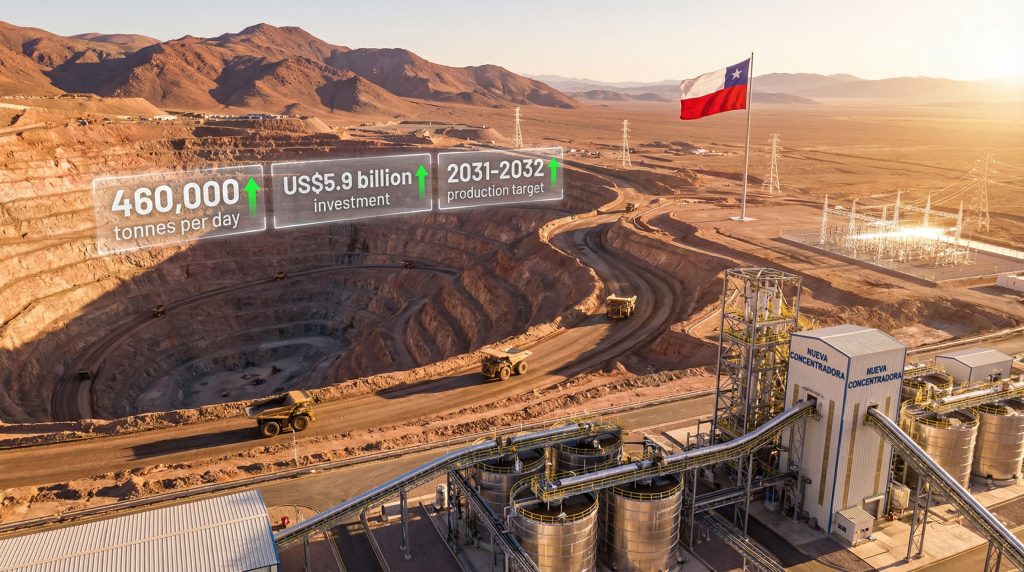
BHP's Nueva Concentradora Escondida project represents a massive infrastructure commitment valued between US$4.4 billion and US$5.9 billion, establishing itself among Chile's most substantial mining initiatives planned for the next decade. The BHP Escondida project SEIA submission demonstrates unprecedented investment scale that reflects the technical complexity required to maintain processing capacity at the world's largest copper operation while addressing fundamental geological challenges.
The financial commitment demonstrates BHP's confidence in Escondida's long-term viability despite structural changes affecting ore characteristics. Unlike expansion projects that seek to increase production capacity, this initiative focuses on capacity preservation through technological advancement, representing a sophisticated approach to mining asset management that aligns with modern copper investment strategies.
| Investment Component | Estimated Value | Strategic Purpose |
|---|---|---|
| Nueva Concentradora facility | US$3.5-4.5 billion | Processing infrastructure replacement |
| Electrical infrastructure | US$500-800 million | Power transmission and distribution |
| Mine development | US$400-700 million | Pit expansion enablement |
Positioning Within Chile's Mining Project Pipeline
The project's scale positions it as a cornerstone initiative within Chile's copper sector modernization efforts. While many Chilean copper operations pursue incremental improvements or life extension projects, Escondida's complete concentrator replacement represents a comprehensive operational transformation that could influence industry standards for infrastructure renewal.
Chile's copper industry faces similar challenges across multiple operations, including declining ore grades and aging processing facilities commissioned during the 1990s copper boom. Furthermore, Escondida's approach may establish precedents for how major producers address these sector-wide challenges through strategic infrastructure replacement rather than operational optimization.
Impact on Global Copper Supply Chain Stability
Escondida's annual copper production represents approximately 5-6% of global copper output, making its operational continuity critical for international supply chain stability. The Nueva Concentradora project addresses supply security concerns by ensuring processing capacity maintenance during a period when many global copper operations face production constraints.
Moreover, the project's completion timeline, targeting first production between 2031-2032, aligns with projected global copper demand increases driven by renewable energy infrastructure development and electric vehicle adoption. This timing suggests BHP's strategic positioning to maintain market share during anticipated supply tightening, particularly relevant for understanding the global copper supply forecast.
How Does the Nueva Concentradora Project Address Escondida's Operational Challenges?
Ore Grade Decline and Processing Complexity Analysis
Escondida faces structural challenges common to mature copper deposits, including declining copper grades and increasing mineral hardness that complicate traditional processing approaches. These geological changes require advanced processing technologies capable of maintaining copper recovery rates despite less favorable ore characteristics.
The existing Los Colorados concentrator, approaching the end of its operational lifespan, was designed for ore characteristics that no longer represent current mining conditions. However, modern concentrator technology can accommodate harder minerals through enhanced crushing systems, advanced flotation techniques, and improved metallurgical processes.
The transition from Los Colorados to Nueva Concentradora represents more than equipment replacement – it reflects adaptation to fundamental changes in deposit geology that require completely different processing approaches.
Infrastructure Aging and Replacement Timeline
Los Colorados concentrator has provided decades of service but now requires replacement due to equipment deterioration and technological obsolescence. Rather than pursuing incremental modernization, BHP selected comprehensive facility replacement to address multiple operational constraints simultaneously.
The replacement strategy enables spatial reconfiguration that supports pit expansion into areas currently occupied by existing processing infrastructure. Consequently, this approach maximizes resource recovery while establishing modern processing capabilities suited to current ore characteristics.
Capacity Maintenance vs. Expansion Strategy
The Nueva Concentradora will maintain processing capacity at approximately 460,000 tonnes per day of sulfurated mineral, representing strategic capacity preservation rather than expansion. This approach reflects market conditions where maintaining existing production levels requires substantial capital investment due to declining ore quality.
| Current Configuration | Proposed Configuration | Operational Impact |
|---|---|---|
| Los Colorados Plant | Nueva Concentradora | Complete technology upgrade |
| 460 ktpd capacity | 460 ktpd maintained | Zero capacity loss during transition |
| Declining efficiency | Enhanced recovery rates | Improved operational performance |
| Limited ore flexibility | Advanced processing capability | Accommodation of harder minerals |
What Are the Technical Specifications and Engineering Requirements?
Processing Capacity and Throughput Metrics
The Nueva Concentradora will process 50-57.5 million tonnes annually while maintaining daily throughput capacity at 460,000 tonnes. This specification reflects engineering optimization for sulfurated mineral processing, which requires different technical approaches compared to oxidized copper ore treatment.
Technical considerations include:
- Enhanced crushing systems for harder mineral processing
- Advanced flotation technology for improved copper recovery
- Automated process control for operational efficiency
- Tailings management integration with existing facilities
Electrical Infrastructure and Power Distribution
The project requires substantial electrical infrastructure development, including a 25.7-kilometre double-circuit transmission line connecting to Chile's national power grid. This infrastructure supports projected power consumption of approximately 45-55 megawatts for continuous concentrator operation.
Electrical specifications include:
- New substation construction with modern switching and protection systems
- Internal distribution networks connecting processing equipment
- Backup power systems ensuring operational continuity
- Integration with existing power infrastructure at Escondida
Mining Operations Scaling and Material Movement
Critical operational adjustment involves scaling mine material movement from 547 million tonnes annually to potentially 669 million tonnes including rehandling operations, representing a 22% increase in mining intensity.
This expansion enables access to previously inaccessible ore zones while accommodating the spatial reconfiguration required for Nueva Concentradora construction. In addition, the increased movement includes:
- Waste rock removal from new mining areas
- Ore extraction from expanded pit boundaries
- Material rehandling during infrastructure transition
- Overburden management for facility construction
How Does This Project Compare to Other Major Chilean Mining SEIA Submissions?
Investment Scale Benchmarking
The US$5.9 billion investment scale positions the Nueva Concentradora among Chile's largest mining projects of the past decade. For comparison, major Chilean copper projects typically range from US$1-3 billion, making BHP's investment substantially larger than sector norms.
Recent comparable projects include:
- Codelco's Chuquicamata Underground: US$5.5 billion
- Antofagasta's Twin Metals expansion: US$2.8 billion
- Freeport's El Abra modernization: US$1.9 billion
Environmental Assessment Complexity
Large-scale mining infrastructure projects in Chile typically require 18-24 months for SEIA approval, depending on environmental sensitivity and community consultation requirements. Furthermore, the Nueva Concentradora's complexity may extend review periods due to its comprehensive scope and regional significance.
The BHP Escondida project SEIA submission reflects modern regulatory requirements that emphasise environmental protection and BHP's environmental framework implementation.
Regional Economic Impact Projections
| Construction Phase | Average Workers | Peak Employment | Economic Multiplier |
|---|---|---|---|
| Phase 1 (2027-2029) | 2,500 | 4,500 | 1.8x indirect jobs |
| Phase 2 (2029-2031) | 3,500 | 6,000 | 2.1x indirect jobs |
| Total Project | 3,000 average | 6,000 peak | 41-month duration |
The construction workforce will generate substantial regional economic impacts through service demand, accommodation requirements, and local supplier opportunities throughout the Antofagasta Region.
What Are the Environmental and Regulatory Considerations?
SEIA Process Timeline and Approval Pathway
BHP submitted the Nueva Concentradora project to Chile's Environmental Impact Assessment System on March 16, 2026, initiating a comprehensive regulatory review process. The SEIA evaluation typically involves multiple technical review rounds, public consultation periods, and potential modifications based on regulatory feedback.
Key regulatory milestones include:
- Technical adequacy review (3-4 months)
- Public consultation period (60 days minimum)
- Indigenous community engagement (ongoing requirement)
- Environmental agency evaluation (6-12 months)
- Final approval determination (varies by complexity)
Water Management and Sustainability Protocols
Copper processing requires substantial freshwater consumption, typically 2-4 tonnes per tonne of mineral processed. The Nueva Concentradora must demonstrate sustainable water sourcing and management practices that comply with Chile's increasingly stringent water regulations.
Furthermore, the project incorporates trolley assist technology to reduce emissions from mining operations, demonstrating BHP's commitment to environmental stewardship.
Community Impact and Stakeholder Engagement
The project's scale necessitates extensive community consultation with local populations, indigenous groups, and regional stakeholders. Construction activity will significantly impact regional infrastructure, housing availability, and public services during the 41-month construction period.
The next major ASX story will hit our subscribers first
How Does This Investment Align with BHP's Long-term Strategy?
Asset Life Extension vs. New Development
BHP's decision to invest US$5.9 billion in infrastructure replacement rather than new mine development reflects strategic asset management principles. Escondida's proven reserves, established infrastructure, and operational expertise provide lower execution risk compared to greenfield developments.
The investment extends Escondida's operational life while maintaining its position as BHP's largest copper-producing asset. Consequently, this approach aligns with industry trends toward maximising returns from existing operations rather than pursuing higher-risk expansion projects.
Technology Integration and Operational Efficiency
The Nueva Concentradora incorporates advanced processing technologies that enhance operational efficiency through:
- Automated process control systems reducing labour requirements
- Energy-efficient equipment lowering operational costs
- Enhanced metallurgical recovery improving copper yields
- Predictive maintenance capabilities reducing downtime
These improvements align with broader mining technology advancements transforming the industry.
Market Position Maintenance in Declining Grade Environment
BHP's investment strategy acknowledges that maintaining market leadership in copper production requires continuous technological advancement as ore grades decline industry-wide. The Nueva Concentradora positions Escondida to maintain competitive cost structures despite challenging geological conditions.
What Are the Economic Implications for Chile's Mining Sector?
Regional Supplier and Contractor Ecosystem Impact
The project will create substantial opportunities for Chilean engineering, construction, and mining service companies during the construction phase. Local supplier development initiatives may provide long-term benefits extending beyond project completion.
Regional economic benefits include:
- Engineering services for detailed design and construction support
- Construction contractors for civil, structural, and mechanical work
- Equipment suppliers for processing and auxiliary systems
- Logistics providers for material transportation and warehousing
Employment Generation During Construction Phase
Peak construction employment of 6,000 workers will significantly impact regional labour markets, potentially requiring worker recruitment from other Chilean regions or international sources. The 41-month construction timeline provides sustained employment opportunities supporting regional economic development.
Tax Revenue and Royalty Projections
The investment will generate substantial tax revenue for Chile through construction-related taxes, equipment import duties, and ongoing operational taxes once production begins. Moreover, enhanced operational efficiency may also increase royalty payments based on improved copper recovery rates.
What Risks and Challenges Could Affect Project Implementation?
Environmental Approval Timeline Uncertainties
Large-scale mining projects face increasing regulatory scrutiny in Chile, potentially extending SEIA approval timelines beyond projected schedules. Community opposition, environmental concerns, or technical deficiencies could delay approvals and impact the targeted 2027 construction start.
The BHP Escondida project SEIA review process will require comprehensive stakeholder engagement and environmental impact mitigation strategies to secure timely approval.
Construction Cost Inflation and Supply Chain Factors
The US$1.5 billion variance in project cost estimates (US$4.4-5.9 billion) reflects uncertainty regarding construction costs, equipment pricing, and supply chain availability. Global supply chain disruptions could impact specialised mining equipment delivery schedules.
Operational Transition Management
Transitioning from Los Colorados to Nueva Concentradora while maintaining production continuity presents complex operational challenges. However, coordination between facility construction, equipment commissioning, and production ramp-up requires sophisticated project management capabilities.
How Will This Project Impact Global Copper Market Dynamics?
Supply Security for Major Consuming Markets
Escondida's production maintenance supports supply security for key copper-consuming markets, particularly China, which relies on Chilean copper exports for industrial manufacturing. Project completion ensures continued production during anticipated global supply constraints.
Price Stability Through Capacity Maintenance
The Nueva Concentradora prevents potential production declines that could affect global copper pricing, particularly during periods of tight supply-demand balances. Maintaining Escondida's output provides market stability during the energy transition period when copper demand growth accelerates, directly influencing copper price drivers in global markets.
Competitive Positioning Against Emerging Copper Projects
BHP's investment maintains Escondida's competitive position against emerging copper projects in Peru, the Democratic Republic of Congo, and other jurisdictions. The technological advancement achieved through Nueva Concentradora may provide cost advantages over higher-cost copper producers.
Furthermore, this investment also supports broader copper-uranium investment trends as mining companies diversify their portfolios across critical minerals.
Disclaimer: This analysis is based on publicly available information and should not be considered investment advice. Mining project development involves significant technical, regulatory, and market risks that could affect outcomes. Readers should conduct independent research and consult qualified professionals before making investment decisions related to BHP or copper market investments.
Ready to Invest in the Next Major Mineral Discovery?
Discovery Alert instantly alerts investors to significant ASX mineral discoveries using its proprietary Discovery IQ model, turning complex mineral data into actionable insights just like how BHP's strategic infrastructure investments demonstrate the critical importance of staying ahead in mineral markets. Understand why historic discoveries can generate substantial returns by visiting Discovery Alert's dedicated discoveries page, showcasing exceptional outcomes, and begin your 14-day free trial today to position yourself ahead of the market.