May 18, 2026
The Structural Forces Reshaping Global Copper Markets
Industrial electrification represents one of the most significant structural transformations occurring across global manufacturing and infrastructure systems today. This transition extends far beyond simple equipment upgrades, fundamentally altering the material requirements of entire economic sectors. The convergence of artificial intelligence infrastructure expansion, renewable energy deployment, and electric mobility adoption creates unprecedented demand patterns that traditional supply planning models struggle to accommodate.
Mining industry analysts increasingly recognise that conventional commodity forecasting approaches may underestimate the scale of this transformation. The copper market, in particular, faces a unique combination of accelerating demand growth and constrained supply expansion capabilities that could reshape pricing dynamics for years to come.
When big ASX news breaks, our subscribers know first
Critical Infrastructure Demands Driving Market Tension
The artificial intelligence revolution has introduced entirely new categories of copper consumption that did not exist in traditional forecasting models. Data center infrastructure requires significantly higher copper content than conventional computing facilities, with AI processing systems demanding 4-6 times more copper per unit of capacity compared to traditional IT infrastructure. This exponential increase in copper intensity occurs precisely as global data center capacity expansion accelerates to support machine learning and artificial intelligence applications.
Electric vehicle adoption patterns further compound these demand pressures. Current generation electric vehicles require approximately 83 kilograms of copper compared to just 23 kilograms in internal combustion engine vehicles, representing a nearly fourfold increase in copper content per vehicle. As electric vehicle production scales from niche market segments toward mass market penetration, this copper intensity differential creates substantial new demand streams.
Renewable energy infrastructure presents additional copper requirements that traditional energy generation systems never demanded. Wind turbine installations typically require 3-5 tonnes of copper per megawatt of capacity, while solar installations demand 2-4 tonnes per megawatt. With renewable energy comprising over 90% of new electrical generating capacity additions globally, these copper-intensive technologies are rapidly displacing less copper-intensive conventional generation methods.
The grid modernisation requirements necessary to support renewable energy integration create exponential copper demands for transmission infrastructure. Unlike traditional centralised power generation, renewable energy systems require extensive transmission networks to connect distributed generation sources with consumption centers, dramatically increasing copper requirements for electrical grid infrastructure.
Supply-Side Constraints Creating Long-Term Imbalances
Mining industry development cycles create inherent supply response limitations that prevent rapid capacity increases even when commodity prices signal strong demand. Mine development projects typically require 7-15 years from initial exploration through commercial production, making supply responses extremely slow compared to demand acceleration patterns.
Current copper pricing reached US$12,998 per tonne as of January 2026, representing a 43% increase from the US$9,094 per tonne level recorded just twelve months earlier. This price appreciation reflects market recognition of the emerging supply-demand imbalance, yet even these elevated price levels may not incentivise sufficient new supply development to meet projected demand growth.
Furthermore, these supply pressures are influenced by global copper supply forecast trends that indicate sustained constraints. Morgan Stanley's analysis suggests that 2026 will witness the copper market's worst deficit in more than two decades, indicating that supply constraints have reached critical levels. Additionally, US-China copper dynamics continue to shape market conditions as trade tensions affect global supply chains.
S&P Global projects that global copper demand will expand from 28 million tonnes in 2025 to 42 million tonnes by 2040, representing a 50% increase over the fifteen-year period that translates to approximately 2.7% compound annual growth.
Processing capacity limitations create additional supply bottlenecks independent of raw material availability. The concentration of copper refining capacity in specific geographic regions introduces supply chain vulnerabilities that extend beyond simple mining output considerations. For instance, strategic partnerships like the Codelco Adani partnership highlight the importance of securing reliable processing capabilities across different regions.
Key Supply Constraint Factors:
• Mine Development Timeline: 7-15 year lead times constraining new supply additions
• Geographic Concentration: Processing bottlenecks in specific regions creating vulnerability
• Environmental Compliance: Rising operational expenses affecting marginal producers
• Capital Intensity: Major capital requirements for new mining project development
• Geological Risk: Decreasing ore grades requiring larger-scale operations for economic viability
ASX 200 Copper Producer Positioning for Market Opportunities
Australian copper producers listed within the ASX 200 index possess several structural advantages that position them favourably within the evolving copper market dynamics. The regulatory stability of Australian mining operations provides operational certainty that many international competitors cannot offer, particularly as geopolitical tensions affect global supply chain planning.
BHP Group represents the largest Australian copper exposure, with record copper production reaching 2,017 kilotonnes in FY2025, demonstrating 28% higher production than FY2022 levels. This production increase occurred over three consecutive years, indicating consistent operational improvements rather than temporary production spikes. Copper's contribution to BHP's total Underlying EBITDA increased to 45% in FY2025, up dramatically from 29% in FY2024, with total copper EBITDA reaching US$12.3 billion and reflecting a 44% annual increase.
The company's FY2026 copper production guidance of 1,800 to 2,000 kilotonnes on a consolidated basis suggests sustained high-level production capabilities. BHP's Escondida operation achieved record concentrator throughput during recent quarterly reporting periods, with 4% increased copper production demonstrating operational optimisation potential even from mature assets.
Sandfire Resources offers more concentrated copper exposure, positioning shareholders for maximum leverage to copper price movements. The company's share price performance of 99.9% over the twelve months ending January 2026 reflects market recognition of its pure-play copper strategy. This performance significantly outpaced broader market returns, with the ASX 200 benchmark gaining just 7.0% over the same period.
Capstone Copper provides mid-tier exposure with 50.6% share price appreciation over twelve months, indicating investor confidence in the company's strategic positioning and operational capabilities. The diversified operational base across multiple jurisdictions provides geographic risk mitigation while maintaining focused copper exposure.
Comparative ASX 200 Performance Analysis:
| Company | 12-Month Return | Dividend Yield | Market Position |
|---|---|---|---|
| Sandfire Resources | +99.9% | Variable | Pure-play specialist |
| Capstone Copper | +50.6% | Variable | Mid-tier diversified |
| BHP Group | +18.4% | 3.7% fully franked | Diversified major |
| ASX 200 Benchmark | +7.0% | Mixed | Broad market index |
Fundamental Market Analysis and Price Trajectory Modelling
Traditional commodity forecasting methodologies face significant challenges when analysing copper markets due to the unprecedented nature of current demand drivers. The artificial intelligence revolution, which began in November 2022 according to S&P Global analysis, represents entirely new demand entering the copper system that previously did not exist. This structural demand shift differs fundamentally from cyclical demand variations that historical models typically accommodate.
Electric vehicle copper intensity creates exponential demand growth patterns rather than linear increases. Current electric vehicles require 2.9 times more copper than conventional vehicles, but this ratio may increase as battery technology advances and vehicle electrification becomes more comprehensive. The transition from early adoption to mass market penetration phases could create demand acceleration that exceeds current projections.
Consequently, investors seeking to capitalise on these trends should consider copper investment strategies that account for both immediate opportunities and long-term structural changes. Moreover, copper-uranium investment opportunities in Australia and Canada present additional diversification options for resource-focused portfolios.
Renewable energy infrastructure requirements compound these demand pressures through multiple channels simultaneously. Solar and wind generation systems require significantly higher copper content than conventional power plants, while the transmission infrastructure necessary to support distributed renewable generation creates additional copper demands that did not exist under centralised fossil fuel generation systems.
Supply-Demand Scenario Modelling:
Conservative Scenario (150-250 kt deficit):
• Moderate demand growth from current sectors
• Some new mine development coming online
• Steady margin expansion for efficient producers
• Price support in the US$4.50-5.50 per pound range
Base Case Scenario (300-400 kt deficit):
• Accelerated AI and EV adoption rates
• Limited new supply development
• Significant earnings growth for established producers
• Sustained pricing in elevated ranges
Bullish Scenario (500+ kt deficit):
• Maximum electrification and AI infrastructure deployment
• Constrained supply due to development delays
• Exceptional returns for well-positioned companies
• Price levels potentially reaching US$6.00+ per pound
Investment Framework and Risk Assessment
Copper equity valuation requires specialised analytical frameworks that differ from traditional mining investment approaches. The structural nature of current demand growth suggests that conventional cyclical analysis methods may underestimate long-term price support levels and earnings sustainability for copper producers.
Operational leverage analysis becomes particularly important when evaluating copper mining investments. Companies with existing production capacity can immediately capitalise on price improvements without the capital expenditure and development timeline requirements that constrain new market entrants. This operational leverage advantage becomes more pronounced during periods of supply constraint and elevated pricing.
Cost curve positioning represents a critical valuation factor, as companies operating in the lower portions of the global cost curve maintain profitability even during commodity price downturns while benefiting disproportionately during price appreciation periods. Australian copper producers generally benefit from stable regulatory environments and established infrastructure that support lower operational costs compared to many international competitors.
Geographic diversification provides risk mitigation while maintaining focused copper exposure. Companies operating across multiple jurisdictions reduce regulatory and operational risks while preserving the ability to capitalise on copper price appreciation.
Risk Assessment Matrix:
| Risk Factor | Probability | Impact Level | Mitigation Approaches |
|---|---|---|---|
| Copper price volatility | High | High | Diversified exposure, operational flexibility |
| Geopolitical supply disruption | Medium | High | Australian jurisdiction stability |
| Demand growth slowdown | Low | Medium | Multiple demand drivers, structural trends |
| New supply development | Medium | Medium | Long development timelines provide protection |
| Currency fluctuation | Medium | Medium | Natural USD revenue hedging |
The next major ASX story will hit our subscribers first
Technological and Geological Considerations
Modern copper mining operations face increasingly complex geological challenges as higher-grade, easily accessible ore bodies become depleted. Ore grade degradation requires larger-scale operations and more sophisticated processing technologies to maintain economic viability, increasing capital requirements and operational complexity for new mine development.
Processing recovery rates vary significantly between operations and ore types, creating competitive advantages for companies with superior metallurgical capabilities. Advanced processing technologies can extract higher percentages of copper from ore bodies that less sophisticated operations cannot economically process.
Reserve replacement ratios indicate long-term sustainability of existing operations. Companies demonstrating consistent ability to replace depleted reserves through exploration and acquisition maintain production capacity over extended periods, providing stability during market volatility.
Environmental compliance requirements continue increasing operational costs across the mining sector, particularly affecting marginal producers operating older facilities. Companies with modern operations and comprehensive environmental management systems maintain competitive advantages through lower compliance costs and reduced regulatory risks.
Market Psychology and Investment Timing Considerations
Commodity markets demonstrate cyclical psychological patterns that can create investment opportunities independent of fundamental supply-demand factors. Current copper market dynamics suggest that investor recognition of structural demand growth may lag behind actual market developments, potentially creating valuation opportunities in well-positioned copper producers.
Institutional investor behaviour increasingly emphasises environmental, social, and governance criteria, which may favour Australian copper producers operating under stable regulatory frameworks with established environmental compliance records. This preference could provide valuation premiums compared to producers operating in jurisdictions with less stringent regulatory oversight.
Resource sector rotation patterns within equity markets can create temporary mispricings as investors move between different commodity exposures based on short-term price movements rather than long-term fundamental analysis. Understanding these rotation patterns can inform optimal investment timing decisions.
The correlation between copper prices and broader equity market performance has weakened as copper demand increasingly derives from structural technological transitions rather than general economic activity. This correlation breakdown suggests that copper equities may provide portfolio diversification benefits during broader market volatility periods.
Strategic Portfolio Construction Approaches
Direct copper equity exposure through ASX 200 listed companies provides several advantages over alternative copper investment approaches. Share liquidity on major exchanges enables position management flexibility that physical commodity investments or smaller mining companies cannot offer.
Diversification within copper exposure can be achieved through combining large-cap diversified miners like BHP with pure-play specialists such as Sandfire Resources. This approach provides stability from diversified operations while maintaining maximum leverage to copper price appreciation through focused exposure.
Position sizing considerations should reflect the inherent volatility of commodity-focused investments while recognising the structural nature of current copper demand growth. Conservative position sizing allows investors to benefit from potential outperformance while managing downside risks during commodity price volatility.
Time horizon alignment becomes crucial when investing in commodity-related equities. The structural nature of current copper demand suggests that longer investment time horizons may be more appropriate than trading approaches focused on short-term price movements.
Long-Term Outlook and Emerging Market Dynamics
The convergence of multiple electrification trends creates copper demand growth patterns that extend far beyond traditional economic cycles. Urbanisation continuation in emerging markets will drive infrastructure copper requirements, while technology evolution creates entirely new applications that did not exist in historical demand forecasts.
Recycling economics present both opportunities and limitations for copper supply growth. While secondary copper supply can supplement mine production, the long service life of copper applications means that recycling supply growth rates remain constrained by the installed base of copper-containing products from previous decades.
Substitution threats from alternative materials remain limited for most copper applications due to the metal's unique combination of electrical conductivity, thermal properties, and workability. Research into copper alternatives continues, but large-scale substitution appears unlikely for primary electrical and electronic applications.
The strategic metal designation of copper by various national governments indicates recognition of the material's critical importance to technological and economic security. This recognition may drive government stockpiling programmes and supply chain diversification initiatives that support long-term demand growth.
However, as highlighted by industry analysts, copper stocks continue to demonstrate significant momentum, particularly as investors recognise the structural nature of current market conditions. Furthermore, 2026 is emerging as copper's potential breakout year according to market forecasters who emphasise the convergence of supply constraints with accelerating demand growth.
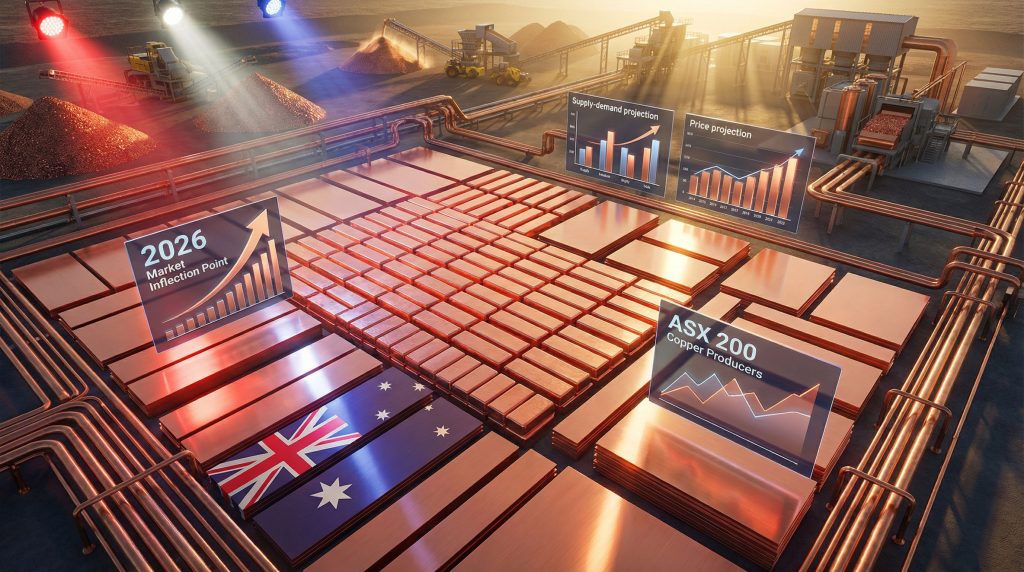
Investment Positioning for the 2026 Market Inflection
The combination of accelerating structural demand growth, constrained supply development capabilities, and advantageous positioning of ASX 200 copper producers creates potentially favourable investment conditions for the 2026 timeframe. Why ASX 200 copper stocks could be in the sweet spot in 2026 relates to this convergence of factors that may not persist indefinitely as markets eventually develop supply responses to elevated pricing levels.
Companies with established operations, strong balance sheets, and strategic asset positions appear well-positioned to capitalise on this market inflection point. The operational leverage provided by existing production capacity, combined with the financial flexibility to navigate commodity price volatility while maintaining shareholder returns, creates competitive advantages during periods of supply constraint and elevated pricing.
Success factors include maintaining operational efficiency during capacity utilisation increases, managing capital allocation between growth investment and shareholder returns, and preserving financial flexibility for potential acquisition opportunities that may emerge during market volatility periods.
Why ASX 200 copper stocks could be in the sweet spot in 2026 becomes particularly evident when considering the timeline misalignment between rapidly accelerating demand and the lengthy development cycles required for new supply additions. This structural imbalance suggests that existing producers may enjoy extended periods of favourable market conditions.
Disclaimer: This analysis is based on current market conditions and publicly available information. Commodity markets involve significant risks, and past performance does not guarantee future results. Investors should consider their individual financial circumstances and risk tolerance before making investment decisions. All projections and scenarios represent potential outcomes based on current information and may not reflect actual future market conditions.
Ready to Capitalise on the Next Major Copper Discovery?
Discovery Alert instantly identifies significant ASX mineral discoveries using its proprietary Discovery IQ model, transforming complex copper market data into actionable investment insights. Explore Discovery Alert's dedicated discoveries page to understand how historic discoveries have generated substantial returns, then begin your 30-day free trial to position yourself ahead of this accelerating copper market transformation.