
August 24, 2026
Strategic Implications of Global Copper Market Dynamics
The industrial metals sector faces unprecedented transformation as traditional supply patterns encounter geological constraints, investment uncertainties, and evolving technological demands. Within this complex environment, established copper-producing regions must navigate declining ore grades, infrastructure limitations, and capital allocation challenges that fundamentally reshape long-term production trajectories. These systemic pressures create ripple effects throughout global supply chains, influencing pricing mechanisms, competitive positioning, and strategic resource planning across multiple industries.
Understanding these market dynamics requires examining how geological realities intersect with investment cycles, technological innovation, and regulatory frameworks. The interplay between these factors determines not only production outcomes but also the broader strategic positioning of nations within the global copper supply forecast.
When big ASX news breaks, our subscribers know first
Global Supply Chain Recalibration in Copper Markets
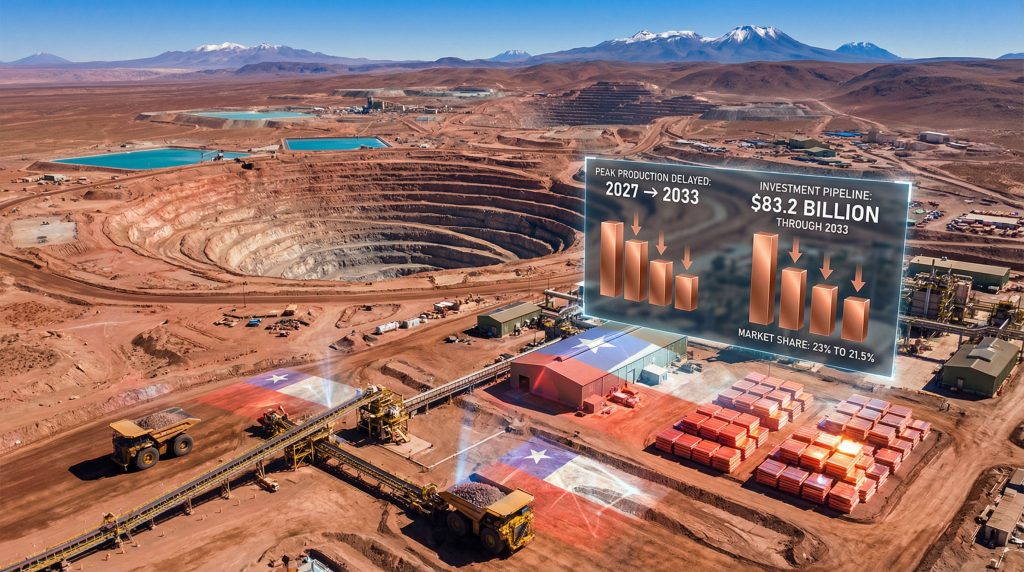
Chile copper production forecasts have undergone substantial revision, with Cochilco projecting the nation's output will peak at 6.06 million metric tons in 2033, representing a significant timeline extension from the previously anticipated 2027 peak of 6.07 million tons. This six-year delay fundamentally alters global copper supply expectations and creates strategic opportunities for alternative producers worldwide.
The revised production ceiling of 5.86 million metric tons by 2034 reflects conservative assessment of operational capabilities amid challenging geological conditions. Annual production forecasts have been systematically reduced across the 2026-2031 period, with recovery anticipated only in the final three years of the projection horizon.
Market Share Dynamics and Competitive Positioning
Chile's global market share trajectory reveals the strategic implications of these production revisions. The country's copper market dominance is projected to decline from 23% in 2027 to 21.5% in 2030, before potentially recovering to 27% by 2034, contingent upon successful investment implementation.
This 1.5 percentage point decline over three years creates substantial market opportunities for competing producers, particularly Peru, the Democratic Republic of Congo, Australia & Canada copper investments, and Indonesia. The temporary reduction in Chilean output enables these jurisdictions to capture increased market share and establish stronger positions within global supply chains.
According to recent industry analysis, the conditional nature of Chile's market share recovery underscores execution risks inherent in large-scale mining investment projects. Dependencies on financing availability, regulatory approvals, and technological implementation create uncertainty around the projected 27% market share target for 2034.
Geological Constraints and Technical Production Challenges
Ore grade deterioration represents the fundamental challenge driving Chile copper production forecasts revisions. Declining mineral quality across major mining districts necessitates increased processing volumes to maintain equivalent copper output, elevating operational costs and reducing extraction efficiency.
Infrastructure Limitations Affecting Operational Efficiency
Aging mining infrastructure compounds the challenges posed by declining ore grades. Processing facilities, transportation networks, and extraction equipment require substantial modernisation investments to maintain productivity levels amid challenging geological conditions.
The intersection of infrastructure constraints with ore quality decline creates compounding effects on operational economics. Lower-grade ores require more intensive processing, straining existing infrastructure capacity and necessitating capital investment in facility upgrades.
Mining Plan Recalibrations Across Operations
Chilean copper producers have implemented comprehensive mining plan revisions to address geological realities and operational constraints. These recalibrations reflect updated assessments of extraction costs, processing requirements, and production timelines based on current ore grade trajectories.
The systematic nature of these revisions across multiple operations indicates industry-wide recognition of changed geological conditions. Mine planning adjustments incorporate technological solutions, operational efficiency improvements, and investment requirements necessary to maintain competitive production costs.
Investment Pipeline Analysis and Capital Deployment Strategies
Investment execution represents the critical variable determining Chile's copper production recovery trajectory. The success of capital deployment across brownfield expansions, new project development, and infrastructure modernisation will determine whether production stabilisation occurs at current levels or achieves meaningful growth.
Brownfield Expansion Opportunities
Existing mining operations offer the most immediate opportunities for production enhancement through targeted expansion investments. Brownfield projects typically require lower capital commitments compared to greenfield developments whilst providing more predictable implementation timelines.
The technical advantages of brownfield expansion include:
• Existing infrastructure utilisation reducing capital requirements
• Established operational expertise accelerating project implementation
• Proven geological understanding minimising exploration risks
• Regulatory familiarity streamlining approval processes
• Community relationships facilitating social licence maintenance
Greenfield Development Challenges
New project development faces substantially higher implementation risks and capital requirements compared to brownfield expansion. Greenfield projects must establish complete infrastructure networks, navigate comprehensive regulatory approvals, and develop community relationships from initial stages.
Environmental compliance requirements add complexity and timeline uncertainty to greenfield developments. Water usage regulations, carbon emission targets, and waste management protocols increase operational complexity and capital requirements for new mining operations.
Technology Innovation Impact on Production Forecasts
Technological advancement represents a potential catalyst for production recovery, though implementation timelines and cost-benefit analyses remain uncertain. Automation systems, enhanced ore processing techniques, and digital monitoring capabilities offer pathways to operational efficiency improvements.
Automated Mining Systems and Cost Reduction
Autonomous equipment deployment can reduce operational costs through improved precision, reduced labour requirements, and enhanced safety performance. However, implementation requires substantial capital investment and technological expertise that may strain resources during periods of challenging operational economics.
The effectiveness of automated systems in addressing ore grade challenges depends on technological sophistication and integration with existing operations. Successful automation implementation requires comprehensive system redesign rather than incremental equipment upgrades.
Enhanced Ore Processing Technologies
Advanced processing techniques offer potential solutions for improving extraction efficiency from lower-grade ores. Technological innovations in mineral separation, chemical processing, and waste reduction can enhance yield rates and reduce environmental impact.
Digital transformation initiatives enable real-time monitoring, predictive maintenance, and data analytics that optimise operational performance. These technological capabilities can partially offset challenges posed by declining ore grades through improved operational efficiency.
Environmental and Social Licence Considerations
Environmental compliance requirements increasingly influence production forecasts and investment decisions. Water usage regulations in arid mining regions, carbon emission reduction targets, and comprehensive waste management protocols add operational complexity and capital requirements.
Community Relations and Indigenous Rights
Social licence considerations affect project timelines and investment requirements. Indigenous rights considerations, local employment requirements, and corporate social responsibility investments impact project economics and implementation schedules.
Community engagement processes require substantial time commitments and may influence project design decisions. Successful community relationships necessitate ongoing investment in local development initiatives and environmental stewardship programs.
The next major ASX story will hit our subscribers first
Market Scenario Analysis and Strategic Planning
Multiple scenario outcomes remain possible depending on investment execution, technological adoption, and regulatory environment evolution. Understanding these potential pathways enables strategic planning for market participants and supply chain stakeholders.
Optimistic Production Scenario
Successful implementation of planned investments combined with effective technology adoption could accelerate production recovery timelines. Bloomberg reports suggest regulatory streamlining and improved permitting efficiency would reduce project implementation risks and timeline uncertainty.
Key success factors include:
• Consistent capital availability throughout investment cycles
• Successful technology integration reducing operational costs
• Streamlined regulatory processes accelerating project approvals
• Community cooperation facilitating project implementation
• Favourable commodity price environments supporting investment returns
Conservative Production Scenario
Continued ore grade decline outpacing technological solutions could extend production challenges beyond current projections. Investment delays due to financing constraints or regulatory complications would further postpone recovery timelines.
Risk factors include:
• Accelerated geological deterioration exceeding current assessments
• Capital market volatility affecting project financing availability
• Environmental regulation expansion increasing compliance costs
• Community opposition creating project implementation delays
• Technology adoption challenges preventing efficiency improvements
Global Competition and Alternative Supplier Development
Chile's production constraints create strategic opportunities for competing copper producers to capture market share and establish stronger competitive positions. Alternative suppliers benefit from reduced Chilean output whilst developing their own production capabilities.
Strategic Positioning of Alternative Producers
Peru, the Democratic Republic of Congo, Australia, and Indonesia represent the primary beneficiaries of Chilean production constraints. These jurisdictions can leverage their competitive advantages to capture increased market share during Chile's production decline period.
Competitive advantages vary among alternative suppliers:
| Producer | Key Advantages | Strategic Focus |
|---|---|---|
| Peru | Geographic proximity, infrastructure | Brownfield expansion |
| DRC | High-grade reserves, low costs | New project development |
| Australia | Technical expertise, regulatory stability | Technology innovation |
| Indonesia | Integrated supply chains, government support | Infrastructure development |
Furthermore, emerging markets like Argentina's copper system present additional opportunities for diversification.
Supply Chain Diversification Strategies
Major copper consumers are implementing supply chain diversification strategies to reduce dependency on Chilean production. These approaches include developing relationships with alternative suppliers, investing in recycling capabilities, and establishing strategic reserve holdings.
Supply security considerations drive consumer preferences toward geographically diversified supplier portfolios. Political stability, environmental compliance, and operational reliability become increasingly important selection criteria for long-term supply agreements.
Investment Strategy Implications for Market Participants
Portfolio strategy considerations for copper market participants must incorporate production timeline delays, execution risks, and alternative supplier development. Understanding copper investment strategies requires balancing exposure to Chilean producers against opportunities in competing jurisdictions.
Risk Assessment Framework
Investment risk evaluation must consider production timeline delays affecting project valuations, regulatory environment changes impacting returns, and currency fluctuation risks in peso-denominated assets. These factors create complexity in valuation models and return projections.
Due diligence requirements extend beyond traditional financial analysis to encompass geological assessments, technological capabilities, and environmental compliance capabilities. Social licence evaluation becomes increasingly important for project success probability.
Portfolio Diversification Approaches
Diversification strategies should incorporate exposure across multiple copper-producing regions, technology companies developing mining innovations, and downstream processing capabilities. This approach reduces concentration risk whilst capturing opportunities across the copper value chain.
Investment timing considerations reflect the extended production recovery timeline. Near-term opportunities may favour alternative suppliers and technology companies, whilst longer-term positions in Chilean producers require patient capital and execution risk tolerance.
Policy Framework Impact on Production Recovery
Regulatory reform opportunities exist to accelerate Chile's copper production recovery through streamlined permitting processes, foreign investment incentives, and infrastructure development partnerships. Policy changes could materially impact production timeline projections.
Regulatory Environment Optimisation
Environmental permitting process improvements could reduce project implementation timelines and lower development costs. Standardised approval procedures and predictable regulatory frameworks would enhance investment attractiveness for international mining companies.
Foreign investment incentive programmes could accelerate capital deployment through tax advantages, infrastructure support, and regulatory facilitation. These policy tools enable government influence over investment timing and project selection.
International Cooperation Frameworks
Technology transfer agreements with mining industry leaders could accelerate innovation adoption and operational efficiency improvements. Joint venture structures with international partners would reduce investment risks whilst providing access to technical expertise.
Trade policy adjustments supporting mining exports could enhance project economics and investment returns. Bilateral agreements with major copper consumers could provide market access guarantees supporting long-term investment commitments.
Long-Term Strategic Implications for Global Copper Markets
The structural challenges facing Chilean copper production reflect broader industry trends affecting geological quality, environmental requirements, and capital intensity. These factors suggest fundamental changes in global copper market dynamics extending beyond Chile's specific circumstances.
In addition, gold-copper exploration insights reveal how integrated mineral strategies are becoming increasingly important for resource companies navigating complex market conditions.
Supply Security and Strategic Reserve Policies
Major copper consuming nations are reassessing supply security policies in response to production constraints among traditional suppliers. Strategic reserve accumulation and alternative supplier development become national security priorities.
The intersection of supply security concerns with environmental objectives creates complex policy frameworks. Governments must balance domestic mining development against environmental protection whilst ensuring adequate copper availability for economic activities.
Price Discovery and Market Volatility
Production timeline delays and execution uncertainties contribute to increased price volatility in copper futures markets. Market participants must incorporate higher uncertainty premiums into pricing models and risk management strategies.
Long-term price forecasting becomes more challenging given production timeline uncertainties and investment execution risks. Supply-demand modelling requires scenario-based approaches incorporating multiple possible outcomes for major producing regions.
The evolution of Chile copper production forecasts over the next decade will significantly influence global market dynamics, competitive positioning, and investment strategies. Understanding these implications enables more effective strategic planning for all market participants navigating this transforming industry landscape.
Could Chile's Copper Production Delays Create New Market Opportunities?
Discovery Alert's proprietary Discovery IQ model delivers real-time alerts on significant copper discoveries across the ASX, helping investors identify actionable opportunities as traditional producers face mounting challenges. With Chilean production timelines extending to 2033 and alternative suppliers gaining market share, explore Discovery Alert's dedicated discoveries page to understand how historic mineral finds have generated substantial returns, then begin your 30-day free trial to position yourself ahead of these evolving market dynamics.