August 3, 2026
When Rivers Fail, Continents Follow: Europe's Hydrological Crisis of 2026
Freshwater systems have always been the invisible infrastructure of industrial civilisation. Long before railways or highways, rivers moved goods, powered mills, cooled machinery, and sustained agriculture across entire continents. Europe's industrial geography was quite literally built around its river network, and for most of the 20th century, that network performed reliably enough that few questioned the assumption it would continue to do so. That assumption is now being stress-tested in ways that are exposing deep structural vulnerabilities across energy, manufacturing, logistics, and food production simultaneously.
Europe's key rivers drying up as extreme heat impact widens is not simply a weather story. It is a convergence of hydrological, industrial, and energy risks that is reshaping how policymakers, investors, and corporate strategists think about the continent's economic resilience. Furthermore, the implications extend well beyond Europe's borders, touching global supply chains and energy transition challenges that are being felt across the world.
When big ASX news breaks, our subscribers know first
The Hydrology Behind the Headlines: What Is Actually Happening
Understanding the current crisis requires grasping how river systems fail, not just that they do. The mechanism is more complex than the phrase "drought" suggests, and the layered nature of that complexity is part of why recovery is so difficult to achieve even when rainfall eventually returns.
Europe's major river systems depend on a combination of direct precipitation, snowmelt from alpine regions, and groundwater contributions from river basin soils. When high-pressure atmospheric blocking systems stall over Central and Western Europe, they deflect moisture-bearing weather systems away from the continent's core watersheds. That alone reduces river inflow. However, the situation compounds itself rapidly.
Soils that have already been depleted of moisture by weeks of heat and minimal rainfall behave differently to normally saturated soils. When limited rainfall does arrive, dry soils absorb it almost entirely before it can generate surface runoff capable of reaching river channels. The result is that even moderate rainfall events produce negligible recharge of river systems already operating below critical thresholds.
According to David Hannah, Professor of Hydrology at the University of Birmingham, climate change amplifies this dynamic by raising the baseline temperature environment, making every hot and dry period more efficient at stripping moisture from landscapes and suppressing river flows. The feedback loop between dry soils, elevated temperatures, and reduced runoff is not a temporary aberration but a structural feature of a warmer climate system.
Compounding this in the Rhine basin specifically is the decline of Alpine glacial and snowpack storage. Late-summer river flows in the upper Rhine have historically been sustained by meltwater from glaciers and residual snowpack. As both shrink under long-term warming trends, the late-summer buffer that once moderated low-water periods is progressively disappearing.
A Continent-Wide Water Deficit: The Rivers and the Numbers
The geographic scope of the 2026 low-water event is what distinguishes it from previous episodes. This is not a single river system underperforming. It is a continent-wide deficit affecting six major river systems across multiple countries.
| River | Region | Primary Impact | Notable Threshold |
|---|---|---|---|
| Rhine | Germany, Switzerland | Freight disruption, chemical supply chains | ~25 cm at Kaub gauge, approaching record low since 1880 |
| Danube | Romania, Slovakia, Hungary | Barge navigation, nuclear cooling impairment | Record lows across multiple stretches |
| Po | Italy | Agricultural irrigation failure, saltwater intrusion | Below historic seasonal lows |
| Loire | France | Extreme low flow, ecological stress | Among lowest recorded levels |
| Rhône | France | Nuclear cooling water temperature risk | Regulatory discharge thresholds under pressure |
| Garonne | France | Nuclear cooling constraints | Thermal discharge regulation active |
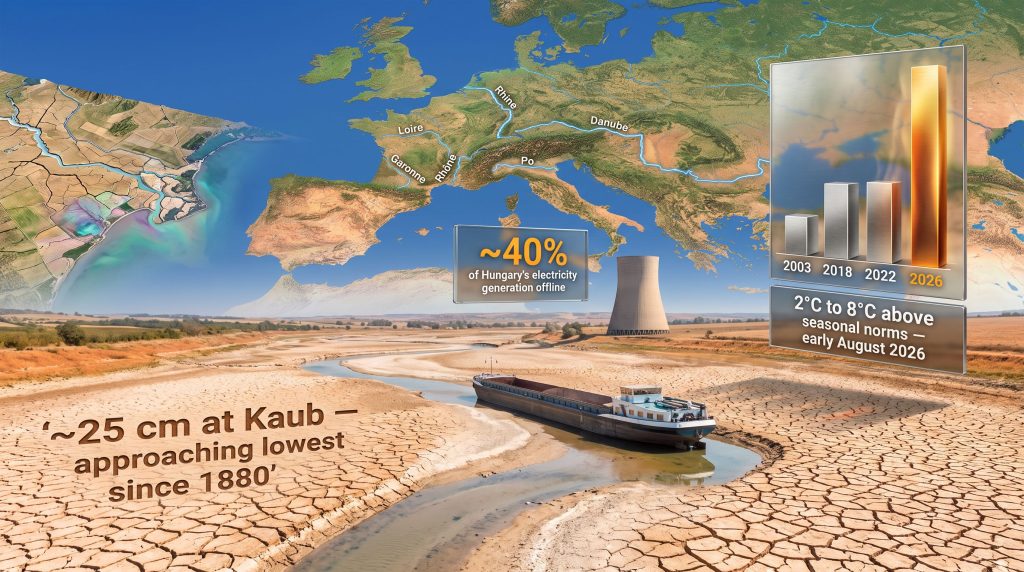
The Rhine at Kaub, a critical navigational chokepoint for freight heading to southern Germany and Switzerland, recorded a water level of approximately 25 centimetres in early August 2026. According to German federal data compiled by ETH Zurich, a drop to 24 centimetres would represent the lowest level since systematic measurement records began in 1880. The fourth consecutive heat wave of the European summer was pushing conditions in that direction.
The Danube, Europe's second-longest river, has seen multiple stretches in Romania and Slovakia fall to record lows. Italy's Po, the country's longest river and the irrigation backbone of its most productive agricultural region, continues to register flows well below historic norms. France's Loire and Rhône are experiencing conditions that simultaneously threaten ecological systems and nuclear power output.
Europe's Industrial Architecture: Why Rivers Are Not Optional Infrastructure
To appreciate the economic stakes, it helps to understand precisely why European industry became so dependent on river transport in the first place. Bulk commodities including chemicals, coal, petroleum products, construction materials, and agricultural inputs are extraordinarily expensive to move by road or rail relative to waterway transport. The Rhine's capacity to move massive cargo volumes at low cost per tonne was not a convenience — it was a foundational input to the cost structure of entire industries.
The Rhine stretches approximately 1,290 kilometres from the Swiss Alps to the North Sea and functions as Europe's busiest inland waterway. Germany's inland shipping sector still accounted for approximately 4.1% of total national freight transport in 2024, down from 4.7% in 2017. That decline reflects deliberate adaptation following the 2018 drought event, when major industrial operators began investing in alternative logistics. However, the absolute volume of freight still dependent on the waterway remains enormous.
When water levels fall, barges cannot carry full loads without risking grounding on the riverbed. Operators must reduce cargo per voyage, which cuts efficiency and drives up cost per tonne delivered. Some vessel classes face hard technical minimums below which they cannot operate at all. Roberto Spranzi, a board member of the German Inland Waterway Transport Cooperative representing around 90 vessels, has noted that some inland vessels face operational shutdown due to technical limitations at very low water levels, with high fuel costs compounding the pressure on operators already managing reduced cargo volumes.
The 2018 Benchmark and What Has Changed
The 2018 Rhine drought forced BASF, the world's largest chemical manufacturer, to curtail production at its flagship Ludwigshafen complex in Germany because historically low water levels restricted vessel access. Research from Saskia Meuchelböck at the Kiel Institute for the World Economy estimated that low Rhine water levels reduced German industrial production by as much as 1.5% in 2018 alone.
That event catalysed significant supply chain restructuring. BASF developed alternative transport options, acknowledging they carry higher costs. DB Cargo expanded dialogue with affected industrial customers. EnBW, which operates coal-fired power plants supplied via Rhine freight, adopted a strategy of pre-building fuel inventories during normal water-flow periods. Grosskraftwerk Mannheim developed contingency protocols including load reduction per vessel, deployment of shallower-draft barges, and partial switching to rail delivery.
The 2026 event is testing whether those investments are adequate against conditions that are tracking at similar or greater severity to 2018. The answer, based on current evidence, is that adaptation has reduced but not eliminated exposure.
Energy System Disruption: The Nuclear Cooling Crisis
Perhaps the least understood dimension of Europe's key rivers drying up is its impact on electricity generation. Nuclear and thermal power plants require enormous volumes of water for cooling operations. The water drawn from rivers absorbs heat generated during power production and is then returned to the river. When river levels fall, intake capacity is reduced. When ambient river water temperatures rise due to summer heat, the temperature of the returned discharge water rises correspondingly, creating a regulatory problem.
European environmental regulations restrict the temperature at which water can be discharged back into river systems to protect aquatic ecosystems and biodiversity. When ambient river temperatures are already elevated by summer heat, power stations have less thermal headroom before their discharge would breach regulatory limits. The result is mandatory output curtailment or complete shutdown. In addition, the pursuit of renewable energy solutions is becoming increasingly urgent as conventional energy infrastructure proves vulnerable to these climate-driven disruptions.
Country-Level Energy Impact in 2026
| Country | Facility | River | Status |
|---|---|---|---|
| Hungary | Sole nuclear plant (44 years old) | Danube | Full shutdown, first in plant history |
| Romania | Cernavoda Nuclear Power Plant | Danube | Alert status; second reactor at risk of shutdown |
| France | Multiple nuclear stations | Rhône, Garonne | Output curtailed during peak heat periods |
| Germany | Coal-fired power plants | Rhine | Fuel inventory management activated |
Hungary's situation is the most acute. The country's only nuclear facility, which has operated continuously for 44 years, was forced into a complete shutdown due to Danube water level constraints, stripping approximately 40% of Hungary's total electricity generation capacity from the national grid. The government responded with a series of emergency demand reduction measures including parliamentary schedule adjustments to reduce building energy consumption, the extinguishing of decorative and non-essential public lighting in Budapest, and voluntary consumption appeals directed at major industrial users including automotive manufacturers and battery production facilities.
Hungary also activated emergency power import protocols to cover the generation gap. The Danube water crisis has placed significant pressure on the newly installed government to demonstrate crisis management competence.
Romania placed its energy sector on a sustained alert through August 2026 as power production declined sharply. Romanian authorities are engaged in cross-border support discussions with Ukraine to cover peak demand hours, and a second reactor at the Cernavoda Nuclear Power Plant faces potential shutdown as Danube conditions worsen. Separately, demand overload from the heat crisis left several thousand residents of Szentendre, north of Budapest, without potable water, illustrating how infrastructure stress cascades from industrial to public health dimensions.
In France, the nuclear fleet, which forms the structural backbone of Western European electricity supply, has been forced to manage output during peak heat events. The Rhône and Garonne-dependent power stations face simultaneous pressure from reduced river levels and from regulatory thermal discharge constraints. Wildlife protection frameworks governing aquatic ecosystems further restrict operational flexibility. Consequently, pumped hydro in Europe is attracting renewed attention as a supplementary energy storage solution that is less dependent on stable river flow conditions.
Agricultural and Ecological Dimensions
The economic damage from Europe's key rivers drying up extends well beyond industrial freight and power generation. Italy's Po Valley, one of Europe's most agriculturally productive regions, depends heavily on Po River water for irrigation. With the river recording flows below historic seasonal lows, farmers face irrigation failure at critical crop development stages. Saltwater intrusion into the Po delta is degrading freshwater availability for both agricultural and domestic use in affected communities, a phenomenon that worsens as river flow weakens and tidal saltwater pushes further inland.
Reduced river flows across multiple systems are elevating water temperatures to levels that trigger harmful algal bloom events, reducing dissolved oxygen concentrations, and generating fish mortality events across several river systems. These ecological disruptions carry both immediate environmental costs and longer-term consequences for freshwater biodiversity that took decades to recover following previous industrial-era degradation.
Carsten Brzeski, an economist at ING Diba AG, has characterised the combined heat and drought conditions as a genuine new risk to growth, noting that declining rivers produce real economic pain that also encapsulates the broader challenges posed by climate change to European industrial competitiveness. Furthermore, the decarbonisation benefits that Europe has pursued are being complicated by the realisation that climate change is simultaneously undermining the infrastructure those strategies depend upon.
The next major ASX story will hit our subscribers first
The Long-Term Science: Frequency, Severity, and Structural Change
The scientific framing of events like the 2026 drought has shifted significantly over the past decade. Where climate scientists once described individual extreme events cautiously, attributing them to natural variability while acknowledging possible climate influence, attribution science has matured to the point where specific quantitative contributions from human-induced warming can be assessed.
Dominik Schumacher, a researcher in the Department of Environmental Systems Science at ETH Zurich, has confirmed that human-induced warming has already made the current drought materially more severe than it would have been under pre-industrial climate conditions, and that the same rainfall deficit in a further warmed world would produce an even worse drought outcome.
Key Scientific Mechanisms Driving River Decline
-
Rising baseline temperatures increase evapotranspiration rates across all vegetation and soil surfaces, reducing the proportion of any given rainfall that ultimately reaches river channels.
-
Shrinking Alpine glacier and snowpack reserves are progressively eliminating the late-summer meltwater buffer that historically sustained Rhine and upper Danube flows during dry periods.
-
Soil moisture deficit feedback loops cause desiccated soils to absorb rainfall almost entirely, preventing runoff generation that would recharge river basins.
-
Atmospheric blocking pattern intensification creates persistent high-pressure systems over Europe that stall for longer periods, extending drought duration beyond historical norms observed in 20th-century meteorological records.
Temperatures across continental Europe were forecast to remain between 2°C and 8°C above seasonal norms through early August 2026, according to analysis from Vaisala meteorologist Matthew Dross. Longer-range atmospheric modelling supported continued dominance of high-pressure blocking through the near term, suggesting the prospect of meaningful drought-breaking rainfall was unlikely before late autumn at the earliest.
Historical Comparison: An Accelerating Pattern
| Year | Primary Rivers | Notable Impact | Severity Marker |
|---|---|---|---|
| 2003 | Rhine, Danube, Po, Loire | Energy and freight disruption | Record European heat wave |
| 2018 | Rhine (primary) | ~1.5% German industrial output loss | Kaub gauge hit historic lows |
| 2022 | Rhine, Po, Loire, Danube | Multi-sector disruption, energy crisis amplification | Po at lowest level in 70 years |
| 2026 | Rhine, Danube, Po, Loire, Rhône, Garonne | Nuclear shutdowns, freight disruption, agricultural stress, public water loss | Rhine approaching lowest since 1880; Danube at record lows |
What this progression reveals is not a series of independent extreme events but a shortening recurrence interval between major low-water episodes. Events that were statistically expected once per generation in the 20th-century climate are now recurring within years of each other. Infrastructure, regulatory frameworks, and investment planning cycles that were calibrated to 20th-century hydrological norms are increasingly misaligned with the frequency at which disruptive conditions are now arriving. The role of critical minerals and energy security in building more resilient energy networks is, consequently, gaining greater strategic importance across European policy circles.
Adaptation: What Works, What Doesn't, and Where the Gaps Are
Post-2018 supply chain restructuring across German industry demonstrated that meaningful adaptation is possible. Chemical manufacturers developed multi-modal logistics protocols. Coal-fired energy operators adopted pre-positioning strategies for fuel inventories. Inland waterway operators explored shallower-draft vessel deployment.
However, adaptation has inherent limits that the 2026 event is clarifying. Alternative freight modes, primarily road and rail, are structurally more expensive than river transport. The competitive cost advantage that European manufacturers derived from low-cost waterway logistics cannot be fully replicated through alternative modes. Every percentage point of margin eroded by higher freight costs makes European manufacturers less competitive against Asian and North American rivals who do not face equivalent climate-driven logistics disruptions.
Energy infrastructure presents even harder adaptation constraints. Nuclear and thermal power stations cannot be physically relocated away from river cooling dependencies on any commercially or technically feasible timescale. Retrofitting alternative cooling systems to existing facilities requires multi-year capital programmes at individual sites. For a continent where nuclear power stations represent decades of sunk investment and remain central to decarbonisation strategies, cooling water vulnerability represents a structural risk that cannot be engineered away quickly.
The critical insight emerging from 2026 is that previous adaptation investments reduced fragility at the margins but did not restructure the fundamental dependency of European industrial and energy systems on stable river hydrology. Adaptation buys time; it does not buy immunity from a climate system that is changing faster than infrastructure investment cycles can respond.
Hungary's Environment Minister Laszlo Gajdos captured the urgency of the structural challenge in noting that without fundamental change in how the country and continent manage resources, conditions approaching desert-like characteristics could become a reality.
Key Data Summary
| Metric | Value |
|---|---|
| Rhine level at Kaub (peak low, 2026) | ~25 cm, approaching lowest since records began in 1880 |
| German industrial output loss (2018 benchmark) | Up to 1.5% |
| Germany inland shipping freight share (2024) | 4.1%, down from 4.7% in 2017 |
| Hungary nuclear capacity removed from grid | ~40% of national electricity generation |
| Temperature forecast deviation (early August 2026) | 2°C to 8°C above seasonal norms |
| Rivers critically affected | Rhine, Danube, Po, Loire, Rhône, Garonne |
| Countries with active energy alerts | Hungary, Romania, France, Germany |
Europe's key rivers drying up as extreme heat impact widens represents not a weather event with an end date but a diagnostic stress test of the degree to which European economic infrastructure remains exposed to hydrological conditions that climate science projects will become progressively more frequent and more severe. The continent's ability to sustain industrial output, energy security, food production, and public water supply under those conditions will depend not on seasonal rainfall recovery but on structural investment choices made over the decade ahead.
This article contains forward-looking analysis and references to forecast meteorological conditions. Readers should note that weather forecasts and economic impact projections involve inherent uncertainty and should not be treated as definitive outcomes. Historical data references are sourced from German federal hydrological records compiled by ETH Zurich and published research from the Kiel Institute for the World Economy.
Want to Capitalise on the Resource Opportunities Emerging From Europe's Energy Crisis?
As climate-driven disruptions reshape energy infrastructure and accelerate demand for critical minerals, Discovery Alert's proprietary Discovery IQ model delivers real-time alerts on significant ASX mineral discoveries, instantly empowering subscribers to identify actionable opportunities ahead of the broader market — explore Discovery Alert's discoveries page to understand how historic mineral discoveries have generated substantial returns, and begin your 14-day free trial today to position yourself ahead of the next major find.