August 3, 2026
The Clean Energy Transition Is Rewriting Africa's Investment Map
The global shift toward electric vehicles, renewable power grids, and battery storage systems has fundamentally altered which resources matter most in the 21st century. Lithium, copper, cobalt, graphite, and nickel have moved from industrial footnotes to the centrepieces of national resource strategies. Africa holds substantial reserves of nearly all of them. That geological reality has made the continent the focal point of an intensifying rivalry between two of Asia's largest economies, with Indian billionaires challenging China in Africa's critical minerals and telecom sector in ways that were unimaginable just a decade ago.
Understanding this competition requires looking beyond headlines and into the structural mechanics of how each country deploys capital, builds relationships, and extracts value across the continent. Furthermore, the critical minerals demand driving this competition is reshaping investment priorities across the globe.
When big ASX news breaks, our subscribers know first
China's Two-Decade Foundation: What India Is Competing Against
China did not arrive in Africa recently. Its strategic engagement with the continent has been building steadily for more than twenty years, primarily through state-owned enterprises, policy bank financing, and preferential trade arrangements that gave Beijing structural advantages no private investor could easily replicate.
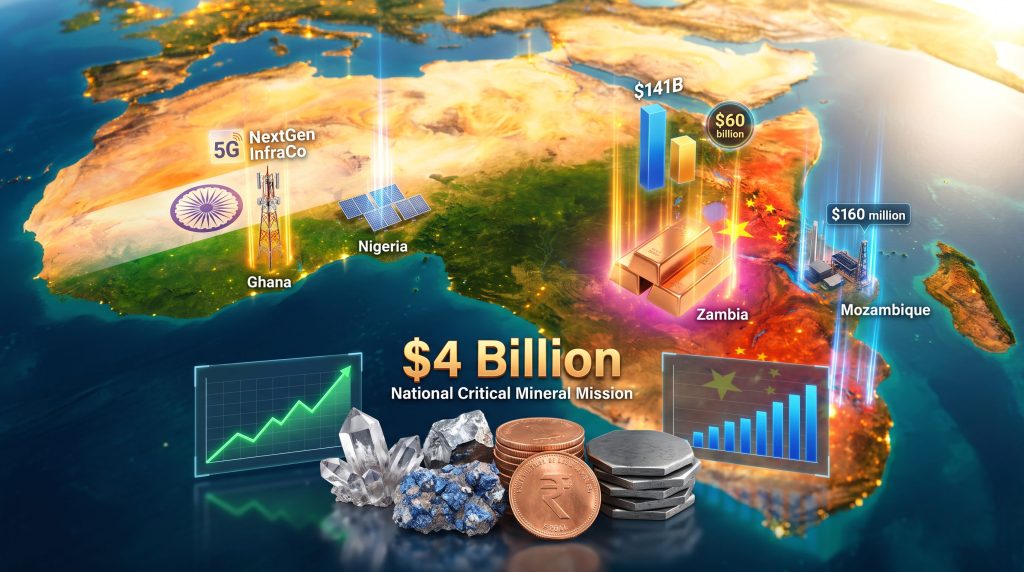
The scale of China's commercial footprint is striking. According to Forbes Africa, China recorded a $60 billion trade surplus with Africa in 2025, with exports reaching $141 billion against $81 billion in imports. China has maintained its position as Africa's largest trading partner for over fifteen consecutive years, a streak underpinned by one of its most effective policy tools: the zero-tariff framework.
China's zero-tariff policy now extends to 53 of Africa's 54 nations, covering virtually the entire continent. The sole exception is Eswatini, whose diplomatic ties with Taiwan place it outside this arrangement. This trade architecture gives Chinese goods a structural price advantage across nearly every African market.
The American Enterprise Institute's China Global Investment Tracker documents hundreds of billions of dollars in Chinese overseas project investment since 2005, with Africa receiving substantial allocations across mining, energy, transport, and physical infrastructure. Chinese state-backed entities such as CMOC Group now operate major copper and cobalt mines in the Democratic Republic of Congo, while multiple Chinese-linked firms have secured significant positions in Zimbabwe's rapidly developing lithium sector.
This is the entrenched position that Indian private capital is now attempting to contest. In addition, African mining finance trends suggest that foreign investment structures across the continent are becoming increasingly sophisticated.
How Indian Billionaires Are Building a Parallel African Presence
The Indian approach is structurally different from China's model in one critical way: it is overwhelmingly driven by private billionaire-led conglomerates rather than state direction. This distinction matters because it changes negotiating dynamics, risk profiles, and the types of deals that get done.
The Key Players and Their African Sectors
Several of India's most prominent business figures have established significant operational presences across the continent:
- Sunil Bharti Mittal leads Airtel Africa, one of the continent's largest telecommunications networks, spanning more than 14 countries and serving tens of millions of mobile and digital financial services subscribers. In June 2026, Bharti completed a $2.9 billion share swap that lifted its effective ownership in Airtel Africa to approximately 79%, cementing its control over one of Africa's most strategically important connectivity platforms.
- Mukesh Ambani's Reliance group, through its Radisys subsidiary, has entered Africa via Ghana-based NextGen InfraCo, supplying 5G infrastructure, applications, and affordable smartphones. This positions Reliance not merely as a connectivity provider but as a builder of full-stack digital ecosystems across the continent.
- Anil Agarwal's Vedanta Resources holds one of India's most significant mineral positions in Africa through Konkola Copper Mines in Zambia, one of the continent's largest copper producers. This asset connects directly to global battery and electrical infrastructure supply chains.
- Lakshmi Mittal's ArcelorMittal maintains integrated mining and metal processing operations in Liberia and South Africa, representing one of the longest-standing Indian-linked industrial presences on the continent.
- Gautam Adani's group is active across mining, port operations, shipping logistics, and energy projects, with a focus on enabling bilateral trade flows rather than purely extractive positioning.
- Raj Gupta has secured approximately 500 hectares in Nigeria to develop what could become sub-Saharan Africa's largest solar-integrated steel plant, converging Indian industrial capital with the continent's clean energy transition.
- Jindal Group is committing $160 million to electrify its Moatize coal mine in Mozambique, embedding Indian industrial capital into African resource supply chains through operational infrastructure upgrades.
India vs. China: A Side-by-Side Comparison
| Dimension | China's Approach | India's Approach |
|---|---|---|
| Primary vehicle | State-owned enterprises and policy banks | Private billionaire-led conglomerates |
| Core focus areas | Infrastructure, minerals, manufacturing | Telecom, copper, clean energy, steel |
| Trade relationship (2025) | $141B exports / $81B imports | Significantly smaller in scale |
| Tariff policy | Zero-tariff on 53 of 54 African nations | Developing bilateral frameworks |
| Mineral control depth | Large-scale operational mines and processing | Mostly early-stage, MoU, or partnership phase |
| Digital infrastructure | Huawei-dominated network rollouts | Reliance/Radisys via NextGen InfraCo (Ghana) |
The Critical Mineral Race: What Both Nations Are Really Competing For
Beneath the telecom deals and port investments lies a more fundamental contest: control over the raw materials that will power the global clean energy economy for decades to come.
The International Energy Agency has identified lithium, copper, nickel, cobalt, and graphite as minerals that will play an increasingly central role in the global shift away from fossil fuels. The IEA has also noted that Africa is actively seeking to leverage its resource endowment to maximise economic benefits through local processing, bilateral cooperation, and greater transparency in critical mineral supply chains.
Africa holds significant reserves of most of these materials. The Democratic Republic of Congo alone accounts for a dominant share of global cobalt production. Zambia and the DRC together represent one of the world's great copper belts. Zimbabwe's lithium resources have attracted intense international attention, and graphite deposits across Tanzania and Mozambique are increasingly relevant to battery anode manufacturing.
Why this matters for supply chain security: Nations and corporations dependent on Chinese-controlled mineral processing networks face concentration risk. If a single country controls both the mining and the refining of a critical input material, it holds significant leverage over downstream manufacturers. Indian billionaires challenging China in Africa's critical minerals and telecom sector is partly a strategic effort to build alternative supply pathways.
India's $4 Billion Critical Mineral Mission
India's government has launched a National Critical Mineral Mission with $4 billion allocated specifically to targeting African mineral supply chains. The initiative is designed to reduce India's dependency on Chinese-controlled processing and refining networks, with priority targets including:
- Lithium for battery manufacturing and energy storage systems
- Copper for electrical grid infrastructure and EV motors
- Cobalt for lithium-ion battery cathode chemistry
- Graphite for battery anode production
Despite this policy intent, honest analysis requires acknowledging that China's operational depth in African mining currently far exceeds India's. Chinese state-backed entities control a significantly larger number of producing mines and processing facilities. Indian efforts, while accelerating, remain predominantly at early-investment or partnership stages in the minerals sector.
The gap is real, though it is narrowing in telecom and clean energy infrastructure where private Indian capital moves faster. Consequently, the copper supply crunch emerging globally is adding further urgency to India's push to secure African assets before China's dominance becomes insurmountable.
The Telecom Battlefield: Huawei vs. Airtel and the 5G Contest
If minerals represent the long game, digital infrastructure is where India is most competitive right now. Huawei has been embedded in African telecom networks for over a decade, building backbone infrastructure across dozens of countries and creating deep technical dependencies that are difficult to unwind.
India's counter-strategy is two-pronged:
- Airtel Africa's existing network gives India a subscriber base and commercial infrastructure that no Chinese telecom operator can match at this scale. With operations across more than 14 countries and a deepening push into mobile financial services, Airtel functions as a platform business, not just a connectivity provider.
- Reliance/Radisys through NextGen InfraCo targets the next layer: 5G hardware, software applications, and affordable devices. The strategy recognises that controlling the device and application layer may ultimately matter as much as owning the network.
Control of 5G infrastructure carries geopolitical significance well beyond commercial returns. Network architecture decisions made today will shape data sovereignty, surveillance capability, and technology dependency for the nations that host them. As the Atlantic Council notes, African governments are increasingly aware of this dimension, and competition for digital infrastructure is becoming as strategically significant as competition for minerals. Furthermore, Indian billionaires challenging China in Africa's critical minerals and telecom sector is reshaping how global powers think about connectivity as a geopolitical tool.
How African Nations Are Turning Foreign Competition Into Leverage
Perhaps the most underappreciated dynamic in this rivalry is how effectively African governments are converting foreign investor competition into structural bargaining power. When two major external blocs compete for the same resources, host governments gain the ability to impose higher conditions on all of them.
Several African nations have already moved aggressively to capture more domestic value from their mineral endowments:
- Zimbabwe enacted a ban on unprocessed lithium exports in 2023, forcing all foreign investors to commit to in-country processing before export.
- Namibia introduced restrictions on raw mineral exports to stimulate domestic industrial development and local employment creation.
- Nigeria has repeatedly mandated local processing requirements across multiple mineral categories.
- Zambia has pushed Chinese firms specifically to invest in domestic copper processing rather than exporting raw ore.
The policy logic is straightforward: raw material exports generate one-time revenue and few skilled jobs, while in-country processing creates industrial capacity, employment, technology transfer, and higher-value export income. African governments with strong mineral assets are increasingly unwilling to accept the former when they can negotiate for the latter.
However, as analysts at The Conversation have argued, African nations need to move beyond simply choosing between competing external powers and instead focus on setting the rules of engagement themselves. This perspective is particularly relevant as Indian billionaires challenging China in Africa's critical minerals and telecom sector creates new negotiating opportunities for host governments. Furthermore, China's battery recycling outlook is increasingly intertwined with African mineral supply chains, as China's battery recycling outlook shapes global demand patterns that directly affect African resource valuations.
Three Scenarios for the India-China-Africa Triangle
Scenario A: Competitive Equilibrium
Both India and China maintain distinct sectoral strongholds, with China dominant in minerals and large-scale infrastructure while India leads in telecom and clean energy. African nations benefit from sustained bidding competition between both blocs.
Scenario B: Indian Acceleration
India's critical mineral mission, combined with accelerating private capital deployment, closes the operational gap in mining over the next five to ten years. This creates genuine supply chain diversification for global battery and EV manufacturers seeking alternatives to Chinese-controlled inputs.
Scenario C: African Value Capture
Strengthened local processing mandates across multiple nations force both Indian and Chinese investors to build industrial capacity in-country. This shifts the economic model from resource extraction toward genuine industrial partnership, fundamentally altering the terms on which foreign capital accesses African minerals.
The next major ASX story will hit our subscribers first
Key Takeaways for Understanding This Structural Shift
| Indian Investor | Primary African Sector | Estimated Scale |
|---|---|---|
| Sunil Bharti Mittal (Airtel Africa) | Telecom, mobile finance | $2.9B share swap (2026) |
| Mukesh Ambani (Reliance/Radisys) | 5G infrastructure, digital ecosystems | NextGen InfraCo (Ghana) |
| Anil Agarwal (Vedanta) | Copper mining (Zambia) | Major operational position |
| Lakshmi Mittal (ArcelorMittal) | Steel, mining (Liberia, South Africa) | Long-standing operational presence |
| Gautam Adani (Adani Group) | Ports, energy, mining logistics | Multi-sector |
| Raj Gupta | Solar-integrated steel (Nigeria) | ~500 hectares secured |
| Jindal Group | Coal mine electrification (Mozambique) | $160M committed |
Several structural conclusions emerge from analysing this competition:
- The India-China rivalry over African resources is not episodic or opportunistic. It is driven by the long-term demand trajectory of the clean energy transition, which makes it durable.
- African nations currently hold more negotiating leverage than at any previous point in their engagement with external investors, and they are increasingly sophisticated in using it.
- Telecom and digital infrastructure is where India's competitive position is strongest today. Critical minerals remain China's more dominant domain, though the gap is narrowing.
- The private-capital model that characterises Indian investment offers different advantages and risks compared to state-directed financing. It can move faster and be more flexible, but it lacks the scale and coordination of Beijing's approach.
- The next five years will be decisive in determining whether India's critical mineral mission translates from policy ambition into the kind of operational reality that genuinely challenges China's established mineral control across Africa.
This article is intended for informational purposes only and does not constitute financial or investment advice. Forecasts, scenarios, and projections discussed above are analytical frameworks, not guaranteed outcomes. Readers should conduct independent research before making any investment decisions. For ongoing coverage of African trade, investment, and resource policy dynamics, Business Insider Africa at africa.businessinsider.com provides regularly updated reporting and analysis.
Want to Position Yourself Ahead of the Next Major Critical Minerals Discovery?
As India and China compete for Africa's lithium, copper, and cobalt reserves, the race to identify high-potential mineral discoveries before the broader market has never been more critical — Discovery Alert's proprietary Discovery IQ model delivers real-time ASX mineral discovery alerts, turning complex commodity data into actionable investment insights. Explore how historic mineral discoveries have generated substantial returns and begin your 14-day free trial today to secure your market-leading edge.