August 2, 2026
The Refinery War Nobody Talks About: How Infrastructure Strikes Are Redrawing Global Fuel Maps
When analysts discuss the economic dimensions of the Russia-Ukraine conflict, attention typically gravitates toward sanctions, energy price volatility, and disrupted grain corridors. Far less examined is a quieter but strategically consequential consequence unfolding in real time: the systematic degradation of Russian domestic refining capacity through sustained drone warfare. The extraordinary global scramble that has followed as Moscow attempts to plug a growing fuel gap from increasingly unconventional sources is reshaping oil price movements in ways analysts are only beginning to quantify.
The decision for Russia to import gasoline from Morocco, a country with negligible crude oil reserves, into one of the planet's largest hydrocarbon producers is not merely a curious trade footnote. It is a signal flare illuminating how profoundly the economics and logistics of global energy are being restructured along geopolitical fault lines. Understanding why this shipment happened, and what it implies for Africa's emerging role in international fuel markets, requires examining the mechanics of refinery warfare itself.
When big ASX news breaks, our subscribers know first
Understanding Russia's Refining Crisis: More Than a Supply Problem
Why Crude Abundance Does Not Guarantee Fuel Security
A persistent misconception in public discourse conflates crude oil reserves with energy self-sufficiency. Russia's predicament exposes this fallacy in stark terms. Possessing some of the world's largest petroleum deposits provides no protection against a shortage of refined products if the processing infrastructure connecting wellhead to fuel pump is compromised.
Crude oil extracted from the ground is not directly usable as motor fuel. It must pass through a complex industrial process at refineries, where fractional distillation, catalytic cracking, hydrotreating, and blending operations convert raw hydrocarbons into specification-grade products including gasoline, diesel, jet fuel, and heating oil. Each of these stages relies on specific equipment, skilled operators, and uninterrupted energy supplies. Destroy or degrade enough of these facilities, and a nation rich in crude can simultaneously run short of refined fuel.
This is precisely the vulnerability that Ukrainian drone strikes have been systematically targeting. By early July 2025, cumulative damage to Russian refining infrastructure had reduced domestic gasoline production to roughly 65% of average summer consumption requirements, according to Reuters reporting. Furthermore, industry estimates placed the resulting daily shortfall at between 40,000 and 45,000 metric tonnes, a volume significant enough to trigger rationing measures across multiple Russian regions.
The Policy Response and Its Limitations
Russian authorities responded through a combination of supply-side and demand-management measures:
- Fuel sales were restricted across several regions to conserve available supply
- Gasoline export programmes were suspended to redirect product toward domestic consumption
- Emergency imports were accelerated from overland partners, primarily Belarus and Kazakhstan
- Supply redistribution was implemented to prioritise major urban centres
In June 2025, President Vladimir Putin publicly acknowledged supply pressure, stating that a certain shortage was observable though not, in his characterisation, critical. Deputy Prime Minister Alexander Novak subsequently confirmed that Russia would pursue both seaborne and overland fuel imports to compensate for refinery outages and elevated seasonal demand.
The overland options from Belarus and Kazakhstan, while useful, carry inherent volume and logistical constraints. Both countries have finite excess refining capacity, and neither can realistically fill a deficit measured in tens of thousands of tonnes per day on a sustained basis. This reality pushed Moscow toward the international seaborne market, with consequences that now involve African ports for the first time.
Russia Imports Gasoline From Morocco: Breaking Down the Transaction
Cargo, Route, and the Role of Tanger Med
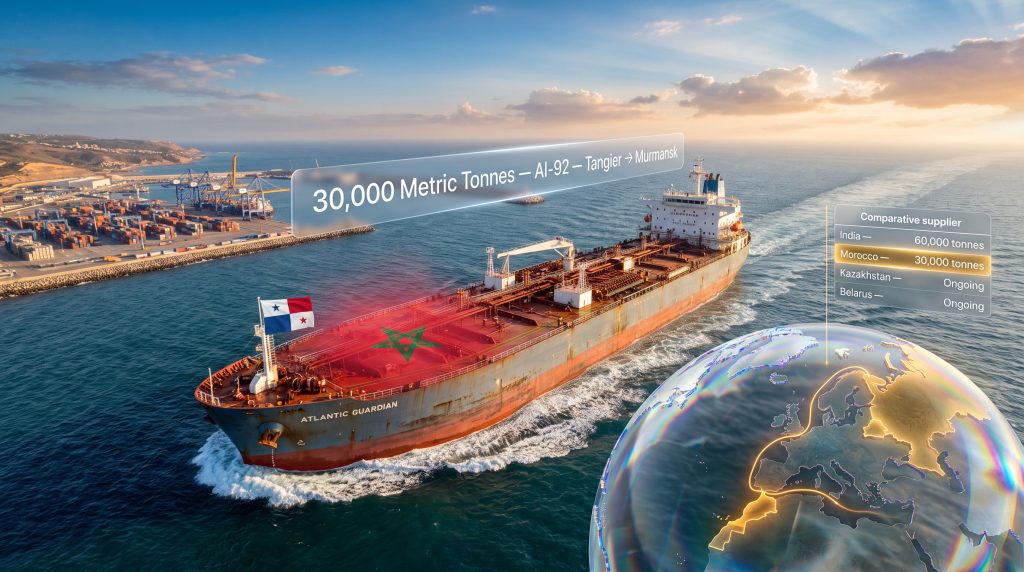
According to Reuters, approximately 30,000 metric tonnes of AI-92 grade gasoline were loaded aboard a Panama-flagged tanker at Morocco's Port of Tangier in mid-July 2025. The vessel sailed northward along Atlantic shipping corridors to Russia's Arctic port of Murmansk, where the cargo was offloaded. Two industry sources identified Lukoil, Russia's largest privately held oil producer, as the entity behind the cargo arrangement.
The distribution pathway inland was corroborated by data from the St. Petersburg International Mercantile Exchange (SPIMEX), which showed AI-92 gasoline being offered for rail delivery from Kola station, the primary rail hub serving Murmansk port.
AI-92 Gasoline: The Fuel Grade at the Centre of Russia's Crisis
| Specification | Detail |
|---|---|
| Fuel Type | Motor gasoline (petrol) |
| Octane Rating | RON 92 |
| Primary Market | Russia and Commonwealth of Independent States (CIS) |
| Western Equivalent | Broadly comparable to standard regular unleaded petrol |
| Domestic Significance | Among the most widely consumed fuel grades in the Russian passenger vehicle fleet |
AI-92 is the everyday fuel of the Russian road network. Its shortage is not an abstract industrial statistic; it directly affects ordinary motorists, logistics operators, and agricultural machinery operators across the country. The political sensitivity of gasoline rationing, particularly ahead of harvest seasons that depend on diesel and petrol-powered equipment, adds an additional layer of urgency to Moscow's import strategy.
Why Morocco and Not a Traditional Energy Exporter?
Morocco produces negligible quantities of crude oil. Its entry into Russia's fuel supply chain is not driven by hydrocarbon endowment but by three structural advantages that few African nations currently combine:
- Strategic maritime geography sitting astride Atlantic and Mediterranean shipping corridors, enabling northward tanker routing toward Arctic Russian ports without traversing heavily monitored chokepoints
- Port infrastructure anchored by the Tanger Med complex, one of Africa's largest port facilities by throughput capacity, providing the storage, handling, and transshipment capabilities needed for large fuel cargoes
- Non-aligned diplomatic positioning that allows Morocco to engage in commercially driven energy transactions without triggering the sanctions exposure faced by entities operating within Western financial systems
Morocco's fuel trade advantage is a product of location and logistics engineering, not hydrocarbon geology. This distinction matters enormously for understanding which African nations can realistically replicate it.
Russia's Expanding Supplier Network: A Comparative Overview
The Moroccan shipment did not occur in isolation. It represents one node in a rapidly diversifying Russian import strategy. Before turning to Morocco, Russia had already been sourcing seaborne gasoline from India, with at least 60,000 tonnes reportedly dispatched. Moscow was simultaneously evaluating purchases of up to 400,000 tonnes per month from a diversified international supplier pool. Consequently, the broader geopolitical oil price analysis suggests this diversification strategy will continue to intensify throughout 2025.
| Supplier Country | Estimated Volume | Import Method | Status |
|---|---|---|---|
| India | At least 60,000 tonnes (initial dispatch) | Seaborne | Confirmed |
| Kazakhstan | Ongoing volumes | Overland pipeline and rail | Confirmed |
| Morocco | ~30,000 metric tonnes | Seaborne (Tangier to Murmansk) | Confirmed |
| Belarus | Ongoing volumes | Overland | Confirmed |
Morocco's position as the third confirmed seaborne supplier and the first African nation identified in this role marks a qualitative shift in where Russia is directing its commercial energy diplomacy.
Africa's Refining Transformation: The Structural Backdrop
From Crude Exporter to Refined Product Supplier
Africa's historical energy trade profile has been defined by a structural imbalance: abundant crude hydrocarbon reserves but limited domestic refining capacity, meaning value-added processing occurred elsewhere. That structural dynamic is now shifting materially, driven by several transformational refinery developments.
Nigeria and the Dangote Effect
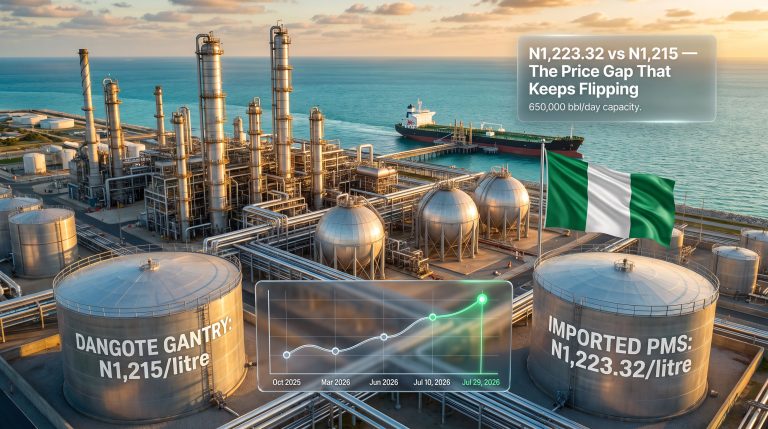
The Dangote Refinery in Lagos, with a nameplate capacity of 650,000 barrels per day, has fundamentally repositioned West Africa's refined product landscape. Nigeria, historically one of the most paradoxical energy economies on the continent — an oil-rich nation that imported most of its fuel — is now capable of producing surpluses for export. The geopolitical implication is significant: a refinery of this scale operating at strong utilisation rates could theoretically supply markets well beyond West Africa.
Algeria's Established Mediterranean Position
Algeria operates a network of functioning refineries, including the Skikda Refinery, which has long supplied Mediterranean markets. Algeria's existing export infrastructure, technical workforce, and proximity to European and Eastern Mediterranean shipping lanes make it a more immediately credible candidate for expanded fuel export partnerships than many peer African nations.
Angola's Growing Refining Footprint
The development of Angola's Cabinda Refinery has added refined product capacity to sub-Saharan Africa's supply landscape. Angola's longer-term trajectory as a participant in global refined fuel trade is credible, though its greater distance from Russian Arctic ports and more complex sanctions environment create meaningful hurdles.
What African Refiners Would Need to Supply Russia at Scale
Any African nation evaluating Russia as a fuel export destination must navigate a genuinely complex matrix of commercial, legal, and logistical constraints. Commercial logic alone is insufficient.
Key factors determining feasibility include:
- Secondary sanctions exposure: US, EU, and UK secondary sanctions frameworks can penalise entities that facilitate Russian fuel imports, even when those entities are not themselves subject to primary sanctions
- Shipping and insurance premium loading: Western marine insurers apply significant premium loading to vessels and cargoes associated with Russian trade, materially affecting freight economics
- Payment settlement complexity: Dollar and euro-denominated transactions with Russian counterparties face restrictions; rouble, yuan, or barter settlement mechanisms each carry their own operational and currency risk dimensions
- Fuel grade specification matching: Russian domestic consumption is built around AI-92 and AI-95 grades; African refineries would need to confirm output specifications align with these standards before commercial agreements are feasible
- Cargo volume and freight economics: Long-haul shipments from West or Southern African ports to Murmansk require sufficient cargo volumes to justify per-tonne freight costs across distances significantly greater than India or Mediterranean supplier routes
Morocco's Broader Strategic Energy Positioning
The Tanger Med Advantage
The Russia gasoline transaction reinforces what Morocco's port infrastructure investment strategy has been signalling for years. The Tanger Med complex was not built simply to serve Morocco's domestic economy. It was designed to position Morocco as a Mediterranean and Atlantic energy and logistics gateway. This vision is now translating into commercial reality in ways that extend well beyond Morocco's traditional trading relationships.
The country is demonstrating that in a world of fragmented energy trade flows, physical geography combined with world-class logistics infrastructure can generate strategic value independent of natural resource endowments. However, this advantage is not without its complications when viewed through the lens of sanctions impact on Russian oil trading and the associated legal frameworks.
Morocco's Non-Aligned Energy Diplomacy in Context
Morocco has cultivated relationships with Western partners including the United States and European Union while simultaneously maintaining commercial relationships with non-Western economies. This positioning mirrors the strategic playbooks of Turkey, the United Arab Emirates, and India — all of which have expanded their roles as intermediaries in redirected Russian commodity flows since 2022.
The common thread is strategic non-alignment: the capacity to make commercially rational trade decisions without being constrained by the bloc loyalties that restrict Western-aligned entities. In addition, this geopolitical trade reshaping extends well beyond fuel markets, affecting logistics networks, financial settlement systems, and diplomatic relationships across the globe. For emerging markets seeking to maximise their economic positioning in a bifurcating global order, Morocco's approach offers a template worth studying.
Furthermore, the broader context of the Venezuela PDVSA policy shift illustrates how geopolitical realignments are creating new supplier dynamics across multiple continents simultaneously, compounding the complexity Russia faces in securing reliable long-term supply agreements.
The next major ASX story will hit our subscribers first
Scenario Analysis: How African Fuel Exports to Russia Could Evolve
| Scenario | Probability Assessment | Key Enabling Conditions |
|---|---|---|
| Morocco expands volumes to Russia | Moderate-High | Sustained Russian deficit; continued non-aligned positioning |
| Nigeria (Dangote) enters Russian supply chain | Low-Moderate | Sanctions risk mitigation; alternative payment mechanism resolution |
| Algeria formalises fuel export arrangement with Russia | Moderate | Existing bilateral energy ties; Mediterranean logistics advantage |
| Angola supplies Russia via indirect routing | Low | Longer shipping distance; greater sanctions exposure complexity |
| African nations form coordinated fuel export bloc | Very Low (near-term) | Requires multilateral coordination currently absent |
Frequently Asked Questions
Why is Russia importing gasoline if it produces so much crude oil?
Crude oil reserves and refined fuel production are distinct capabilities. Ukraine's sustained drone campaign against Russian oil refining facilities has created a domestic processing capacity shortfall. Russia possesses abundant raw petroleum but lacks sufficient operational refinery throughput to convert it into consumer-grade fuel at the volumes required. Consequently, Russia imports gasoline from Morocco and other international suppliers to bridge this gap.
How much gasoline did Russia import from Morocco?
The confirmed shipment totalled approximately 30,000 metric tonnes of AI-92 grade gasoline, loaded at Morocco's Port of Tangier and delivered to the Arctic port of Murmansk, as reported by Reuters.
Is Morocco exposed to Western sanctions for this transaction?
Morocco is not subject to Western sanctions. As a sovereign state with non-aligned positioning, it retains the legal right to conduct bilateral commercial trade. However, individual companies and financial institutions involved in such transactions may face scrutiny depending on their exposure to US, EU, or UK financial systems and secondary sanctions frameworks.
Which other African countries could supply gasoline to Russia?
Nigeria, Algeria, and Angola have been identified as potential candidates based on their expanding refining capacity. Each faces distinct logistical, sanctions-related, and commercial barriers that would need resolution before trade at meaningful scale could materialise.
What is AI-92 gasoline?
AI-92 is a RON 92-rated motor gasoline that functions as the standard passenger vehicle fuel across Russia and broader CIS markets. It is broadly comparable to regular unleaded petrol in Western European markets and represents one of the highest-volume fuel grades consumed across the Russian domestic road network.
Key Takeaways
- Russia's domestic gasoline production shortfall, estimated at 40,000 to 45,000 metric tonnes per day below consumption requirements, has compelled Moscow to seek refined fuel imports from a widening international supplier pool
- Morocco's 30,000-tonne AI-92 gasoline shipment to Murmansk, with Lukoil identified as the cargo's originating supplier, marks the first publicly confirmed African seaborne fuel supply to Russia during the current crisis period
- Morocco's role as an energy intermediary reflects the strategic value of geography and logistics infrastructure rather than hydrocarbon production capacity — a distinction with broad implications for how African nations can participate in global energy trade
- Africa's expanding refining capacity, anchored by Nigeria's Dangote Refinery, Algeria's Skikda facility, and Angola's Cabinda Refinery, positions the continent as a potential long-term participant in reconfigured global fuel trade flows
- The transaction illustrates how the geopolitical fragmentation of global energy markets is generating new commercial roles for non-aligned nations, as traditional trade routes face sustained disruption from conflict and sanctions regimes
This article contains forward-looking analysis and scenario assessments that involve inherent uncertainty. Readers should not interpret any scenario projections as financial advice or as a reliable forecast of future geopolitical or commercial outcomes.
Want To Stay Ahead of the Next Major Resource Discovery Reshaping Global Markets?
As geopolitical tensions continue to redraw global energy and commodity trade flows, Discovery Alert's proprietary Discovery IQ model instantly notifies subscribers of significant ASX mineral discoveries — translating complex resource data into actionable investment opportunities the moment they hit the market. Explore historic discoveries and their remarkable returns, then begin your 14-day free trial at Discovery Alert to position yourself ahead of the broader market.