August 2, 2026
The Supply Illusion: Why OPEC+'s Quota Restoration Tells Only Half the Story
Oil markets have a long history of reacting to headline numbers before the underlying mechanics become clear. Announced production figures, quota targets, and alliance communiqués tend to move prices in the moment, yet the physical reality of what actually flows through pipelines and loading terminals often tells a starkly different story. Understanding that gap between paper policy and real-world barrels is arguably the most important analytical skill any observer of global crude markets can develop heading into the second half of 2026.
The completion of OPEC+'s phased quota restoration cycle offers a textbook example of this dynamic. The headline reads cleanly: the alliance has unwound the voluntary production cuts introduced in 2023, restoring approximately 3.5 million barrels per day (MMbpd) of notional output across four monthly increments. The market reality, however, is considerably more layered.
When big ASX news breaks, our subscribers know first
Understanding the Three-Year Architecture of OPEC+'s Supply Intervention
To properly contextualise what the OPEC+ final production quota increase means for global oil markets, it helps to understand what preceded it. Beginning in 2023, the alliance assembled one of the most substantial coordinated supply-side interventions in its recent institutional history. The voluntary cuts totalling roughly 3.5 MMbpd were not a single uniform decision but a composite of individually agreed national contributions, staggered across multiple rounds of negotiation.
The motivations were multi-layered. Post-pandemic demand recovery had proven uneven across major consuming regions. Macroeconomic headwinds, particularly in China and Europe, threatened to outpace consumption growth projections. Meanwhile, U.S. shale production had rebounded faster than many within the alliance had anticipated, applying additional downward pressure on prices. The cuts functioned as a defensive mechanism designed to hold a pricing floor while the demand picture clarified.
By early 2026, with supply disruptions originating from Middle East conflict dynamics introducing a different kind of market tightness, the group began an orderly reversal. Furthermore, OPEC's market influence over the broader pricing environment remained substantial throughout this transition period. The architecture of that unwind was notably disciplined.
The Phase-by-Phase Reversal: How the Unwind Was Structured
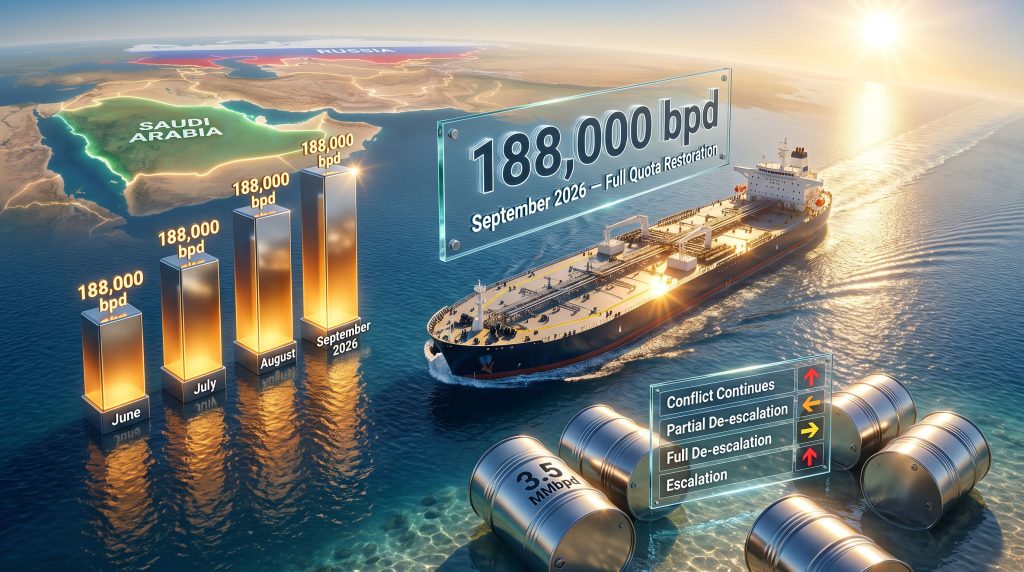
Rather than restoring supply in a single move, OPEC+ deployed a phased approach across four consecutive months, each carrying an identical increment of 188,000 barrels per day (bpd). The consistency of that figure across all four phases reflects a deliberate policy choice to signal predictability to markets while preserving the flexibility to pause or reverse if conditions deteriorated.
| Phase | Month | Quota Increase (bpd) | Cumulative Reversal |
|---|---|---|---|
| Phase 1 | June 2026 | 188,000 | ~25% of cuts reversed |
| Phase 2 | July 2026 | 188,000 | ~50% of cuts reversed |
| Phase 3 | August 2026 | 188,000 | ~75% of cuts reversed |
| Phase 4 (Final) | September 2026 | 188,000 | Full quota restoration |
Key structural insight: The selection of a uniform monthly increment rather than front-loaded or back-loaded phases is itself a market communication strategy. It reduces the risk of sudden price dislocation while keeping the alliance's collective commitment to the unwind visible and credible.
September 2026: The End of One Policy Cycle, Not the Start of a Supply Surge
The September 2026 quota increase, agreed by a coalition of seven OPEC+ producers anchored by Saudi Arabia and Russia, formally closes the voluntary cut programme. However, treating this as the equivalent of 3.5 MMbpd of new physical oil entering the market would be a significant analytical error.
The distinction between quota entitlement and operational production capacity is at the centre of what makes this moment more complex than its headline suggests. A meaningful share of OPEC+ membership, particularly several African producers and smaller-output Gulf states, have been operating well below their allotted quota levels throughout the cut period. Their underperformance reflects infrastructure deterioration, chronic underinvestment in upstream capacity, and in some cases outright technical breakdown rather than voluntary restraint.
This creates an important market dynamic: the paper restoration of 3.5 MMbpd does not correspond to 3.5 MMbpd of incremental physical barrels. The actual market-facing supply increase from completing the quota cycle is likely to be considerably smaller, concentrated among the high-capacity producers that have both the infrastructure and the institutional discipline to translate quota allocations into real output.
The compliance asymmetry problem: Within OPEC+, high-compliance producers are predominantly Gulf Cooperation Council (GCC) members with direct state control over production decisions. Low-compliance producers frequently cite technical constraints rather than deliberate non-adherence. This means effective market influence within the alliance is increasingly concentrated in a smaller subset of major producers.
Following the September adjustment, the group has signalled its intention to hold quotas steady through the remainder of 2026, according to reporting by Bloomberg citing delegate briefings. That pause is not a passive decision. It reflects a deliberate reading of demand-side fragility and the ongoing physical disruption caused by geopolitical conflict, allowing the alliance to observe inventory trajectories before committing to any further supply additions. In addition, OPEC demand forecasts have consistently shaped how member states calibrate their output decisions in this kind of uncertain environment.
Geopolitical Risk as the Invisible Hand Shaping Physical Supply
Quota policy is only one input into actual market supply. In the current environment, active conflict dynamics involving Iran and associated maritime security risks across the Persian Gulf and Red Sea are functioning as a parallel and largely uncontrollable constraint on crude flows. OPEC+ formally acknowledged these risks in its August 2026 communiqué, flagging threats to regional energy infrastructure and shipping corridor security as potential sources of renewed market volatility.
The practical effect is a bifurcation between OPEC+'s official supply policy and the physical volume of crude that actually reaches buyers. Even if high-capacity Gulf producers were to ramp toward their restored quota levels, logistical bottlenecks and security-related operational constraints along key maritime routes would limit how quickly those incremental barrels reach consuming markets. Consequently, global crude shipments have remained a closely watched indicator of the gap between announced policy and physical delivery.
Scenario Analysis: How Conflict Resolution Would Shift the Supply Equation
| Scenario | Likely Supply Impact | Market Price Direction |
|---|---|---|
| Conflict continues at current intensity | Physical supply constrained below quota levels | Prices supported above fundamental equilibrium |
| Partial de-escalation (limited shipping normalisation) | Gradual crude flow recovery; modest inventory build | Moderate price softening |
| Full de-escalation (Gulf producers restore full output) | Saudi Arabia and Gulf states deploy spare capacity | Potential shift toward market surplus |
| Escalation beyond current levels | Supply shock risk; significant inventory drawdown | Sharp upward price pressure |
Saudi Arabia occupies a uniquely important position in this framework. It holds significant spare production capacity that can be activated relatively quickly under the right geopolitical conditions. A meaningful de-escalation scenario could allow Riyadh to deploy that spare capacity simultaneously with other Gulf producers, accelerating the transition from the current supply-constrained environment toward surplus conditions and applying meaningful downward pressure on prices.
The Inventory Rebuild Problem: A Critical and Underappreciated Constraint
One of the most consequential yet least-discussed dimensions of the 2026 oil market is the state of global crude inventories. Months of supply disruption linked to Middle East conflict and maritime route constraints have drawn stockpiles down from levels that prevailed at the start of the year.
Rebuilding those inventories requires sustained physical supply meaningfully above current consumption levels. That condition is unlikely to be met while conflict-related disruptions continue to suppress output and shipping throughput. The September quota restoration, even if fully and uniformly implemented, may not generate surplus volumes at a pace sufficient for significant inventory accumulation in the near term.
For OPEC+ strategists, this is actually a relatively comfortable position. Depleted inventories provide a natural pricing floor, reducing the risk that restoring quotas triggers a sharp price collapse. The alliance is, in effect, unwinding its production restrictions into a market where the geopolitical backdrop is absorbing much of the additional supply before it can generate oversupply conditions.
Conditions Required for a Genuine Inventory Rebuild
For global crude stockpiles to recover meaningfully, several converging conditions would need to be met simultaneously:
- Full or near-full implementation of restored OPEC+ quotas by high-capacity producers, including Saudi Arabia, the UAE, and Iraq
- Normalisation of Persian Gulf and Red Sea shipping routes to pre-conflict throughput levels
- Stable or moderating demand growth in key consuming economies, particularly China
- A limited incremental supply response from non-OPEC producers, especially U.S. shale operators responding to price incentives
Five Variables That Will Determine Oil Prices Through Q4 2026
With quota policy effectively paused, the pricing trajectory for the remainder of 2026 will be shaped almost entirely by external variables that OPEC+ cannot directly control. Investors and traders tracking crude oil price trends should monitor the following dynamics closely:
- Geopolitical resolution timeline — the pace and scale of any Middle East de-escalation represents the single largest supply-side wildcard in the current environment
- Chinese demand trajectory — uncertainty around industrial activity levels and the pace of strategic petroleum reserve purchasing continues to cloud the demand picture
- U.S. shale production response — elevated price levels incentivise incremental American output, which competes directly with the volumes OPEC+ is restoring to market
- Global inventory levels — the rate at which stockpiles rebuild will determine how much pricing headroom OPEC+ retains before market balance tilts toward surplus
- Currency dynamics — a strengthening U.S. dollar structurally depresses crude demand in import-dependent emerging market economies, softening the demand floor even when supply is constrained
Furthermore, the oil prices and trade war dynamic between the United States and China continues to introduce additional uncertainty into consumption projections for the second half of the year.
Strategic takeaway for market observers: The OPEC+ final production quota increase is best understood not as a supply surge but as the formal conclusion of a defensive policy posture adopted three years ago. The real supply story for the second half of 2026 will be written by geopolitical events, not quota announcements.
The next major ASX story will hit our subscribers first
Frequently Asked Questions: OPEC+ Final Production Quota Increase
What is the OPEC+ final production quota increase for 2026?
The final quota increase in OPEC+'s current unwind cycle is 188,000 barrels per day, approved for implementation in September 2026. This completes the four-phase reversal of approximately 3.5 MMbpd in voluntary production cuts originally introduced in 2023.
Which countries agreed to the September 2026 quota increase?
The increase was agreed by a group of seven OPEC+ producers, with Saudi Arabia and Russia serving as the primary architects of the collective decision. Smaller member states broadly aligned with the Saudi-Russian consensus position.
Will OPEC+ increase production further after September 2026?
The alliance has indicated it plans to hold quotas steady for the remainder of 2026 following the September increase. Delegate briefings reported by Bloomberg suggest this is the current baseline expectation, though the position remains subject to revision if market conditions or geopolitical developments shift materially.
Why aren't all OPEC+ members producing at their quota levels?
Many member nations face technical and operational constraints, including infrastructure limitations, underinvestment in upstream capacity, and production degradation, that prevent them from reaching their allotted output targets. This structural production deficit within the membership acts as a natural buffer against oversupply conditions.
How does the Middle East conflict affect OPEC+ production?
Active conflict dynamics and associated maritime security risks across the Persian Gulf and Red Sea are constraining the physical movement of crude and suppressing output from affected producers. OPEC+ formally cited these risks in its August 2026 statement as potential drivers of increased market volatility.
What happens to oil prices if the Middle East conflict eases?
A significant de-escalation would likely enable Gulf producers, particularly Saudi Arabia, to deploy spare capacity and add physical barrels to the market. Depending on the pace and scale of that supply restoration, the oil market could transition from a supply-constrained environment toward surplus conditions, applying downward pressure on crude prices and accelerating global inventory rebuilding.
Key Metrics at a Glance: OPEC+'s 2026 Supply Strategy
| Metric | Detail |
|---|---|
| Final quota increase volume | 188,000 bpd |
| Implementation month | September 2026 |
| Total voluntary cuts reversed | ~3.5 MMbpd (2023 programme) |
| Monthly increase phases | 4 (June through September 2026) |
| Post-September plan | Quota hold through Q4 2026 |
| Lead decision-makers | Saudi Arabia and Russia (plus 5 additional members) |
| Primary risk factor | Middle East conflict and maritime disruption |
| Key market shift trigger | Gulf producer spare capacity deployment post-conflict |
Readers seeking further context on OPEC+ production policy and upstream oil market dynamics can explore related reporting and analysis at worldoil.com, which provides ongoing coverage of Middle East energy developments and global crude market trends.
Want to Stay Ahead of the Next Major Resource Discovery Before the Market Catches On?
While OPEC+ quota mechanics shape the macro energy landscape, the real wealth-creation moments in resources often emerge from significant mineral discoveries on the ASX — and Discovery Alert's proprietary Discovery IQ model delivers real-time alerts the moment those discoveries are announced, turning complex geological data into actionable investment insights. Explore historic examples of exceptional discovery-driven returns or begin your 14-day free trial today to position yourself ahead of the broader market.