
August 3, 2026
When Export Routes Run Out: The Hard Limits Behind Saudi Arabia's Crude Crisis
Global oil markets have long operated on a comforting assumption: that the world's largest crude exporters possess enough route flexibility to absorb geopolitical shocks without sustained supply disruption. The thinking goes that pipelines, alternative ports, and diversified shipping lanes provide a meaningful buffer against any single chokepoint failure. What the current Middle East crisis has exposed, with uncomfortable clarity, is that this assumption breaks down entirely when multiple corridors face simultaneous, compounding pressure. Saudi oil reroutes hit capacity and security limits not because of a single failure point, but because the entire architecture of Gulf export logistics was never designed to operate under systemic, multi-front threat.
When big ASX news breaks, our subscribers know first
The Architecture of Saudi Crude Exports and Why It's Failing
Saudi Arabia's crude export network was built around a primary artery through the Strait of Hormuz, with secondary infrastructure designed to handle partial overflow rather than full-scale substitution. When Iran effectively paralysed vessel traffic through the Strait in early March, Riyadh activated its contingency infrastructure at speed. Arab Light volumes from eastern Gulf terminals were redirected through the East-West Petroline toward the Red Sea port of Yanbu on Saudi Arabia's western coast. Understanding the geopolitical oil price drivers behind this disruption helps frame the severity of what followed.
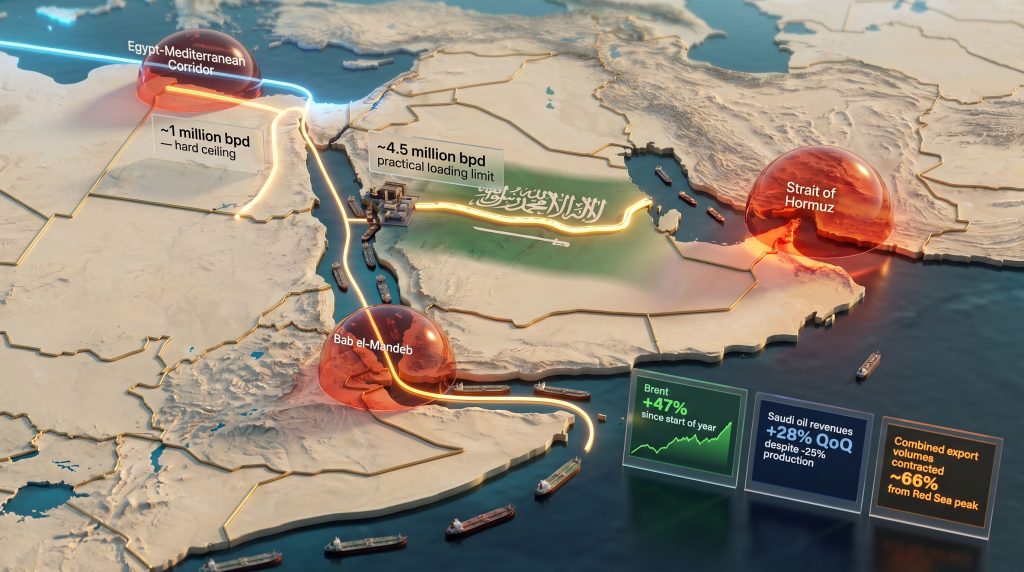
The initial results were dramatic. Yanbu export volumes surged to approximately 2.47 million barrels per day, a 330% increase over pre-conflict baseline levels, according to Windward maritime intelligence data. By April, loading volumes at Yanbu had climbed further to approximately 4 million barrels per day, approaching the port's practical loading ceiling of roughly 4.5 million bpd. On the surface, the rerouting appeared to be working.
What the headline numbers concealed, however, was the growing strain beneath them.
| Infrastructure Asset | Rated Capacity | Key Constraint |
|---|---|---|
| East-West Petroline | Up to 7 million bpd (crisis mode) | Domestic refinery demand competes for throughput |
| Yanbu Terminal | ~4.5 million bpd practical loading limit | Terminal congestion; tanker availability bottleneck |
| SUMED Pipeline (Egypt) | 2.5 million bpd total capacity | Partially pre-reserved by other sovereign users |
| Suez Canal | ~1 million bpd crude throughput | Hard physical ceiling; cannot scale |
| Strait of Hormuz | ~20 million bpd regional throughput (pre-crisis) | Severely disrupted; single-digit tanker crossings |
Structural Reality: Even at maximum theoretical throughput across every available alternative corridor, Saudi Arabia cannot come close to replicating its pre-crisis export volumes. The ceiling is physical, not political.
The Three-Phase Collapse of Saudi Export Volumes
Phase One: The Hormuz Shutdown and the Red Sea Surge
Iran's closure of the Strait of Hormuz in early March triggered immediate and coordinated rerouting decisions across Gulf producers. Saudi Arabia's rapid pivot to the East-West Petroline and Yanbu represented the most significant operational response, with Yanbu throughput climbing to levels never previously sustained. The speed of the ramp-up demonstrated genuine infrastructure capability but also began revealing the downstream bottlenecks that would constrain the strategy over the following months.
Phase Two: The Yanbu Peak and the Slide Toward Structural Constraint
The April peak at approximately 4 million barrels per day from Yanbu proved unsustainable. A temporary ceasefire arrangement between Iran and the United States allowed partial Hormuz traffic resumption in late June, briefly reducing pressure on Yanbu loading infrastructure. However, when the ceasefire collapsed and missile strikes resumed, Hormuz re-closed, but Yanbu volumes had already declined to approximately 2.39 million barrels per day by June.
The implications of this decline are stark when measured against Saudi Arabia's pre-crisis export baseline. Total Saudi crude flows across both Gulf and Red Sea terminals stood at approximately 7.96 million barrels per day in January. By June, the combined figure represented roughly a 66% contraction from peak Red Sea throughput levels, according to Wood Mackenzie analysis. Monitoring the current crude oil market confirms the sustained downstream pressure this contraction has generated.
Phase Three: The Houthi Blockade and the Northern Pivot to Egypt
The strategic calculus shifted again when the Houthi movement declared a blockade specifically targeting Saudi vessels operating in the southern Red Sea. This eliminated the southward shipping lane from Yanbu entirely, forcing Saudi tankers to sail northward toward the Suez Canal rather than south toward the Bab el-Mandeb strait.
Windward maritime intelligence tracked at least three Saudi very large crude carriers (VLCCs) operating in AIS dark mode, transporting crude from Yanbu to the Egyptian port of Ain Sukhna for injection into the SUMED pipeline. Separately, tankers were identified loading Saudi crude from the Mediterranean terminus at Sidi Kerir, with cargoes destined for Asian buyers via extended routing. Meanwhile, six Saudi oil tankers were reported circumnavigating Africa entirely, bypassing both Bab el-Mandeb and Suez to avoid Houthi threat exposure.
The Hard Capacity Ceilings That No Rerouting Can Overcome
Why SUMED Cannot Solve the Volume Problem
The SUMED pipeline connects the Red Sea port of Ain Sukhna to the Mediterranean terminal at Sidi Kerir, carrying a maximum rated capacity of 2.5 million barrels per day. This figure sounds substantial until it is measured against the export volumes Saudi Arabia needs to move. More critically, a portion of SUMED's capacity is already contractually reserved by other sovereign producers, meaning Saudi Arabia cannot access the full 2.5 million bpd ceiling.
Analysis from Kpler confirms that even under optimistic assumptions, Saudi Arabia could realistically redirect approximately half of its Yanbu volumes through the SUMED corridor, not the entirety. The mathematics alone make clear that SUMED functions as a supplementary pressure valve, not a primary export replacement.
The Suez Canal's Fixed Crude Throughput Ceiling
The Suez Canal's ability to handle crude oil tanker traffic is physically constrained to approximately 1 million barrels per day, a limit that cannot be expanded without multi-year infrastructure investment. This figure represents roughly 12.5% of Saudi Arabia's January export baseline, underscoring how marginal the Suez route is as a volume solution.
Port Congestion: When Pipeline Speed Outpaces Loading Capacity
A less-discussed but operationally critical constraint has emerged at Yanbu itself. The East-West Petroline, operating at elevated throughput in crisis mode, has been delivering crude to the coast faster than Yanbu's loading infrastructure can process it. The bottleneck has shifted from pipeline capacity to port loading infrastructure, creating vessel queuing, tanker availability shortfalls, and operational delays that further compress effective export volumes.
An additional complication is that a meaningful portion of East-West pipeline throughput is consumed by western-coast domestic refineries and fuel supply obligations. The volume available for export loading is therefore lower than raw pipeline throughput figures suggest.
Scenario Modelling Note: If Saudi Arabia were to redirect the full theoretical 5 million bpd to the Red Sea corridor, the combined capacity of Yanbu's loading infrastructure and SUMED (~3.5 million bpd maximum, accounting for pre-reserved capacity) would still produce a structural export gap exceeding 1.5 million bpd, before factoring in tanker availability constraints and security-driven routing delays.
Security Risk Is Expanding Along the Remaining Corridor
AIS Dark Mode as a Measure of Market Anxiety
The proliferation of Saudi tankers operating in Automatic Identification System (AIS) dark mode is one of the most telling indicators of how deeply the security threat has penetrated commercial decision-making. Dark mode involves deliberately disabling vessel tracking signals to reduce visibility to threat actors, including Houthi targeting systems.
The operational consequences extend well beyond individual voyage decisions:
- Insurance underwriters face acute information deficits, driving war-risk premium surges
- Cargo buyers and trading desks lose supply chain visibility critical for scheduling
- Freight costs increase materially as voyages become longer, less predictable, and riskier to insure
- Port operators and pipeline managers face difficulty coordinating arrivals and throughput scheduling
The Damietta Drone Strikes: A Geographical Escalation Signal
Drone strikes on LNG tankers at the Egyptian port of Damietta represent a qualitative escalation that extends the threat envelope well beyond the southern Red Sea. The strikes demonstrate that the Houthi and allied threat architecture is not geographically confined to the Bab el-Mandeb corridor. Saudi Arabia's current reliance on the Egypt-Mediterranean axis as its primary viable export route consequently faces a credible, if not yet sustained, security risk at its northern terminus.
The Cape Route: Safety at a High Commercial Cost
The circumnavigation of Africa via the Cape of Good Hope adds approximately 10 to 14 days to voyage times for Asian-bound cargoes. At scale, this represents a significant increase in freight costs, a material reduction in effective tanker fleet utilisation, and a compounding effect on landed crude costs for Asian refiners operating on thin margins. Furthermore, the oil market trade war impact has added additional pricing pressure for refiners already absorbing elevated freight costs.
Hormuz Recovery: Encouraging but Structurally Insufficient
As of late July, Windward data recorded just five tankers entering the Strait of Hormuz on July 29, with only three exiting. ING analysts characterised tanker crossings as remaining in single digits, marginally improved from the lowest points but representing a severe structural deficit relative to pre-war traffic density.
U.S. Energy Secretary Chris Wright indicated that approximately 13 million barrels per day was flowing out of the Persian Gulf, representing roughly 65% of pre-conflict levels according to ING analysis. Partial recovery is not the same as functional restoration.
The grade-specific dimension of this problem deserves attention. Asian refiners, particularly in China, India, Japan, and South Korea, have built refinery configurations around Arab Light and Arab Medium grades. Substitute supplies from alternative producers frequently involve different sulphur content, density profiles, and processing requirements that existing refinery configurations cannot immediately accommodate without yield penalties or capital investment. For instance, tracking WTI and Brent futures reveals how these grade substitution challenges are feeding directly into forward pricing dynamics.
The next major ASX story will hit our subscribers first
The Saudi Fiscal Paradox: Revenue Up Despite Output Down
Saudi Arabia's financial position during the crisis has produced a counterintuitive outcome:
| Metric | Change |
|---|---|
| Brent crude price appreciation (year-to-date) | +47% |
| Saudi oil production decline (Q2) | -25% |
| Saudi oil revenue change (Q1 to Q2) | +28% |
The price appreciation from the supply shock has more than offset the volume reduction, narrowing Saudi Arabia's fiscal deficit materially. This fiscal buffer, however, creates a false sense of resilience. Revenue improvement does not resolve the underlying infrastructure constraints, and the compounding exposure across multiple threatened corridors simultaneously represents a vulnerability that price appreciation alone cannot hedge.
Analyst Caution: The revenue picture masks a structural fragility. Saudi Arabia's export infrastructure is being operated near stress limits across several corridors at once. Any additional disruption — whether a successful strike on Yanbu terminal facilities, further pre-emption of SUMED capacity, or a northward escalation of Houthi operations — could produce a non-linear export collapse with minimal remaining fallback options. Investors and energy security planners should weight this tail risk carefully.
Three Trajectories: Scenario Analysis for Saudi Export Recovery
Scenario A: Houthi Blockade Lifted, Red Sea Partially Reopens
- Probability: Low near-term, given the absence of credible diplomatic progress
- If realised: Yanbu southward routing resumes; SUMED pressure eases; export volumes recover toward 5 to 6 million bpd
- Market impact: Moderate price relief; freight cost normalisation on Red Sea lanes
Scenario B: Prolonged Stalemate, SUMED Becomes Primary Corridor
- Probability: Moderate; reflects current operational trajectory
- Key constraint: SUMED's 2.5 million bpd ceiling and pre-reserved capacity limit Saudi throughput well below pre-crisis levels
- Market impact: Sustained supply tightness; elevated freight premiums; Asian buyers accelerate diversification toward non-Gulf grades
Scenario C: Escalation Reaches Egyptian or Mediterranean Infrastructure
- Probability: Low but non-trivial, given the Damietta drone precedent
- If realised: Saudi Arabia's last viable high-volume export corridor faces direct security threat; potential for an acute supply shock exceeding current market pricing
- Market impact: Severe; Brent price spike scenario; emergency SPR release discussions; accelerated structural buyer diversification
What This Crisis Reveals About Global Energy Security Architecture
Saudi Arabia's export network was designed on the foundational assumption that not all corridors would face simultaneous threat. The current crisis has invalidated that assumption at scale. The $5 billion U.S.-Saudi consortium refinery project planned outside the Hormuz zone signals awareness of this structural gap, but long-lead infrastructure investment offers no relief within the current crisis window. In addition, OPEC market influence over production decisions remains constrained when the physical export infrastructure itself becomes the binding limitation.
The broader lesson extends well beyond Saudi Arabia. Energy security frameworks that treat route flexibility as a reliable buffer need to incorporate hard physical capacity ceilings and concurrent multi-corridor threat scenarios into their stress-testing models. Political willingness to reroute is not the binding constraint.
Infrastructure throughput, port loading capacity, pipeline reservation structures, and tanker fleet availability are the binding constraints, and none of them can be resolved by geopolitical negotiation alone. Energy security analysts at leading institutions have long flagged this infrastructure gap, yet the current crisis has brought it into sharp relief in ways that theoretical modelling could not fully anticipate.
For global markets, the period ahead hinges on whether even partial Hormuz normalisation can absorb enough volume to offset the structural compression in Saudi Red Sea and Egypt-Mediterranean flows. Based on current capacity arithmetic, the answer appears to be: not entirely, and not quickly enough to prevent sustained tightness in the grades and volumes Asian refinery systems depend upon most. Consequently, maritime shipping analysts tracking vessel movements expect the pattern of AIS dark mode operations and extended Cape routing to persist well into the coming quarters, reinforcing the structural nature of the current supply disruption.
This article is intended for informational purposes only and does not constitute financial, investment, or trading advice. Forecasts, scenario projections, and capacity estimates involve inherent uncertainty and should not be relied upon as predictions of future market conditions.
Want to Stay Ahead of the Commodity Shifts Reshaping Global Markets?
While geopolitical disruptions compress Saudi export volumes and rattle energy supply chains, the ripple effects across commodity markets create windows of opportunity for informed investors. Discovery Alert's proprietary Discovery IQ model delivers real-time alerts on significant ASX mineral discoveries — instantly translating complex market signals into actionable insights — so whether you're tracking energy-driven commodity repricing or seeking the next major resource discovery, you can explore historic examples of exceptional returns and start your 14-day free trial at Discovery Alert to position yourself ahead of the market.