June 16, 2026
The Hidden Carbon Problem Inside Every Copper Mine
Most conversations about decarbonising copper production focus on smelter emissions, haulage electrification, or renewable energy procurement. Far less attention lands on what happens inside the grinding mill, despite the fact that comminution — the mechanical process of crushing and grinding ore into fine particles — consistently ranks among the most energy-hungry operations on any mine site. Estimates from the mining industry suggest that grinding alone can account for between 30% and 50% of a mine's total electricity consumption, and in some large-scale porphyry copper operations, that figure climbs even higher.
This is the operational reality that makes the entry of ME Elecmetal joins the International Copper Association so analytically significant. It is not simply a membership announcement. It represents a structural shift in how the copper industry is thinking about where sustainability leverage actually lives, and who belongs at the table when that conversation happens.
When big ASX news breaks, our subscribers know first
Why the ICA's Membership Composition Tells a Bigger Story
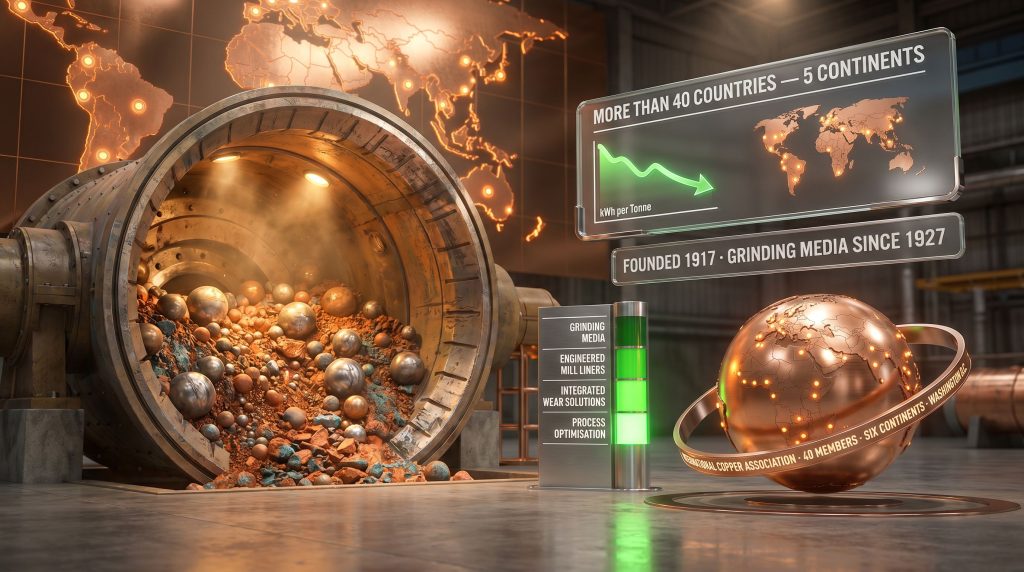
The International Copper Association has historically drawn its membership from copper producers, smelters, refiners, and end-use market developers. With 40 members spanning six continents and collectively representing more than half of global copper output, the ICA operates as the industry's most authoritative collective voice, headquartered in Washington, D.C. and running regional hubs across the United States, Europe, Asia, and Latin America.
Its policy mandate covers a wide spectrum, from climate and environment to health and safety, circular economy principles, and societal and economic development. However, the inclusion of a mining consumables and engineered solutions provider signals something that producer-focused membership structures rarely capture: the recognition that copper's sustainability performance is not determined at the boardroom level alone.
It is determined, tonne by tonne, inside grinding circuits operating around the clock at mine sites across South America, Africa, Asia-Pacific, and beyond. Furthermore, understanding copper market trends helps contextualise why membership diversity within the ICA has become strategically important at this particular moment.
The copper industry's decarbonisation challenge cannot be solved by producers acting in isolation. The technical levers for reducing energy intensity per tonne of refined copper are often controlled not by miners themselves, but by the suppliers engineering the equipment and consumables those miners depend on.
This is a perspective that ICA's evolving membership strategy appears to increasingly reflect.
A Century of Comminution Expertise: Understanding ME Elecmetal's Unique Position
Founded in Chile in 1917, ME Elecmetal began manufacturing grinding media specifically for the mining sector in 1927, giving the company nearly a century of focused specialisation in comminution technology. That depth of experience is not incidental; it is the foundation of the company's ability to contribute meaningful technical intelligence to an industry-wide body like the ICA.
Today, ME Elecmetal supports mining customers across more than 40 countries on five continents, with a core product and services portfolio that spans:
- Grinding media engineered to specific ore hardness profiles and mill operating conditions
- Engineered mill liners designed to protect grinding mills, extend equipment service life, and influence charge trajectory inside the mill
- Integrated wear management systems that treat wear as a circuit-wide variable rather than an individual component problem
- Process optimisation and engineering services that translate operational data into measurable efficiency improvements
What is less widely understood outside the mining processing community is that the geometry of a mill liner is not simply a protective feature. Liner profile directly influences how the grinding charge moves inside the mill, which in turn affects both the rate of ore breakage and the specific energy consumed per tonne processed. This means that liner design is simultaneously a productivity tool and a decarbonisation instrument — a dual function that is rarely communicated outside specialist engineering circles.
How ME Elecmetal's Capabilities Align With Copper Mining Needs
| Capability Area | Relevance to Copper Mining | Sustainability Impact |
|---|---|---|
| Grinding Media Supply | Reduces ore particle size for downstream extraction | Influences energy intensity per tonne of copper produced |
| Engineered Mill Liners | Protects grinding mills and controls charge motion | Reduces material waste, unplanned downtime, and energy draw |
| Integrated Wear Solutions | Holistic wear management across the full circuit | Lowers total cost of ownership and replacement frequency |
| Process Optimisation | Improves throughput and metallurgical recovery | Minimises energy and water use per unit of production |
| Engineering and Technical Services | Supports operational decision-making with data | Enables continuous measurable improvement in sustainability metrics |
The Ore Grade Problem: Why Comminution Efficiency Is Becoming More Critical Over Time
One of the less frequently discussed structural forces shaping copper mining's sustainability challenge is the long-term decline in average ore grades. Globally, copper ore grades have fallen substantially over the past several decades. Where operations once processed ore averaging well above 1% copper, many of the world's major porphyry copper deposits now operate at grades closer to 0.4% to 0.6% Cu, and some large-scale operations are processing ore at grades below 0.3%.
The consequence of lower ore grades is mathematically straightforward but operationally severe: to produce the same quantity of refined copper, a mine must process a significantly larger volume of rock. More rock means more comminution. More comminution means more energy. And more energy, unless sourced entirely from renewables, means higher carbon intensity per tonne of copper produced.
In addition, the critical minerals demand trajectory tied to the energy transition is placing further pressure on producers to scale output — often from these very lower-grade deposits — making comminution efficiency an increasingly urgent operational and environmental priority.
Ore Grade Scenarios and Their Decarbonisation Implications
| Ore Grade Scenario | Relative Tonnes Processed per Tonne of Copper | Comminution Energy Intensity | Decarbonisation Implication |
|---|---|---|---|
| High Grade (above 1.5% Cu) | Lower throughput volume required | Relatively contained energy draw | Moderate pressure on grinding circuit efficiency |
| Medium Grade (0.5% to 1.5% Cu) | Moderate throughput volume | Meaningful energy consumption | Efficiency gains yield material carbon savings |
| Low Grade (below 0.5% Cu) | High throughput volume required | Elevated energy intensity per tonne Cu | Comminution optimisation becomes a primary decarbonisation lever |
This dynamic amplifies the strategic value of what engineered wear solution providers actually deliver. As the industry moves into lower-grade ore bodies, the ability to extract more value from each kilowatt-hour consumed in the grinding circuit becomes increasingly consequential — not just for operating costs, but for carbon accounting.
How Optimised Wear Solutions Reduce Environmental Impact: A Process View
Understanding how comminution efficiency improvements translate into environmental outcomes requires tracing the intervention logic step by step.
- Baseline circuit assessment gathers data on liner wear rates, grinding media consumption, mill power draw, and throughput per unit time, establishing a performance benchmark.
- Engineered solution design matches liner profile geometry, alloy composition, and grinding media size distribution to the specific ore hardness, mill dimensions, and target grind size for that operation.
- Controlled implementation installs the optimised solution with performance tracking in place from day one, capturing data on power draw, throughput, and product particle size distribution.
- Wear life extension through superior alloy selection and liner geometry means fewer liner change-outs per year, directly reducing the volume of steel consumed and the downtime associated with maintenance shutdowns.
- Energy benchmarking compares post-implementation kilowatt-hours per tonne of ore processed against the pre-optimisation baseline, quantifying the carbon intensity reduction achieved.
- Iterative refinement applies learnings from operational data to the next liner generation, creating a continuous improvement cycle that compounds efficiency gains over successive campaigns.
A point that is frequently underappreciated by observers outside the processing engineering discipline is that a reduction of even 5% to 10% in specific energy consumption across a large-scale copper concentrator processing tens of millions of tonnes per year can translate into tens of thousands of megawatt-hours saved annually. At a mine powered partly by fossil-fuel-derived electricity, this carries a directly measurable carbon abatement value. Energy-efficient mine design principles, when applied consistently across the circuit, compound these gains further.
What Full Value Chain Representation Means for ICA's Advocacy Effectiveness
When ICA engages with policymakers, regulators, or multilateral bodies on topics like energy efficiency standards, emissions reporting frameworks, or responsible production certification, the credibility of those submissions depends on the technical depth of the evidence base behind them.
A membership that includes only producers can speak to what is achieved at the extraction and refining stages. A membership that also includes the engineers designing the equipment and consumables that determine how efficiently ore is processed can speak to how those outcomes are being generated — and what the realistic improvement trajectories look like across different operational contexts.
Eduardo Munoz, COO International Business of ME Elecmetal, has made clear that the company's intent in joining the ICA extends beyond passive membership. The stated objective is active collaboration with industry counterparts to advance comminution efficiency and develop sustainable mining solutions that measurably reduce environmental impact while improving operational performance — a mandate that is directly complementary to ICA's climate and environment policy focus.
ICA Chair Steve Rowland and President and CEO Juan Ignacio Diaz have both emphasised that as copper demand continues its structural growth trajectory driven by electrification and clean energy infrastructure, collaboration across the full value chain will be essential. Understanding the copper growth drivers underpinning this demand expansion clarifies why whole-of-chain partnerships are no longer optional.
The International Energy Agency and other bodies have projected that copper demand could roughly double by 2040 under accelerated energy transition scenarios — a scale of demand growth that cannot be met without simultaneously addressing the carbon intensity of production.
As ore grades decline and processing volumes rise, the industry's ability to constrain its carbon footprint will depend increasingly on the performance of equipment and consumables operating inside the concentrator, not just on decisions made at the executive level.
The next major ASX story will hit our subscribers first
Geographic Reach as a Source of Collective Intelligence
ME Elecmetal's operational footprint spanning more than 40 countries is not merely a commercial statistic. It represents an accumulated body of knowledge about how copper ore behaves differently across geological environments, how wear rates vary with ore mineralogy and hardness, and how grinding circuit performance responds to changes in ore feed characteristics as mines progress through different ore domains.
Major copper-producing regions including Chile, Peru, the Democratic Republic of Congo, Zambia, Australia, and the United States each present distinct ore types, mineralogical profiles, and grinding challenges. Porphyry copper deposits, which account for the majority of global copper production, tend toward moderate to high ore hardness and relatively coarse liberation sizes.
By contrast, sediment-hosted deposits such as those in the Central African Copperbelt often present different abrasion characteristics and finer liberation requirements, demanding different approaches to media selection and liner design. This granular, region-specific operational intelligence enriches ICA's collective knowledge base in ways that producer-only membership cannot replicate.
Why This Intelligence Matters for Policy
This grounds policy discussion in the operational realities of what is technically achievable — in which environments, and at what pace. Consequently, mining decarbonisation benefits are more likely to be realised at scale when policy frameworks are informed by this kind of whole-of-circuit, multi-regional expertise. According to recent ICA coverage, the association's expanding membership reflects a deliberate strategy to bring exactly this type of technical depth into its advocacy work.
Key Takeaways for the Copper Industry
- Comminution accounts for a disproportionately large share of mine-site energy consumption, making grinding efficiency a material lever in copper mining decarbonisation
- Declining global copper ore grades structurally increase the volume of material requiring comminution per unit of copper produced, amplifying the importance of wear solution optimisation over time
- ICA's expanding membership model reflects a strategic recognition that responsible copper production requires whole-of-value-chain collaboration, beyond the producer tier
- ME Elecmetal joins the International Copper Association with nearly a century of specialisation in grinding technology, combined with operational presence across more than 40 countries, positioning it as a technically credible contributor to ICA's sustainability and innovation agenda
- Mill liner geometry influences not just equipment longevity but the energy mechanics of ore breakage itself — a connection that is underappreciated outside specialist engineering circles
- As copper demand scales in response to electrification megatrends, the pressure to produce more copper with lower carbon intensity per tonne will intensify, making cross-value-chain partnerships increasingly consequential to the industry's long-term licence to operate
This article contains forward-looking statements and projections relating to copper demand and industry trends. These are based on publicly available research and analyst estimates and should not be relied upon as investment advice. Readers are encouraged to conduct independent research and seek professional guidance before making investment decisions.
Want to Identify the Next Major Copper Discovery Before the Market Does?
Discovery Alert's proprietary Discovery IQ model scans ASX announcements in real time, instantly alerting subscribers to significant mineral discoveries across copper and more than 30 other commodities — turning complex geological data into clear, actionable opportunities. Explore historic examples of exceptional discovery returns and begin your 14-day free trial today to position yourself ahead of the broader market.