July 24, 2026

When Two Earnings Multipliers Fire Simultaneously: The Copper Mining Playbook in 2026
The economics of large-scale copper mining are rarely straightforward, but periodically the commodity cycle aligns in a way that makes even veteran analysts take notice. The mechanism is well understood in theory: a producer positioned low on the global cost curve, operating a high-volume asset, will experience non-linear earnings expansion when commodity prices rise. What is less common is when that price appreciation occurs simultaneously with a meaningful volume increase. When both variables move in the same direction at the same time, the earnings outcome does not simply add the two effects together. It multiplies them.
That is precisely the dynamic at work in Teck Resources' performance during the June quarter of 2026, a result that captures something deeper than a single company's good fortune. It reflects where copper sits in the global commodity cycle right now, and why the metal's structural fundamentals are rewriting the financial arithmetic of every major producer with significant copper exposure.
When big ASX news breaks, our subscribers know first
Why Copper's Price Rally Is Different This Time
Copper has experienced price spikes before, typically tied to Chinese construction booms or short-term supply disruptions. What distinguishes the current environment is the origin of demand. The electrification of transport, the modernisation of electricity grids across North America, Europe, and Asia, and the rapid buildout of renewable generation capacity have created a demand base that is structurally different from traditional industrial consumption.
Electric vehicles contain roughly 83 kilograms of copper per unit, compared to approximately 23 kilograms in a conventional internal combustion vehicle. Offshore wind turbines require between 8 and 15 tonnes of copper per megawatt of installed capacity. Grid infrastructure upgrades, which are accelerating across most developed economies, rely on copper as a foundational material in transformers, cabling, and substation equipment.
Layered on top of this is an emerging and frequently underappreciated demand source: data centres and AI computing infrastructure. The thermal management and power distribution systems within large-scale data centre facilities are copper-intensive, and as hyperscaler investment continues to surge globally, this sector is becoming a meaningful incremental demand contributor. Furthermore, understanding the copper price growth drivers behind this rally is essential for any investor assessing long-term exposure to the metal.
Copper vs. Other Base Metals: 2025 to 2026 Performance Comparison
| Commodity | Approximate YoY Price Change | Primary Demand Driver |
|---|---|---|
| Copper | ~+37% | EVs, grid infrastructure, AI data centres |
| Nickel | Declining to flat | Oversupply from Indonesian laterite production |
| Zinc | Moderate gains | Industrial construction activity |
| Aluminium | Modest recovery | Packaging, transport lightweighting |
Against this backdrop, copper moved from approximately US$4.24 per pound in the first quarter of 2025 to approximately US$5.83 per pound in the equivalent period of 2026, representing a year-over-year appreciation exceeding 37%. For a producer with Teck's production scale, that price shift alone would have been enough to generate a substantial earnings uplift. However, Teck also added volume.
Dissecting the Financial Architecture of a 200%+ EBITDA Surge
Teck reported adjusted EBITDA of C$2.2 billion for the June 2026 quarter, a result that represented growth of more than 200% compared to the same period in 2025. The copper segment drove the overwhelming majority of that performance, with gross profit from copper operations expanding from approximately C$343 million to C$1.4 billion within a single year. Adjusted earnings per share reached C$1.75, exceeding analyst consensus expectations.
To understand how this happened, it is necessary to separate the two earnings drivers and examine their interaction.
The Price Lever
A 37.5% increase in realised copper price flowing through a high-volume operation creates an earnings effect that is disproportionate to the price move itself. This is because the cost base of an established mining operation is largely fixed in the short to medium term. Staff costs, energy contracts, processing plant depreciation, and site-level overhead do not increase in proportion to commodity prices. When revenue rises sharply while costs remain relatively stable, the incremental revenue falls almost entirely to operating margin.
The Volume Lever
Copper production increased from 106,100 tonnes to 140,000 tonnes year-over-year, an improvement of approximately 32%. This was not a random operational variation. It reflects the continued ramp-up of Quebrada Blanca Phase 2 (QB2), Teck's flagship copper operation in the Atacama region of northern Chile, which has been progressing toward its design throughput capacity over the preceding several quarters. In addition, this volume growth is consistent with trends observed across the largest copper mines globally as major projects reach nameplate capacity.
Earnings Sensitivity: A Quantitative Summary
| Performance Variable | Q1 2025 | Q1 2026 | Change |
|---|---|---|---|
| Realised Copper Price | US$4.24/lb | US$5.83/lb | +37.5% |
| Copper Production | 106,100 tonnes | 140,000 tonnes | +31.9% |
| Copper Segment Gross Profit | C$343M | C$1.4B | +308% |
| Adjusted EBITDA | ~C$933M (implied) | C$2.2B | +136% |
"The non-linear relationship between price appreciation and EBITDA is one of the most important concepts in mining finance. When a producer sits near the bottom of the global cost curve, each incremental dollar of copper price above the breakeven threshold flows almost entirely to earnings. Combine that with a simultaneous 32% increase in production volume, and the mathematical outcome becomes transformative."
Quebrada Blanca: The Asset Behind the Numbers
No analysis of Teck's copper performance is complete without examining QB2 in detail. The operation is located at an elevation of approximately 4,400 metres in the Atacama Desert in Chile's Tarapacá Region, one of the driest environments on earth. The extreme aridity that makes QB2's location challenging from a water management perspective is the same characteristic that has shaped one of the most significant operational decisions in the project's development: the adoption of seawater desalination as the primary water source, pumped inland over approximately 165 kilometres.
This is a technically demanding and capital-intensive solution, but it eliminates QB2's dependence on freshwater resources in a water-stressed region. Furthermore, it positions the operation as a best-practice response to one of the most pressing ESG challenges in South American mining. Communities and regulators across Chile have become increasingly attentive to water consumption by mining operations, and QB2's seawater-based approach provides a degree of social licence resilience that many competing operations in the region do not have.
From an orebody perspective, QB2 processes a porphyry copper-molybdenum deposit, which is the dominant deposit type among large-scale copper operations globally. Porphyry deposits are characterised by low-to-moderate copper grades distributed across enormous tonnage, making them suitable for bulk mining via open-pit methods. The processing route at QB2 uses conventional flotation concentration, producing a copper concentrate exported primarily to smelters in Asia.
Cost Structure and the Importance of C1 Cash Costs
In copper mining, the C1 cash cost metric represents direct mining, milling, and concentrating costs, plus site general and administrative expenses, net of any by-product credits. C1 costs are the primary benchmark for assessing an operation's position on the global cost curve.
Teck's copper operations are positioned in the lower half of the global cost curve, meaning that in a declining price environment they would be among the last operations to experience margin compression. By-product molybdenum credits provide an additional buffer that effectively reduces the net cost of copper production. A lesser-known nuance is that QB2's molybdenum circuit, when operating at full throughput, can generate by-product credits significant enough to materially reduce reported C1 costs.
The Proposed Anglo American Merger: Strategic Context and Market Implications
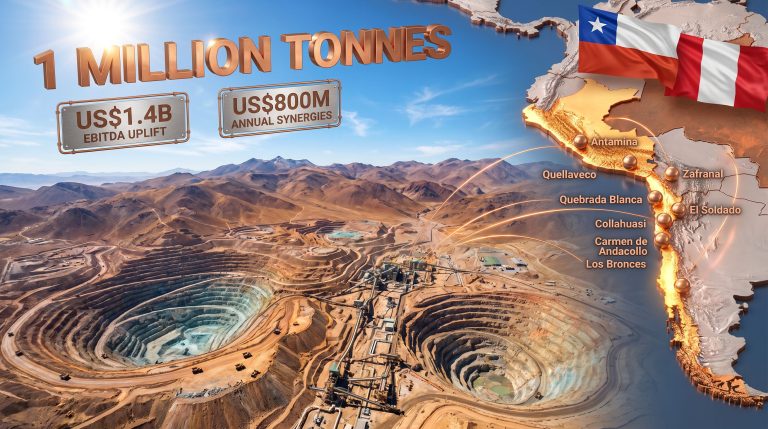
Teck's exceptional quarterly result arrives at a particularly consequential moment, given the company's announced intention to merge with Anglo American, one of the world's largest diversified mining groups. Anglo American had been the subject of an unsolicited takeover approach from BHP in 2024, which was ultimately rejected, and the company has since undertaken a significant portfolio restructuring programme focused on its core copper and iron ore assets.
A combination of Teck and Anglo American would bring together Teck's high-growth Chilean copper assets with Anglo American's copper portfolio, which includes Los Bronces and Collahuasi in Chile, as well as El Soldado. Collahuasi is among the world's largest copper operations by reserve base, and its inclusion in a combined entity would create a copper production platform of considerable scale.
"If the proposed combination proceeds, the resulting entity could rank among the world's top three copper producers by volume, alongside Codelco and Freeport-McMoRan. At a time when the market faces a structural supply deficit, that scale would carry significant pricing influence and operational optionality."
Teck's financial strength heading into this transaction matters considerably. A balance sheet fortified by C$2.2 billion in quarterly EBITDA provides negotiating leverage, reduces refinancing risk during the transition period, and signals to counterparties and regulators alike that the combined entity would operate from a position of financial health.
Any merger of this scale would require regulatory approvals across multiple jurisdictions, including Chile, Canada, the United Kingdom, and potentially South Africa given Anglo American's platinum and iron ore assets. Antitrust scrutiny of combined copper market share, particularly in the Chilean production context, would be among the most closely examined issues.
Supply Pipeline Constraints and Why Elevated Prices May Endure
One of the most critical and frequently underestimated factors in copper market analysis is the extraordinary lead time between a discovery decision and commercial production at a greenfield copper mine. The process of drilling out a resource, completing a prefeasibility study, advancing to a bankable feasibility study, securing financing, obtaining environmental and community permits, and constructing a major open-pit operation typically spans 10 to 15 years.
This structural lag means that even if copper prices at current levels catalyse a wave of new project approvals tomorrow, the resulting supply additions would not reach the market until the mid-to-late 2030s at the earliest. The projects that were advanced and funded in the 2015 to 2020 period are only now entering the production ramp-up phase. Consequently, the copper supply crunch that analysts have long warned about is now materialising in a way that is directly visible in price data.
Several additional supply-side friction points compound this constraint:
- Water scarcity in the Atacama and other major copper-producing regions in Chile and Peru is intensifying regulatory scrutiny of new project water licences, adding permitting complexity and cost.
- Ore grade decline at existing producing mines is a long-term structural headwind. The average copper grade mined globally has fallen from roughly 1.8% Cu in the 1980s to below 0.6% Cu today at many major operations, meaning more ore must be processed to produce the same quantity of metal.
- Community engagement requirements across South America, particularly in indigenous territories, have become more demanding, creating timeline uncertainty for projects in advanced development stages.
- Energy transition within mining itself is adding capital expenditure requirements, as miners face pressure to decarbonise their own operations through fleet electrification and renewable energy procurement.
For instance, a major copper project such as Reko Diq in Pakistan illustrates precisely how lengthy and complex the path from resource definition to production can be, even when the underlying orebody is world-class.
Copper Demand by End-Use Sector Through 2030
| End-Use Sector | Copper Intensity | Growth Outlook to 2030 |
|---|---|---|
| Electric Vehicles | ~83 kg per EV | Strong, EV adoption accelerating across all major markets |
| Grid Infrastructure | Very high per km | Critical, ageing grids requiring large-scale modernisation |
| Solar and Wind Generation | Moderate to high | Expanding rapidly with renewable energy targets |
| AI Data Centres | Emerging but growing | Increasingly material as hyperscaler investment surges |
| Traditional Industrial | Moderate | Stable, not a primary growth driver |
The next major ASX story will hit our subscribers first
How Investors Should Read a 200% EBITDA Increase
When a company reports earnings growth of this magnitude in a single quarter, the risk of over-extrapolation is genuine. Commodity prices are inherently volatile, and a reversal in the copper price driven by a Chinese demand slowdown, a strengthening US dollar, or a resolution of trade tensions affecting metals flows could compress margins sharply in subsequent quarters.
Experienced mining sector investors typically apply through-the-cycle pricing assumptions when building valuation models, using long-run copper price forecasts often in the range of US$3.80 to US$4.50 per pound rather than spot prices. This approach deliberately discounts the current elevated price environment to arrive at an intrinsic value that is more stable across market conditions.
What is more durable, and therefore more important from a fundamental investment perspective, is the volume growth component of Teck's result. A 32% increase in production output driven by QB2's ramp-up is not a price-dependent outcome. It represents real operational progress that will contribute to earnings regardless of where copper prices settle over the medium term.
Key Financial Metrics Worth Monitoring
- EV/EBITDA multiple compression: As EBITDA rises at a relatively stable enterprise value, the multiple compresses, signalling improving value for investors who entered at prior price levels.
- Free cash flow conversion: The critical question is how much of EBITDA translates into distributable cash after sustaining capital expenditure, particularly given QB2's ongoing ramp-up capital requirements.
- Net debt trajectory: Strong quarterly earnings create an opportunity to accelerate debt reduction, which reduces financial risk heading into a major corporate transaction.
- Dividend and buyback capacity: In a sustained high-price environment, shareholder return programmes become more credible and better supported by cash generation.
"Quarterly earnings driven primarily by commodity price appreciation should always be evaluated against the full price cycle. The more analytically meaningful component of Teck's result is the 32% production volume increase, which reflects durable operational improvement rather than a transient price tailwind. Investors should weight these contributions accordingly when forming views on long-term intrinsic value."
What Teck's Result Signals for Junior Copper Explorers
Major producer profitability has historically functioned as a leading indicator for capital availability in the exploration and development sectors. When large-cap miners generate substantial free cash flow, several downstream effects tend to follow: increased corporate acquisition activity targeting advanced-stage development assets, improved equity market conditions for junior copper companies seeking to raise exploration capital, and greater appetite among institutional investors for copper-focused equity exposure.
The current environment, in which Teck triples earnings on high copper prices and output growth simultaneously, creates precisely the kind of sector validation that junior explorers need to attract investor interest. Elevated copper prices also improve the economics of lower-grade discoveries that would have been marginal at US$3.50 per pound but become genuinely viable at US$5.00 and above. Understanding copper exploration importance has therefore never been more relevant, as the supply gap can only be addressed through sustained investment in new discovery programmes.
For exploration geologists and project developers, the current period represents a window in which the capital markets are receptive to copper stories. The structural supply deficit framework provides a credible investment thesis that can support project financing conversations in a way that was considerably more difficult during the lower-price period of 2015 to 2020. According to the International Copper Study Group, global refined copper demand is forecast to outpace supply through the end of the decade, reinforcing the structural case for new project development.
The compounding effect of higher copper prices, QB2's production ramp, and a transformational corporate transaction positions Teck at the intersection of multiple value-creating forces simultaneously. Whether all of those forces remain aligned through 2026 and beyond will depend on factors ranging from Chinese macroeconomic conditions to the progress of merger regulatory approvals. What the June quarter result demonstrates, without ambiguity, is that the operational foundation underpinning that value has never been stronger. As the World Bank's commodity outlook continues to reflect robust long-term copper demand projections, producers with low-cost, high-volume assets such as QB2 appear well placed to benefit from the decade ahead.
Want to Catch the Next Major Copper Discovery Before the Market Does?
Discovery Alert's proprietary Discovery IQ model scans ASX announcements in real time, instantly identifying significant copper and mineral discoveries and translating complex data into actionable investment insights — explore historic discoveries and their remarkable returns, then begin your 14-day free trial at Discovery Alert to position yourself ahead of the broader market.