May 9, 2026
Understanding Copper Oxide Exploration in Queensland's Mt Isa Mineral Province
Copper oxide mineralization systems represent a complex interplay between primary sulfide deposition and subsequent weathering processes, creating near-surface enrichment zones that fundamentally alter exploration targeting strategies. In northwest Queensland's Mt Isa Mineral Province, these oxidized copper systems develop through groundwater-driven alteration of primary sulfide deposits, concentrating copper minerals in more accessible, near-surface geological environments that offer distinct advantages for modern mining operations.
The geological framework underlying these systems extends across approximately 41,000 square kilometers of structurally complex Proterozoic terrain, where metasedimentary sequences have hosted multiple generations of copper mineralization events. Understanding how these ancient depositional environments interact with modern weathering profiles becomes critical for explorers targeting oxide copper resources in this globally significant mineral district.
Geological Framework of Near-Surface Copper Systems
Near-surface copper oxide systems in the Mt Isa region develop within weathered profiles that extend 50 to 150 meters below surface, where primary copper-bearing sulfides undergo oxidation and dissolution. These supergene processes concentrate copper through chemical precipitation, creating mineralized zones with significantly different metallurgical characteristics compared to their primary sulfide counterparts.
The oxidation process involves complex hydrogeochemical reactions where copper sulfides dissolve in acidic groundwater, migrate downward through the weathering profile, and reprecipitate as secondary copper minerals including malachite, azurite, and chrysocolla. This natural beneficiation process often increases copper grades while creating more amenable ore types for hydrometallurgical processing.
Historical Mining Context and Modern Exploration Approaches
The Mt Isa Mineral Province has contributed over 50 million tonnes of copper production since mining commenced in the early 20th century, establishing the region as Australia's most prolific copper district. Historical operations focused primarily on high-grade sulfide ores, leaving significant oxide copper potential largely unexplored until recent decades when technological advances made lower-grade oxide processing economically viable.
Modern exploration methodologies integrate geophysical targeting with systematic drilling programs designed to define both lateral and vertical extent of oxide mineralization. This approach contrasts sharply with historical exploration that prioritized immediate high-grade sulfide targets, often bypassing oxide zones that are now recognised as valuable standalone resources.
Structural Controls on Mineralization Distribution
Structural geology plays a fundamental role in controlling copper distribution across the Mt Isa province, with mineralization commonly occurring along fault systems, stratigraphic contacts, and zones of enhanced permeability. These structural controls influence both primary sulfide deposition and subsequent oxidation patterns, creating predictable corridors where oxide copper exploration can be systematically targeted.
Near-vertical structural orientations, particularly those maintained through multiple deformation events, provide optimal geometries for both mineralization emplacement and mining extraction. These steep-dipping systems minimise stripping ratios in open-pit scenarios while maintaining geological continuity across significant strike lengths.
When big ASX news breaks, our subscribers know first
What Makes Mt Oxide's Copper Discovery Technically Significant?
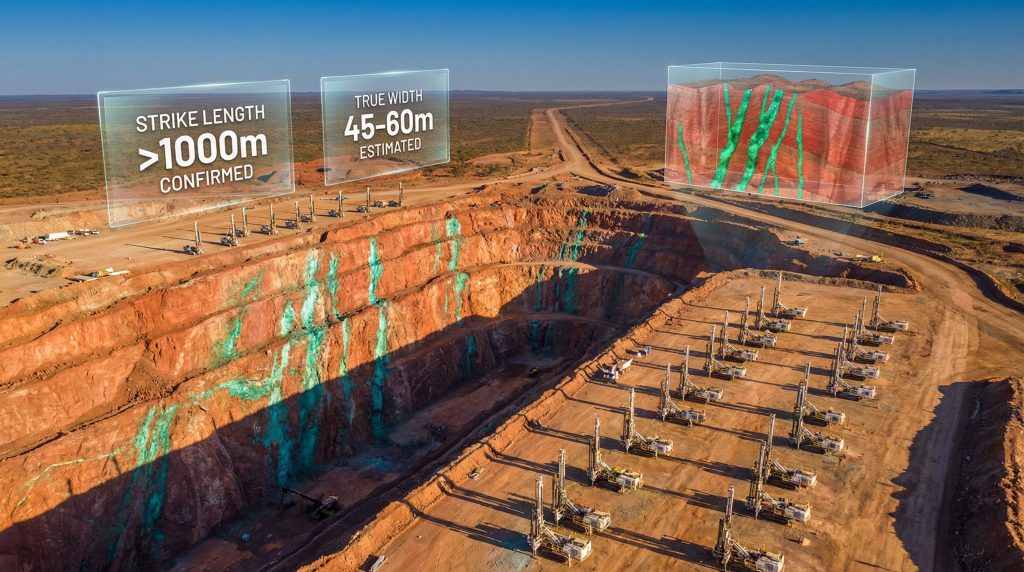
The Aquila Discovery at True North Copper Mt Oxide exploration project demonstrates exceptional geometric characteristics that distinguish it from typical early-stage copper discoveries across Australia's exploration landscape. With confirmed strike lengths exceeding 1,000 meters and estimated true widths ranging from 45 to 60 meters, the mineralized system substantially surpasses industry benchmarks for oxide copper discoveries.
Furthermore, the mineral exploration insights gained from this project highlight the importance of systematic targeting approaches in identifying significant copper systems.
Key Performance Metrics Comparison:
| Characteristic | Aquila Discovery | Industry Average | Significance |
|---|---|---|---|
| Strike Length | >1,000m | 500-800m | 25-100% above average |
| True Width | 45-60m | 20-40m | 50% above typical range |
| Central Zone | ~250m continuous | Variable | High-confidence zone |
| Geometry | Near-vertical | Variable dips | Optimal for extraction |
Drilling Results Analysis: Grade Distribution and Continuity
Phase 2 reverse circulation drilling results from the True North Copper Mt Oxide exploration program confirm mineralization continuity across multiple drill holes, indicating systematic geological controls rather than isolated mineralized pods. The consistency of copper-silver-cobalt associations suggests a coherent metallogenic system with predictable grade distribution patterns.
Near-surface positioning of the mineralized system provides immediate advantages for resource definition drilling, eliminating the need for deep drilling programs that characterise many copper exploration projects. This shallow geometry reduces drilling costs per meter of mineralized intersection while accelerating the timeline for resource estimation work.
Geometric Characteristics of the Mineralized System
The near-vertical orientation of the Aquila Discovery creates optimal mining geometry for potential open-pit extraction, allowing consistent bench heights and simplified pit slope design compared to shallowly-dipping mineralized zones. This structural configuration minimises ore dilution during extraction while maximising equipment efficiency through predictable mining geometries.
Central zone definition across approximately 250 meters represents the highest-confidence portion of the discovery where drilling has confirmed both lateral and vertical continuity. This zone provides the foundation for initial resource calculations while demonstrating the systematic nature of mineralization distribution across the broader corridor.
Comparison with Regional Copper Oxide Deposits
Historical oxide copper operations in the Mt Isa district, including portions of the Osborne Mine complex, demonstrate the commercial viability of near-surface copper systems within this geological setting. However, few recent discoveries have matched the combination of strike length, true width, and near-surface geometry demonstrated at the Aquila Discovery.
The multi-element signature incorporating copper, silver, and cobalt provides additional economic potential through byproduct revenue streams, particularly given current market dynamics favouring critical minerals including cobalt for battery applications.
How Do Reverse Circulation Drilling Programs Optimise Resource Definition?
Reverse circulation drilling methodology provides the optimal balance between sample quality, drilling speed, and cost-effectiveness for oxide copper exploration in the Mt Isa geological environment. RC drilling enables continuous sampling at one to two-meter intervals, creating detailed grade profiles essential for understanding mineralization distribution and geological continuity.
The hammer drill bit percussion system used in RC drilling fragments rock material into fine particles that return to surface through the drill string's inner tube, ensuring representative sampling of the mineralized intervals. This methodology proves particularly effective in oxidised, friable rock types characteristic of weathered copper systems.
Phase 2 Drilling Strategy and Target Selection
True North Copper's Mt. Oxide copper project employs systematic grid-based drilling designed to define both lateral extent and vertical continuity of mineralization across priority targets. The fully funded 2026 exploration program provides financial certainty for completing resource definition work without funding interruptions that commonly affect junior exploration companies.
According to company management, the Phase 2 results establish a strong technical foundation for expanded drilling and geophysical programs planned throughout 2026. This staged approach allows for iterative target refinement based on drilling results while maintaining capital efficiency through focused targeting.
Geophysical Integration with Drilling Programs
Integration of induced polarisation geophysics with drilling programs provides cost-effective target generation across the broader Mt Oxide corridor. IP surveys identify subsurface chargeability anomalies associated with sulfide minerals, creating systematic exploration targets for validation drilling.
The successful correlation between IP anomalies and drilling intersections at both Aquila and Acanthis targets validates the regional geophysical model, supporting confidence in district-scale exploration potential across the 10-kilometre-plus corridor.
Sample Quality and Analytical Protocols
RC drilling maintains sample integrity through continuous sample recovery and systematic quality assurance protocols including field duplicates, certified reference standards, and blank samples. These procedures ensure analytical reliability essential for resource estimation and metallurgical testing programs.
Sample preparation involves riffle splitting at the drill site to create representative sub-samples for laboratory analysis, with remaining material retained for potential metallurgical testwork and geological logging. This comprehensive approach maximises the value derived from each drill hole while maintaining strict quality control standards.
What Role Does Induced Polarisation Play in Copper Exploration?
Induced polarisation geophysics measures the electrical chargeability response of subsurface rocks, providing a cost-effective method for identifying mineralized zones before committing to drilling programs. Copper minerals and associated iron sulfides produce distinctive IP signatures that can be mapped across large areas using ground-based survey techniques.
The method operates by injecting electrical current into the ground and measuring the polarisation response during current cessation, creating chargeability maps that highlight areas of elevated sulfide mineral content. This technique proves particularly effective in oxide copper exploration where residual sulfide minerals within the weathering profile maintain detectable IP responses.
IP Anomaly Correlation with Mineralization
Validation drilling at the Acanthis target successfully intersected copper mineralization coincident with induced polarisation anomalies, confirming the predictive power of IP geophysics within the Mt Oxide geological setting. This correlation demonstrates that IP surveys can effectively vector exploration teams toward mineralized zones across the broader corridor.
The systematic relationship between chargeability amplitude and mineralization intensity provides a quantitative tool for prioritising drilling targets based on geophysical response characteristics. Strong IP anomalies become first-priority drilling targets, while moderate anomalies receive lower priority ranking within the exploration sequence.
District-Scale Geophysical Modelling Applications
District-scale IP modelling across the 10-kilometre Mt Oxide corridor creates a comprehensive framework for understanding mineralization distribution beyond immediate drilling areas. This regional perspective enables exploration teams to identify structural corridors and geological controls that influence mineralization emplacement across the broader landholding.
Geophysical modelling integrates IP chargeability data with magnetic and electromagnetic surveys to create multi-parameter target ranking systems. This integrated approach reduces exploration risk by providing multiple lines of evidence supporting target prioritisation decisions.
First-Pass Drilling Validation at Acanthis Target
Initial drilling at the Acanthis target confirmed the presence of copper mineralization within zones of elevated IP chargeability, validating the regional exploration model developed for the Mt Oxide corridor. This successful validation supports confidence in applying similar targeting methodologies across other untested IP anomalies within the broader project area.
The Acanthis discovery provides proof-of-concept for systematic exploration across the corridor, demonstrating that multiple mineralized zones may occur within the structural framework controlling copper distribution at Mt Oxide.
Evaluating the 10-Kilometre Mt Oxide Corridor Potential
The Mt Oxide corridor represents a structurally controlled mineralized trend extending over 10 kilometres, with confirmed copper discoveries at Aquila and Acanthis providing evidence for district-scale mineralization potential. This corridor-scale approach to exploration offers significant advantages over single-target focus by diversifying geological risk across multiple prospects.
Systematic evaluation of the corridor involves integrating geophysical targeting with strategic drilling to identify and prioritise exploration targets based on technical merit and economic potential. The corridor concept recognises that mineralization often occurs in clusters controlled by regional geological structures rather than as isolated occurrences.
Regional Exploration Targets Beyond Aquila Discovery
Beyond the established Aquila and Acanthis discoveries, the Mt Oxide corridor contains multiple untested IP anomalies that represent potential drilling targets for future exploration programs. These targets benefit from the geological understanding developed through successful drilling at the primary discoveries.
Target Prioritisation Framework:
• Primary targets: Strong IP anomalies with geological characteristics similar to Aquila
• Secondary targets: Moderate IP responses along structural corridors
• Tertiary targets: Geochemical anomalies requiring additional geophysical confirmation
• Regional prospects: Exploration concepts requiring systematic geophysical surveys
Systematic Approach to Corridor-Scale Assessment
Corridor-scale exploration employs a phased methodology that balances capital efficiency with technical risk management. Initial phases focus on highest-confidence targets identified through integrated geophysical surveys, while later phases systematically evaluate lower-priority prospects based on results from primary discoveries.
This systematic approach enables exploration teams to refine their geological model through iterative drilling and geophysical programs, improving target selection accuracy while maintaining focus on the most prospective areas within the corridor.
Infrastructure Advantages in Northwest Queensland
The Mt Oxide project benefits from established infrastructure networks in northwest Queensland, including road access, electrical power availability, and proximity to experienced mining service providers based in the Mt Isa region. These infrastructure advantages reduce both exploration costs and potential development timelines compared to remote exploration projects.
Regional mining expertise and established supply chains provide additional competitive advantages for advancing exploration programs and potential future development activities. The presence of existing copper processing facilities within the broader region offers potential toll-treatment opportunities for future production scenarios.
How Does True North Copper's Exploration Strategy Compare to Industry Standards?
True North Copper employs a copper growth strategy that aligns with industry best practices for managing exploration risk while optimising capital deployment across multiple project phases. This methodical approach contrasts with high-risk, single-asset strategies that commit substantial capital before achieving adequate technical validation.
The company's approach involves systematic progression through defined exploration phases, with go/no-go decision points based on technical results and economic assessments. This disciplined methodology enables management to optimise capital allocation while reducing exposure to exploration risk through diversified target portfolios.
Staged Growth Approach vs. Single-Asset Focus
True North Copper's Phased Development Model:
• Phase 1 (Completed): Reconnaissance surveys, target generation, initial geophysics
• Phase 2 (Current): Resource definition drilling at priority discoveries
• Phase 3 (Planned 2026): Expanded drilling programs and metallurgical studies
• Phase 4 (Future): Engineering studies and pre-feasibility assessments
This phased approach enables continuous refinement of the geological model while maintaining capital discipline throughout the exploration process. Each phase builds upon previous results, creating systematic progression toward potential development decisions.
Funding Allocation for Multi-Year Programs
The fully funded 2026 exploration program provides operational certainty that eliminates funding risk during critical resource definition phases. This financial stability enables True North Copper Mt Oxide exploration to maintain consistent drilling schedules and technical programs without interruptions common among cash-constrained junior explorers.
Adequate funding also supports comprehensive technical programs including metallurgical testwork, environmental studies, and engineering assessments that become essential for transitioning successful exploration projects toward development consideration.
Technical Risk Management in Early-Stage Exploration
Technical risk management involves diversifying exploration investment across multiple targets within the Mt Oxide corridor, reducing dependence on any single discovery for project success. The validation of mineralization at both Aquila and Acanthis provides portfolio diversification while maintaining focus within a coherent geological framework.
Systematic application of proven exploration methodologies, including integrated geophysics and phase-appropriate drilling techniques, further reduces technical risk through established industry practices adapted to the specific geological setting at Mt Oxide.
The next major ASX story will hit our subscribers first
What Are the Key Technical Challenges in Copper Oxide Development?
Copper oxide deposits present distinct metallurgical challenges compared to conventional sulfide copper ores, requiring specialised processing approaches to achieve commercial metal recovery rates. Oxide copper minerals typically exhibit high acid solubility, making them amenable to hydrometallurgical processing through heap leaching or agitated leaching systems.
However, oxide processing requires different infrastructure compared to conventional sulfide flotation, including acid-resistant equipment, solution handling systems, and copper recovery circuits designed for pregnant leach solutions rather than concentrate production.
Metallurgical Considerations for Oxide Copper Processing
Primary Processing Routes for Oxide Copper:
• Heap leaching: Low-cost processing suitable for low-grade oxide ores
• Agitated leaching: Higher recovery rates for complex oxide mineralogy
• Solvent extraction-electrowinning: Standard copper recovery from pregnant solutions
• Direct smelting: Alternative route for high-grade oxide concentrations
Each processing route requires specific ore characteristics and economic thresholds, making metallurgical testwork critical for determining optimal processing strategies during feasibility studies. Early-stage metallurgical assessment becomes essential for understanding potential recovery rates and processing costs.
Open-Pit Mining Optimisation for Near-Surface Deposits
Near-surface copper oxide deposits typically employ open-pit mining methods due to shallow ore depths and relatively large tonnage requirements for economic viability. The near-vertical geometry demonstrated at the Aquila Discovery provides optimal mining characteristics through consistent ore boundaries and predictable extraction geometry.
Mining Advantages of Near-Vertical Geometry:
• Simplified pit slope design reduces geotechnical risk
• Consistent ore-to-waste ratios across mining benches
• Predictable equipment requirements for ore extraction
• Minimal dilution during selective mining operations
Environmental and Regulatory Framework in Queensland
Queensland's regulatory framework for copper mining includes comprehensive environmental assessment requirements, water management protocols, and community engagement standards. The established regulatory environment provides predictable approval processes whilst maintaining rigorous environmental protection standards.
Native title considerations and cultural heritage assessments form integral components of the regulatory approval process, requiring early engagement with traditional landowners and comprehensive cultural surveys across project areas.
How Do Multiple Target Areas Reduce Exploration Risk?
Portfolio diversification through multiple target areas within the Mt Oxide corridor provides risk management benefits whilst maintaining geological coherence across the broader project. Multiple discoveries reduce dependence on single-target success while leveraging shared infrastructure and geological understanding across the project area.
The successful validation of mineralization at both Aquila and Acanthus demonstrates that multiple copper systems occur within the corridor, supporting confidence in the regional exploration model and providing multiple pathways toward resource development.
Portfolio Diversification Through Geographic Spread
Geographic diversification across the 10-kilometre corridor reduces geological risk whilst maintaining operational efficiency through shared logistics and technical expertise. Multiple target areas enable exploration teams to test different geological concepts whilst building systematic understanding of mineralization controls across the broader region.
Risk Reduction Benefits:
• Geological diversity: Multiple ore types and structural settings
• Operational efficiency: Shared infrastructure and expertise
• Economic optimisation: Economies of scale across multiple deposits
• Development optionality: Flexible development sequencing
Technical Synergies Between Aquila and Acanthis Discoveries
Technical synergies between discoveries include shared geological understanding, similar metallurgical characteristics, and complementary resource development potential. Both discoveries occur within the same regional structural framework, enabling systematic application of exploration methodologies developed through the Aquila program.
Similar oxide copper mineralogy between discoveries suggests potential for unified processing approaches and shared infrastructure development, creating economies of scale that enhance overall project economics compared to standalone deposit development.
Resource Consolidation Potential Across the Corridor
Multiple discoveries within the Mt Oxide corridor create potential for resource consolidation and integrated development planning, potentially supporting larger-scale mining operations than individual deposits could justify independently. Consolidated resources enable optimisation of mine planning, processing capacity, and infrastructure investment across the broader project.
This consolidation potential becomes particularly valuable in oxide copper development, where processing facilities typically require minimum throughput thresholds to achieve economic viability. Multiple resource areas provide flexibility in mine sequencing and processing optimisation strategies.
Frequently Asked Questions About Mt Oxide Copper Exploration
What is the significance of near-vertical copper systems?
Near-vertical copper systems provide optimal mining geometry for open-pit extraction by maintaining consistent ore boundaries across mining benches and minimising ore dilution during extraction operations. The vertical orientation enables straightforward pit slope design whilst reducing stripping ratios compared to shallowly-dipping mineralized zones.
Vertical systems also facilitate predictable drilling programs for resource definition, as drill holes can intersect mineralization at consistent angles across the deposit. This geometric predictability reduces drilling costs whilst improving geological confidence in resource estimation work.
How does True North Copper's approach differ from competitors?
True North Copper Mt Oxide exploration employs a systematic, corridor-scale approach that prioritises technical validation before major capital commitments. The staged growth strategy enables iterative refinement of geological understanding whilst maintaining capital discipline through defined decision points at each exploration phase.
The company's focus on oxide copper systems within established mining districts provides infrastructure advantages and proven geological concepts compared to greenfield exploration in remote locations. This approach balances exploration upside with reduced operational risk through established regional support networks.
What are the next critical milestones for the project?
Immediate Milestones (2026):
• Completion of Phase 2 resource definition drilling
• Initial resource estimation for the Aquila Discovery
• Expansion drilling at priority IP targets across the corridor
• Preliminary metallurgical testwork on representative samples
Medium-term Objectives (2026-2027):
• Resource expansion drilling at multiple discoveries
• Detailed metallurgical studies and process optimisation
• Environmental baseline studies and regulatory engagement
• Preliminary economic assessments for development scenarios
How do copper oxide deposits compare to sulfide deposits?
Copper oxide deposits typically occur in near-surface weathering environments and exhibit distinct advantages including lower-cost processing through heap leaching, simplified metallurgy compared to flotation systems, and reduced environmental impact through established acid leaching technologies.
However, oxide deposits generally contain lower grades than high-grade sulfide systems and require larger tonnages for economic viability. Processing infrastructure differs significantly, with oxide operations requiring acid leaching circuits rather than conventional flotation and smelting facilities.
Investment and Development Outlook for Queensland Copper Projects
The investment outlook for Queensland copper projects benefits from established infrastructure networks, experienced workforce availability, and supportive regulatory frameworks that facilitate project advancement from exploration through development phases. True North Copper Mt Oxide exploration positioning within the Mt Isa Mineral Province provides access to these competitive advantages whilst targeting oxide copper systems with distinct development characteristics.
Market positioning within Australia's copper sector emphasises the strategic importance of domestic copper production for critical minerals supply chains and energy transition infrastructure requirements. Queensland's stable political environment and established mining industry provide additional investment appeal compared to overseas copper development opportunities.
Market Positioning Within Australia's Copper Sector
Australia ranks as the world's second-largest copper producer, with Queensland contributing approximately 6% of national production through established operations in the Mt Isa region. The Mt Oxide project benefits from this established copper production infrastructure whilst targeting oxide resources that complement existing regional sulfide operations.
Domestic copper demand continues increasing through renewable energy infrastructure development, electrical vehicle adoption, and grid modernisation programs that require substantial copper consumption. This demand growth supports positive long-term market fundamentals for new Australian copper production capacity.
Infrastructure Development Requirements
Near-surface oxide copper development typically requires different infrastructure compared to deep sulfide operations, including acid leaching facilities, solution handling systems, and copper recovery circuits designed for pregnant leach solutions rather than concentrate production.
Infrastructure Advantages at Mt Oxide:
• Road access via established Mt Isa transportation networks
• Power availability through Queensland electrical grid connections
• Water access from regional aquifer systems
• Proximity to experienced mining service providers
• Regional workforce with copper mining expertise
Timeline Projections for Resource Expansion
Resource expansion timelines for the Mt Oxide corridor depend on successful completion of Phase 2 drilling programs and subsequent resource estimation work planned for 2026. Systematic exploration across the 10-kilometre corridor may require multiple years to fully evaluate district-scale potential across all identified targets.
Projected Development Timeline:
• 2026-2027: Resource definition and expansion drilling
• 2027-2028: Preliminary feasibility studies and metallurgical optimisation
• 2028-2029: Environmental approvals and detailed engineering
• 2029-2030: Development decision and construction commencement
The Australia‑Canada copper‑uranium investment trends indicate increasing interest in domestic copper projects. Furthermore, the global copper supply forecast suggests significant opportunities for new production, particularly as record‑high copper prices continue to support project development economics.
Disclaimer: This analysis contains forward-looking statements and projections based on current exploration results and industry assumptions. Actual results may differ significantly from projections due to geological uncertainty, market conditions, regulatory changes, and other factors beyond company control. True North's investor updates and Mineral exploration involves inherent risks, and there can be no guarantee that exploration programs will result in commercial mineral deposits. Investment decisions should not be based solely on this analysis and should incorporate comprehensive due diligence including review of technical reports, financial statements, and professional investment advice.
Looking to Capitalise on Australia's Next Major Copper Discovery?
Discovery Alert's proprietary Discovery IQ model delivers instant notifications when significant ASX mineral discoveries are announced, giving subscribers immediate access to actionable trading opportunities in copper and other critical commodities. With proven success tracking historic discoveries that delivered exceptional returns, Discovery Alert ensures you're positioned ahead of the market when the next major copper breakthrough emerges from projects like True North Copper's Mt Oxide exploration – begin your 14-day free trial today to secure your competitive advantage.