July 22, 2026
When Markets Price the Future Before Policy Arrives
Commodity markets have a long history of front-running government decisions, and few metals demonstrate this behaviour more dramatically than copper. Before a tariff is signed, before a regulation is enacted, before a single tonne of refined metal crosses a border under a new duty regime, prices move. Traders, smelters, and industrial buyers all reposition simultaneously, creating self-fulfilling supply dislocations that can persist for months. Understanding this dynamic is essential context for anyone trying to make sense of why copper prices in New York near record on China supply tightness and US tariff expectations are converging at the same moment.
What makes the mid-2026 copper rally particularly significant is not the magnitude of the price move in isolation, but the fact that multiple independent supply stress signals are all pointing in the same direction simultaneously. That convergence is rare, and historically, it tends to produce price moves that are more durable than those driven by a single catalyst.
When big ASX news breaks, our subscribers know first
Two Independent Forces Are Compressing Copper Supply at Once
The copper market is currently being squeezed from two distinct directions, and the interaction between them is amplifying price pressure in ways that neither force could achieve alone.
The first force is a measurable, physical tightening of copper availability inside China, the world's largest consumer of the metal. The second is a probabilistic repricing of U.S. import policy risk, driven by market expectations that Washington will impose tariffs on refined copper imports. These copper tariff fears are operating across different geographies and through different mechanisms, but their effects are converging on the same outcome: higher prices, particularly in New York.
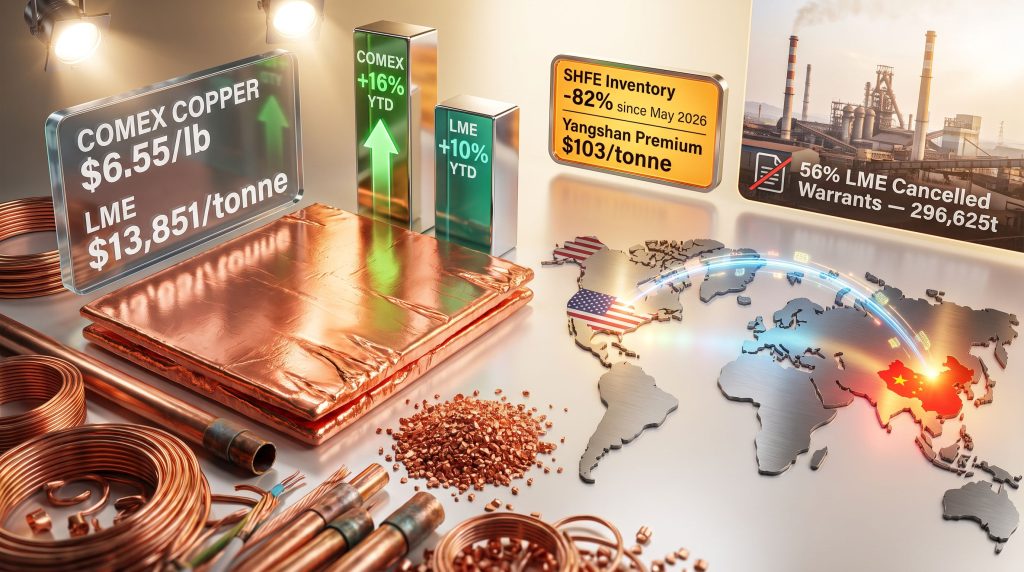
COMEX September copper futures climbed to $6.55 per pound, placing the metal within less than 2% of its all-time high set in early June 2026. During particularly volatile trading sessions tied to tariff speculation, intraday COMEX copper touched as high as $6.716 per pound. On the London Metal Exchange, three-month copper advanced 1.7% to $13,851 per tonne, its strongest level since mid-June 2026. Year-to-date, COMEX copper has appreciated approximately 16% in New York compared to roughly 10% in London, and the gap between those two figures tells its own story.
The COMEX-LME Premium as a Live Tariff Probability Gauge
One of the most analytically useful features of the current copper market is the transatlantic price spread between COMEX and LME copper. This gap, which expanded to approximately $500 to $600 per tonne, more than doubling from the prior week's differential, functions as a real-time market estimate of U.S. tariff probability.
The logic is straightforward. If the U.S. imposes import duties on refined copper, domestic buyers must pay the world price plus the tariff. That additional cost gets embedded into COMEX prices ahead of time, because sophisticated market participants build positions based on probability-weighted outcomes rather than waiting for certainty. The wider the COMEX-LME spread, the more the market is pricing in the likelihood of an import duty becoming law.
| Metric | Value | Significance |
|---|---|---|
| COMEX-LME price premium | ~$500-$600/tonne | More than double the prior week's spread |
| COMEX September copper | $6.55-$6.716/lb | Within 2% of all-time record |
| LME 3-month copper | $13,851/tonne | Highest since June 15, 2026 |
| YTD COMEX copper gain | ~16% | Outperforming London on tariff premium |
| YTD LME copper gain | ~10% | Reflecting global supply fundamentals |
What the market is currently pricing reflects expectations of a phased tariff structure on refined copper imports, with rates potentially starting at around 15% from January 2027 and escalating toward 30% by 2028. These remain market expectations rather than confirmed policy. The U.S. Department of Commerce was originally scheduled to update its copper market assessment by late June 2026, and that deadline has passed without a formal announcement. The White House retains final decision-making authority, meaning any development — or prolonged silence — can trigger sharp price movements in either direction.
The premium embedded in COMEX copper over LME represents probabilistic policy risk, not verified supply value. If Washington signals a delay or scaled-back approach, the $500-plus per tonne premium could unwind rapidly.
China's Physical Copper Market Is Flashing Multiple Stress Signals
While the tariff premium explains the New York-London price gap, the broader copper rally requires a separate explanation rooted in genuine physical market tightness inside China. Two specific indicators from Chinese copper markets are particularly telling.
Domestic Cathode Premiums Surge From Zero
The spot cathode premium paid above Shanghai Futures Exchange copper futures climbed to 435 yuan per tonne, equivalent to approximately $61 per tonne, having stood at essentially zero just one week earlier. This is the highest domestic cathode premium recorded since May 2025. A rising cathode premium signals that buyers are willing to pay above the futures benchmark to secure copper for immediate physical delivery rather than forward contracts. It is a classic and reliable indicator of near-term physical scarcity.
What makes this move notable is the speed of the reversal. Moving from zero to a 14-month high in a single week is not a gradual tightening; it reflects an abrupt shift in the balance between available supply and immediate demand.
Yangshan Import Premiums at 14-Month Highs
The Yangshan copper import premium, which importers pay on top of the LME price to bring refined copper physically into China, reached $103 per tonne according to Shanghai Metals Market data. This is also the highest level since May 2025, and represents a more than fivefold increase from the $20 per tonne level recorded in January 2026.
Import premiums at this level confirm that domestic Chinese copper supply chains are unable to satisfy near-term demand without drawing in higher-cost material from international markets. When both the domestic cathode premium and the import premium rise simultaneously, it indicates copper is becoming scarce across multiple supply pathways within China at the same time.
Warehouse Inventory Data Confirms the Physical Tightness
The premium data is corroborated by inventory figures across the major global exchange warehouses, and the picture they paint is consistent with genuine supply stress rather than speculative positioning.
Shanghai Futures Exchange inventories have collapsed by 82% since early May 2026. This is one of the most rapid drawdown rates observed for a major exchange in recent years, and the pace far exceeds typical seasonal patterns. Furthermore, Shanghai stockpiles dropping 82% has drawn significant attention from commodity analysts globally.
LME warehouse stocks declined 28% over the same period, reaching 296,625 tonnes as of the most recent reporting date. Of that total, 166,025 tonnes, representing 56% of all registered stocks, were under cancelled warrants. In LME market terminology, a cancelled warrant means the copper has been formally earmarked for physical withdrawal from the warehouse system. Cancelled warrant copper is no longer available as tradeable buffer stock, meaning the effective available inventory is far smaller than the headline figure suggests. The LME cash-to-three-month spread also moved close to backwardation, a market structure in which near-term delivery commands a premium over forward contracts, historically associated with acute short-term supply shortages.
COMEX inventories, by contrast, remain elevated at over 630,000 tonnes, accumulated across eight consecutive quarters. This stockpile does not reflect robust U.S. demand growth; it reflects proactive pre-tariff accumulation by market participants importing copper ahead of potential duties.
| Exchange | Inventory Level | Recent Change | Key Context |
|---|---|---|---|
| SHFE (Shanghai) | Sharply reduced | -82% since May 2026 | Fastest drawdown in recent history |
| LME (London) | 296,625 tonnes | -28% since May 2026 | 56% under cancelled warrants |
| COMEX (New York) | 630,000+ tonnes | +8 consecutive quarters | Pre-tariff accumulation, not demand-driven |
Global Smelter Networks Are Under Structural Pressure
The tightness in the refined copper market cannot be fully understood without examining conditions at the smelting level, where concentrate from mines is processed into the cathode copper that eventually reaches industrial users. The picture here adds a medium-term dimension to what might otherwise appear to be a short-cycle supply disruption.
The SAVANT satellite activity index, developed by Earth-i using remote sensing technology to track thermal and operational signatures at smelter facilities globally, recorded that 16% of global copper smelting capacity was inactive during Q2 2026. In Chile, specifically, smelter inactivity reached 25.4%, the highest level recorded since 2019. This coincides with a 12.9% year-on-year decline in Chilean copper production in May 2026. The resulting Chile supply gap has consequently become one of the most closely watched metrics in global copper market analysis.
Satellite-based smelter monitoring is a relatively recent innovation in commodity market intelligence. Unlike trade data or government statistics, which can lag by weeks or months, satellite thermal signatures provide near-real-time visibility into whether a smelter is operating at capacity, running at reduced throughput, or fully idled. The SAVANT dataset has become an increasingly referenced tool for commodity analysts seeking to cut through reporting delays in key producing nations.
Treatment Charge Economics Are Squeezing Refiner Margins
A key driver of smelter inactivity is the collapse in treatment charges. Treatment charges, commonly abbreviated as TCs in industry parlance, are the fees that smelters earn from mining companies for converting copper concentrate into refined metal. When TC rates fall too low, smelters cannot cover their operating costs and face a choice between running at a loss or idling capacity.
In Japan, the Onahama smelter, which operates with an annual capacity of 354,000 tonnes, showed no operational activity signatures in June 2026 according to satellite intelligence data. Market assessments suggest this facility may cease processing copper concentrate by early 2027, which would represent a meaningful reduction in global refining capacity at a time when the physical market is already tight.
Smelter inactivity driven by low treatment charges is not a temporary blip. It represents a structural constraint on refined copper supply growth that could persist well into 2027 and 2028, even if mine output recovers. The refining bottleneck may outlast the current tariff-driven price cycle.
The next major ASX story will hit our subscribers first
The Sulphur Supply Chain: An Underappreciated Vulnerability
One dimension of the copper supply picture that receives far less mainstream attention than mine output or smelter capacity is the vulnerability of the sulphur supply chain, particularly as it relates to a specific production method known as solvent extraction-electrowinning, or SX-EW.
SX-EW is used to produce copper directly from oxide ore deposits using a hydrometallurgical process that relies on sulphuric acid as the primary leaching agent. The copper leaching process depends on sulphur, which is largely a byproduct of oil and gas refining. Middle East instability, including reported threats to maritime routes near Saudi Arabia and an incident involving a vessel in the Strait of Hormuz in mid-July 2026, carries indirect but material implications for sulphur supply chains that feed oxide copper operations globally.
While a ceasefire proposal between the U.S. and Iran briefly reduced oil price volatility and improved risk sentiment for industrial metals, renewed tensions have kept supply chain risks elevated. If sulphur availability were disrupted, SX-EW copper producers — which account for a meaningful share of output in Chile, Peru, and parts of Africa — could face additional production constraints beyond those already visible in the data.
Equity Markets Are Amplifying the Signal
Copper mining equities moved sharply higher in response to the price rally, and the breadth and magnitude of gains across geographies confirm that professional investors are interpreting this as a structural market development rather than a short-term technical bounce.
| Company | Exchange | Single-Day Gain | Context |
|---|---|---|---|
| Lundin Mining | TSX | +6.7% | High direct copper revenue exposure |
| Southern Copper | NYSE | +6.5% | One of the world's largest copper producers |
| Freeport-McMoRan | NYSE | +6.3% | Largest U.S.-listed pure-play copper major |
| First Quantum Minerals | TSX | +5.9% | Significant copper operations in Zambia |
| Teck Resources | NYSE/TSX | +3.7% | Growing copper profile post-coal divestiture |
| BHP | NYSE/ASX | +3.6% | Copper increasingly central to group strategy |
| Glencore | LSE | +3.0% | Diversified major with large copper trading book |
| Rio Tinto | NYSE/LSE | +2.0% | Oyu Tolgoi copper ramp-up in focus |
The gains reflect operating leverage — the mechanism by which mining company profits grow disproportionately relative to commodity price increases once fixed costs are covered. A producer with a cost base of $3.50 per pound sees its margin nearly double when copper moves from $5.50 to $6.55 per pound, even though the price itself has only increased by roughly 19%.
Three Scenarios for Copper Prices Through 2027
Given the multi-factor nature of the current rally, any serious assessment of where copper prices go from here requires thinking across multiple scenarios rather than committing to a single forecast. In addition, the copper supply crunch dynamic underlying these scenarios has been building for considerably longer than the current tariff cycle suggests.
Scenario 1 (Bullish): Tariff confirmation plus sustained China tightness
- Washington announces a phased refined copper tariff starting at 15% from January 2027
- SHFE inventories continue declining; Yangshan premiums hold above $80 per tonne
- COMEX copper tests and potentially exceeds its all-time high
- Equity upside concentrated in U.S.-listed producers and royalty companies
Scenario 2 (Neutral/Consolidation): Tariff delay with China demand stabilisation
- Washington delays its refined copper tariff decision into the first half of 2027
- The COMEX-LME premium compresses back toward $200-$300 per tonne
- Copper consolidates in the $5.80-$6.20 per pound range on COMEX
- LME copper remains supported above $12,500 per tonne by physical fundamentals
Scenario 3 (Bearish): Tariff abandonment plus China demand disappointment
- The U.S. opts for alternative trade measures, bypassing refined copper-specific duties
- China demand softens due to property sector headwinds or manufacturing deceleration
- The COMEX-LME spread collapses; copper retreats toward $5.00-$5.50 per pound
- Smelter restarts ease physical tightness and inventory rebuilding begins
The current market is priced closest to Scenario 1, with the COMEX premium embedding significant tariff probability. The asymmetric risk lies in Scenario 2 or 3 outcomes, where the policy-driven component of the copper price unwinds faster than physical fundamentals can absorb. Traders tracking live copper prices will want to monitor the COMEX-LME spread closely as the primary real-time signal.
Frequently Asked Questions About Copper's 2026 Price Surge
What is driving copper prices in New York near record highs?
COMEX copper has approached all-time highs because of two converging forces: measurable physical tightness inside China's copper market, evidenced by collapsing warehouse inventories and surging import premiums, combined with market expectations that the U.S. will impose tariffs on refined copper imports beginning as early as January 2027. This is precisely why copper prices in New York near record on China supply tightness and US tariff expectations has become one of the most closely followed stories in commodity markets.
What does a cancelled warrant in LME copper warehouses mean?
A cancelled warrant indicates that a specific parcel of copper in an LME-registered warehouse has been formally earmarked for physical withdrawal. Once a warrant is cancelled, that copper is no longer available as tradeable buffer stock. When 56% of LME copper stocks carry cancelled warrants, the effective available inventory is far smaller than the headline tonnage figure suggests.
Why does LME backwardation matter for copper markets?
Backwardation occurs when the cash price for immediate delivery trades above the forward price for future delivery. In copper, this structure signals that buyers are willing to pay a premium to secure metal now rather than wait, reflecting urgent near-term scarcity. It is a high-conviction physical market stress indicator.
What are treatment charges and why do they affect copper supply?
Treatment charges are fees paid by mining companies to smelters for converting copper concentrate into refined metal. When TC rates fall to levels where smelters cannot cover operating costs, facilities reduce throughput or idle entirely. The current low-TC environment is a key reason why smelter inactivity reached 16% globally and 25.4% in Chile during Q2 2026.
How does sulphur connect to copper production risk?
Oxide copper deposits are processed using sulphuric acid in the SX-EW method. Sulphur, the feedstock for sulphuric acid, is predominantly a refinery byproduct. Geopolitical disruptions affecting major oil-producing regions in the Middle East carry indirect implications for sulphur availability, which could constrain oxide copper output if supply chains are materially disrupted.
Key Takeaways: What the Copper Market Is Signalling in Mid-2026
The copper price environment in mid-2026 is not the product of a single catalyst or a speculative momentum trade. It reflects a genuine convergence of structural supply constraints across multiple dimensions of the global copper system. However, as with any complex multi-factor market, the same confluence of forces that drove prices higher could reverse with equal speed.
- Physical tightness in China is measurable and multi-dimensional, with SHFE inventories down 82%, Yangshan premiums at 14-month highs of $103 per tonne, and domestic cathode premiums at 435 yuan per tonne
- U.S. tariff expectations are embedding a $500-$600 per tonne premium into COMEX copper over LME, reflecting probabilistic policy pricing that remains sensitive to Washington's next move
- Global smelter constraints, particularly the 25.4% inactivity rate in Chile and the potential idling of Japan's Onahama facility, are limiting refined copper supply growth and could extend tightness into 2027
- LME market structure signals, including a 56% cancelled warrant rate and proximity to backwardation, reinforce near-term physical scarcity across exchange warehouse systems
- Equity markets have amplified the price signal, with major producers gaining 3% to 7% in a single session, reflecting investor confidence in the structural durability of the rally
The risk in the current setup lies in its complexity. A rally supported by multiple converging forces can also be undone by multiple factors reversing simultaneously. Investors and market participants should approach the current copper price environment with a clear-eyed understanding of both the genuine physical constraints driving the market and the policy uncertainty that remains unresolved.
This article is intended for informational purposes only and does not constitute financial or investment advice. Forecasts, price scenarios, and tariff expectations described herein reflect market consensus views at the time of writing and are subject to change. Readers should conduct independent research and consult qualified advisers before making investment decisions. Physical market data referenced in this article is sourced from Shanghai Metals Market and MINING.COM industry reporting.
Want to Track the Next Major Copper Discovery Before the Market Does?
Discovery Alert's proprietary Discovery IQ model scans ASX announcements in real time, instantly identifying significant mineral discoveries — including copper — and converting complex data into actionable insights for investors at every experience level. Explore how historic mineral discoveries have generated substantial returns on Discovery Alert's dedicated discoveries page, and begin your 14-day free trial today to position yourself ahead of the broader market.