July 22, 2026
When Commodity Price Leverage Becomes Profit Alchemy
In mining, there is a concept that experienced commodity investors understand intuitively but rarely see executed this cleanly: the asymmetric relationship between input costs and revenue when metal prices move sharply higher. When a producer's cash cost per pound remains near the bottom of the global cost curve while the commodity price surges by nearly a third year-over-year, the financial outcome is not merely good. It is transformational. This is precisely the dynamic that defined Grupo Mexico's second quarter of 2026, and it offers a masterclass in how Grupo Mexico profit beats estimates on higher copper prices through price leverage at scale.
When big ASX news breaks, our subscribers know first
Why Grupo Mexico Profit Beats Estimates on Higher Copper Prices: The Core Mechanics
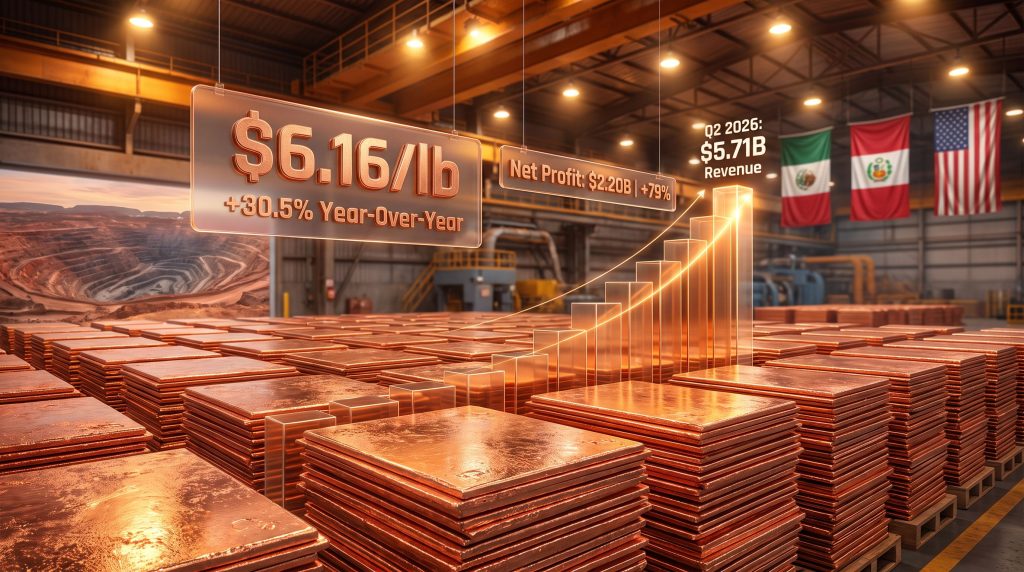
The headline result demands immediate attention. Grupo Mexico recorded net profit of $2.20 billion for Q2 2026, a figure that surpassed the $1.66 billion consensus estimate compiled by LSEG by a substantial margin. Total revenues climbed 35% year-over-year to $5.71 billion, edging past the $5.65 billion analyst forecast. These are not marginal beats. They represent a structural divergence between what models projected and what commodity markets actually delivered.
Understanding why this result unfolded requires dissecting three simultaneous forces that converged in the quarter:
- Copper prices rose 30.5% year-over-year, reaching a realised price of $6.16 per pound
- Cash costs in the mining division fell 10% to just $0.93 per pound
- Mining division sales grew 41.3% from the same period in 2025
Each of these forces would be meaningful in isolation. Together, they created an earnings outcome that caught consensus estimates flatfooted, illustrating how quickly commodity price models can become obsolete in a fast-moving market.
The Full Q2 2026 Financial Scorecard
| Financial Metric | Q2 2026 Actual | Analyst Estimate (LSEG) | Year-Over-Year Change |
|---|---|---|---|
| Net Profit | $2.20 billion | $1.66 billion | +79% |
| Total Revenue | $5.71 billion | $5.65 billion | +35% |
| Copper Price Realised | $6.16/lb | — | +30.5% |
| Cash Cost (Mining Division) | $0.93/lb | — | -10% |
| Copper Production (Q2) | 257,537 tonnes | — | -3.7% |
What the table above communicates clearly is that volume was not the driver of this result. Production actually declined 3.7% from the prior year period, weighed down by softer output from Peruvian operations and the US-based Asarco unit. Mexican operations partially offset these declines. The lesson is unambiguous: in a high-price environment, price per unit exerts dramatically more influence over profitability than modest volume fluctuations.
The Copper Price Story Behind the Numbers
How Copper Reached $6.16 Per Pound
A 30.5% year-over-year move in copper prices is not routine. To contextualise it, copper spent much of the 2015-to-2020 period trading in a range between $2.50 and $3.00 per pound. The structural shift in demand that began accelerating post-2020 has fundamentally repriced what the market considers a fair value for the metal. Furthermore, understanding the copper price drivers that underpin this repricing is essential context for any forward earnings analysis.
The demand architecture driving this repricing rests on several interconnected pillars:
- Electric vehicles (EVs) require approximately 2.5 to 4 times more copper than internal combustion engine vehicles, with battery electric vehicles using between 60 and 83 kilograms of copper depending on vehicle size and drivetrain configuration
- Grid modernisation programs across North America, Europe, and Asia are requiring unprecedented volumes of copper wiring, transformers, and switchgear as ageing electrical infrastructure is overhauled
- Renewable energy installations including wind turbines and solar farms are highly copper-intensive, with offshore wind projects requiring roughly 9.9 tonnes of copper per megawatt of installed capacity
- Data centre construction driven by artificial intelligence infrastructure investment has added a less-discussed but rapidly growing source of copper demand, as power delivery and cooling systems are copper-dependent
The structural demand floor for copper is now higher than at any previous point in the metal's industrial history, because electrification is not a cyclical trend but a multi-decade infrastructure imperative. This is what distinguishes the current copper bull market from prior price cycles.
Supply Constraints That Amplify Price Sensitivity
What makes copper's price trajectory particularly durable is the supply side of the equation. Developing a new copper mine from discovery to production typically requires 10 to 20 years, and grades at many of the world's largest operating mines are declining. The average copper ore grade at major producing mines has fallen from roughly 1.5% in the 1990s to closer to 0.5% today at many operations, meaning more rock must be processed to produce the same volume of metal.
Consequently, this structural tightening of supply against rising demand creates a persistent upward bias in pricing. The copper supply crunch that analysts have long flagged is now manifesting directly in quarterly earnings results, benefiting low-cost producers disproportionately.
Cost Efficiency: The Other Half of the Margin Story
What $0.93 Per Pound Really Means in a $6.16 World
Grupo Mexico's cash cost reduction to $0.93 per pound deserves separate examination. A cash cost at this level places the company firmly in the lowest quartile of global copper producers by production cost. This positioning is strategically important not just for profitability in good times, but for resilience during periods of price weakness.
The gross cash margin per pound implied by these figures is striking:
- Realised price: $6.16/lb
- Cash cost: $0.93/lb
- Implied gross cash margin: approximately $5.23 per pound
Multiplied across 257,537 tonnes of quarterly production (roughly 567 million pounds), the raw cash generation capacity from copper alone in Q2 2026 was exceptional. The 10% reduction in cash costs year-over-year is also notable because it occurred at the same time as a volume decline, suggesting genuine operational efficiency improvements rather than simply the benefit of fixed cost dilution across higher volumes.
For every sustained $0.50 per pound increase in copper prices above the cash cost floor, Grupo Mexico's mining division captures that margin across its entire production base. With annual guidance of 1.03 million tonnes, price sensitivity analysis is essential for any forward earnings model.
Scenario Analysis: Copper Price Sensitivity on Annual Earnings Direction
| Copper Price Scenario | Implied Cash Margin | Earnings Direction vs. Q2 Run-Rate |
|---|---|---|
| Copper at $4.50/lb | ~$3.57/lb | Significant margin compression |
| Copper at $5.50/lb | ~$4.57/lb | Moderate normalisation |
| Copper at $6.16/lb (Q2 2026) | ~$5.23/lb | Strong beat territory |
| Copper at $7.00/lb | ~$6.07/lb | Material outperformance vs. consensus |
Note: Scenario analysis is illustrative and does not constitute financial advice. Forward earnings are subject to commodity price volatility, operational variables, and currency movements.
Production Geography and the Volume Decline in Context
Three Operating Jurisdictions, Three Risk Profiles
Grupo Mexico operates across Mexico, Peru, and the United States through its Asarco subsidiary. Each jurisdiction carries a distinct risk and operational profile:
- Mexico delivered a production increase during Q2 2026, partially offsetting declines elsewhere, and represents the company's core operational base
- Peru experienced lower output, a reflection of the operational complexity that frequently affects large-scale South American mining operations, including geological variability and community relations dynamics that can disrupt extraction schedules
- Asarco (USA) also recorded lower volumes, with the US operations facing their own cost structure and regulatory environment distinct from the Latin American assets
The importance of geographic diversification in copper mining is often underappreciated. Concentrating production in a single jurisdiction exposes operators to country-specific risks including political change, permitting delays, water access restrictions, and labour disputes. Grupo Mexico's multi-country footprint provides a structural hedge against any single jurisdiction underperforming simultaneously.
Annual Production Guidance and Global Peer Comparison
Grupo Mexico maintained its 2026 full-year guidance of 1.03 million tonnes of copper production, reinforcing confidence that Q2's volume shortfall reflects timing factors rather than structural production challenges. In addition, peer context is instructive when assessing where the company sits in the global competitive landscape, particularly relative to the top copper producer rankings globally.
| Producer | Estimated Annual Copper Output (2026) | Primary Operating Regions |
|---|---|---|
| BHP | ~1.7 million tonnes | Chile, Australia |
| Grupo Mexico | ~1.03 million tonnes | Mexico, Peru, USA |
| Rio Tinto | ~700,000 tonnes | Mongolia, USA, Australia |
| First Quantum Minerals | ~750,000 tonnes | Panama (suspended), Zambia |
Production estimates are approximate and sourced from publicly available company guidance and analyst data. Figures may differ from final reported outputs.
Tia Maria: The $1.25 Billion Growth Bet on Peru's Copper Future
Project Status and Financing Structure
Among the forward-looking developments disclosed alongside Q2 earnings, the Tia Maria copper project in Peru stands out as the most consequential near-term growth catalyst. At 42% completion as of the end of Q2 2026, the project is targeting first production during the second half of 2026.
To fund Tia Maria's development, Grupo Mexico executed a $1.25 billion, 10-year senior unsecured bond issuance. The choice of this financing instrument is strategically revealing for several reasons:
- Senior unsecured status signals that lenders are comfortable extending credit based on the company's overall creditworthiness rather than requiring project-specific asset collateral
- A 10-year tenor locks in growth capital at fixed terms without diluting existing shareholders, preserving the equity upside of production expansion
- The scale of the issuance reflects institutional investor confidence in both Grupo Mexico's credit profile and the long-term trajectory of copper demand
What Tia Maria Means for Peru and Regional Copper Economics
Tia Maria has had a prolonged and contentious development history, with community opposition and permitting challenges delaying the project for many years before construction ultimately commenced. Its progression to 42% completion represents a meaningful milestone in what has been one of Peru's most watched mining development stories.
Peru is consistently one of the world's top two or three copper producers, and large new projects like Tia Maria carry significant implications for national export revenues, government royalty streams, and local employment. The project's eventual commissioning will add to Peru's copper export capacity at a time when global demand for the metal is accelerating. Furthermore, the emergence of copper project partnerships between major producers and development-stage operators reflects a broader industry trend of de-risking large capital projects through collaborative financing structures.
The next major ASX story will hit our subscribers first
Infrastructure Diversification: Beyond the Mine Gate
Rail Asset Strategy in Brazil and Argentina
One of the less-discussed dimensions of Grupo Mexico's strategic positioning is its active pursuit of freight rail infrastructure assets across Latin America. The company has disclosed interest in acquiring a stake in a rail asset in Brazil and is monitoring the outcome of a freight rail tender process in Argentina.
The Argentina opportunity comes with an important qualifier: Grupo Mexico has indicated it would only proceed if granted full operational and infrastructure control. This condition reflects a lesson well understood by mining conglomerates that have been caught in partial-ownership arrangements where operational decision-making authority is fragmented, creating inefficiencies and strategic friction.
The logic behind a mining company owning freight rail infrastructure is more compelling than it might initially appear:
- Vertical integration reduces dependence on third-party logistics providers whose pricing can erode mining margins during periods of high freight demand
- Transportation assets generate revenue streams that are largely uncorrelated with copper price movements, providing natural earnings diversification
- Rail ownership provides strategic control over the supply chain that connects mine sites to ports and processing facilities, a particularly valuable capability in regions where infrastructure reliability is variable
Infrastructure diversification into freight rail is not simply a financial hedge. For a company with large mining footprints across multiple Latin American countries, controlling the movement of product from extraction point to export terminal represents a genuine operational advantage that is difficult for competitors to replicate quickly.
Investment Framework: Reading the Signals in Grupo Mexico's Q2 Beat
Three Structural Takeaways for Copper Sector Investors
For investors monitoring the copper sector broadly, Grupo Mexico's Q2 2026 performance communicates several durable insights. Copper investment strategies that account for producer cost positioning and price leverage are particularly well-suited to the current market environment.
1. Cost position is the primary determinant of earnings leverage in commodity cycles. A company with a cash cost of $0.93 per pound experiences earnings growth that is exponentially superior to a competitor at $2.50 per pound when prices move from $5.00 to $6.16 per pound. The margin expansion is not linear; it is multiplicative at lower cost bases.
2. Volume declines need not be alarming in a price-driven bull market. A 3.7% production decline alongside a 30.5% price increase produces a dramatically superior financial outcome. Investors who fixate on volume metrics during commodity price surges risk misreading the fundamental profitability trajectory.
3. Bond financing for growth projects is a shareholder-friendly capital allocation signal. When a company with strong credit quality funds expansion through debt rather than equity issuance, it is communicating confidence in future cash flows while protecting existing shareholders from dilution. The $1.25 billion Tia Maria bond should be interpreted through this lens.
Key Forward Indicators to Monitor
- Tia Maria commissioning timeline: Any delay beyond the second half of 2026 target would defer the production volume uplift the market is pricing into forward estimates
- Copper spot price trajectory: Given the sensitivity illustrated above, movements beyond $6.50 per pound would generate significant additional upside versus current consensus
- Peru and Asarco operational recovery: A return to normalised volumes in these two units alongside sustained high prices would compound an already strong earnings base
- Latin American infrastructure tender outcomes: Progress on Brazil and Argentina rail assets will indicate whether the transportation diversification strategy is advancing materially
Frequently Asked Questions
What drove Grupo Mexico profit to beat estimates so significantly in Q2 2026?
Three converging factors produced the outperformance. Copper prices rose 30.5% year-over-year to $6.16 per pound, cash costs fell 10% to $0.93 per pound, and mining division sales grew 41.3%. The combination pushed net profit to $2.20 billion against a consensus expectation of $1.66 billion, a beat of roughly 33%. As Reuters reported, the result was driven primarily by the exceptional price environment rather than volume growth.
Why did production fall 3.7% while profits surged 79%?
Lower output from Peruvian operations and the Asarco unit in the United States reduced total volumes. However, the magnitude of copper's price appreciation relative to the modest volume decline demonstrates a core principle of commodity economics: in high-price environments, realised price per unit dominates profitability far more than incremental volume changes.
How does Grupo Mexico's $0.93 per pound cash cost compare globally?
A cash cost at this level positions Grupo Mexico among the lowest-cost major copper producers globally, likely in the bottom quartile of the industry cost curve. This provides substantial protection against price downturns and amplifies margin expansion when prices rise, creating an asymmetric earnings profile that investors in commodity stocks should recognise as structurally advantageous.
What is the strategic purpose of the Tia Maria bond issuance?
The $1.25 billion, 10-year senior unsecured bond funds construction of the Tia Maria copper project in Peru, which was 42% complete at the end of Q2 2026 and is targeted to begin operations in the second half of 2026. The unsecured structure and decade-long tenor reflect strong institutional confidence in the company's balance sheet and the long-term copper demand outlook, while avoiding equity dilution for existing shareholders.
Is Grupo Mexico's infrastructure push into rail assets a distraction from its core mining business?
The rail asset strategy in Brazil and Argentina represents deliberate earnings diversification rather than strategic drift. Freight infrastructure revenues are largely independent of copper price movements, providing a natural offset during commodity downturns. For a Latin American mining conglomerate, controlling logistics infrastructure is also a genuine operational advantage in regions where third-party freight reliability can be variable. BingX market analysis of the Q2 result likewise highlighted the infrastructure strategy as a complementary long-term value driver rather than a distraction from the core business.
This article is intended for informational purposes only and does not constitute financial advice. All earnings figures, production data, and analyst estimates are sourced from publicly available reporting. Scenario analyses and forward-looking statements involve assumptions that may not reflect actual outcomes. Readers should conduct their own independent research before making any investment decisions. Further coverage of global copper market dynamics and Latin American mining developments is available through Mining Weekly at miningweekly.com.
Want To Catch the Next Major Copper Discovery Before the Market Does?
Discovery Alert's proprietary Discovery IQ model scans ASX announcements in real time, instantly identifying significant mineral discoveries across copper and 30+ other commodities — turning complex data into actionable investment opportunities for both short-term traders and long-term investors. Explore historic discoveries and their exceptional returns, then begin your 14-day free trial at Discovery Alert to position yourself ahead of the broader market.