May 21, 2026
Mining operations across global copper markets are witnessing unprecedented convergence of geological, technological, and infrastructure challenges that threaten established supply chains. As mature mining districts face resource depletion and declining ore quality, the industry confronts a fundamental recalibration period where traditional extraction methodologies prove insufficient against evolving operational constraints.
This structural transformation extends beyond isolated operational difficulties, encompassing systematic pressures from water scarcity in arid mining regions, increasing geological complexity at deeper extraction levels, and rising safety standards that prioritise workforce protection over production targets. Understanding these dynamics becomes critical as global copper demand accelerates through electric vehicle manufacturing, artificial intelligence infrastructure development, and industrial electrification initiatives.
Strategic Implications of Major Copper Output Reductions
Market participants increasingly recognise that significant production adjustments at major mining operations create cascading effects throughout global copper supply networks. When established producers reduce output guidance, the ripple effects extend far beyond immediate tonnage shortfalls, influencing price discovery mechanisms, inventory management strategies, and long-term investment planning across the entire value chain.
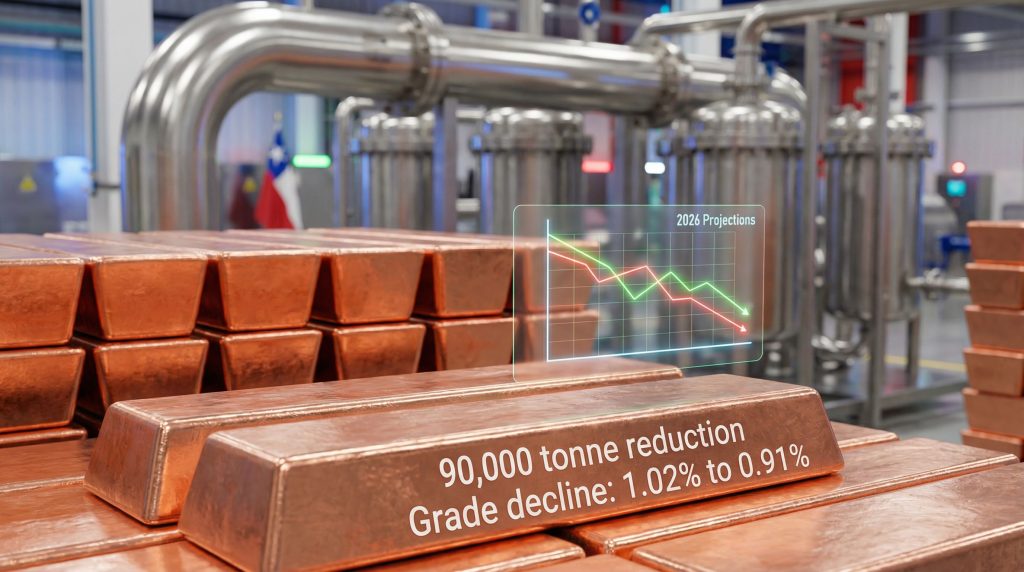
Glencore Collahuasi mine copper production reduction represents a prime example of how operational constraints at a single facility can reshape market expectations. The company has revised its 2026 copper output forecast downward to 840,000 tonnes from an original target of 930,000 tonnes, creating a 90,000-tonne annual deficit that market analysts view as symptomatic of broader industry evolution trends.
Quantifying Production Shortfall Impact
The magnitude of this reduction becomes more significant when contextualised against Glencore's production trajectory. Current 2025 output expectations hover around 850,000 tonnes, indicating that the 2026 forecast represents not growth from current levels, but an actual decline in productive capacity.
Key production metrics reveal the scale of adjustment:
• 2025 Expected Output: 850,000 tonnes (current year baseline)
• 2026 Revised Target: 840,000 tonnes (90,000-tonne reduction from original plans)
• Production Variance: 9.7% below initially projected capacity expansion
• Recovery Timeline: Output restoration to 930,000 tonnes targeted for 2027
This production profile indicates that operational constraints have effectively postponed Glencore's copper expansion plans by approximately 12 months, with broader implications for global supply adequacy during a period of accelerating demand growth.
Mine Sequencing Challenges and Grade Deterioration Patterns
Technical analysis of the Glencore Collahuasi mine copper production reduction reveals two primary operational constraints driving the output revision. Lower copper ore grades at the Collahuasi facility represent a fundamental challenge affecting extraction economics and processing efficiency.
Grade deterioration manifests through several interconnected mechanisms:
• Resource Depletion: Higher-quality ore bodies within the deposit have been progressively exhausted
• Geological Complexity: Remaining ore reserves require advanced extraction techniques and extended processing cycles
• Infrastructure Strain: Lower grades demand increased processing volumes to maintain equivalent metal output
• Unit Cost Escalation: Reduced ore quality directly correlates with higher per-tonne extraction and processing expenses
Water supply infrastructure limitations compound these geological challenges, creating a dual constraint environment that limits operational flexibility and expansion potential. The interaction between inadequate water supplies and declining ore grades creates operational bottlenecks that traditional mining optimisation strategies struggle to resolve effectively.
When big ASX news breaks, our subscribers know first
Water Supply Constraints in Chile's Atacama Region
Chile's Atacama Desert presents one of the world's most extreme arid environments for large-scale mining operations. The region's virtually non-existent precipitation patterns create fundamental water scarcity challenges that affect multiple mining operations beyond Glencore's Collahuasi facility.
Collahuasi operates as a joint venture between Glencore and Anglo American in this challenging geographical context, where water sourcing becomes a critical production constraint. The facility's operational challenges stem directly from inadequate water supplies that limit ore processing capacity and overall extraction efficiency.
Desalination Technology as Production Enabler
Advanced desalination infrastructure represents the most viable long-term solution for sustainable mining operations in the Atacama region. These technological systems convert seawater into industrial-grade water suitable for ore processing, tailings management, and dust suppression activities.
Desalination implementation provides several operational advantages:
• Consistent Supply: Ocean-based water sources eliminate dependency on variable groundwater or precipitation
• Quality Control: Processed seawater offers predictable chemical composition for ore processing optimisation
• Environmental Compliance: Reduced pressure on local aquifer systems addresses regulatory concerns
• Scalability: Desalination capacity can expand to match increased production requirements
However, desalination infrastructure requires substantial capital investment and ongoing operational costs, particularly energy consumption for water treatment and transportation to mining sites located hundreds of kilometres inland from coastal desalination facilities.
Infrastructure Investment Requirements for Sustainable Operations
Water security projects in the Atacama region demand comprehensive infrastructure development spanning desalination facilities, pipeline networks, and storage systems. These projects typically require multi-year development timelines and significant capital commitments before generating operational benefits.
Infrastructure components include:
• Coastal Desalination Plants: High-capacity seawater processing facilities
• Pipeline Networks: Pressure-resistant transportation systems spanning desert terrain
• Storage Infrastructure: Strategic water reserves for operational continuity during maintenance periods
• Treatment Facilities: On-site water processing for specific ore processing requirements
The capital-intensive nature of these projects often requires partnership structures or long-term financing arrangements that can affect mine development timelines and overall project economics. Furthermore, copper exploration challenges in water-scarce regions demonstrate the industry's broader struggle with infrastructure limitations.
Glencore's Revised Production Timeline Signals for Copper Markets
Glencore's production forecast adjustments provide valuable insights into broader copper market dynamics and supply-side pressures affecting the global mining industry. The company's revised timeline suggests that operational constraints are temporary rather than permanent, with clear recovery pathways identified for 2027 and beyond.
Production Forecast Analysis:
| Year | Original Target (tonnes) | Revised Forecast (tonnes) | Variance |
|---|---|---|---|
| 2026 | 930,000 | 840,000 | -90,000 |
| 2027 | 930,000 | 930,000 | 0 |
| 2028 | 1,000,000 | 1,000,000 | 0 |
This production trajectory indicates that 2026 represents the nadir of operational constraints, with full recovery anticipated by 2027 and expansion resuming in 2028.
Long-term Growth Strategy Through Asset Diversification
Glencore management has articulated an ambitious long-term vision extending well beyond the current operational challenges at Collahuasi. The company targets approximately 1.6 million tonnes of annual copper production by 2035, representing a substantial increase from current output levels.
This expansion strategy encompasses multiple development components:
Alumbrera Mine Restart (2028):
• Copper Production: 75,000 tonnes annually
• Gold Output: 317,000 ounces annually
• Molybdenum Production: 1,000 tonnes annually
• Commercial Timeline: First half 2028 startup
African Operations Expansion:
• Enhanced production capacity at existing African mining assets
• Brownfield development opportunities in established mining districts
• Infrastructure improvements supporting increased throughput
Latin American Growth Projects:
• Brownfield expansion at existing facilities
• Resource base extensions through exploration and development
• Regional infrastructure optimisation for cost reduction
This diversification approach reduces concentration risk associated with single-asset dependency while creating multiple pathways for production growth independent of Collahuasi performance. Moreover, this strategy aligns with broader copper investment trends favouring geographically diversified portfolios.
Treatment Charges Reflecting Supply-Side Pressures
Copper concentrate treatment charges serve as a critical market indicator reflecting supply-demand dynamics between mining operations and smelting facilities. Recent treatment charge movements provide clear evidence of tightening supply conditions across global copper concentrate markets.
The Fastmarkets copper concentrates TC index reached $(66.40) per tonne on November 28, 2025, representing a $1.00 per tonne increase from the previous week's assessment of $(65.40) per tonne. This negative territory pricing has persisted since mid-December 2024, indicating sustained supply constraints lasting approximately 11 months.
Concentrate Market Tightness Indicators
Negative treatment charges represent an unusual market condition where smelters must provide financial incentives to secure adequate concentrate supplies. This pricing dynamic directly contradicts normal market operations where concentrate suppliers pay treatment fees to smelting facilities for processing services.
Market tightness manifests through several key indicators:
• Sustained Negative Pricing: Extended periods of negative TC values indicate structural supply deficits
• Procurement Competition: Smelting facilities compete aggressively for available concentrate supplies
• Regional Premium Development: Geographic pricing differentials emerge as transportation costs become significant
• Quality Specification Premiums: Higher-grade concentrates command additional pricing advantages
Price Discovery Mechanisms in Copper Concentrates
The TC index calculation methodology reflects real market dynamics through midpoint assessment between smelter buying positions and trader selling levels. This transparent price discovery mechanism provides market participants with reliable benchmarks for contract negotiations and risk management strategies.
Asia Pacific regional pricing serves as the global reference point, reflecting the region's dominant smelting capacity concentration. The geographic focus on Asia Pacific markets acknowledges the region's critical role in global copper processing and its influence on worldwide concentrate pricing patterns.
Treatment charge volatility affects multiple stakeholders:
• Mining Companies: Negative TCs improve concentrate sales revenues
• Smelting Operations: Reduced processing margins pressure operational profitability
• Trading Firms: Arbitrage opportunities emerge from regional pricing differentials
• End Users: Refined copper pricing incorporates concentrate market dynamics
Broader Industry Trends Amplifying Supply Concerns
Global copper mining operations face convergent challenges that extend far beyond isolated operational difficulties at individual facilities. Industry-wide patterns suggest systematic constraints affecting multiple major producers simultaneously, creating compound effects on global supply adequacy.
The mining sector confronts three primary challenge categories that are reshaping production capabilities across established operations:
Declining Ore Grades: Mature mining districts worldwide experience progressive depletion of higher-quality ore bodies, requiring increased processing volumes to maintain equivalent metal output levels.
Difficult Geological Conditions: Deeper mining operations encounter more complex geological formations that demand advanced extraction techniques, specialised equipment, and extended operational timelines.
Safety-Related Disruptions: Fatal accidents at mining operations have triggered production suspensions and enhanced safety protocols that prioritise workforce protection over production targets.
Multi-Mine Operational Disruptions Across Major Producers
Recent industry developments demonstrate that supply constraints affect multiple major producers simultaneously, creating cumulative market impact beyond individual operational adjustments. For instance, Argentina copper systems face similar grade decline challenges as operations mature.
Current Industry Disruptions:
| Company | Primary Challenge | Production Impact | Recovery Timeline |
|---|---|---|---|
| Glencore | Grade decline/water supply | -90,000 tonnes (2026) | 2027-2028 |
| Teck Resources | Red Dog mine depletion | Gradual zinc decline from 2026 | Permanent reduction |
| Various Operators | Fatal accident responses | Temporary suspensions | Variable recovery periods |
These simultaneous challenges create market conditions where traditional supply buffer mechanisms prove insufficient to maintain stable pricing and delivery schedules.
Demand-Side Pressure From Emerging Technologies
Copper consumption patterns are experiencing fundamental transformation driven by technological advancement and industrial electrification trends. Three primary demand drivers create unprecedented consumption requirements that traditional supply models struggle to accommodate:
Electric Vehicle Manufacturing:
• Powertrain systems require substantially higher copper content than internal combustion engines
• Battery management systems utilise extensive copper wiring and components
• Charging infrastructure development demands significant copper cable installations
AI Data Center Construction:
• High-performance computing systems require enhanced electrical conductivity
• Cooling system infrastructure utilises copper heat exchange components
• Power distribution systems demand high-capacity copper cabling
Industrial Electrification:
• Manufacturing sector transition from fossil fuel to electrical systems
• Smart grid infrastructure development requiring extensive copper installations
• Renewable energy systems utilising copper-intensive components
The convergence of declining supply reliability with accelerating demand growth from emerging technologies creates unprecedented market dynamics that challenge traditional copper market forecasting models and supply chain management strategies.
Strategic Resource Security Implications
Geographic concentration of copper production in South American regions creates strategic vulnerability concerns for technology-dependent industries. The Glencore Collahuasi mine copper production reduction exemplifies how operational challenges in specific geographic regions can disproportionately affect global supply security.
Resource security considerations include:
• Supply Chain Vulnerability: Heavy dependency on specific geographic regions increases disruption risk
• Alternative Sourcing Strategies: Industrial consumers seek diversified supply arrangements
• Strategic Reserve Development: Government and corporate stockpiling programmes gain importance
• Recycling Capacity Enhancement: Secondary copper sources become increasingly valuable
Additionally, US copper production overview reveals similar constraints affecting North American operations, highlighting the global nature of these challenges.
Investor Interpretation of Production Guidance Revisions
Mining industry investors require sophisticated analytical frameworks for interpreting production guidance adjustments and their implications for equity valuations, dividend sustainability, and long-term investment returns. The Glencore Collahuasi mine copper production reduction provides a case study for evaluating how operational challenges translate into financial performance metrics.
Production variance analysis must consider multiple factors beyond immediate tonnage shortfalls, including capital allocation priorities during operational challenges, cash flow impact scenarios, and management's demonstrated ability to execute recovery strategies.
Risk Assessment Framework for Mining Equity Valuations
Sophisticated investors employ multi-factor analytical approaches when evaluating production guidance revisions and their implications for mining company valuations. These frameworks consider both quantitative metrics and qualitative factors that influence long-term value creation potential.
Key Valuation Considerations:
• Revenue Impact Modelling: 90,000-tonne reduction affects gross revenue calculations based on prevailing copper price assumptions
• Cash Flow Sensitivity: Lower production volumes reduce operating cash flow generation during the constraint period
• Capital Allocation Efficiency: Management's approach to addressing operational challenges affects investor confidence
• Recovery Probability Assessment: Market evaluation of management's ability to execute stated recovery timelines
Comparative Analysis Against Industry Benchmarks
Investment analysis requires contextualising individual company performance against broader industry patterns and peer company operational metrics. Glencore's production challenges occur within a broader industry context of simultaneous constraints affecting multiple major producers.
Peer Performance Comparison:
• Rio Tinto: Announcing increased copper output targets amid Oyu Tolgoi mine expansion
• Teck Resources: Managing permanent production decline as Red Dog zinc mine approaches depletion
• Anglo American: Joint ownership of Collahuasi creates shared exposure to operational constraints
• BHP: Maintaining stable production guidance across diversified asset portfolio
This comparative analysis helps investors distinguish between company-specific operational challenges and systemic industry constraints affecting multiple operators.
The next major ASX story will hit our subscribers first
Global Copper Price Discovery Implications
Production shortfalls at major mining operations create immediate and long-term implications for copper price discovery mechanisms across spot, forward, and derivative markets. The Glencore Collahuasi mine copper production reduction contributes to broader supply-side pressures that influence price formation across global copper trading venues.
Supply deficit scenarios create price elasticity testing environments where market participants reassess fundamental supply-demand balance assumptions and adjust trading strategies accordingly.
Supply Deficit Scenarios and Price Elasticity
Copper markets exhibit varying price responsiveness to supply shortfall announcements depending on inventory levels, forward curve positioning, and broader economic conditions. The 90,000-tonne Glencore production reduction represents approximately 0.4% of global copper production, but market impact often exceeds proportional mathematical relationships.
Price discovery factors include:
• Inventory Drawdown Rates: Exchange inventory levels affect market sensitivity to supply announcements
• Forward Curve Adjustments: Future contract pricing incorporates supply uncertainty risk premiums
• Spot Market Dynamics: Immediate delivery requirements create price pressure during supply constraints
• Derivative Market Response: Options and futures positioning reflects market sentiment regarding supply adequacy
Regional Premium Development in Physical Markets
Physical copper markets often develop regional pricing differentials when supply constraints affect specific geographic regions or transportation routes. The concentration of copper production in South American mining districts creates potential for regional premium development during operational disruptions.
Transportation cost implications become significant when alternative sourcing requires longer shipping routes or different logistics arrangements. Quality specification impacts also affect pricing mechanisms when concentrate supplies exhibit varying chemical compositions or processing requirements.
Frequently Asked Questions About Copper Production Disruptions
Why Are Copper Mines Experiencing Simultaneous Production Issues?
Multiple convergent factors create industry-wide production challenges affecting numerous major mining operations simultaneously. Resource depletion patterns in mature mining districts represent a fundamental constraint as higher-quality ore bodies become progressively exhausted over decades of extraction activity.
Infrastructure ageing requires increased maintenance schedules and capital investment to maintain operational efficiency. Mining equipment, processing facilities, and transportation systems experience cumulative wear that eventually demands major refurbishment or replacement programmes.
Environmental compliance costs continue escalating as regulatory requirements become more stringent and monitoring technologies more sophisticated. These compliance requirements often necessitate operational modifications that can temporarily reduce production capacity whilst systems are upgraded or modified.
How Long Do Mine Sequencing Adjustments Typically Last?
Mine sequencing optimisation cycles vary significantly depending on geological complexity, infrastructure requirements, and resource base characteristics. Technical planning cycles for ore body optimisation typically require 12-24 months for comprehensive assessment and implementation.
Equipment repositioning requirements often extend these timelines, particularly when mining operations must relocate major infrastructure components such as processing plants, conveyance systems, or power distribution networks. Large-scale equipment moves can require 6-12 months for planning and execution.
Workforce retraining programmes for new extraction zones add additional time requirements, as personnel must develop proficiency with modified extraction techniques, safety protocols, and equipment operations specific to different geological conditions.
What Alternative Supply Sources Could Offset Production Losses?
Recycling capacity expansion represents the most immediate alternative supply source for offsetting primary production losses. Copper recycling operations can often increase throughput more rapidly than new mine development, though total recycling volume remains constrained by available scrap materials.
Secondary market activation during price rallies creates additional supply as industrial consumers and trading firms release inventory holdings. However, these secondary sources typically provide temporary supply augmentation rather than sustained production replacement.
Exploration pipeline development offers long-term supply potential but requires 5-10 years minimum for new discovery development through permitting, construction, and production ramp-up phases. This timeline limitation means exploration projects cannot address immediate supply shortfalls effectively.
Note: Market conditions and production forecasts referenced in this analysis reflect data available as of December 2025 and may be subject to revision as operational conditions evolve. Investors should verify current production guidance and market conditions before making investment decisions.
Further Reading: Readers seeking comprehensive copper market intelligence and pricing analysis can explore specialised commodity research platforms that provide detailed market assessments, forecasting analysis, and pricing data for metals and mining sectors.
Ready to Identify the Next Major Copper Discovery?
With global copper production facing unprecedented constraints and demand accelerating through technological advancement, Discovery Alert's proprietary Discovery IQ model delivers real-time notifications on significant ASX copper and mineral discoveries, empowering subscribers to capitalise on actionable opportunities ahead of the broader market. Explore how major mineral discoveries can generate substantial returns by examining historic examples of exceptional outcomes, and begin your 30-day free trial today to secure your competitive advantage during this critical period of supply-demand imbalance.