August 8, 2026
Copper's Coming Shortage and Why Restart Projects Are Gaining Serious Attention
The copper market is entering a prolonged period of structural tightness. Decades of underinvestment in new mine development, combined with surging energy transition demand from electric vehicles, grid infrastructure, and renewable energy systems, have created a supply gap that the industry is struggling to close. Greenfield copper projects routinely require ten to fifteen years from discovery to first production, and the permitting environment across many tier-one jurisdictions has grown more complex, not less. Against this backdrop, a distinct class of asset has attracted renewed investor scrutiny: the past-producing mine with retained infrastructure, a known resource, and a credible path to near-term production.
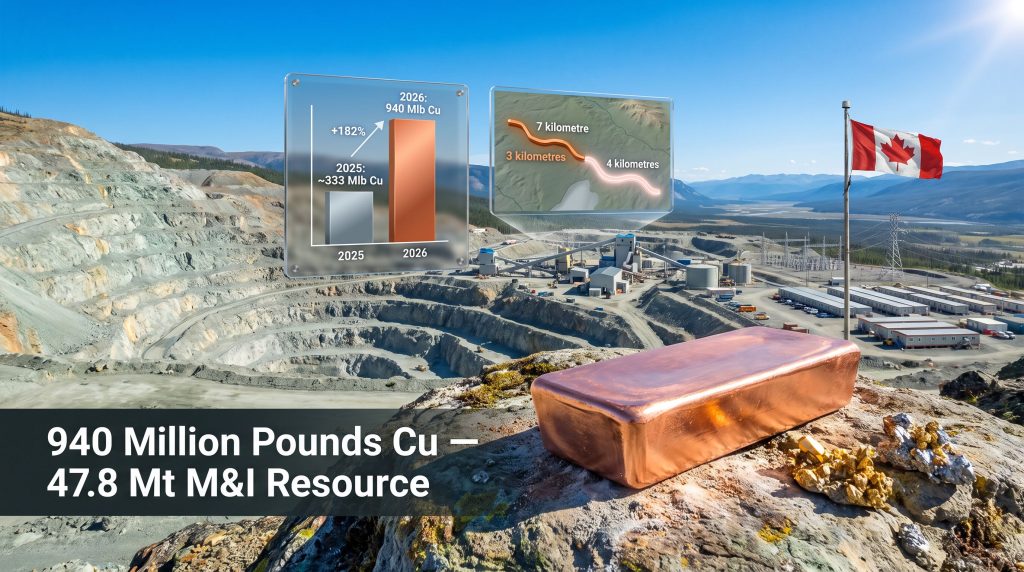
The Selkirk Copper Minto resource update, released on July 30, 2026, places the Minto copper-gold-silver project in central Yukon squarely within that category. However, the scale of the resource revision — a 182% increase in contained measured and indicated copper to 940 million pounds — warrants analysis beyond headline numbers. Understanding what drove that growth, what remains unbooked, and what the project's structural characteristics mean for its economics requires looking beneath the surface.
When big ASX news breaks, our subscribers know first
What the Minto-Carmacks Belt Offers That Most Explorers Can't
The Minto project sits approximately 250 kilometres north of Whitehorse within the Minto-Carmacks copper belt, a polymetallic corridor recognised for its copper-gold-silver endowment across multiple styles of mineralisation. The project itself covers 26,850 hectares, yet only roughly 3 kilometres of a 7-kilometre mineralised trend has been systematically drill-tested to date. That ratio is important context for any resource growth discussion.
What separates Minto from the broader universe of Yukon exploration plays is its operational history. The mine reached peak annual output of approximately 31,000 tonnes of copper, 40,000 ounces of gold, and 355,000 ounces of silver in 2016, demonstrating metallurgical performance and throughput rates at meaningful scale. That historical production baseline anchors the technical assumptions underpinning any restart study in a way that a purely exploration-stage project simply cannot replicate.
An operating history at or above the targeted restart production rate is analytically significant. It substantially reduces the metallurgical risk embedded in engineering assumptions, because the ore body's processing behaviour has already been demonstrated at commercial throughput.
Dissecting the 2026 Selkirk Copper Minto Resource Update
The Headline Numbers in Full
The 2026 mineral resource estimate, prepared independently by Moose Mountain Technical Services with an effective date of June 10, 2026, produced the following figures:
| Resource Category | Tonnes (Mt) | Cu (%) | Au (g/t) | Ag (g/t) | Cu (Mlb) | Au (koz) | Ag (Moz) |
|---|---|---|---|---|---|---|---|
| Measured & Indicated | 47.8 | 0.89 | 0.34 | 3.2 | 940 | 530 | 4.97 |
| Inferred | 16.9 | 0.76 | 0.29 | 2.8 | 281 | 142 | 1.50 |
The estimate is underpinned by 428,388 metres of drilling across 1,956 holes, representing a substantial body of geological data collected across multiple operators and exploration campaigns stretching back decades.
Year-on-Year Comparison: What Actually Changed?
| Metric | 2025 Estimate | 2026 Estimate | Change |
|---|---|---|---|
| M&I Tonnage | ~12.6 Mt | 47.8 Mt | +280% |
| M&I Copper Grade | 1.20% Cu | 0.89% Cu | -26% |
| M&I Contained Cu | ~333 Mlb | 940 Mlb | +182% |
| M&I Contained Au | Not reported | 530 koz | +184% |
| M&I Contained Ag | Not reported | 4.97 Moz | +188% |
The grade decline from 1.20% to 0.89% copper is the number most likely to draw scrutiny from investors unfamiliar with how resource estimates evolve. It deserves careful framing, and the role of cut-off grade economics is central to that understanding.
A falling grade alongside rising contained metal is not inherently a negative signal. In many mature resource expansions, it reflects a deliberate and rational widening of the economic boundary rather than geological deterioration.
Selkirk Copper has attributed the expansion to two roughly equal contributors:
- New drill-defined mineralisation at Minto North, Ridgetop, and the newly delineated Area 118 lens system, where the Phase 1 programme intersected economic-grade material in 87% of the 175 holes drilled across 52,288 metres
- Economic cut-off optimisation driven by higher prevailing copper, gold, and silver price assumptions, which reclassified previously sub-economic lower-grade material into the reportable resource
Investors evaluating the quality of this growth should treat these two mechanisms differently under a price-stress scenario. Drill-defined tonnes represent geological confirmation that is not price-dependent; cut-off-driven reclassification is inherently sensitive to metal price movements. Consequently, if copper prices were to decline materially, a portion of the 2026 resource could theoretically revert below the economic threshold.
Underground vs. Open Pit: Why the Split Matters for Mine Sequencing
The 2026 MRE separates underground and open pit components, with the underground portion carrying higher average grades. This architectural distinction is not merely technical — it has direct implications for capital sequencing, early cash flow generation, and the internal rate of return profile of any restart scenario.
Higher-grade underground zones are typically targeted for early production to maximise revenue per tonne processed in the capital recovery phase, while lower-grade open pit material extends the tail of the mine life and supports the overall resource tonnes needed to sustain the 12-to-15-year production target.
The Phase 1 Drilling Programme: Methodology and What an 87% Hit Rate Signals
For context, an 87% success rate in resource-expansion drilling is unusually high. Most resource-expansion drilling programmes targeting step-out zones or new lenses operate with considerably more geological uncertainty. The exceptional hit rate at Minto reflects the repeatability of the targeting model developed through prior operations and the continuity of the mineralised system along strike.
This is a technically meaningful data point for institutional investors. Repeatable targeting models reduce the exploration risk premium embedded in a project's valuation, because they suggest that future drilling programmes are more likely to yield economic intersections than programmes on less well-understood systems.
The three areas targeted in Phase 1 illustrate the breadth of the programme:
- Minto North extensions: Step-out holes confirming the northern continuation of the principal resource corridors
- Ridgetop extensions: Infill and step-out drilling along an elevated structural corridor with documented copper-gold mineralisation
- Area 118: A newly defined lens system representing genuinely new geological discovery within the broader Minto-Carmacks mineralised trend
The Unbooked Upside: Phase 2 Drilling and the Open Trend
Perhaps the most strategically significant piece of information in the July 30, 2026 release is what it does not include. A 50,000-metre Phase 2 drill programme was approximately 75% complete at the time of MRE publication. Those results are entirely absent from the current resource estimate.
This creates a quantifiable source of near-term resource upside that has not yet been reflected in any economic study. When Phase 2 results are eventually incorporated, the resource base supporting the feasibility study could be materially larger than the figures published in the current MRE.
Furthermore, approximately 4 kilometres of the 7-kilometre Minto-Carmacks mineralised trend remains completely undrilled. The inferred resource of 281 million pounds of copper at 0.76% Cu represents the most proximate conversion target, but the undrilled ground represents a longer-dated exploration option with no current carrying value in any economic assessment.
Infrastructure: The Variable That Changes the Capital Intensity Calculus
One of the least discussed but most financially consequential aspects of the Minto restart thesis is the retained asset base. When most development-stage copper projects are modelled, a substantial portion of the capital expenditure estimate relates to infrastructure construction: processing plants, accommodation, power supply, water management, and access roads.
At Minto, the following assets remain on site from prior operations:
- A fully constructed processing plant capable of supporting the targeted 4,100-tonne-per-day throughput
- A 400-person accommodation camp requiring refurbishment rather than construction
- Grid power connections, eliminating the need for diesel generation or new transmission infrastructure
- Water treatment facilities compliant with Yukon environmental requirements
This infrastructure footprint compresses both the capital requirement and the timeline to first production in ways that are difficult to replicate on a greenfield site. The engineering firms engaged for the trade-off study and PEA, Hatch and SRK Consulting, are working within an execution-oriented framework precisely because the fundamental infrastructure engineering is already resolved.
The management team has characterised the definitive feasibility study accordingly, describing it as an execution-focused exercise rather than a ground-up engineering programme, because so much of the foundational work is already complete.
The next major ASX story will hit our subscribers first
Ownership Structure and the Economic Alignment of the Selkirk First Nation
How the Current Structure Came to Be
The Minto project's ownership history is directly relevant to its current economics. The prior operator, Minto Metals (formerly Pembridge Resources), entered insolvency in May 2023. During those proceedings, two significant financial encumbrances were extinguished:
- The Wheaton Precious Metals gold and silver stream, which had generated more than US$250 million in payments to Wheaton over the mine's operating life
- The Sumitomo concentrate offtake agreement, which had governed the terms on which Minto's copper concentrate was sold into the market
The removal of these two instruments during insolvency is a material structural improvement for any future equity holder. Streaming agreements and offtake contracts at below-market terms can consume a substantial proportion of a mine's economic value, particularly for precious metals by-products that carry high margins. Their elimination means that the economics available to Selkirk Copper's shareholders are structurally cleaner than those available to the prior operator.
The only remaining royalty obligation is a 1.5% net smelter return payable to the Selkirk First Nation, which is the conventional royalty structure for Indigenous land use in the Yukon context.
Why 18.2% Equity Ownership by the Selkirk First Nation Is More Than a Political Signal
The Selkirk First Nation's position as the company's largest single shareholder at 18.2%, combined with its NSR royalty, creates a structurally aligned economic interest in the project's success. In the Canadian regulatory context, this alignment has practical consequences for the duty-to-consult process that accompanies permit applications and amendments.
Projects where Indigenous communities hold economic stakes alongside the developer have generally navigated permitting processes with fewer adversarial complications than projects where the community's interests are purely regulatory rather than financial. The permit amendment submission is targeted for October 2026, with the existing operating permit providing a regulatory baseline that a new entrant to the jurisdiction would not have.
The Study Pathway and Catalyst Timeline
| Milestone | Target Date |
|---|---|
| Preliminary Economic Assessment (PEA) | Mid-2026 |
| Feasibility Study commencement | Q3 2026 |
| Permit amendment submission | October 2026 |
| Feasibility Study completion | Mid-2027 |
| Investment decision | Mid-2027 |
| Mill commissioning | Q1 2028 |
| First production | Mid-2028 |
The PEA is notably the first economic assessment published on Minto since 2021, predating both the ownership restructuring and the Phase 1 resource expansion. Its release establishes the first market-facing economic framework under the current ownership and updated resource base, and sets the stage for institutional investors to evaluate the project against comparable copper development assets on a standardised NPV and IRR basis.
The feasibility study, targeting completion in mid-2027, is explicitly designed as an execution document rather than a discovery exercise, given the retained infrastructure and the geological knowledge base accumulated across more than 1,900 drill holes.
Targeted Production Parameters and What They Imply for Revenue Scale
| Production Parameter | Target |
|---|---|
| Throughput | 4,100 tonnes per day |
| Annual ore processed | ~1.5 million tonnes |
| Mine life | 12-15 years |
| Annual copper production | 18,000-22,000 tonnes |
| Annual gold production | ~25,000 ounces |
| Annual silver production | ~250,000 ounces |
| Annual copper equivalent | ~30,000 tonnes |
| First production target | Mid-2028 |
At current copper prices above US$4.50 per pound, an annual production profile of 18,000 to 22,000 tonnes of copper (approximately 40 to 49 million pounds) generates gross copper revenue in the range of US$180 million to US$220 million per year, before gold and silver credits. The precious metals by-product credits — roughly 25,000 ounces of gold and 250,000 ounces of silver annually — provide meaningful cost offsets that reduce the effective cash cost per pound of copper produced. In addition, the broader context of a copper supply crunch means that projects capable of delivering production within this timeframe command a structural premium in investor assessments.
Disclaimer: Revenue projections based on current spot prices are illustrative only and should not be interpreted as forecasts. Metal prices are volatile and actual production outcomes are subject to numerous operational, geological, regulatory, and market risks. Investors should rely on the company's formal economic studies for project economics.
Key Takeaways for Investors Evaluating the Minto Restart Case
The Selkirk Copper Minto resource update delivers several analytically distinct signals that deserve individual weighting:
- Scale confirmation at 940 Mlb M&I copper provides a resource foundation capable of sustaining the targeted 12-to-15-year mine life at 4,100 tpd throughput
- An 87% drill success rate in Phase 1 indicates a highly repeatable targeting model and reduces the geological risk premium embedded in the project
- Phase 2 drilling results remain unbooked, representing the most proximate source of near-term resource upside not yet reflected in any economic study
- Approximately 4 kilometres of undrilled trend provides longer-dated exploration optionality with no current carrying value
- Retained infrastructure compresses both capital requirements and the timeline to commissioning relative to comparable greenfield development projects
- Elimination of the Wheaton stream and Sumitomo offtake during insolvency leaves a structurally clean royalty position with only a 1.5% NSR
- Selkirk First Nation's 18.2% equity stake creates a structurally aligned partnership that addresses a category of permitting and community risk that has historically delayed comparable northern Canadian projects
- The dense catalyst schedule from Q3 2026 through mid-2028, encompassing feasibility completion, permit amendment, investment decision, and first production, provides multiple potential re-rating events within a compressed timeframe
This article is for informational purposes only and does not constitute financial advice. Past production performance does not guarantee future results. All timelines, production targets, and resource estimates are subject to change. Investors should conduct their own due diligence and consult a licensed financial adviser before making investment decisions.
Want to Know When the Next Major Copper Discovery Hits the ASX?
Discovery Alert's proprietary Discovery IQ model scans ASX announcements in real time, delivering instant notifications on significant mineral discoveries — including copper plays with the potential for substantial resource growth — so subscribers can act ahead of the broader market. Explore historic examples of major mineral discoveries and their returns, then begin your 14-day free trial at Discovery Alert to secure your market-leading edge.