June 11, 2026
Canada's Only Copper Smelter at a Crossroads: Emissions, Regulation, and Supply Chain Sovereignty
Few industrial policy challenges illustrate the complexity of the energy transition era quite like the dilemma facing legacy copper smelting operations. Across the developed world, governments are simultaneously demanding faster emissions reductions from ageing industrial facilities while recognising that those same facilities anchor domestic supply chains for critical minerals. The tension is not theoretical. It plays out in capital allocation boardrooms, courtrooms, and provincial legislatures, with consequences that ripple far beyond fence lines and into national economic resilience strategies.
Nowhere is this tension more sharply focused than at a single industrial facility in northwestern Québec, where decades of operational history, a community's health concerns, a nation's supply chain ambitions, and a multi-hundred-million-dollar investment decision have all converged simultaneously.
When big ASX news breaks, our subscribers know first
The Strategic Weight of Canada's Last Copper Smelter
The Horne Smelter in Rouyn-Noranda, Québec, occupies a position that no other facility in Canada replicates. As the country's only remaining copper smelting operation, it processes both primary copper concentrates and secondary recycled materials, feeding output directly to the Canadian Copper Refinery in Québec City, which represents Canada's sole integrated copper refining capability. The loss of either facility would sever the country's domestic copper midstream entirely, creating a structural dependency on foreign smelting that contradicts Canada's stated critical minerals energy security objectives.
According to a 2026 KPMG socioeconomic study, Glencore's Canadian copper operations supported more than 2,330 direct, indirect, and induced jobs in 2024, while contributing $1.2 billion in direct GDP. These figures frame the smelter not as a local employer but as a regional economic anchor whose disruption would generate cascading effects across the Abitibi-Témiscamingue region and beyond.
The facility's strategic significance has intensified in recent years amid rising global trade tariffs, geopolitical disruption to established supply chains, and growing competition for access to processed critical minerals. Glencore Canada's custom metallurgical assets COO, Marc Bédard, has articulated the view that Canada's domestic copper processing capacity has never carried greater national importance than it does today, pointing to the convergence of trade pressures and the global copper supply crunch as factors reshaping the facility's geopolitical relevance.
What makes the Horne Smelter case particularly instructive for policymakers and investors is that its future hinges not solely on operational economics or environmental performance, but on the intersection of both, shaped by regulatory design decisions that either enable or obstruct the capital investment required to advance emissions reductions.
How Glencore Horne Smelter Air Emissions Reductions Have Progressed Over Two Decades
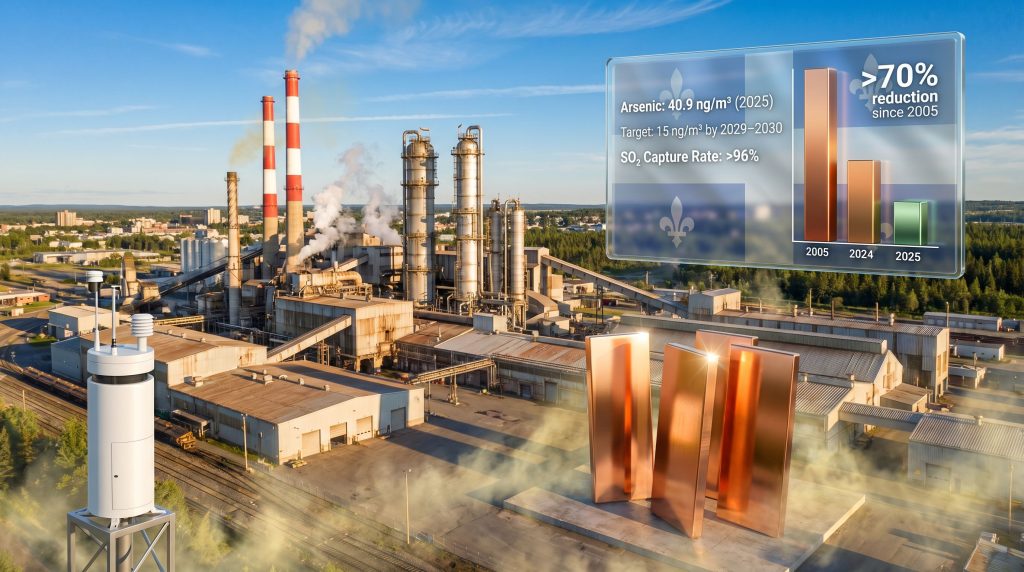
Understanding current emission levels requires situating them within a longer historical trajectory. Since 2005, ambient arsenic concentrations recorded near the Horne Smelter have declined by more than 70%, representing genuine and substantial operational progress driven by successive investments in emissions control infrastructure.
The following table summarises the key data points in the smelter's arsenic emissions history:
| Period / Metric | Arsenic Level |
|---|---|
| 2005 baseline | Substantially higher; 70%+ reduction achieved since |
| 2024 annual average | 39.1 ng/m³ |
| 2025 annual average | 40.9 ng/m³ |
| Current regulatory ceiling | 45 ng/m³ |
| Near-term target (extended by Bill 11) | 15 ng/m³ by 2029–2030 |
| Québec provincial standard | 3 ng/m³ |
The 2025 reading of 40.9 ng/m³ sits below the current regulatory ceiling of 45 ng/m³, maintaining technical compliance. However, it represents a marginal year-on-year increase from the 2024 figure of 39.1 ng/m³, a signal that warrants monitoring even if it does not constitute a regulatory breach. Operational variability in feedstock arsenic content, process conditions, and seasonal meteorological factors can all contribute to such fluctuations, and the industry literature on complex multi-pollutant metallurgical systems documents this challenge extensively.
Perhaps the most critical contextual figure is that the 2025 ambient level remains approximately 13.6 times above Québec's provincial standard of 3 ng/m³. This gap is not a product of regulatory negligence but of a fundamental technical constraint: achieving the provincial standard under the smelter's current configuration and feedstock profile is not technically feasible without transformative capital investment and potentially fundamental changes to operational approach.
Spatial monitoring data adds important nuance. In 2025, 96% of Rouyn-Noranda's urban area recorded arsenic concentrations at or below 15 ng/m³, with levels falling sharply as distance from the facility increases. This gradient confirms the highly localised nature of elevated arsenic exposure, concentrated in areas immediately adjacent to the smelter rather than distributed uniformly across the community.
Why the Technical Challenge Deepens at Lower Concentrations
A principle well understood in industrial air quality management is that early-phase emissions reductions yield the most dramatic improvements per dollar invested, as facilities capture and eliminate the largest emission sources first. Achieving the initial 70% reduction since 2005 was accomplished through a combination of process modifications and end-of-pipe control improvements that targeted primary emission sources.
The path from 40.9 ng/m³ to 15 ng/m³, and ultimately toward the 3 ng/m³ provincial standard, requires a fundamentally different approach. Arsenic volatilises from copper concentrates at smelting temperatures (typically 1,200°C to 1,300°C in flash furnace operations), converting to gaseous compounds including arsenic trioxide (As₂O₃), which condenses at approximately 465°C. The chemical behaviour of these compounds at varying temperatures affects capture efficiency across different control technologies, and fugitive emissions from multiple process points throughout the facility contribute to the overall ambient concentration. Addressing these sources requires integrated process re-engineering rather than incremental enhancement of existing controls.
Québec's Bill 11: Regulatory Certainty as an Investment Catalyst
The passage of Québec's Bill 11 in June 2026 represents a substantive legislative intervention that reshapes the regulatory landscape for the Horne Smelter through to 2033. Its most consequential provision is the extension of the deadline for achieving 15 ng/m³ ambient arsenic levels to 2029–2030, a two-year delay from the previously mandated 2027 target. The legislation maintains this 15 ng/m³ standard as a required floor through at least 2033, providing a defined compliance pathway over a seven-year horizon.
The mechanism through which this regulatory certainty generates environmental benefit is counterintuitive but well-supported by industrial investment theory. Earlier in 2026, Glencore Canada had suspended $300 million in planned environmental investments due to unresolved questions around air emission allowances and permit conditions. The operational logic is straightforward: without a defined compliance pathway, capital committed to emissions reduction infrastructure faces unquantifiable regulatory risk, making investment approval impossible regardless of environmental intent.
Regulatory uncertainty did not simply delay environmental progress at the Horne Smelter. It actively prevented it by making capital commitment for emissions reduction projects untenable. Bill 11 demonstrates that phased, certainty-backed compliance frameworks function as investment catalysts rather than operational burdens.
Bill 11's passage directly unlocks the resumption of these suspended projects, translating legislative action into near-term environmental investment. Furthermore, the broader policy implication is significant: rigid compliance deadlines that trigger operational paralysis or closure risk generate worse environmental outcomes than phased frameworks that provide the certainty required to mobilise capital. This insight has implications for industrial emissions governance well beyond the Horne Smelter.
Public Health Dimensions: Quantifying the Residual Risk
The health debate surrounding Glencore Horne Smelter air emissions reductions centres on the gap between what is industrially achievable and what constitutes an acceptable community health threshold. International health classification frameworks provide a structure for assessing this gap:
| Emission Level | Associated Cancer Risk Estimate |
|---|---|
| 45 ng/m³ (current regulatory ceiling) | Approximately 1 case per 10,000 people |
| 15 ng/m³ (extended interim target) | Approximately 4 cases per 100,000 people |
| 3 ng/m³ (Québec provincial standard) | Below Québec's negligible risk threshold |
At the current operational ceiling of 45 ng/m³, international health frameworks classify the associated cancer risk level as unacceptable for chronic community exposure. The extended target of 15 ng/m³, while representing a substantial improvement, still carries residual risk exceeding Québec's negligible risk benchmark. This creates a situation where even full compliance with the Bill 11 framework leaves a meaningful gap between regulatory achievement and the provincial health standard.
This gap is not unique to the Horne Smelter. It reflects a broader structural challenge in industrial emissions governance where health-protective standards are established based on epidemiological evidence, while compliance timelines must account for the technical and capital constraints of operating facilities. The Horne Smelter case makes this tension unusually visible because the provincial standard of 3 ng/m³ is among the most stringent arsenic limits applied to any industrial facility globally, stricter than European Union reference values that typically target below 6 ng/m³. Concerns about delays to emission targets and their health impacts have been widely reported, underscoring the community dimension of this challenge.
The Class Action Dimension
Compounding the regulatory complexity, a court-authorised class action lawsuit has been filed naming both Glencore and the Québec government as defendants. Plaintiffs are seeking moral damages, punitive damages, and injunctive relief related to arsenic exposure in the Rouyn-Noranda community. The court's authorisation of this proceeding signals that the judiciary views the emissions exposure as a legitimate basis for harm claims, creating a parallel accountability track alongside the legislative framework established by Bill 11.
The simultaneous existence of a legislated compliance extension and active litigation creates a complex accountability environment where Glencore must navigate regulatory, legal, and community relations pressures concurrently. For investors and analysts monitoring the company's Canadian operations, this dual exposure represents a material non-financial risk dimension that extends beyond the capital requirements of environmental modernisation. Indeed, the smelter bailout pressures observed in other Glencore operations globally offer a useful parallel for understanding how these dynamics can evolve.
The AERIS Program: Engineering a Path to Global Environmental Leadership
The technical roadmap for achieving the 15 ng/m³ target and progressing toward longer-term standards centres on the AERIS modernisation program, a capital initiative of more than $500 million structured around three interdependent sub-projects:
-
PHENIX — Re-engineering of the copper transformation process to reduce emissions generated at source, addressing the primary point of arsenic volatilisation within the smelting furnace environment.
-
R3 — Installation of a high-capacity industrial air cleaning system designed to capture fugitive emissions that bypass primary process controls, targeting the secondary emission sources distributed across the facility.
-
ECCO — Construction of a new energy-efficient casting wheel to modernise anode production, improving both environmental performance and operational efficiency in the later stages of copper processing.
A 2024 feasibility study produced an important and often overlooked finding: full simultaneous implementation of all three AERIS sub-projects would compromise operational stability rather than accelerate environmental outcomes, potentially delaying the achievement of emissions targets. This conclusion led Glencore to adopt an optimised phased implementation approach, sequencing the sub-projects to preserve plant viability while advancing emissions reductions progressively. Glencore's plan to invest over $500 million to address the facility's emissions has been widely noted as a landmark commitment.
This phased strategy reflects sophisticated industrial engineering judgement. Large-scale simultaneous modifications to interconnected process systems in an operating smelter create significant risks of unplanned interactions, extended commissioning periods, and operational disruptions that can temporarily increase rather than decrease emissions. The sequenced approach trades headline capital deployment speed for higher probability of achieving target outcomes on schedule.
Secondary Emission Controls Already Performing at High Standards
Beyond arsenic, the Horne Smelter's broader environmental performance profile includes several metrics that benchmark competitively against global peers:
-
The facility's sulfuric acid recovery plant captures over 96% of sulfur from incoming copper concentrates, placing it within the 95–98% capture range achieved by modern flash smelting operations globally.
-
An Intermittent Control System (ICS) was activated more than 350 times during 2024 to manage sulfur dioxide plume behaviour during adverse meteorological conditions, demonstrating active real-time emissions management.
-
Annual particulate matter emission intensity is maintained at 2 kg per tonne of copper produced, consistent with Glencore's environmental agreement with the Canadian federal government and competitive with top-quartile global operators.
Near-term infrastructure investments completed prior to the AERIS program are also delivering measurable fugitive dust reductions. These include concentrate storage domes, windbreak fencing installations, vacuum and water truck fleets, truck wheel cleaning stations, and optimisation of fugitive gas capture networks within the anode processing area. These lower-capital interventions represent the continued operationalisation of emissions commitments during the period when major capital projects are being sequenced.
The next major ASX story will hit our subscribers first
How the Horne Smelter Benchmarks Against Global Copper Smelting Standards
Placing the Horne Smelter's performance within a global context provides essential perspective for evaluating both its progress and its remaining challenges:
| Performance Metric | Horne Smelter (2025) | Global Benchmark Range |
|---|---|---|
| Ambient arsenic average | 40.9 ng/m³ | EU reference values typically below 6 ng/m³ |
| SO₂ capture rate | Above 96% | 95–98% for modern flash smelters |
| Particulate matter intensity | 2 kg/tonne | Competitive with top-quartile global operators |
| Arsenic reduction since 2005 | More than 70% | Benchmark-level long-term improvement trajectory |
The sulfur dioxide capture rate and particulate matter intensity place the Horne Smelter within competitive global performance ranges. Arsenic remains the primary performance gap, and understanding why requires acknowledging a feedstock-specific factor that distinguishes the Horne operation from many global comparators.
The facility processes a significant proportion of complex recycled and secondary copper materials, which often contain higher and more variable arsenic concentrations than primary concentrates from established mining operations. This feedstock characteristic is not a management failure but a deliberate operational choice that supports the circular economy by recycling materials that would otherwise require disposal. It also directly affects achievable arsenic emission levels under any given process configuration.
Full AERIS implementation, when completed, is projected to position the Horne Smelter among the highest environmental performers globally for copper smelting, a target that Marc Bédard has confirmed publicly as a core commitment of the modernisation program.
The Federal Funding Gap: Canada's Critical Minerals Ambition Meets Implementation Reality
Québec's Bill 11 represents a concrete, targeted regulatory response aligned with the operational realities of the Horne Smelter. The provincial government's action stands in contrast to the pace of federal implementation, where stated strategic priorities have not yet translated into the concrete support mechanisms that capital investment decisions require. In this respect, canada's energy transition challenges are particularly evident in the gap between policy ambition and on-the-ground investment delivery.
Glencore Canada has specifically identified the Strategic Response Fund as the federal mechanism through which co-investment support could be channelled to the Horne Smelter and the Canadian Copper Refinery. Bédard has made clear that federal partnership is not supplementary to the smelter's future but essential to it, framing the investment case as a supply chain security argument with national economic resilience dimensions rather than a request for sectoral subsidy.
The argument has structural logic that extends beyond the facility itself. Canada's stated critical minerals strategy explicitly identifies copper as a priority mineral for domestic processing and supply chain development. The Horne Smelter and Canadian Copper Refinery constitute the entirety of Canada's integrated copper midstream processing infrastructure. Federal inaction on Strategic Response Fund deployment does not simply affect one facility's environmental investment programme; it signals to global investors whether Canada's critical minerals ambitions are operationally backed or remain at the level of policy aspiration.
Canada has identified critical minerals and secure supply chains as strategic priorities, but the pace of federal implementation has not caught up to the urgency of on-the-ground investment decisions. Bédard has consistently made clear that decisive federal action is what remains between Canada having a genuine midstream anchor for its critical minerals ambitions and losing its only copper smelting capacity entirely. (Mining Weekly, June 2026)
The glencore canadian smelting challenges extend well beyond a single facility, however, reflecting systemic questions about how legacy industrial infrastructure is supported through the energy transition era.
Three Scenarios for the Horne Smelter's Future
The trajectory of the Horne Smelter over the next decade will be shaped by the interaction of environmental investment delivery, federal policy action, and legal proceedings. Three distinct scenarios emerge from current conditions:
| Scenario | Key Conditions | Projected Outcome |
|---|---|---|
| Full AERIS Implementation | Federal co-investment secured; phased AERIS delivery on schedule | Global top-tier environmental performance achieved by early 2030s |
| Partial Modernisation | Federal support delayed; optimised AERIS approach proceeds independently | 15 ng/m³ target met by 2029–2030; longer-term gap to provincial standard persists |
| Operational Closure Risk | No federal support; legal pressure intensifies; capital withheld | Loss of Canada's only copper smelting and refining capacity; critical minerals supply chain gap |
The asymmetry between these scenarios is striking. The upside of the full implementation pathway delivers both environmental leadership and supply chain security. The downside of closure delivers neither, while simultaneously eliminating any future possibility of achieving the emissions targets that regulators and communities are seeking.
Frequently Asked Questions: Glencore Horne Smelter Air Emissions
What is the current arsenic emission level at the Horne Smelter?
As of 2025, the recorded annual average ambient arsenic concentration near the facility was 40.9 ng/m³, below the current regulatory ceiling of 45 ng/m³ but approximately 13.6 times above Québec's long-term provincial standard of 3 ng/m³.
What does Québec's Bill 11 change for the smelter's operations?
Bill 11 provides a legislated operating framework through 2033 and extends the deadline for achieving 15 ng/m³ ambient arsenic levels to 2029–2030, a two-year extension from the prior 2027 target. This regulatory certainty directly enabled Glencore to resume environmental investment projects that had been suspended.
Why did Glencore pause its $300 million environmental upgrade programme?
Glencore suspended the upgrade programme in early 2026 because unresolved permit conditions and uncertain emissions allowances made it impossible to commit capital to projects with unquantifiable regulatory risk. Bill 11's passage resolved this uncertainty and allowed investment to resume.
What is the AERIS modernisation programme?
AERIS is a $500 million-plus capital modernisation initiative comprising three sub-projects: PHENIX (copper transformation process re-engineering), R3 (high-capacity air cleaning infrastructure), and ECCO (new casting wheel for anode production). Full implementation is targeted to achieve top-tier global environmental performance for the facility.
Is there active litigation related to the Horne Smelter's emissions?
A court-authorised class action lawsuit has been filed against both Glencore and the Québec government, seeking moral damages, punitive damages, and injunctive relief related to community arsenic exposure in Rouyn-Noranda.
What is the economic contribution of the Horne Smelter to Canada?
According to the 2026 KPMG socioeconomic study, Glencore's Canadian copper operations supported more than 2,330 direct, indirect, and induced jobs in 2024 and contributed $1.2 billion in direct GDP.
What the Horne Smelter Case Reveals About Industrial Emissions Governance
The Horne Smelter case is ultimately instructive not because it involves an intractable conflict between environment and economy, but because it illustrates how regulatory design choices determine whether these goals reinforce or undermine each other.
Regulatory frameworks that provide phased, certainty-backed compliance pathways generate more actual investment in environmental improvement than rigid deadlines that trigger investment paralysis or closure risk. Bill 11 is a practical demonstration of this principle. The $300 million in suspended environmental investment that resumed following its passage would not have been mobilised by an enforcement action under a fixed deadline without operational clarity.
The gap between industrially achievable targets (15 ng/m³) and community health thresholds (3 ng/m³) represents the genuinely unresolved dimension of the Glencore Horne Smelter air emissions reductions story. Bridging it will require not only the completion of AERIS but likely ongoing technological development, potential feedstock management changes, and federal investment support that matches the scale of the challenge.
Canada's critical minerals strategy cannot be credibly advanced without a functioning domestic copper midstream. Consequently, the Horne Smelter's continued viability is therefore not a sectoral concern but a national industrial policy question, one whose resolution will reveal whether Canada's articulated ambitions in critical minerals supply chain sovereignty are matched by the policy architecture and investment commitments required to realise them.
This article is intended for informational purposes only and does not constitute financial, investment, or legal advice. Forecasts, scenarios, and projections discussed involve inherent uncertainty and should not be relied upon as predictions of future outcomes. Readers with specific investment or legal questions should consult qualified professionals.
Want to Stay Ahead of the Next Major Copper Discovery on the ASX?
Discovery Alert's proprietary Discovery IQ model scans ASX announcements in real time, instantly identifying significant mineral discoveries across copper and more than 30 other commodities — turning complex data into actionable investment insights before the broader market catches on. Explore how historic discoveries have generated substantial returns on Discovery Alert's dedicated discoveries page, and begin your 14-day free trial today to position yourself ahead of the market.