
July 17, 2026
The Hidden Input That Copper Markets Forgot to Price
For most of the past decade, copper market analysis has been dominated by two dominant narratives: the energy transition demand surge and the geological depletion of high-grade deposits. Both remain structurally valid. But a third variable, one that rarely appears in exploration reports or mine feasibility studies, is now setting the pace of copper production more effectively than either grade decline or demand growth. That variable is sulfuric acid, and the sulfuric acid shortages in copper production now emerging across Latin America and sub-Saharan Africa represent a category of supply constraint that traditional mine models were never designed to capture.
Understanding why this matters requires stepping back from the geological framework that governs most copper analysis and examining the chemistry of how roughly one-fifth of the world's refined copper is actually produced.
When big ASX news breaks, our subscribers know first
How Sulfuric Acid Became the Rate-Limiting Factor in Copper Production
The Hydrometallurgical Chain: From Leach Pad to Cathode
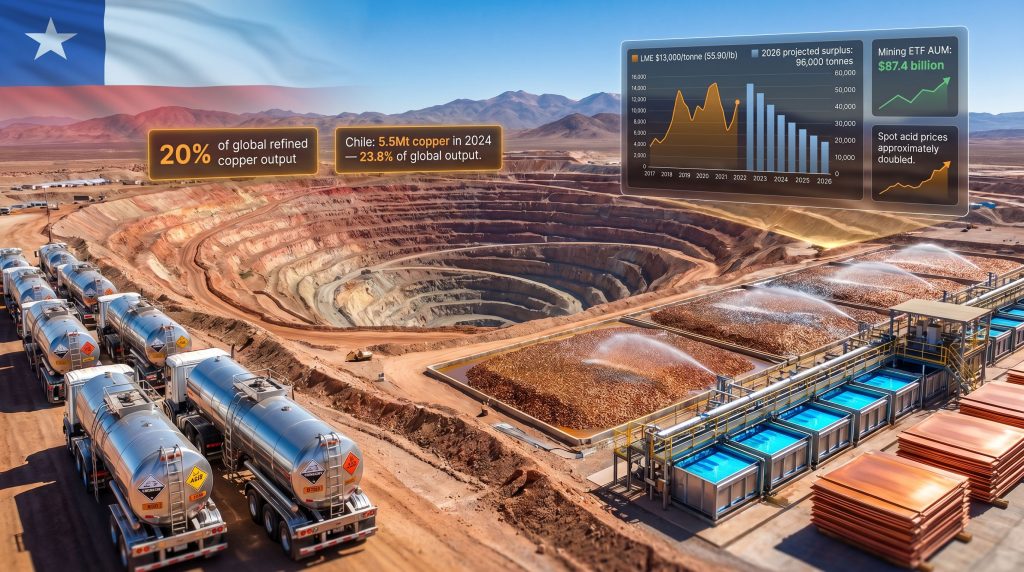
Approximately 20% of global refined copper output is produced not through smelting but through heap leaching followed by solvent extraction-electrowinning (SX-EW). In this process, copper oxide ores are stacked on lined pads and irrigated with an acidic solution that dissolves copper ions from the rock. The copper-rich solution is then processed through a solvent extraction circuit before electrowinning deposits pure copper cathode onto steel blanks.
The critical operational dependency in this chain is sulfuric acid. There is no viable chemical substitute at the throughput volumes required by commercial operations, and acid consumption scales in direct proportion to ore processed. This creates a production constraint that is fundamentally different from, say, a drilling delay or a processing plant bottleneck. Furthermore, copper smelting expansion dynamics are closely intertwined with acid availability, since smelters are a primary source of byproduct acid supply.
Key Insight: Because sulfuric acid is a co-product of smelting, sulfur combustion, and oil refining, its supply is governed by industries that operate on entirely different economic cycles from copper mining. Acid does not get produced in greater volumes because copper demand rises, and it does not get produced faster because copper prices increase.
Wood Mackenzie's April 30, 2026 outlook identified sulfuric acid availability, treatment and refining charge compression, trade policy, and fiscal risk as the operative supply constraints on copper, explicitly noting that none of these constraints reside in a resource statement. This observation carries significant analytical weight: it means production guidance issued by SX-EW operators now depends on inputs and policy variables that mine geology models cannot anticipate, and that can tighten on the timescale of weeks rather than years.
A sulfur shipment delay, for instance, reduces acid availability at the leach pad within weeks, then reduces cathode output within the same quarter, compressing the lag between a geopolitical event and its appearance in a producer's earnings report.
Why Acid Supply Cannot Respond to Price Signals
The structural inelasticity of sulfuric acid supply to copper price signals is one of the most important and least-discussed dynamics in global copper markets. The table below illustrates how response times differ across the supply chain:
| Supply Factor | Responsive to Copper Price? | Minimum Adjustment Lead Time |
|---|---|---|
| New copper mine development | Yes | 5 to 15 years |
| Smelter throughput expansion | Partially | 1 to 3 years |
| Dedicated acid plant construction | No | 6 to 18 months minimum |
| Acid logistics and import substitution | No | 3 to 9 months |
Even at elevated copper prices near $5.90 per pound (approximately $13,000 per tonne), acid producers cannot meaningfully accelerate output to satisfy copper leach demand. This makes sulfuric acid a genuine binding constraint rather than a temporary inconvenience that higher prices can resolve. Consequently, analysts tracking the copper supply crunch must now incorporate reagent availability as a core variable alongside traditional geological metrics.
The Dual Supply Shock: China's Export Restrictions and Middle East Sulfur Disruption
China's Policy Trigger and Its Effect on Chilean Acid Markets
China's implementation of sulfuric acid export restrictions beginning May 2026 represents the most consequential near-term supply disruption to regional acid markets in memory. China had historically served as a substantial acid exporter to copper-producing nations, with its share of Chilean sulfuric acid imports estimated at approximately 37% of total supply. The policy rationale centres on protecting domestic smelter feed economics and ensuring adequate acid availability for China's own industrial base.
The practical consequences for Chilean copper producers have been swift and severe. According to Reuters reporting on Chile's acid supply crunch, the situation has deteriorated rapidly as Chinese volumes have dried up ahead of the policy's effective date:
- Chinese acid shipments into Chile came to a near-complete standstill ahead of the May 2026 effective date
- Spot sulfuric acid prices have approximately doubled from pre-disruption levels
- Second-half 2026 acid requirements for Chilean operators remain largely uncovered by existing contracts or alternative supply arrangements
- Domestic Chilean supply from Noracid, Codelco, and Anglo American covers near-term requirements, but visibility deteriorates materially beyond mid-2026
- Logistics barriers associated with transporting hazardous chemicals significantly delay the substitution of Chinese volumes with alternative sources such as Peru
The Chile copper outlook has consequently darkened considerably. Chile produced 5.5 million metric tonnes of copper in 2024, representing approximately 23.8% of global output. Any sustained acid-driven production constraint in the world's largest copper-producing nation carries outsized consequences for global refined copper supply balances.
The Middle East Sulfur Chain: A Compounding Supply Constraint
Simultaneously, geopolitical conflict in the Middle East has disrupted sulfur exports to Asian sulfuric acid producers. Elemental sulfur is the primary feedstock for dedicated acid manufacturing plants, meaning reduced sulfur availability in Asia has further constrained the pool of acid available for export to copper-producing regions.
The compounding nature of these two disruptions is what makes the current situation structurally distinct from previous acid market tightness:
- Middle East sulfur export interruptions reduce Asian acid plant utilisation rates
- Reduced Asian acid output limits the alternative supply pool that Chilean and Peruvian operators might otherwise access
- China's export restriction and Middle East sulfur logistics disruptions are simultaneously compressing supply from different points in the acid production chain
- The two shocks are not correlated with each other, meaning they cannot self-correct simultaneously
Regional Exposure: Where Shortages Hit Hardest
| Region | Acid Demand Scale | Chinese Import Dependency | Domestic Production Coverage | H2 2026 Supply Risk |
|---|---|---|---|---|
| Chile | High (5.5Mt copper, 2024) | ~37% of imports | Partial via Noracid, Codelco, Anglo | High, H2 largely uncovered |
| DRC | ~2 million metric tonnes/year | Moderate | ~1/3 via smelter byproduct | Elevated, volumes already reduced |
| Peru | Significant | Moderate | Limited surplus capacity | Moderate to High |
| Zambia | Significant | Moderate | Low domestic production | High |
| Indonesia | Moderate | Moderate | Limited | Moderate |
In the Democratic Republic of Congo, the Kamoa-Kakula smelter produces approximately 117,871 tonnes of acid annually as a smelting byproduct, with potential capacity to reach 600,000 to 700,000 tonnes at full operation. Even at maximum byproduct recovery, domestic smelter acid covers only roughly one-third of DRC leaching requirements, compelling operators to ration acid consumption, reduce ore throughput, and rethink forward procurement strategies entirely.
Financial Flows Versus Physical Fundamentals: The Price Paradox
Why Copper Is Trading at $5.90/lb With a Surplus on Record
The International Copper Study Group's April 2026 spring meeting produced a remarkable set of revisions that reframed the global copper balance:
- 2025 global surplus revised to 455,000 tonnes, more than double the 178,000 tonnes implied by the October 2025 forecast
- 2026 surplus projected at 96,000 tonnes, a complete reversal from a prior forecast of a 150,000-tonne deficit
- Exchange warehouse inventories at 1.3 million tonnes, signalling physical abundance
- LME three-month copper near $13,000 per tonne ($5.90 per pound), inconsistent with what physical supply-demand fundamentals alone would support
The explanation for this disconnect lies not in the ore body but in the fund flow data. According to ETFGI, mining exchange-traded fund assets under management grew from $37 billion to $87.4 billion in the twelve months to March 31, 2026. First-quarter 2026 inflows of $8.24 billion reversed $2.52 billion of outflows recorded in the equivalent prior-year period.
Speculative positioning data reinforces this picture. Money managers held 59,132 net long CME copper contracts as of early May 2026, the largest bull commitment since mid-January 2026. Understanding the underlying copper price drivers therefore requires separating financial positioning effects from genuine physical supply signals.
Investor Warning: The price premium above physical fundamentals is driven by speculative positioning and generalist fund rotation into hard assets. A positioning unwind, rather than a smelter outage or physical supply disruption, now represents the primary near-term downside risk for copper equities.
Copper has evolved to function simultaneously as an industrial commodity and a macro hedge against inflation and geopolitical risk, which means price volatility is increasingly a function of positioning dynamics rather than mine supply. Investors underwriting copper equities at $5.90 per pound need to separate the price floor set by marginal production cost from the price premium set by financial flows. The former supports long-duration project economics. The latter supports near-term equity beta but introduces a specific and non-geological downside scenario.
Valuation Context: Where Multiples Sit in the Cycle
Major mining companies currently trade at 7 to 8 times EV/EBITDA, compared with 14 times during the 2008 to 2010 commodity supercycle peak. This valuation gap suggests that while generalist capital has rotated significantly into the sector, the market has not yet repriced mining equities to supercycle multiples. The implication for capital allocation is that disciplined, low-cost operators occupy a disproportionately attractive position: they benefit from elevated copper prices driven by financial flows while their cost structures are not yet threatened by the full weight of acid and energy cost inflation.
China's Policy Distortions and the Reliability Problem for Demand Data
VAT Enforcement and the Inventory Signal Problem
Stricter enforcement of value-added-tax invoicing rules in China is altering the behaviour of copper market intermediaries in ways that complicate the interpretation of physical demand signals. When tighter compliance requirements reduce the financial benefit of holding inventory for trading purposes, warehouse drawdowns can occur without reflecting genuine industrial demand growth.
ING noted on April 30, 2026 that stricter invoicing enforcement was slowing spot trading volumes, reducing the reliability of short-term demand data. Pre-holiday restocking ahead of China's Labor Day supported physical premiums in Shanghai, creating a temporary demand signal that may not reflect underlying consumption trends. Real consumption becomes harder to distinguish from policy-driven inventory behaviour, increasing the risk of misreading Chinese demand signals at a moment when the market is already complex.
The International Copper Study Group reduced its 2026 copper usage growth forecast to 1.6% from 2.1%, citing geopolitical headwinds as likely to moderate global industrial activity. In addition, the combination of overstated short-term physical signals and a downgraded medium-term demand outlook creates a narrow window for reading Chinese copper data cleanly. The broader copper trade impacts of policy-driven distortions further complicate demand forecasting across multiple regions simultaneously.
Capital Allocation Is Being Rewritten Around Input Security
The New Project Evaluation Hierarchy
The acid shortage environment has materially altered the criteria that institutional capital applies when evaluating copper development projects. The traditional hierarchy, which prioritised resource size, grade, and metallurgical recovery, is being supplemented by a new set of operational and input security filters:
- Input security – Is acid procurement contracted, infrastructure-leveraged, or exposed to the spot market?
- Capital intensity – Does the project fall below the $15,000 per tonne threshold?
- Infrastructure access – Can existing processing facilities eliminate standalone plant capital expenditure?
- Producer validation – Has a strategic investor or established operator provided a credibility signal?
- Pathway to production – Is there a funded, permitted, and executable construction timeline?
- Resource quality – Grade, strip ratio, and metallurgy remain necessary but no longer sufficient screens
Discovery upside has not lost strategic value, however institutional capital is increasingly discounting exploration results unless a credible, financed pathway to production exists alongside secured input supply.
Capital Intensity as the Primary Financial Differentiator
Marimaca Copper's 2025 feasibility study illustrates the economic advantage of efficient mine design in the current environment. The project can be constructed for just under $600 million to produce 50,000 tonnes of copper per year, translating into a capital intensity of approximately $11,700 per tonne, well below the $15,000 to $25,000-plus typical of comparable projects.
The key driver of this efficiency is strip ratio. The mine plan requires removing only 0.8 tonnes of waste to access 1 tonne of ore, versus 2 to 4 tonnes at many comparable Chilean projects. This directly lowers mining cost per tonne and reduces fuel, labour, and equipment intensity throughout the mine life.
| Project Type | Capital Intensity ($/t Cu) | Typical Strip Ratio | Capital Market Reception |
|---|---|---|---|
| High-efficiency, low-strip open pit | ~$11,700 | ~0.8:1 | Strongly favoured |
| Average open pit copper project | $15,000 to $20,000 | 2:1 to 4:1 | Selectively funded |
| Complex or high-strip development | $20,000 to $25,000+ | 4:1+ | Increasingly discounted |
| Underground copper development | $25,000 to $40,000+ | N/A | Requires exceptional grade |
At a copper price of $4.30 per pound, the Marimaca configuration delivers a 39% internal rate of return, demonstrating resilience well below current spot prices. The company raised C$80 million in April 2026 from Australian, Canadian, and US institutional investors and is targeting construction commencement before year-end 2026.
Hayden Locke, President and CEO of Marimaca Copper, has emphasised the importance of execution discipline in protecting project economics, noting that the company intends to increase the maturity of the project before committing to construction in order to reduce variations during the execution phase, rather than accelerating into development prematurely.
Infrastructure Leverage as an Acid Procurement Strategy
One of the least-discussed responses to the acid-constrained environment is the strategic decision by some developers to access existing SX-EW processing infrastructure rather than constructing standalone circuits. This approach simultaneously eliminates the capital expenditure of building a dedicated processing plant and bypasses the acid procurement risk associated with commissioning a new facility into a disrupted spot market.
Fitzroy Minerals signed a non-binding Letter of Intent on April 23, 2026 with Sociedad Punta del Cobre (Pucobre) to utilise Pucobre's Planta Biocobre SX-EW facility, which carries 9,600 tonnes per annum of nameplate cathode capacity and is located approximately 70 kilometres from the Buen Retiro Copper Project near Copiapó, Chile. Rather than constructing a standalone processing circuit and competing in a disrupted spot acid market, Fitzroy enters an existing acid supply arrangement through the joint venture structure.
Merlin Marr-Johnson, President and CEO of Fitzroy Minerals, has described the logic of this approach, noting that the company has initiated a preliminary economic assessment and is working on terms with Pucobre to establish a heap leach joint venture that could provide near-term, non-operated cash flow, which the company believes will distinguish it from other explorers in the current market environment.
Advantages of infrastructure-leveraged SX-EW development in an acid-constrained market:
- Access to established acid procurement contracts rather than spot market exposure
- Elimination of standalone plant capital expenditure
- Faster pathway to first cathode production
- Reduced earnings volatility from reagent cost inflation
- De-risked permitting through utilisation of an already licensed facility
Producer Validation as an Institutional Capital Signal
Strategic investment by established mining companies in exploration and development-stage projects has emerged as a key institutional capital filter. Abitibi Metals secured a C$30.75 million investment from Discovery Silver on April 23, 2026, representing approximately 9.9% of issued shares on a non-diluted basis. The financing is structured to fund more than 80,000 metres of drilling through 2027 with no warrants issued, preserving the existing capital structure through the targeted preliminary economic assessment milestone.
The B26 polymetallic deposit in Quebec hosts 12.96 million tonnes indicated at 2.08% copper equivalent and 12.34 million tonnes inferred at 2.20% copper equivalent, per the November 2024 NI 43-101 Technical Report by SGS Canada.
Jonathon Deluce, President and CEO of Abitibi Metals, has identified the strategic value of producer-level validation as a forward signal for institutional capital, noting that having attracted a world-class producing partner with a 9.9% equity stake provides a credibility signal that the company expects will drive continued interest from larger generalist funds.
In Canada's Yukon, Selkirk Copper is advancing the Minto Mine restart with 12.6 million tonnes indicated at 1.2% copper, 0.46 grams per tonne gold, and 4.27 grams per tonne silver. The project features more than C$300 million of sunk infrastructure including a 4,100-tonne-per-day mill, eliminating greenfield capital risk. Bankruptcy-cleared stream and offtake agreements preserve full project economics, while the Selkirk First Nation's 22% equity participation provides social licence stability in a jurisdiction that elected a pro-mining government in November 2025.
The next major ASX story will hit our subscribers first
The Investment Thesis for Copper in a Post-Acid Disruption World
Separating Durable Price Support from Temporary Financial Premia
The current copper market presents a genuine analytical challenge: prices near $5.90 per pound are being sustained by a combination of structural input cost inflation and non-fundamental financial positioning. Separating these two forces is essential for building a durable copper investment thesis. As Fastmarkets noted at CESCO Week 2026, sulfuric acid shortages in copper production have become one of the defining themes reshaping market dynamics for producers and investors alike.
The structural case rests on the following foundations:
- Sulfuric acid shortages in copper production are creating a permanent cost-floor reset for SX-EW operators without contracted input supply
- AISC inflation across the producing universe is raising the marginal cost floor that anchors long-term copper price expectations, compressing margins for spot-exposed operators
- China's export restrictions represent a policy-driven supply constraint with a political rather than geological resolution pathway, introducing a different kind of uncertainty than grade decline
The financial positioning case rests on:
- Mining ETF assets at $87.4 billion representing a generalist rotation into hard assets that has not yet been fully priced into mining equities trading at 7 to 8 times EV/EBITDA
- Copper functioning as both an industrial and macro hedge, attracting capital from funds that do not traditionally participate in mining
- Net long positioning at 59,132 CME contracts creating both upside momentum and a meaningful downside scenario if macro sentiment shifts
Disclaimer: The financial data, price projections, feasibility metrics, and positioning figures discussed in this article are drawn from sources including ETFGI, the International Copper Study Group, and company disclosures as of May 2026. This article does not constitute financial advice. Past performance and historical market relationships are not reliable indicators of future outcomes. Copper markets involve substantial commodity price risk, input cost volatility, and geopolitical uncertainty. Investors should conduct independent due diligence before making any investment decision.
The Framework That Is Rewarding Capital Allocation in 2026
Copper's investment case has shifted from how much resource exists to who can produce reliably under input, policy, and capital constraints. Resource size remains a necessary screen but is no longer sufficient. The framework rewarding capital allocation in the current environment prioritises:
- Input security over geological scale
- Capital intensity below $15,000 per tonne over reserve size
- Infrastructure access over standalone development ambition
- Producer validation over exploration upside narratives
- Funded construction timelines over resource delineation programs
The sulfuric acid shortages in copper production that are reshaping the Chilean and DRC leaching sectors are not a transient disruption that higher copper prices will resolve. They are a structural reminder that the inputs enabling copper extraction are governed by supply chains entirely separate from the geological and financial variables that copper analysts have historically tracked. The projects and operators that recognised this dependency early, and structured their procurement and processing strategies accordingly, are the ones that will convert the current macro tailwind into delivered cathode and durable cash flow.
Want to Know Which ASX Copper Explorers Are Positioned Ahead of the Acid Supply Crunch?
Discovery Alert's proprietary Discovery IQ model scans ASX announcements in real time, instantly identifying significant mineral discoveries — including copper — so subscribers can act on high-potential opportunities before the broader market catches on. Explore historic examples of major discovery returns and begin your 14-day free trial today to gain a market-leading edge in an increasingly complex copper landscape.