August 6, 2026
Global copper supply chains face unprecedented transformation pressures as traditional mining jurisdictions encounter increasing regulatory complexity and geopolitical tensions. The emergence of large-scale copper-gold developments in previously untapped regions represents a fundamental shift in how the mining industry addresses critical minerals energy security. These mega-projects must navigate intricate ownership structures, environmental considerations, and financing frameworks that differ substantially from conventional mining ventures. Understanding these dynamics becomes essential as investors and policymakers evaluate long-term supply resilience strategies.
Assessing the Scale and Significance of Pakistan's Copper-Gold Development
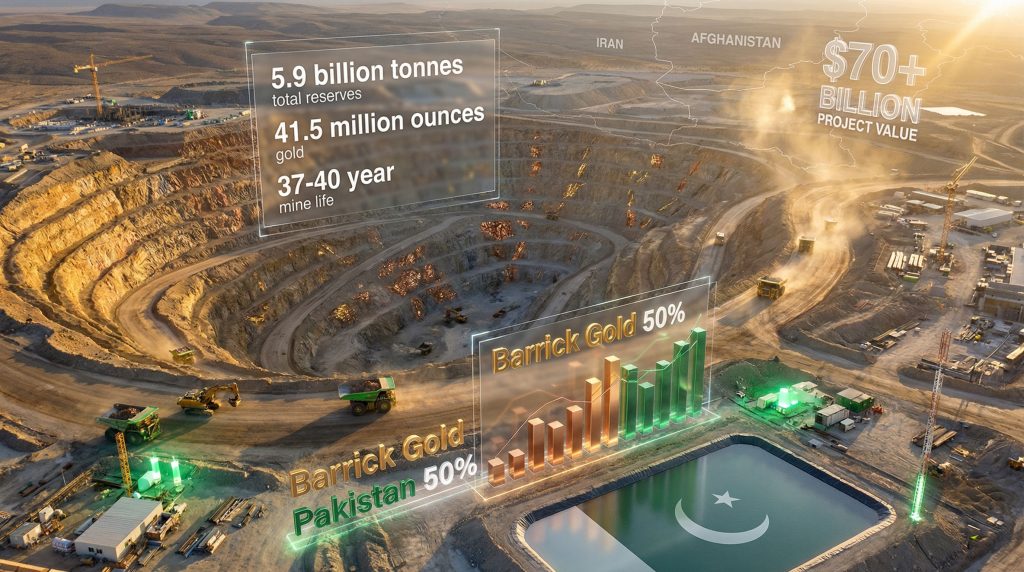
The Reko Diq copper-gold project stands among the world's most significant undeveloped mineral resources, containing an estimated 5.9 billion tonnes of ore reserves with an average copper grade of 0.41% and approximately 41.5 million ounces of gold content. These figures position the deposit within the top tier of global copper resources, with mineable reserves calculated at 2.2 billion tonnes grading 0.53% copper and 0.30 grams per tonne gold.
Resource Classification Breakdown:
• Proven reserves: Constitute the highest-confidence geological category for immediate mining planning
• Probable reserves: Represent additional resources with strong geological continuity
• Inferred resources: Indicate further expansion potential beyond current mine life projections
The projected operational lifespan extends between 37 and 40 years based on current reserve calculations, though this timeline could expand significantly through ongoing mineral exploration in gold and copper activities and technological improvements in ore processing efficiency.
Geological Significance
The deposit's porphyry copper-gold system demonstrates classic characteristics of world-class ore bodies, featuring:
• Consistent grade distribution across large tonnage volumes
• Favourable metallurgical properties for conventional processing methods
• Minimal deleterious elements that could complicate concentrate production
• Strategic location for accessing major Asian copper markets
Industry Context: Porphyry copper deposits typically provide the foundation for long-life, low-cost mining operations that can withstand commodity price volatility more effectively than smaller, higher-grade deposits.
When big ASX news breaks, our subscribers know first
Understanding the Complex Ownership and Governance Framework
The reconstituted ownership structure established through the December 2022 agreement demonstrates sophisticated risk-sharing mechanisms between international mining expertise and national resource sovereignty. This framework allocates 50% operational control to Barrick Gold, while ensuring Pakistani interests maintain majority ownership through combined federal and provincial stakes.
Ownership Distribution Analysis:
| Stakeholder | Ownership % | Financial Structure | Strategic Role |
|---|---|---|---|
| Barrick Gold | 50% | Fully funded operations | Technical leadership |
| Balochistan Government | 25% | 15% funded, 10% carried | Regional development |
| Federal Pakistani SOEs | 25% | Shared among three entities | National oversight |
The Balochistan Government's 25% stake incorporates both funded participation (15%) and free-carried interest (10%), allowing provincial authorities to benefit from project economics without upfront capital requirements. This structure addresses local community concerns while providing revenue streams for regional infrastructure development.
Federal State-Owned Enterprise Participation
Three Pakistani state-owned enterprises share the remaining 25% federal allocation, though specific entity identifications require verification through official government documentation. This multi-entity approach distributes national interests across different governmental departments and reduces single-point decision-making risks.
Governance Innovation: The majority Pakistani ownership (50% combined) paired with Barrick operational control represents a balanced approach to foreign investment in strategic mineral resources, potentially serving as a model for similar developments across emerging mining jurisdictions.
Evaluating Production Phases and Economic Projections
The development strategy incorporates staged production increases designed to optimise capital allocation while building operational expertise progressively. Phase 1 operations, scheduled for completion by end-2028, target processing capacity of 45 million tonnes per annum, generating approximately 200,000 tonnes of copper and 250,000 ounces of gold annually.
Phase 1 Production Parameters:
• Mill throughput: 45 million tonnes annually
• Copper production: ~200,000 tonnes per year
• Gold production: ~250,000 ounces per year
• Construction period: Current through end-2028
• Capital investment: Subject to final feasibility study confirmation
Phase 2 Expansion Potential
Future expansion planning considers doubling processing capacity to 90 million tonnes per annum, which could potentially double annual production outputs. However, Phase 2 implementation depends on successful Phase 1 commissioning, market conditions, and additional financing arrangements.
The project's lifetime free cash flow projections exceed $70 billion, though these calculations require verification against current commodity price assumptions, operating cost estimates, and capital expenditure schedules. Such valuations typically incorporate:
-
Base case commodity price scenarios over projected mine life
-
Operating cost escalation factors including labour, energy, and consumables
-
Capital replacement and sustaining expenditure requirements
-
Tax and royalty obligations to Pakistani federal and provincial governments
-
Discount rate assumptions reflecting project risk and financing costs
Analysing International Financing Architecture
The project's financing structure demonstrates strong multilateral development bank confidence through committed funding from major international institutions. The Asian Development Bank's $410 million commitment combines $300 million in direct project loans with $110 million in risk guarantees, providing both capital and credit enhancement.
Major Financial Institution Commitments:
• US Export-Import Bank: $1.25 billion in direct project financing
• International Finance Corporation: Approximately $700 million investment package
• Extended ADB/IFC Framework: Additional $2.6+ billion in development financing
This financing architecture totals over $4.5 billion in committed and proposed funding, though individual commitment timelines and conditions require verification through institutional press releases dated within the current timeframe.
Strategic Partnership Discussions
Several additional strategic investors have expressed interest in minority equity positions:
• Saudi Arabia's Manara Minerals: Evaluating 10-20% stake acquisition ($500 million to $1 billion range)
• Export Development Canada: Participating in financing negotiations
• Japan Bank for International Cooperation (JBIC): Exploring strategic partnership opportunities
Financing Strategy: The combination of development finance institution funding with potential sovereign wealth fund participation creates a balanced capital structure that reduces political risk while maintaining competitive funding costs.
Geographic Positioning and Infrastructure Requirements
The project's location in Balochistan's Chagai District presents unique logistical considerations due to its proximity to international borders and distance from existing infrastructure. The site sits approximately 35 kilometres from the Afghanistan border and 40 kilometres from Iran, creating both opportunities and challenges for regional economic integration.
Transportation Infrastructure Planning
The primary concentrate transportation route extends approximately 1,350-1,400 kilometres to Port Qasim near Karachi, requiring significant rail infrastructure development or enhancement. Current transportation analysis includes:
-
Rail connectivity establishment for high-volume concentrate transport
-
Road infrastructure upgrades for equipment and personnel movement
-
Port handling facilities modification for copper concentrate exports
-
Cross-border logistics coordination with neighbouring countries
Essential Infrastructure Development:
• Power generation and transmission systems for energy-intensive processing operations
• Water supply infrastructure critical for arid region mining operations
• Communications networks supporting modern mining technology integration
• Security infrastructure appropriate for remote location operations
• Community facilities including housing, healthcare, and educational services
The infrastructure investment extends beyond immediate mining requirements to encompass broader regional development that could benefit local communities and support additional economic activities.
Environmental Management and Social Impact Frameworks
The project operates under Category A environmental designation, reflecting the scale and complexity of environmental management requirements for large-scale open-pit mining operations. This classification demands comprehensive environmental impact assessments and ongoing monitoring protocols.
Environmental Management Priorities:
• Water resource management in arid climate conditions
• Air quality control throughout mining and processing operations
• Biodiversity conservation for local ecosystem protection
• Waste management systems for tailings and waste rock storage
• Land rehabilitation planning for post-mining landscape restoration
Community Development Initiatives
The social impact framework emphasises local economic development through:
-
Employment generation prioritising local hiring where skills permit
-
Educational infrastructure development including technical training programmes
-
Healthcare facilities establishment and enhancement
-
Water supply systems serving both operations and local communities
-
Advance royalty payments providing immediate community benefits
Land Use Considerations:
The project benefits from government-leased land arrangements, eliminating private land acquisition challenges that often complicate large mining developments. This approach reduces resettlement requirements while ensuring appropriate compensation mechanisms for affected communities.
The next major ASX story will hit our subscribers first
Strategic Role in Global Critical Minerals Supply
The development occurs within evolving global supply chain considerations as consuming nations seek to diversify critical mineral sources beyond traditional suppliers. The project's contribution to copper supply diversification addresses growing concerns about supply concentration risks in an increasingly electrified global economy, particularly when considering copper investment perspectives across different jurisdictions.
Supply Chain Strategic Importance:
• Geographic diversification away from politically sensitive regions
• Production scale sufficient to impact global supply-demand balance
• Processing capability for value-added mineral products
• Export infrastructure serving major Asian consumption centres
Pakistan Mining Sector Development
The project represents a transformational opportunity for Pakistan's mineral sector profile enhancement, potentially serving as a catalyst for additional mining investment and geological exploration throughout the country. Furthermore, the Reko Diq copper-gold project demonstrates how emerging jurisdictions can leverage their mineral endowments to attract international capital and expertise.
Regional Economic Integration:
Strategic location advantages include:
-
Proximity to Chinese markets through existing trade corridors
-
Access to Indian subcontinent consumption centres
-
Middle Eastern processing facility integration opportunities
-
Central Asian mineral trade route development potential
Security Considerations and Risk Assessment
The project's remote location and regional security environment require comprehensive risk management protocols addressing multiple threat categories. Balochistan's security challenges include separatist activities, cross-border tensions, and general regional instability factors that mining operations must address through appropriate mitigation strategies.
Security Risk Categories:
• Operational security for personnel and equipment protection
• Transportation security along concentrate transport routes
• Facility security for processing infrastructure and storage areas
• Community relations management to prevent local conflicts
Risk Mitigation Approaches
-
Comprehensive security protocols developed with government coordination
-
Community engagement programmes building local stakeholder support
-
Government security cooperation utilising national defence resources
-
International stakeholder coordination through diplomatic channels
Security Investment: Mining operations in challenging security environments typically allocate 2-5% of operating costs to security measures, though specific allocations depend on threat assessments and mitigation requirements.
Development Timeline and Investor Expectations
Project development follows staged milestone progression designed to manage execution risks whilst optimising capital deployment efficiency. Near-term milestones through 2028 focus on construction completion and operational commissioning for Phase 1 production.
2025-2028 Development Phase:
• Feasibility study completion and regulatory approval finalisation
• Construction commencement for processing and infrastructure facilities
• Infrastructure development including power, water, and transportation systems
• Phase 1 operational launch targeting end-2028 commissioning
2029-2035 Optimisation Period
• Phase 1 production optimisation achieving nameplate capacity and efficiency targets
• Phase 2 feasibility assessment evaluating expansion economics and financing
• Expansion construction subject to market conditions and approvals
• Full-scale operations reaching maximum production capacity
Long-term Operations Beyond 2035:
• Sustained production optimisation through technology integration and process improvements
• Resource extension exploration expanding proven reserves through continued geological investigation
• Technology advancement integration incorporating mining innovation developments
• Regional development leadership serving as catalyst for broader Balochistan economic growth
Market Dynamics and Competitive Positioning
The project's development timing aligns with accelerating global copper demand driven by renewable energy infrastructure, electric vehicle adoption, and industrial electrification trends. These demand drivers create favourable long-term market conditions for large-scale copper production facilities, particularly when considering gold strategic investment portfolios that often complement copper exposure.
Copper Demand Growth Factors:
• Renewable energy systems requiring extensive copper wiring and components
• Electric vehicle production consuming significantly more copper per unit than conventional vehicles
• Grid modernisation projects supporting renewable energy integration and smart grid technologies
• Industrial electrification replacing fossil fuel systems across manufacturing sectors
Competitive Advantages Assessment
The project's competitive positioning benefits from:
-
Large-scale production capacity enabling economies of scale
-
Long operational life providing supply security for long-term contracts
-
Strategic Asian market access reducing transportation costs to major consumption centres
-
Integrated copper-gold production diversifying revenue streams and reducing commodity price risks
Market Positioning Challenges:
• Production cost competitiveness relative to established low-cost producers
• Transportation cost management for concentrate exports to processing facilities
• Quality specifications meeting precise customer requirements for different market segments
• Supply chain reliability maintaining consistent delivery schedules despite geographic constraints
In addition, understanding how the Reko Diq copper-gold project compares to other major developments provides valuable context through comprehensive Reko Diq project comparison analysis with established operations.
The Reko Diq copper-gold project represents a significant development in critical minerals supply chain diversification, combining substantial resource endowments with complex financing and governance structures. Success depends on effective execution of environmental management protocols, community engagement strategies, and operational efficiency optimisation throughout the extended development timeline.
Disclaimer: This analysis is based on publicly available information and industry estimates. Actual project performance, timeline achievement, and financial returns may vary significantly from projections due to operational, market, regulatory, and geopolitical factors. Investors should conduct independent due diligence and consult qualified professionals before making investment decisions.
Looking to Capitalise on Emerging Mineral Discoveries?
Discovery Alert's proprietary Discovery IQ model provides instant notifications on significant ASX mineral discoveries, enabling investors to identify actionable opportunities ahead of the broader market. Explore how historic discoveries have delivered exceptional returns and begin your 14-day free trial today to secure your market-leading advantage.