May 10, 2026
Global mining enterprises face unprecedented pressure to secure long-term copper supplies as demand from renewable energy infrastructure accelerates beyond traditional production capacity. The economics of exploration investment have fundamentally shifted, with state-controlled mining corporations emerging as dominant players willing to commit substantial capital over extended timeframes where private entities increasingly hesitate.
This transformation reflects broader structural changes in mineral resource availability, technological requirements for discovery, and the strategic imperative for nations to maintain commodity security in an era of energy transition. Understanding how major exploration programs translate exploration budgets into resource discovery reveals critical insights for investors, policymakers, and industry participants navigating copper market dynamics.
Why State-Owned Mining Giants Are Tripling Exploration Budgets in 2026
State-owned mining enterprises demonstrate fundamentally different investment behavior compared to publicly traded corporations when allocating capital toward exploration activities. The dramatic escalation in exploration spending reflects strategic calculations that extend beyond quarterly earnings considerations to encompass national resource security, long-term supply chain control, and economic sovereignty objectives.
The Copper Supply Crisis Driving Unprecedented Investment
Global copper demand projections indicate consumption will increase by 70% through 2035, driven primarily by electrical grid expansion, electric vehicle manufacturing, and renewable energy infrastructure development. Current copper mine production globally totals approximately 22 million tonnes annually, while projected demand suggests requirements approaching 35 million tonnes by the mid-2030s.
This supply-demand imbalance creates strategic urgency for nations dependent on copper export revenues. Chile's government looks to speed up copper expansion as the world's largest copper producer, contributing 5.7% of global mine production, positions the country's exploration investment decisions as critical factors in global supply chain stability.
Codelco exploration investment demonstrates this strategic imperative through its budget expansion from US$39 million in 2020 to US$136.5 million in 2025, representing a 250% increase over five years. Furthermore, this investment trajectory reflects recognition that aging mineral deposits, declining ore grades, and accelerating global copper demand create structural challenges requiring systematic geological investigation.
The company's dominance in Chilean production, representing 24.6% of national output, means its exploration success directly impacts both domestic economic performance and international copper market stability. Since 1971, the organisation has contributed US$164 billion to Chilean fiscal revenues, establishing exploration investment as a mechanism for sustaining long-term economic benefits.
Exploration Investment as Economic Policy Tool
State-owned mining enterprises utilise exploration budgets as instruments of economic policy, extending beyond corporate profitability to encompass national resource sovereignty objectives. In addition, this approach enables sustained investment during commodity price downturns when private corporations typically reduce exploration spending.
The strategic allocation of exploration capital reflects long-term economic planning rather than short-term market responsiveness. Geographic concentration strategies, such as allocating US$125 million to Chilean domestic exploration versus US$11.5 million internationally, demonstrate prioritisation of national resource base expansion while maintaining selective international diversification.
Economic multiplier effects from large-scale exploration programs extend throughout regional economies. Direct employment in geological services, drilling operations, and analytical support creates demand for specialised technical services, equipment suppliers, and logistical support systems. Consequently, indirect benefits include infrastructure development, local procurement opportunities, and skills development in geological sciences.
Historical analysis indicates exploration investment generates substantial returns through resource discovery, mine development, employment creation, and fiscal revenue generation. However, the extended timeframes required for exploration-to-production cycles, typically 10-15 years, align with state-owned enterprises' investment horizons better than publicly traded companies facing quarterly reporting pressures.
When big ASX news breaks, our subscribers know first
What Does a $136.5 Million Exploration Budget Actually Buy?
Understanding the practical applications of large-scale exploration budgets requires analysis of cost structures, technological investments, human capital allocation, and expected outcomes across different geological environments and discovery methodologies.
Breaking Down Modern Exploration Economics
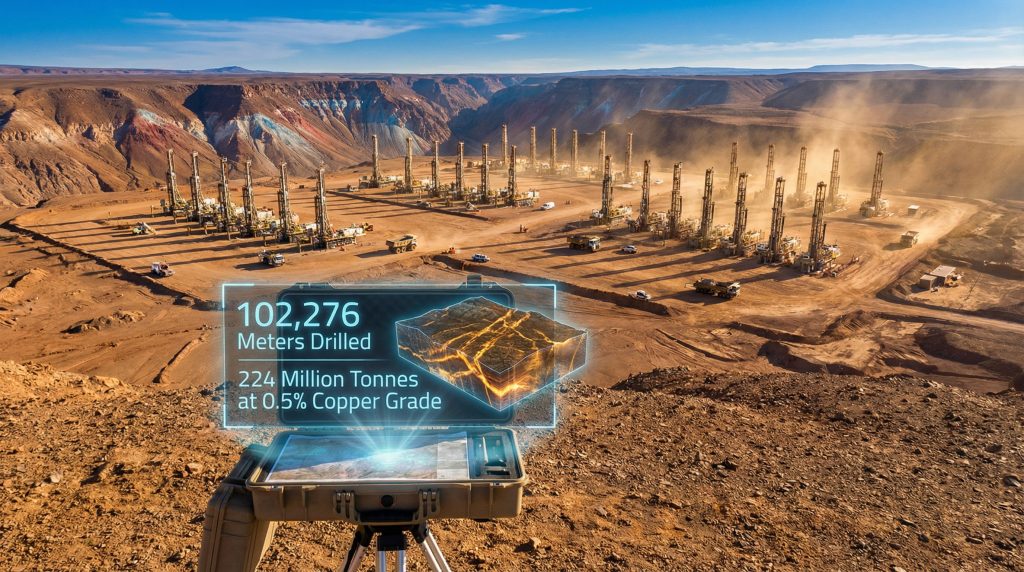
The execution of 102,276 metres of drilling during 2025 provides concrete insight into exploration budget utilisation and strategic prioritisation. Drilling costs vary significantly based on geological conditions, accessibility, depth requirements, and analytical complexity.
District-scale drilling encompassed 20,928 metres focused on near-mine expansion opportunities. This category typically costs US$200-400 per metre in established mining districts with existing infrastructure and geological understanding. For instance, the strategic value lies in extending mine life and optimising existing processing facilities.
Regional exploration drilling totalled 36,287 metres, representing the largest allocation toward discovering new deposits. Costs range from US$300-600 per metre depending on remoteness, geological complexity, and environmental requirements. Furthermore, this investment category carries higher risk but potentially transformative returns through major discovery.
International project drilling comprised 4,772 metres across diversified geographic locations. International exploration typically incurs higher costs due to regulatory compliance, logistics, and local partnership requirements, often exceeding US$500-800 per metre.
| Drilling Category | Metres Completed | Estimated Cost Range | Strategic Timeline |
|---|---|---|---|
| District-scale | 20,928 | US$4-8 million | 3-5 years to production |
| Regional exploration | 36,287 | US$11-22 million | 8-12 years to production |
| International projects | 4,772 | US$2-4 million | 10-15 years to production |
Modern exploration programs incorporate artificial intelligence for geological target identification, satellite-based mineral mapping, and predictive modelling systems. Technology investments typically represent 15-25% of total exploration budgets, focusing on efficiency improvements and discovery probability enhancement.
ROI Metrics for Large-Scale Exploration Programs
Historical analysis indicates successful copper exploration programs achieve discovery rates of approximately 1-3% for significant economic deposits from initial target identification. However, large-scale systematic programs demonstrate higher success rates through comprehensive geological understanding and sustained investment across multiple prospects.
The economic thresholds for viable copper deposits depend on grade, tonnage, metallurgy, infrastructure proximity, and processing requirements. Current market conditions suggest minimum economic requirements of 0.3-0.4% copper grades for bulk tonnage deposits exceeding 100 million tonnes, assuming conventional mining and processing methodologies.
Timeline expectations from exploration to production typically span 10-15 years, including resource delineation, feasibility studies, permitting, financing, construction, and commissioning phases. Consequently, state-owned enterprises demonstrate greater tolerance for extended development timelines compared to private sector participants seeking faster capital returns.
Return on investment calculations for exploration programs must account for discovery probability, resource size, grade quality, development costs, commodity price assumptions, and operational cash flows over mine life. Successful programs generate returns of 15-25% internal rate of return, while unsuccessful programs result in total capital loss.
How Geological Partnerships Reshape Industry Dynamics
Strategic alliances between state-owned mining enterprises and multinational corporations create synergistic combinations of capital, technology, expertise, and risk-sharing capabilities that individual organisations cannot achieve independently. Furthermore, these partnerships enable access to Codelco's available exploration portfolio and advanced technical capabilities.
Strategic Alliance Models in Modern Mining
Codelco exploration investment strategy incorporates partnerships with BHP and Rio Tinto as fundamental components rather than ancillary activities. The Proyecto Anillo collaboration with BHP in Antofagasta Region focuses on copper exploration within established geological frameworks where both parties contribute specialised capabilities.
Joint venture structures typically distribute costs and risks proportionally to ownership percentages while sharing technological expertise and operational capabilities. For instance, risk-sharing mechanisms prove particularly valuable in high-capital exploration projects where individual organisations may lack sufficient capital or expertise for optimal execution.
Three separate initiatives with Rio Tinto in Atacama Region, including the shared-ownership Nuevo Cobre deposit, demonstrate partnership evolution from exploration planning into development phases. In addition, these arrangements enable technology transfer, operational knowledge sharing, and capital efficiency optimisation.
The codelco copper partnership demonstrates how strategic alliances expand access to international markets and diversified expertise.
Partnership benefits include:
- Risk diversification across multiple geological prospects and geographic regions
- Technology access to proprietary exploration techniques and analytical capabilities
- Capital efficiency through shared investment in expensive exploration infrastructure
- Expertise combination of geological knowledge, engineering capabilities, and operational experience
- Market access to international commodity marketing and financing networks
Case Study Analysis: Major Partnership Outcomes
Successful mining partnerships demonstrate specific characteristics that enhance exploration effectiveness and economic outcomes. Joint ventures between state and multinational corporations combine long-term investment horizons with technological sophistication and operational excellence.
BHP's partnership approach emphasises systematic geological investigation, advanced technological application, and rigorous project evaluation methodologies. The collaboration model provides access to proprietary geological databases, exploration technologies, and analytical capabilities developed across global operations.
Rio Tinto's joint venture structure focuses on operational excellence, engineering optimisation, and sustainable development practices. Furthermore, the shared-ownership model in exploration assets creates alignment between partners regarding investment decisions, development timelines, and operational strategies.
Competitive advantages emerge through:
- Pooled geological expertise combining regional knowledge with international experience
- Enhanced analytical capabilities through sophisticated laboratory and modelling technologies
- Operational synergies leveraging existing infrastructure and logistical networks
- Financial optimisation accessing diverse funding sources and capital market relationships
- Regulatory navigation combining local knowledge with international compliance experience
Where Future Copper Reserves Will Come From
Systematic geological investigation reveals specific regions and deposit types likely to supply future copper demand, with northern Chile's underexplored districts demonstrating particular potential for large-scale discoveries. However, copper investment insights suggest international diversification remains crucial for portfolio optimisation.
Geological Targeting in Chile's Underexplored Regions
Porphyry copper systems represent the world's primary source of copper production, characterised by large tonnage, bulk mineable deposits amenable to conventional extraction and processing methodologies. These geological environments occur throughout northern Chile's established mining districts, suggesting significant undiscovered potential.
Radomiro Tomic Norte exemplifies successful systematic exploration within established mining regions. Preliminary economic evaluation identified leachable resources totalling 224 million tonnes with average copper grade of 0.5%, plus 685 million tonnes of hypogene sulfides averaging 0.41% copper content.
These resource estimates demonstrate substantial mineral inventory within proximity to existing mining infrastructure, processing facilities, and transportation networks. The dual resource categorisation (leachable and sulfide material) provides operational flexibility for different processing methodologies and market conditions.
Chocal-Puno-Sapunta district in Antofagasta Region represents regional exploration success approximately 30 kilometres from existing Quebrada Blanca and Collahuasi operations. Drilling confirmed porphyry copper-molybdenum systems with high prospective potential, indicating significant additional discoveries possible within established geological frameworks.
International Exploration Diversification Strategy
Geographic risk mitigation requires exploration investment across multiple jurisdictions to reduce political, regulatory, and economic risks associated with single-country concentration. International exploration represents approximately 8% of total Codelco exploration investment, focusing on high-confidence opportunities rather than speculative regional programs.
The argentina copper system demonstrates how regional diversification strategies can identify high-potential targets across Latin America's established mining districts.
Diversification considerations include:
- Regulatory environment stability and mining-friendly policy frameworks
- Infrastructure accessibility for exploration logistics and potential development
- Political risk assessment regarding resource nationalism and fiscal policy changes
- Currency exposure management and foreign exchange risk mitigation
- Operational complexity of international project management and partnership requirements
International exploration success requires local partnerships, regulatory expertise, cultural understanding, and operational capabilities adapted to specific jurisdictional requirements. Consequently, the selective approach suggests focus on jurisdictions with established mining industries, stable legal frameworks, and favourable geological potential.
What 102,276 Meters of Drilling Reveals About Resource Discovery
Drilling program results provide quantitative insight into exploration strategy effectiveness, resource discovery success, and economic viability of identified mineral deposits across different geological environments and exploration approaches.
Technical Analysis of Drilling Program Results
The strategic allocation of drilling metres reveals prioritisation toward regional exploration (35.5%) over district-scale expansion (20.4%) and international projects (4.7%). This distribution suggests management emphasis on discovering new deposits rather than solely expanding existing resources.
| Drilling Category | Metres Completed | Percentage of Total | Strategic Focus | Expected Development Timeline |
|---|---|---|---|---|
| District-scale | 20,928 | 20.4% | Near-mine expansion | 3-5 years |
| Regional exploration | 36,287 | 35.5% | New deposit discovery | 8-12 years |
| International projects | 4,772 | 4.7% | Portfolio diversification | 10-15 years |
| Total Program | 102,276 | 100% | Integrated strategy | Varied timelines |
District-scale drilling focuses on extending mine life and optimising existing infrastructure through systematic resource expansion. These programs typically achieve higher success rates due to established geological understanding and proximity to proven mineralisation.
Regional exploration drilling targets new discovery within established mining districts where geological frameworks suggest additional porphyry systems. Success rates are lower but potential returns substantially higher through major discovery.
International drilling programs provide geographic diversification and access to different geological environments. The modest allocation suggests selective targeting of high-confidence opportunities rather than broad exploratory programs.
Resource Classification and Economic Viability
Radomiro Tomic Norte's preliminary economic evaluation demonstrates successful conversion of exploration drilling into quantified mineral resources suitable for development planning. The identification of 224 million tonnes of leachable material at 0.5% copper grade meets economic thresholds for bulk mining operations.
Resource grade analysis indicates:
- Leachable resources: 224 million tonnes @ 0.5% copper (suitable for heap leaching)
- Sulfide resources: 685 million tonnes @ 0.41% copper (requiring conventional processing)
- Combined resource base: 909 million tonnes of copper-bearing material
- Processing flexibility: Multiple metallurgical pathways available
Economic cut-off grades depend on commodity prices, processing costs, mining methods, and infrastructure requirements. Current copper prices above US$4.00 per pound support economic viability for grades exceeding 0.3-0.4% in bulk tonnage deposits with favourable metallurgy.
Infrastructure proximity factors significantly affect project economics through reduced capital requirements for power, water, transportation, and processing facilities. Furthermore, locations near existing mining operations benefit from established workforce, service providers, and regulatory relationships.
How Exploration Investment Impacts National Economic Strategy
Large-scale exploration programs generate substantial economic benefits extending beyond direct mineral discovery to encompass fiscal revenue generation, employment creation, technology development, and regional economic development.
Fiscal Revenue Projections from New Discoveries
Historical analysis indicates Codelco exploration investment success translates into significant fiscal contributions over extended timeframes. The company's US$164 billion contribution to Chilean fiscal revenues since 1971 demonstrates exploration's role in sustaining long-term economic benefits.
Future revenue projections depend on exploration success rates, resource development timelines, commodity price trajectories, and operational efficiency improvements. Successful exploration programs generate fiscal returns through corporate taxation, royalty payments, export duties, and indirect economic activity.
Revenue modelling considerations include:
- Discovery probability and resource size distributions across exploration targets
- Development timelines from resource identification to production commencement
- Commodity price assumptions over 20-30 year mine life cycles
- Fiscal regime stability and taxation policy continuity
- Operational performance and cost structure optimisation
Conservative projections suggest successful exploration programs generate fiscal returns of 5-10 times exploration investment over mine life cycles, while exceptional discoveries may exceed 20-30 times returns through large-scale, long-life operations.
Employment and Regional Development Implications
Exploration activities create immediate employment in geological services, drilling operations, analytical support, and logistical coordination. Sustained exploration programs develop specialised workforce capabilities and support service industries throughout mining regions.
Direct employment effects include:
- Geological professionals: Field geologists, geological engineers, and analytical specialists
- Drilling operations: Drill operators, technical support, and equipment maintenance
- Support services: Logistics coordination, environmental monitoring, and community liaison
- Technical analysis: Laboratory technicians, data management, and geological modelling
Indirect employment benefits encompass:
- Service providers: Equipment suppliers, transportation, and accommodation services
- Infrastructure development: Road maintenance, utility services, and communication networks
- Regional commerce: Local procurement, banking services, and commercial activity
- Skills development: Technical training, educational partnerships, and knowledge transfer
Regional economic development benefits extend beyond direct mining employment to encompass broader economic diversification and infrastructure improvement. Consequently, successful exploration programs attract additional investment, develop regional expertise, and create sustainable economic opportunities.
The next major ASX story will hit our subscribers first
What Market Forces Drive Exploration Budget Decisions
Understanding the economic factors influencing exploration investment decisions reveals how commodity price cycles, competitive dynamics, and strategic considerations shape budget allocation and timing decisions.
Commodity Price Cycles and Investment Timing
Copper price volatility significantly influences exploration investment decisions, though state-owned enterprises demonstrate greater stability in budget allocation compared to private sector participants. Strategic timing of exploration during different market cycles affects project economics and resource valuation.
Price cycle considerations include:
- Counter-cyclical investment: Increased exploration during price downturns when costs are lower
- Resource valuation: Higher commodity prices improve project economics and development timing
- Competitive positioning: Market share considerations during industry consolidation periods
- Long-term planning: Price forecasting methodologies and scenario analysis
Historical analysis indicates optimal exploration timing occurs during moderate price environments where costs remain reasonable but economic thresholds support development decisions. However, extreme price volatility creates planning challenges for long-term investment commitments.
Competition Analysis: Global Exploration Spending Trends
Codelco exploration investment growth occurs within broader industry trends toward increased exploration spending by major mining companies responding to supply-demand fundamentals and resource depletion concerns.
Global exploration budgets for copper-focused companies increased substantially between 2020-2025, driven by energy transition demand projections and declining discovery rates. State-owned mining enterprises demonstrate higher growth rates in exploration spending compared to publicly traded corporations.
The tamarack copper project exemplifies how successful exploration programs generate industry-wide competitive pressures and investment reallocations.
Competitive benchmark analysis reveals:
- State enterprises: Higher exploration spending growth and longer investment horizons
- Multinational corporations: Selective investment in proven districts and partnership opportunities
- Junior exploration companies: Focused programs in early-stage targets with higher risk profiles
- Private equity-backed operations: Opportunistic investment in undervalued exploration assets
Government policy influence on exploration activity levels varies significantly across jurisdictions, with mining-friendly policies encouraging private investment while resource nationalism may favour state-controlled development.
Future Implications for Global Copper Markets
Successful exploration programs reshape global copper supply chains through new production capacity, geographic diversification, and strategic resource control by state-owned enterprises.
Supply Chain Security Through Strategic Exploration
National resource security considerations drive exploration investment beyond commercial considerations to encompass strategic metal reserves and economic sovereignty objectives. Countries controlling significant copper resources gain substantial geopolitical influence through supply chain security.
Strategic considerations include:
- Resource sovereignty: National control over critical mineral supplies
- Supply chain reliability: Reduced dependence on imports during geopolitical tensions
- Economic leverage: Influence over global commodity markets and pricing mechanisms
- Industrial competitiveness: Secure raw material access for domestic manufacturing industries
Impact on global copper price stability depends on exploration success rates, development timelines, and market share changes among producing countries. Large-scale discoveries can stabilise long-term supply projections while reducing price volatility.
Technology Integration in Next-Generation Exploration
Digital transformation in geological survey methods enhances exploration efficiency through artificial intelligence applications, predictive modelling, and precision targeting methodologies. Technology integration reduces environmental impact while improving discovery probability.
Technological advances include:
- Satellite-based targeting: Mineral mapping and geological characterisation from remote sensing
- AI-driven analysis: Pattern recognition and predictive modelling for target identification
- Precision drilling: Reduced environmental footprint through optimised drilling programs
- Real-time data integration: Continuous analysis and program optimisation during execution
Machine learning applications analyse geological data patterns across successful discoveries to identify similar characteristics in unexplored regions. These technologies improve capital efficiency and reduce exploration timeframes through enhanced targeting accuracy.
Key Takeaways for Industry Stakeholders
Understanding exploration investment dynamics provides critical insights for institutional investors, mining sector participants, and policymakers evaluating long-term copper market fundamentals.
Investment Implications for Mining Sector
Codelco exploration investment strategy demonstrates how state-owned enterprises approach long-term resource development with different risk tolerances and investment horizons compared to private sector participants.
The development of copper investment strategies requires understanding of exploration pipeline quality, partnership structures, and technological advancement capabilities.
Portfolio diversification strategies include:
- Geographic risk management: Investment across multiple jurisdictions and geological environments
- Operational risk distribution: Balanced allocation between near-mine expansion and regional exploration
- Technology risk mitigation: Partnership arrangements for accessing advanced exploration capabilities
- Market risk hedging: Long-term investment horizons reducing commodity price sensitivity
Risk assessment frameworks for exploration-stage investments require understanding of geological probability, regulatory environments, technological requirements, and development timelines. Institutional investors seeking mining sector exposure must evaluate exploration pipeline quality and development potential.
Timeline expectations for exploration-to-production cycles typically span 10-15 years, requiring patient capital and strategic planning beyond typical investment horizons. Success rates vary significantly based on geological environments, exploration quality, and technological application.
Policy and Regulatory Considerations
Government support mechanisms for exploration activities include tax incentives, geological surveys, infrastructure development, and regulatory streamlining. Policy frameworks significantly influence private sector exploration investment and discovery rates.
Environmental permitting requirements increasingly emphasise sustainable exploration practices, community engagement, and ecological protection. Modern exploration programs integrate environmental considerations from initial planning through development phases.
International cooperation frameworks for cross-border exploration projects enable technology transfer, risk sharing, and capital efficiency optimisation. These arrangements require careful attention to sovereignty concerns, revenue sharing, and operational control mechanisms.
This analysis is based on publicly available information and should not be considered investment advice. Mineral exploration involves substantial risks including geological uncertainty, regulatory changes, commodity price volatility, and operational challenges. Investors should conduct independent research and consult qualified professionals before making investment decisions.
Looking to Capitalise on the Next Major Copper Discovery?
Discovery Alert's proprietary Discovery IQ model delivers real-time alerts on significant ASX mineral discoveries, empowering subscribers to identify actionable copper opportunities ahead of the broader market. Begin your 14-day free trial today and position yourself to benefit from the strategic exploration programs that are reshaping global copper supply chains.