August 25, 2026
The Copper Supply Crunch and Why Project Quality Has Never Mattered More
Across the global mining industry, a structural tension is building between copper demand trajectories and the reality of a thinning project pipeline. The International Energy Agency has projected that clean energy transitions alone could require copper demand to nearly double by 2040, yet the average time from discovery to first production for a new copper mine now exceeds 16 years. Against this backdrop, the copper supply crunch is making projects that combine high-grade mineralisation, long mine life, and a credible financing architecture command serious institutional attention. It is within this context that the FireFly Metals Green Bay development case and A$190 million raising deserves careful, systematic analysis — not as a news event, but as a strategic case study in what a genuinely compelling copper development asset looks like in the current cycle.
When big ASX news breaks, our subscribers know first
Why Green Bay Is Emerging as One of the Most Significant Copper-Gold Development Stories in the Western World
The Green Bay Copper-Gold Project, located in Newfoundland and Labrador, Canada, sits at an intersection of characteristics that are increasingly rare in the copper development world: high resource grade, substantial scale, advanced geological confidence, and a jurisdiction with a stable, transparent regulatory environment.
To understand why this matters, consider what separates a project that advances to construction from the many that stall. Project finance institutions and offtake counterparties typically require not just a compelling resource, but a resource they can model with confidence. Newfoundland and Labrador has a long track record in base metals mining and provides the kind of institutional familiarity that accelerates financing conversations.
The Ming Mine, at the heart of Green Bay, is not a greenfields discovery — it has historical production context, established underground infrastructure, and a mineralised system that continues to grow with every drill campaign.
What Makes a Copper Project Tier 1 and Does Green Bay Qualify?
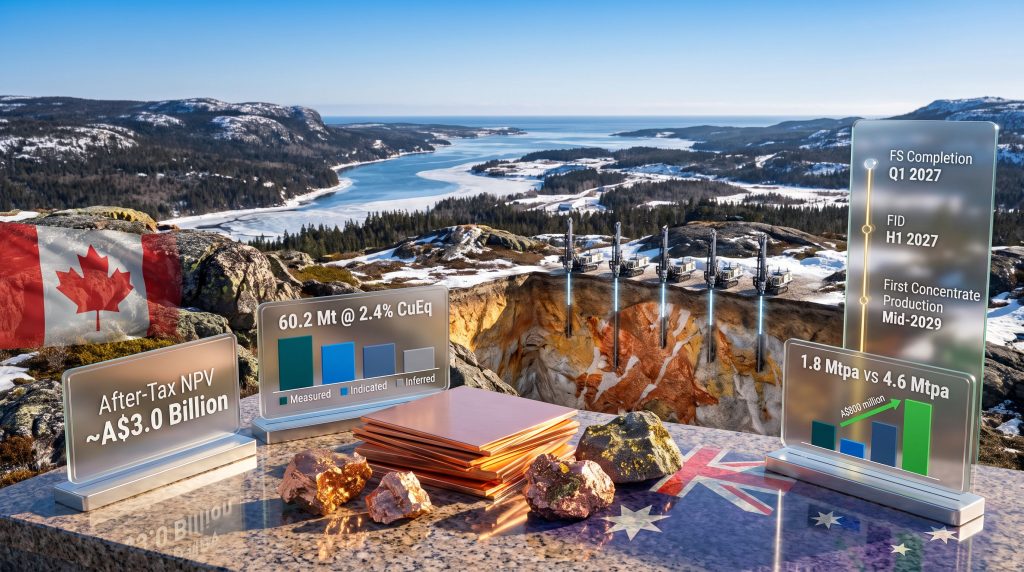
The term Tier 1 gets applied liberally in mining, but it has a reasonably consistent technical meaning: a project capable of producing at least 100,000 tonnes of copper equivalent per year, with a mine life exceeding 20 years, in a low-risk jurisdiction, at costs in the lower half of the global cost curve. Our Tier 1 deposit guide outlines this in detail, and by those criteria, the 4.6 Mtpa expansion scenario at Green Bay — with peak annual output of approximately 106,000 tonnes CuEq and a mine life of around 22 years — sits at the threshold of that classification.
The base case at 1.8 Mtpa falls below Tier 1 production thresholds but compensates with an extraordinary 32-year mine life and a 1.9-year capital payback period that few projects of any scale can match.
Understanding the Two-Scenario Development Architecture at Ming Mine
The Preliminary Economic Assessment (PEA) released alongside the capital raise presents decision-makers with a genuinely unusual optionality structure. Rather than a single development path, the study models two distinct throughput scenarios with meaningfully different capital profiles, risk characteristics, and return outcomes.
Scenario 1: The 1.8 Mtpa Base Case Economics and Strategic Logic
The base case is built around a processing rate of 1.8 million tonnes per annum, equivalent to approximately 4,800 tonnes per day underground. This is a scale achievable with conventional underground mining methods and does not require exceptional infrastructure investment relative to the economics it generates.
Snapshot: 1.8 Mtpa Base Case Key Metrics
Metric Value After-Tax NPV (7% discount) ~A$2.2 billion Initial Mine Life ~32 years Steady-State CuEq Output (avg.) ~50,000 t/year over 14 years Peak Annual Production ~60,000 t CuEq Capital Payback Period ~1.9 years Estimated Net Initial Project Capital ~A$513 million Indicative Commercial Debt Capacity >US$350 million (~A$500 million)
The 1.9-year payback period is a standout figure. Across the broader copper development universe, payback periods of 3 to 6 years are common, and anything below 3 years typically signals either unusually high grades, favourable commodity pricing assumptions, or both. At Green Bay, it is the grade that does the heavy lifting — particularly the high-grade core zones averaging above 4% CuEq — which compresses both unit operating costs and the time required to recover initial capital.
Scenario 2: The 4.6 Mtpa Expansion Case and the Throughput Premium
The expansion scenario roughly doubles throughput to 4.6 Mtpa, compressing the mine life from 32 to approximately 22 years while dramatically improving production intensity. The economic return on this approach is substantially higher.
Snapshot: 4.6 Mtpa Expansion Case Key Metrics
Metric Value After-Tax NPV (7% discount) ~A$3.0 billion Initial Mine Life ~22 years Steady-State CuEq Output (avg.) ~90,000 t/year over 11 years Peak Annual Production ~106,000 t CuEq High-Output Period ~6 years averaging ~100,000 t/year
The NPV differential between the two scenarios is approximately A$800 million — a figure that signals disproportionate economic value is locked in the throughput scale decision. This is a known dynamic in underground copper mining: grade leverage multiplies with volume, because fixed costs are distributed across a larger revenue base.
The pre-feasibility study on the 4.6 Mtpa case is being developed concurrently with the feasibility study on the base case, preserving optionality through to the Final Investment Decision (FID) targeted for H1 2027.
Strategic Insight: The dual-scenario PEA structure is not uncommon in major copper development projects, but the A$800 million NPV differential between the two cases signals that throughput scale carries disproportionate value at Green Bay. This is a key variable that feasibility study outcomes will need to resolve before lenders and offtake partners can finalise their participation frameworks.
Dissecting the A$190 Million Capital Raise: Structure, Pricing, and Strategic Rationale
The FireFly Metals Green Bay development case and A$190 million raising is structured across three interconnected components designed to provide both immediate funding certainty and broader retail participation. According to Firefly's A$3 billion Green Bay announcement, institutional appetite for the raise was substantial, reflecting the strength of the underlying economics.
How the Funding Package Is Structured Across Three Components
-
Component 1: A$180 million institutional equity raising, split across an Australian institutional placement and a Canadian bought deal financing on the TSX
-
Component 2: A non-underwritten Share Purchase Plan (SPP) targeting up to A$10 million at the same price of A$1.78 per share, providing retail investor access at identical terms to institutions
-
Component 3: Existing cash and liquid investments of approximately A$183 million already on the company's balance sheet
Pro-Forma Treasury Position and Capital Stack Analysis
Pro-Forma Cash Position After Raise Completion
Source Amount Institutional Placement + Canadian Bought Deal A$180 million SPP (if fully subscribed) Up to A$10 million Existing Cash and Liquid Investments ~A$183 million Total Pro-Forma (pre-costs) ~A$373 million
The dual-listed capital access structure across ASX and TSX is strategically significant and often underappreciated by purely Australian-focused investors. Canadian resource capital markets have deep familiarity with Newfoundland base metals projects, given the province's mining history, and a bought deal structure on the TSX signals that Canadian institutional investors have conducted sufficient due diligence to underwrite the transaction without a marketing period. This is a materially stronger signal of institutional conviction than a standard bookbuild.
Where Raise Proceeds Are Directed
Capital allocation from the raise is mapped against four priority areas:
-
Early project works and procurement of long-lead items, which are critical for maintaining the H1 2027 construction start target
-
The 1.8 Mtpa feasibility study, targeting completion in Q1 2027
-
A pre-feasibility study examining the 4.6 Mtpa expansion scenario in parallel
-
Continued resource growth drilling and the development of a maiden Ore Reserve
The Debt Financing Dimension
An often-underweighted element of this capital raise announcement is the debt capacity signal. Initial advice indicates the 1.8 Mtpa base case alone could support commercial debt facilities exceeding US$350 million (approximately A$500 million), compared with estimated net initial project capital of A$513 million.
This means debt alone could theoretically fund the vast majority of initial project capital requirements, suggesting the equity raise functions primarily as a balance sheet strengthening and study-acceleration mechanism rather than the primary source of construction funding. This debt capacity figure, if confirmed through formal credit agreements, would materially reduce dilution risk for existing shareholders at the construction financing stage.
Green Bay's Resource Foundation: What the Updated Mineral Resource Estimate Reveals
The economic credibility of any copper development project ultimately rests on its resource base — not just the tonnage, but the confidence level, grade distribution, and geological continuity that underpin it.
Breaking Down the 60.2 Mt Measured and Indicated Resource
Mineral Resource Estimate Summary — Green Bay (Ming Mine)
Category Tonnage Grade (CuEq) Measured + Indicated 60.2 Mt 2.4% Inferred 23.5 Mt 2.5% High-Grade Core (M+I) 18.1 Mt 4.3% High-Grade Core (Inferred) 7.0 Mt 4.4%
The headline grade of 2.4% CuEq across 60.2 Mt of Measured and Indicated material places Green Bay comfortably above the global average copper resource grade of approximately 0.6%, and above the typical cutoff grades used by major copper producers for mine planning. However, the truly differentiated asset within this resource is the high-grade core: 18.1 Mt grading 4.3% CuEq in Measured and Indicated categories, with a further 7.0 Mt at 4.4% CuEq Inferred. These zones represent concentrations of copper-gold mineralisation that are genuinely uncommon at this scale in underground settings globally.
Why 79% Resource Confidence Is Materially Significant for Project Finance
Project lenders applying conservative Ore Reserve conversion assumptions typically apply discounts to Inferred resources and sometimes exclude them entirely from bankable feasibility economics. The fact that 79% of the Ming Mine resource sits in the higher-confidence Measured and Indicated categories is not merely an exploration milestone — it is a financing pre-condition.
Lenders need confidence that the tonnes used in mine scheduling actually exist in the ground with sufficient certainty to underwrite debt repayment. A resource base with this level of classification confidence is meaningfully de-risked relative to peers where Inferred material dominates. Furthermore, understanding interpreting drill results correctly is essential when evaluating how this confidence level translates into bankable project economics.
The High-Grade Core Advantage
What makes the Ming Mine's grade profile particularly compelling from a mine economics perspective is the internal architecture of the orebody. The high-grade core zones at 4.3 to 4.4% CuEq sit within a broader lower-grade envelope. In underground mining, this type of grade shell structure allows mine planners to sequence production through the highest-value material first, accelerating revenue generation and cash payback in the critical early years of operation. It is this structural grade advantage, more than any single economic metric, that explains the otherwise surprising 1.9-year payback period modelled in the base case PEA.
Open-Ended Mineralisation and What Six Underground Rigs Signal
Mineralisation at Ming remains open in multiple directions, with six underground drill rigs currently targeting high-grade extensions. This is a substantial drilling programme by any measure — maintaining six rigs underground simultaneously implies both confidence in the geological model and a commitment to resource conversion ahead of the feasibility study. The PEA economics are built on a resource that is still growing, which means the economic inputs used in the current study may prove conservative if drilling continues to deliver.
What the PEA Deliberately Excludes
One of the less-discussed aspects of the Green Bay development case is how much it does not include:
-
The Little Deer deposit is excluded from current PEA economics entirely
-
Regional targets including Rambler, East Mine, Main Mine, Tilt Cove, and Nugget Pond are outside the current study scope
-
District-scale exploration is being maintained with three surface rigs operating within 5 kilometres of the Ming Mine
Upside Framing: The PEA's deliberate exclusion of multiple regional deposits means the A$2.2 to A$3.0 billion NPV range is constructed entirely on the Ming deposit alone. Any resource conversion from adjacent targets represents incremental economic upside that is not captured in the current development case. For investors assessing the district-scale potential of the Green Bay land package, the PEA economics represent a floor, not a ceiling.
The Development Pathway: Milestones, Timelines, and Decision Gates
Key Development Milestones and Target Dates
Development Timeline Overview
Milestone Target Date Feasibility Study (1.8 Mtpa) Completion Q1 2027 Maiden Ore Reserve Declaration Q1 2027 Pre-Feasibility Study (4.6 Mtpa) Concurrent with FS Final Investment Decision (FID) H1 2027 Construction Commencement H1 2027 First Concentrate Production Mid-2029
The timeline from Q1 2027 feasibility completion to H1 2027 FID and construction commencement is aggressive by industry standards, implying that financing, permitting, and offtake discussions must be substantially advanced in parallel with the study process rather than sequentially. Regulatory approvals are already in place for select early works, which supports the credibility of this compressed schedule.
The mid-2029 target for first concentrate production implies a construction period of approximately two to two-and-a-half years. For an underground copper project with existing mine access and infrastructure, this is achievable but will require disciplined project execution and early procurement of critical long-lead items — a clear rationale for directing raise proceeds toward this activity immediately.
A definitive feasibility study of this complexity typically demands parallel workstreams across geotechnical, metallurgical, and infrastructure disciplines, all of which must be coordinated against the Q1 2027 completion target.
The next major ASX story will hit our subscribers first
How Does Green Bay Compare to Peer Copper Development Projects Globally?
Benchmarking Green Bay Against Comparable Projects
Comparative Framework: Key Project Metrics
Attribute Green Bay Base Case Typical Mid-Tier Copper Developer After-Tax NPV A$2.2B (base) / A$3.0B (expansion) A$0.5B to A$1.5B Mine Life 32 years (base case) 15 to 20 years Resource Confidence (M+I %) 79% 50% to 65% Payback Period ~1.9 years 3 to 6 years High-Grade Core CuEq 4.3% to 4.4% 1.0% to 2.5%
The copper-gold combination at Green Bay also has an underappreciated economic dimension. Gold credits in copper concentrates reduce the effective cash cost of copper production by offsetting processing and refining costs, while simultaneously providing leverage to precious metals prices. In environments where gold prices are elevated, this byproduct credit can meaningfully compress the all-in sustaining cost (AISC) profile and lower the copper price required for the project to break even.
This dual-commodity exposure makes Green Bay more resilient across a wider range of commodity price scenarios than a pure copper project of equivalent grade would be.
Why Newfoundland and Labrador Represents a Tier-1 Mining Jurisdiction
Jurisdiction risk is a variable that project finance institutions price directly into debt terms, debt capacity, and the willingness to advance funding at all. Newfoundland and Labrador has a long history of base metals mining, transparent regulatory processes, and established community engagement frameworks. For project lenders assessing the viability of offering debt facilities exceeding US$350 million, the jurisdictional profile of Green Bay is as important as its geological attributes.
What the A$190 Million Raise Means for FireFly Metals' Strategic Positioning
The FireFly Metals Green Bay development case and A$190 million raising collectively represent a structural inflection point in the company's lifecycle. The transition from exploration-focused drilling programmes to a funded feasibility study with a defined construction timeline is a categorical shift that changes how institutional investors assess and value the asset.
The dual-listed structure across ASX and TSX is a genuine strategic advantage for accessing capital in two of the world's most active mining finance markets simultaneously. Canadian institutions bring deep familiarity with underground base metals projects in Atlantic Canada, while Australian institutional investors are experienced copper-gold project evaluators with appetite for high-grade development assets.
For investors considering broader copper investment strategies, the Green Bay raise illustrates how dual-listed structures can reduce pricing pressure and increase the likelihood of oversubscription in institutional placements. The SPP component, offering retail shareholders participation at A$1.78 per share on identical terms to institutional investors, reflects an alignment of interests that sophisticated retail investors should note. In many large institutional placements, retail shareholders are excluded or offered materially worse terms.
Frequently Asked Questions: FireFly Metals Green Bay Development Case and A$190 Million Raising
What is the Green Bay Copper-Gold Project?
Green Bay is a copper-gold development project located in Newfoundland and Labrador, Canada. Its primary asset is the Ming Mine, which hosts a Mineral Resource Estimate of 60.2 Mt at 2.4% CuEq in Measured and Indicated categories, plus a high-grade core averaging 4.3% CuEq. FireFly Metals also holds a 90% interest in the Limestone Well Vanadium-Titanium Project in Western Australia.
What are the two development scenarios in the PEA?
The PEA models a 1.8 Mtpa base case with an after-tax NPV of approximately A$2.2 billion and a 32-year mine life, and a larger 4.6 Mtpa expansion scenario with an after-tax NPV of approximately A$3.0 billion and a 22-year mine life. Furthermore, the economic study's full results confirm the scale, grade, and long-life growth potential underpinning these projections.
How is the A$190 million raising structured?
It comprises a A$180 million institutional equity raising across an Australian placement and a Canadian bought deal on the TSX, plus a non-underwritten SPP targeting up to A$10 million, both priced at A$1.78 per new share.
When is first concentrate production targeted?
FireFly is targeting first copper concentrate production in mid-2029, following a Final Investment Decision and construction commencement in H1 2027.
How does the project plan to fund construction beyond the equity raise?
Initial advice indicates the 1.8 Mtpa base case could support commercial debt facilities exceeding US$350 million (approximately A$500 million), which compares favourably against estimated net initial project capital of A$513 million. Discussions with banks, offtake groups, and strategic financing partners are ongoing.
Key Takeaways: Five Strategic Signals to Monitor
The Green Bay development story has multiple catalysts ahead that will progressively de-risk or re-rate the asset. Investors and industry observers should, consequently, track the following in sequence:
-
Feasibility study outcomes in Q1 2027 — whether base case economics hold, improve, or encounter cost inflation relative to PEA assumptions
-
Pre-feasibility progress on the 4.6 Mtpa expansion — the A$800 million NPV differential makes this the single most important throughput decision in the project's history
-
Debt financing terms from banking discussions — the quantum and covenants attached to any commercial debt facility will define the equity dilution required at FID
-
Offtake agreement progress — the willingness of copper consumers or trading houses to commit to offtake is one of the clearest external validations of project commercial confidence
-
Underground drilling results from six active rigs — continued resource growth could expand the economic base beyond what the current PEA captures, providing further NPV upside
The broader implication of the Green Bay development case extends beyond a single company's project advancement. High-grade, long-life copper assets in stable jurisdictions are among the scarcest commodities in the mining development pipeline. As the gap between copper demand growth and new supply widens through the late 2020s, projects with the grade, scale, and financing architecture demonstrated at Green Bay will increasingly attract the attention of major producers, sovereign wealth funds, and commodity-linked financiers seeking exposure to the structural copper story.
This article is intended for informational purposes only and does not constitute financial advice. Forward-looking statements, projections, and NPV estimates referenced in this article are based on PEA-level economic assessments and are subject to a wide range of assumptions, risks, and uncertainties. PEA-level studies are preliminary in nature and are not definitive. Readers should conduct their own due diligence and consult a qualified financial adviser before making investment decisions.
Want to Capitalise on the Next Major Copper Discovery Before the Market Does?
Discovery Alert's proprietary Discovery IQ model scans ASX announcements in real time, instantly identifying significant mineral discoveries — including high-grade copper and gold projects — and delivering actionable alerts to subscribers ahead of the broader market. Explore how historic discoveries have generated extraordinary returns on Discovery Alert's dedicated discoveries page, and begin your 14-day free trial today to position yourself at the forefront of the next major find.