August 25, 2026
Why Ore Reserve Upgrades Are the Most Consequential Metric in Copper Mining
The global copper industry runs on confidence, and nowhere is that confidence more precisely quantified than in the distinction between a mineral resource and an ore reserve. For investors, lenders, and joint venture partners alike, the ore reserve figure is the single most bankable number a mining company can publish. It represents not just geological possibility, but economic reality, shaped by commodity price assumptions, metallurgical recovery rates, mining method constraints, and regulatory conditions.
Understanding the South32 Sierra Gorda reserve upgrade requires starting from this foundational principle. The 61% increase in Sierra Gorda's ore reserve, lifting the total to 1.1 billion tonnes, is not simply a geological revision. It is a comprehensive recalibration of the mine's financial trajectory, production scheduling horizon, and capital allocation framework for the next two decades.
The JORC Hierarchy and Why Ore Reserves Carry Maximum Weight
Under the JORC Code 2012, the internationally recognised standard governing mineral reporting in Australia and widely adopted across global capital markets, mineral estimates are classified in ascending order of geological confidence and economic feasibility:
- Exploration Target – a range of tonnage and grade based on limited data with significant uncertainty
- Inferred Mineral Resource – estimated with low geological confidence, insufficient for reserve conversion
- Indicated Mineral Resource – estimated with reasonable geological confidence, sufficient basis for mine planning studies
- Measured Mineral Resource – the highest confidence resource category, based on closely spaced sampling
- Probable Ore Reserve – derived from Indicated resources, incorporating modifying factors confirming economic extractability
- Proved Ore Reserve – derived from Measured resources, the highest confidence reserve classification
The critical distinction lies in the modifying factors applied during the transition from resource to reserve. These include assessments of mining method, processing recovery, infrastructure costs, environmental considerations, and assumed commodity prices. A reserve, by definition, has survived economic scrutiny that a resource estimate has not. This is precisely why a reserve upgrade carries substantially more weight than an equivalent resource upgrade in the eyes of financiers, offtake counterparties, and institutional investors.
Furthermore, understanding cut-off grade economics is essential here, as these thresholds determine which portions of a mineralised body qualify for inclusion in the reserve estimate at any given commodity price assumption.
An ore reserve upgrade is not simply a geological announcement. It is a recalibration of a mine's entire financial and operational trajectory, from processing throughput to workforce planning and multi-decade infrastructure investment cycles.
Strip Ratio, Cost Profiles, and the Long-Term Implications of Reserve Depth
One dimension of reserve upgrades that receives insufficient attention is how deeper ore access changes a mine's strip ratio, which is the volume of waste rock that must be removed per unit of ore extracted. As open-pit mines extend deeper into porphyry copper systems, strip ratios typically increase, placing upward pressure on operating costs per tonne of ore processed. However, the economic viability of accessing deeper ore zones is simultaneously supported by the polymetallic credit structure of deposits like Sierra Gorda, where molybdenum and gold byproducts materially reduce the effective cost of copper production.
Reserve life also functions as a critical risk metric for lenders and project financiers. A mine with a defined reserve horizon extending to 2045 can support long-dated debt structures, equipment financing arrangements, and take-or-pay offtake agreements that a mine with a five-year reserve life simply cannot. This financial optionality is one of the underappreciated strategic benefits of reserve life extension.
When big ASX news breaks, our subscribers know first
What Drove the South32 Sierra Gorda Reserve Upgrade: Geology and Methodology
Infill Drilling and the Mechanics of Resource-to-Reserve Conversion
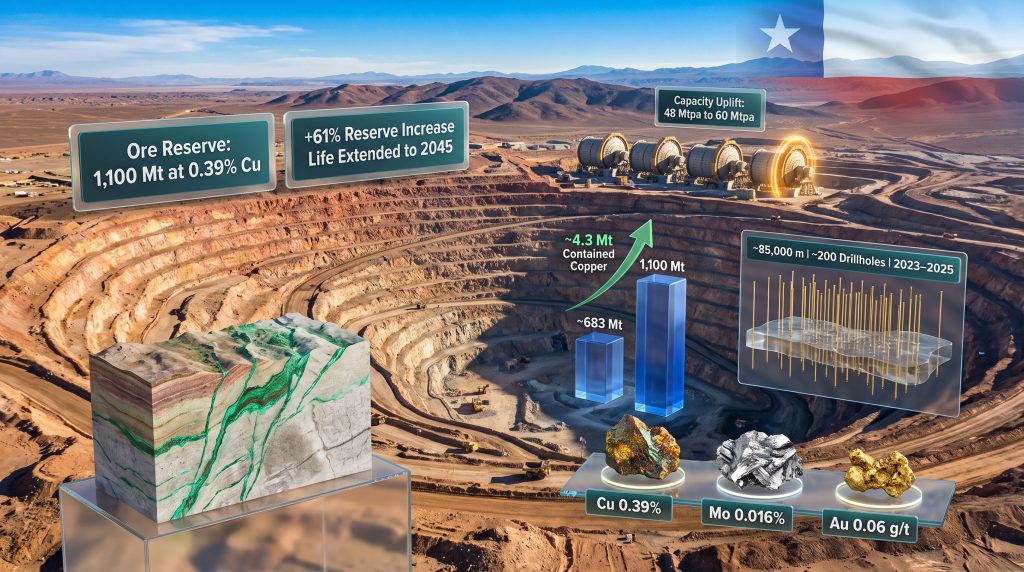
The reserve upgrade at Sierra Gorda did not emerge from new discovery. It was generated through a systematic infill drilling program executed between 2023 and 2025, comprising approximately 85,000 metres drilled across roughly 200 drillholes. This distinction is important because it clarifies the nature of the geological work involved.
Infill drilling is the discipline of tightening the spatial density of sample data within a known mineralised body to elevate geological confidence from Inferred to Indicated or Measured classification. Under JORC 2012, specific confidence thresholds must be demonstrated before any portion of a mineral resource can be declared as an ore reserve. The volume of drilling conducted at Sierra Gorda reflects a deliberate, multi-year investment in geological confidence building, rather than speculative exploration targeting unknown mineralisation.
For context, infill drilling programs of this scale are capital-intensive undertakings requiring sustained commitment to geological data collection, assay laboratory processing, and 3D geological modelling. The fact that approximately 200 drillholes were required to upgrade the reserve confidence across the orebody illustrates both the scale of the Sierra Gorda deposit and the methodological rigour applied to the estimation process.
Open-Depth Potential: The Exploration Upside That Reserve Figures Do Not Capture
One of the most consequential pieces of geological information embedded within the Sierra Gorda reserve update is the confirmation that the orebody remains open at depth. In the context of porphyry copper systems, this statement carries significant forward-looking implications that the headline reserve figure alone does not communicate.
Porphyry copper deposits are formed by magmatic-hydrothermal processes that create large, disseminated to stockwork mineralisation systems with characteristic vertical continuity. Unlike many other deposit types, porphyry systems do not terminate abruptly at depth. Instead, they frequently exhibit gradual grade zonation patterns that can extend hundreds or even thousands of metres below currently drilled intervals. This structural characteristic is what has enabled successive reserve upgrade cycles at many of the world's largest copper mines over multi-decade operational histories.
The practical implication for Sierra Gorda is that the current 1.1 billion tonne reserve and 1.87 billion tonne mineral resource likely do not represent the ultimate mineralised inventory of the system. Future infill and extensional drilling programs targeting deeper portions of the orebody could support additional reserve conversion cycles beyond 2045, subject to commodity price assumptions and mining cost economics at greater depths.
In porphyry copper systems, the phrase open at depth is not a geological footnote. It is a forward-looking indicator that the deposit's full mineralised extent remains incompletely defined, with potential for successive reserve upgrade cycles as drilling programs extend deeper into the system.
Reserve and Resource Grade Profile: The Polymetallic Advantage
Sierra Gorda is not a simple copper deposit. Its polymetallic character, encompassing copper, molybdenum, and gold, creates a credit structure that fundamentally alters the economic calculus of ore processing. The updated reserve and resource grades are presented below:
| Commodity | Ore Reserve Grade | Mineral Resource Grade |
|---|---|---|
| Copper | 0.39% | 0.37% |
| Molybdenum | 0.016% | Not separately stated |
| Gold | 0.06 g/t | Not separately stated |
Notably, the reserve grade of 0.39% copper is marginally higher than the resource grade of 0.37%, which reflects the application of economic cut-off grade criteria that filter out lower-grade marginal material from the reserve estimate. This grade relationship confirms that the economically declared reserve represents the higher-quality core of the broader mineralised system.
Molybdenum is a particularly strategically valuable byproduct in this context. Used extensively in high-strength steel alloys and specialised industrial applications, molybdenum pricing cycles can materially influence cut-off grade economics at polymetallic copper deposits. During periods of elevated molybdenum prices, the economic threshold for declaring ore reserves can shift lower, potentially bringing additional lower-grade copper zones into the reserve envelope. This dynamic creates an embedded optionality within Sierra Gorda's reserve base that purely copper-focused operations do not possess.
Gold, while present at a relatively modest 0.06 grams per tonne, contributes a meaningful copper-equivalent credit at scale when applied across 1.1 billion tonnes of ore. These byproduct revenues reduce the effective cash cost of copper production, improving the mine's competitive position on the global copper cost curve.
Breaking Down the Numbers: What 1.1 Billion Tonnes at 0.39% Copper Means
Comparing Previous and Updated Estimates
The magnitude of the South32 Sierra Gorda reserve upgrade becomes clearer when the previous and updated estimates are placed side by side:
| Metric | Previous Estimate | Updated Estimate | Change |
|---|---|---|---|
| Ore Reserve (tonnes) | ~683 Mt (implied) | 1,100 Mt | +61% |
| Mineral Resource (tonnes) | ~1,730 Mt (implied) | 1,870 Mt | +8% |
| Reserve Grade (Cu) | Not separately stated | 0.39% | – |
| Resource Grade (Cu) | Not separately stated | 0.37% | – |
| Reserve Life | To ~2040 (implied) | To 2045 | +~5 years |
| Estimated Contained Copper | ~2.66 Mt (implied) | ~4.3 Mt | +~62% |
The most analytically important relationship in this table is the contrast between the 61% reserve growth and the 8% resource growth. These two figures, taken together, communicate that the upgrade was achieved primarily through improved geological confidence and more refined economic modelling, rather than through the discovery of previously unknown mineralisation. The resource base was already known. What changed was the confidence level and the economic assessment of that material.
This distinction is not merely technical. For investors and analysts interpreting drill results and reserve announcements, it signals that the geological team has de-risked a large portion of the previously Inferred and Indicated resource base. Consequently, interpreting drill results correctly helps distinguish between speculative exploration announcements and genuine reserve de-risking events of this nature.
Contained Copper Metal: Placing Sierra Gorda in Global Context
At 1,100 million tonnes at 0.39% copper, Sierra Gorda's updated reserve hosts approximately 4.3 million tonnes of contained copper metal. To contextualise this figure, global annual copper mine production has consistently ranged between 20 and 22 million tonnes in recent years, according to data published by the International Copper Study Group. Sierra Gorda's reserve alone therefore represents a contained copper inventory equivalent to roughly 20% of a single year's entire global mine production, a substantial figure for a single operating asset.
Furthermore, the reserve life extension to 2045 enables a range of long-term operational and capital planning activities that shorter reserve horizons preclude:
- Multi-decade infrastructure investment programs with appropriate depreciation schedules
- Long-term workforce development and training pipelines
- Extended offtake agreements and sales contracts aligned with the operational horizon
- Capital expenditure programs, including the fourth grinding line, underpinned by ore inventory certainty
- Reduced sovereign risk exposure by maintaining operational continuity independent of short-term commodity price volatility
The Fourth Grinding Line: Engineering a 30% Production Uplift
Processing Circuit Engineering and Throughput Mechanics
The approved fourth grinding line project at Sierra Gorda is designed to lift processing throughput from approximately 48 million tonnes per annum (Mtpa) to 60 Mtpa, representing a 25% increase in plant capacity. Understanding what this involves from a comminution engineering perspective adds important context to the headline production growth figures.
Grinding circuits at large-scale porphyry copper operations typically comprise a multi-stage comminution sequence:
- Primary crushing – reducing run-of-mine ore to manageable fragment sizes for mill feed
- SAG (Semi-Autogenous Grinding) milling – using the ore itself, supplemented by steel grinding media, to reduce fragment size
- Ball milling – further reducing SAG mill product to the fine particle size required for flotation
- Classification circuits – cyclone clusters that separate correctly-sized particles from oversize material requiring further grinding
Adding a fourth grinding line means duplicating this circuit sequence to increase total mill feed capacity. At a mine processing nearly 50 million tonnes annually, the infrastructure involved, including additional SAG and ball mill installations, expanded classification circuit capacity, and associated flotation cell additions, represents a capital undertaking of considerable scale. The reserve upgrade provides the ore inventory certainty that makes this capital commitment economically justified.
Why Reserve Upgrades Are Prerequisites for Throughput Expansion Approval
There is a logical sequencing requirement that is sometimes overlooked in coverage of mining expansion projects: processing capacity expansion without confirmed ore inventory creates stranded asset risk. Installing a fourth grinding line capable of processing 60 Mtpa is economically rational only if sufficient reserves exist to sustain that throughput rate for a period long enough to generate adequate returns on the capital invested.
The South32 Sierra Gorda reserve upgrade directly addresses this prerequisite. By extending the reserve horizon to 2045 and growing the total reserve to 1.1 billion tonnes, the geological foundation now exists to support decades of operation at the expanded throughput rate. The capital cost per tonne of ore processed declines as the total ore inventory grows, improving the project-level internal rate of return on the grinding line investment. In many respects, this mirrors the logic underpinning a definitive feasibility study, where capital commitments are only sanctioned once sufficient economic certainty is established.
At porphyry copper operations, throughput expansion is most economically justified when paired with a commensurate reserve upgrade. The capital cost per tonne of ore processed improves as the total reserve inventory grows, and the expanded ore base ensures the additional processing infrastructure can be fully utilised across its economic life.
The Compounding Production Effect: Reserve Upgrade Plus Throughput Expansion
The interaction between the reserve upgrade and the fourth grinding line creates what can be described as a compounding production volume effect. The reserve upgrade extends the mine life and increases the total ore inventory available for processing. The grinding line expansion increases the annual rate at which that ore can be processed. Together, these two factors are projected to deliver approximately 30% higher copper-equivalent production from 2031 compared to the current operational baseline.
This compounding dynamic is also visible in the mine planning implications of the updated reserve. A larger reserve base allows geotechnical and mine planning engineers to redesign pit shell optimisation models, using methodologies such as the Lerchs-Grossmann algorithm, to identify the optimal ultimate pit design that maximises net present value across the expanded ore inventory. A larger pit design may also enable planners to sequence pushback phases that access higher-grade portions of the orebody earlier in the mine schedule, generating improved early-period cash flows and NPV outcomes.
Sierra Gorda Within South32's Copper Strategy and the Global Supply Context
The Structural Copper Demand Thesis
The energy transition is fundamentally a copper-intensive industrial transformation. Electrification of transport systems, expansion of renewable generation capacity, construction of grid-scale energy storage infrastructure, and deployment of electric vehicle drivetrains all require copper at volumes that exceed historical demand patterns. Industry analysts across multiple institutions project a structural copper supply deficit emerging in the late 2020s and extending through the 2030s, driven by the gap between declining average ore grades at existing mines and the lengthy development timelines of new copper projects.
Against this backdrop, the copper supply crunch makes a reserve upgrade at a large, operating copper mine carry supply-side significance that extends beyond the individual asset. Sierra Gorda's confirmed reserve growth and the associated production uplift from 2031 represent a meaningful contribution to the global copper supply pipeline during a period when new supply sources will be critically needed.
Chile's Atacama Region: The World's Premier Copper Corridor
Sierra Gorda operates within Chile's Atacama region, which sits at the heart of the world's most copper-productive geological province. Chile consistently accounts for approximately 25 to 27% of global copper mine production according to data from the International Copper Study Group, a share underpinned by the exceptional grade and scale of porphyry copper systems concentrated in the Atacama and adjacent zones.
Operating within an established Chilean mining jurisdiction provides access to existing logistics infrastructure, a skilled mining workforce developed over generations of large-scale copper extraction, and a regulatory framework with decades of operational precedent. These brownfield advantages represent genuine capital efficiency benefits compared to developing equivalent copper inventory in frontier or emerging mining jurisdictions.
Brownfield Expansion: The Capital Efficiency Advantage
One of the most analytically significant, but often underappreciated, dimensions of the South32 Sierra Gorda reserve upgrade is what it illustrates about the comparative capital efficiency of brownfield expansion versus greenfield project development.
Greenfield copper projects face a formidable set of execution challenges:
- Extended permitting and environmental approval timelines, frequently spanning a decade or more
- Infrastructure construction requirements including roads, power, water, and processing facilities from a zero base
- Community consultation and social licence development processes
- Workforce recruitment and training in locations that may lack an established mining labour pool
- Higher initial capital intensity per tonne of copper production capacity established
By contrast, Sierra Gorda's reserve upgrade and grinding line expansion leverage existing infrastructure, an established operational workforce, proven processing technology, and a known geological setting. The capital required to expand production from an operating asset is structurally lower per unit of additional copper output than building equivalent capacity at a new project. This makes the Sierra Gorda investment case a textbook example of high capital efficiency growth within a diversified mining portfolio.
Frequently Asked Questions: South32 Sierra Gorda Reserve Upgrade
What does the 61% ore reserve increase mean for Sierra Gorda?
The ore reserve grew from an implied approximately 683 million tonnes to 1.1 billion tonnes, extending the mine's operational life by roughly five years to 2045 and providing the geological foundation for the approved fourth grinding line throughput expansion. The updated reserve contains an estimated 4.3 million tonnes of contained copper metal.
What is the difference between an ore reserve and a mineral resource at Sierra Gorda?
The total mineral resource at Sierra Gorda now stands at 1.87 billion tonnes, representing all mineralisation with reasonable prospects for eventual economic extraction. The ore reserve of 1.1 billion tonnes is the economically mineable subset of that resource, incorporating modifying factors including commodity price assumptions, mining method, and processing recovery rates under JORC Code 2012 guidelines.
What is the fourth grinding line project at Sierra Gorda?
An approved processing circuit expansion designed to increase annual plant throughput from approximately 48 Mtpa to 60 Mtpa, targeting a roughly 30% increase in copper-equivalent production from 2031 onward.
Why does the orebody being open at depth matter?
For porphyry copper systems like Sierra Gorda, the orebody remaining open at depth indicates that the current reserve and resource estimates do not capture the full mineralised extent of the deposit. Future drilling programs targeting deeper zones could support additional resource-to-reserve conversion cycles beyond 2045, subject to prevailing commodity price economics and mining cost assumptions at greater depths.
The next major ASX story will hit our subscribers first
Key Metrics Summary: Sierra Gorda Reserve Upgrade at a Glance
| Parameter | Detail |
|---|---|
| Updated Ore Reserve | 1,100 million tonnes (1.1 Bt) |
| Reserve Grade (Copper) | 0.39% |
| Reserve Grade (Molybdenum) | 0.016% |
| Reserve Grade (Gold) | 0.06 g/t |
| Reserve Increase | +61% |
| Updated Mineral Resource | 1,870 million tonnes (1.87 Bt) |
| Resource Grade (Copper) | 0.37% |
| Resource Increase | +8% |
| Reserve Life Extension | To 2045 (~5 additional years) |
| Drilling Program Scale | ~85,000 m across ~200 drillholes (2023-2025) |
| Fourth Grinding Line Throughput | 48 Mtpa to 60 Mtpa |
| Copper-Equivalent Production Uplift | ~30% from 2031 |
| Estimated Contained Copper (Reserve) | ~4.3 million tonnes |
The Sierra Gorda reserve upgrade is most accurately interpreted not as a single geological event, but as the technical foundation enabling a decade-long production growth cycle. It begins with systematic drilling data collection, progresses through reserve classification under rigorous economic criteria, and ultimately materialises as expanded processing throughput and higher annual copper output from 2031 onward. For investors evaluating South32's copper growth strategy, the upgrade represents a convergence of geological de-risking, economic feasibility confirmation, and operational capacity expansion that few brownfield assets in the global copper landscape can match at equivalent scale.
This article contains forward-looking statements and projections based on publicly available information and industry analysis. Actual outcomes may differ materially from projections due to commodity price movements, geological uncertainty, regulatory changes, and other factors. This content is intended for informational purposes only and does not constitute financial or investment advice.
Want to Capitalise on the Next Major Copper Discovery Before the Market Moves?
Discovery Alert's proprietary Discovery IQ model delivers real-time alerts on significant ASX mineral discoveries — cutting through complex geological and economic data to surface actionable opportunities the moment they are announced. Explore why major discoveries have historically generated exceptional returns on Discovery Alert's dedicated discoveries page, and begin your 14-day free trial today to position yourself ahead of the broader market.