August 25, 2026
The Quiet Revolution in US Industrial Finance: How Export Credit Is Being Turned Inward
For most of its eight-decade history, the Export-Import Bank of the United States operated on a straightforward premise: help American companies sell goods and services abroad by offering financing that private lenders would not. The institution existed to promote outward commercial flows, not to bankroll mines in Arizona. That logic is now being systematically dismantled.
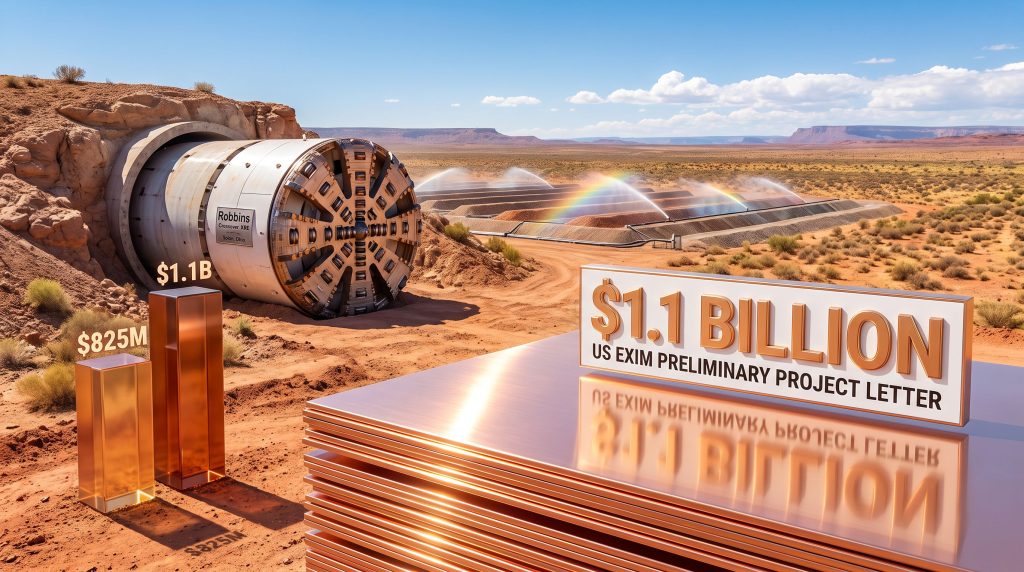
The US EXIM Ivanhoe Electric Santa Cruz Copper Project financing milestone — a Preliminary Project Letter indicating $1.1 billion in potential debt financing — is not simply a large number attached to a single mining development. It is evidence of a structural shift in how the United States government is deploying its balance sheet to address a vulnerability that took decades to create: the near-total offshoring of critical mineral refining capacity, and concentrated dependence on foreign supply chains for materials underpinning the entire energy transition and defence manufacturing base.
Understanding what this financing milestone actually means, and what it does not yet guarantee, requires moving beyond the headline figure and examining the policy mechanics, the project fundamentals, and the considerable distance that still separates a preliminary letter from a funded copper mine.
When big ASX news breaks, our subscribers know first
Rethinking the EXIM Mandate: From Export Credit to Supply Chain Security
The Make More in America Initiative represents a deliberate departure from the Export-Import Bank's conventional toolkit. Where traditional EXIM facilities are structured around export credit guarantees for overseas buyers of American goods, this programme channels debt financing directly toward US-based projects that build domestic manufacturing and resource production capacity.
The distinction matters enormously from a policy architecture standpoint. Traditional export credit financing is demand-driven: a foreign buyer needs capital to purchase American equipment, and EXIM bridges the gap. The Make More in America framework is supply-driven: the federal government identifies strategic gaps in domestic production and offers financing to catalyse projects that address those gaps. This approach reflects a broader critical minerals policy shift that has been reshaping federal resource strategy in recent years.
The copper sector illustrates why this reorientation has occurred. China controls an estimated 40% of global copper refining capacity, and US domestic copper cathode production has long been insufficient to meet industrial demand without relying on imported refined metal or sending ore concentrate overseas for processing.
The comparison below captures the structural difference between the two financing approaches:
| Feature | Traditional US EXIM | Make More in America |
|---|---|---|
| Primary Purpose | Support US exports | Strengthen domestic supply chains |
| Project Location | Overseas (buyer country) | United States |
| Strategic Trigger | Trade competitiveness | National security and resource sovereignty |
| Sector Focus | Broad capital goods and services | Critical minerals and manufacturing |
| Financing Type | Export credit guarantees | Direct project debt financing |
Decoding the Preliminary Project Letter: What It Means and What It Does Not
One of the most commonly misunderstood aspects of federal project financing is the significance of individual milestones along the approval pathway. A Preliminary Project Letter is frequently described in coverage as evidence of federal backing, but it carries important caveats that investors and analysts should understand clearly.
The Four-Stage US EXIM Financing Process
The pathway from initial interest to binding commitment at US EXIM follows a structured sequence:
- Letter of Interest (LOI) — An early-stage indication that a project may qualify for financing. No due diligence has been conducted and no quantum is guaranteed.
- Preliminary Due Diligence — EXIM conducts technical, financial, environmental, and policy review of the project against its eligibility criteria.
- Preliminary Project Letter (PPL) — A formal document issued following preliminary due diligence that indicates a potential financing quantum. It is explicitly not a financing commitment.
- Board Approval — The definitive step. Only after board consideration and affirmative vote does a binding financing commitment exist.
For the Santa Cruz project, the timeline has progressed as follows:
- April 2025: US EXIM issues a Letter of Interest indicating potential debt financing of up to $825 million with a 15-year repayment tenor
- August 2026: Following preliminary due diligence, US EXIM issues a Preliminary Project Letter lifting the indicated financing to $1.1 billion, a $275 million uplift from the initial figure
- Spring 2027: Ivanhoe Electric anticipates the US EXIM Board will formally consider the financing application
The increase from $825 million to $1.1 billion is analytically significant. It suggests that the due diligence process found the project's scope, capital requirements, and strategic credentials sufficiently robust to justify expanding the financing envelope rather than contracting it. This is not a common outcome: preliminary due diligence frequently results in revised, sometimes reduced, indications as technical complexity becomes clearer.
Inside the Santa Cruz Copper Project: Technical Foundations of a $1.1 Billion Financing Case
Project Fundamentals
The Santa Cruz Copper Project is located in Arizona and encompasses approximately 6,000 acres of privately held land, with Ivanhoe Electric holding surface rights, mineral rights, and associated water rights across the full acreage. The private ownership structure is a meaningful advantage in the US permitting environment, where federal land permitting timelines can stretch for years.
Key production parameters that underpin the financing rationale include:
- Product: Copper cathode at 99.99% purity (known in the industry as Grade A copper cathode, meeting the London Metal Exchange's highest delivery specification)
- Processing method: Fully heap leach operation with solvent extraction and electrowinning (SX-EW), eliminating the need for a conventional smelter
- Operational lifespan: 23 years
- Processing approach: No smelting required, meaning copper is refined on-site to finished product standard
The smelter-free model is more significant than it may appear at first glance. Conventional copper mines produce concentrate — a partially processed material containing roughly 25–30% copper alongside sulfur, iron, and trace elements — which must then be shipped to a smelter for further refining. The vast majority of global copper smelting capacity is concentrated in China, Chile, and Japan. A heap leach operation that produces finished copper cathode domestically bypasses this bottleneck entirely, delivering a product that goes directly into manufacturing without any further offshore processing.
The Robbins Crossover XRE Tunnel Boring Machine: Engineering Innovation Underground
One of the more technically distinctive elements of the Santa Cruz development plan is the decision to use a Robbins Crossover XRE tunnel boring machine for underground mine access. The machine is supplied by the Robbins Company, headquartered in Solon, Ohio, which reinforces the domestic manufacturing content of the project's supply chain.
Conventional underground mine access in hard rock environments typically uses drill-and-blast decline development, a method that is effective but slower, more labour-intensive, and generates significant ground disturbance. TBM-based access, however, offers several advantages in the right geological setting:
- Faster advance rates once the machine is established
- A smoother tunnel profile that reduces ground support requirements
- Lower dust and blast fume exposure for workers
- Continuous spoil removal integrated into the boring process
- Reduced surface footprint compared to open-cut access ramps
The Crossover XRE is specifically engineered to handle mixed-face conditions, meaning it can transition between hard rock and softer ground without requiring full machine replacement or extensive modification. This capability is particularly relevant in the geological variability typical of Arizona porphyry copper systems.
Is the September 2026 Updated Feasibility Study a Critical Milestone?
An updated Preliminary Feasibility Study is expected in September 2026, and its findings will carry substantial weight in the progression toward the spring 2027 EXIM Board consideration. The updated study is expected to incorporate:
- Full engineering details of the TBM-based underground access methodology
- Revised capital cost estimates reflecting current input pricing environments
- Updated mine scheduling and production sequencing
- Environmental management and water handling engineering refinements
- Any revisions to the processing plant configuration following post-2025 technical work
The September 2026 PFS will effectively serve as the primary technical document supporting the formal EXIM Board financing application. Investors and analysts tracking the US EXIM Ivanhoe Electric Santa Cruz Copper Project financing process should treat this document as a definitive data point for assessing project credibility.
The Capital Stack: How $1.1 Billion Fits Into a Larger Financing Architecture
The EXIM Preliminary Project Letter does not represent the only financing element already in motion at Santa Cruz. Ivanhoe Electric has already closed a $200 million senior secured bridge facility to fund early construction activities and working capital requirements while the long-term EXIM debt package moves through its approval process.
The bridge facility serves a dual purpose in project finance terms. It demonstrates to EXIM and other potential lenders that the project has sufficient institutional support to commence activity, and it ensures that development momentum is not entirely dependent on the outcome of a federal financing process with a timeline extending into 2027.
In project finance structures of this kind, the overall capital stack typically includes:
- Senior secured debt (the intended EXIM facility at $1.1 billion)
- Bridge financing (the $200 million facility already in place)
- Equity contributions from the project sponsor
- Potentially offtake-linked prepayment facilities or streaming arrangements, though none have been publicly confirmed at this stage
The leverage profile implied by a $1.1 billion debt facility against a project of this nature is consistent with major infrastructure-style mining project financings, where long-life, low-technical-risk assets with defined product specifications can support higher debt-to-equity ratios than shorter-life or more speculative developments.
The Structural Copper Deficit: Why This Project Exists
The financing cannot be understood in isolation from the macro demand story driving it. Furthermore, the copper supply crunch currently unfolding globally makes the domestic production case for Santa Cruz all the more compelling. Copper demand drivers are being structurally amplified by several concurrent forces:
- Electric vehicles: A single battery electric vehicle contains approximately 2.5 to 4 times more copper than a conventional internal combustion engine vehicle
- Grid infrastructure: The International Energy Agency has estimated that achieving net-zero emissions by 2050 would require more than doubling annual copper supply relative to current production levels
- Data centres: AI-driven demand for data centre construction is creating an accelerating secondary copper demand signal, with large-scale facilities requiring substantial quantities of copper wiring and cooling infrastructure
- Defence manufacturing: Advanced weapons systems, shipbuilding programmes, and military electronics represent a growing copper demand category within US domestic production requirements
Against this demand trajectory, US domestic refined copper production capacity is structurally insufficient. The country imports significant volumes of refined copper and copper semi-fabricates, with a meaningful portion of global refining occurring in jurisdictions where supply chain reliability cannot be assured over a multi-decade horizon. In addition, growing critical minerals demand across the energy transition is placing further pressure on existing production infrastructure. Consequently, projects such as Santa Cruz carry strategic weight well beyond their standalone economics.
The next major ASX story will hit our subscribers first
Risks and Uncertainties: What Could Derail the Financing
Financing and Approval Risks
The distance between a PPL and a board-approved financing commitment is not trivial. Several variables could alter the outcome ahead of the spring 2027 consideration:
- EXIM Board composition changes: Board membership and policy priorities can shift with administrations, potentially affecting the Make More in America Initiative's funding availability
- Federal budget constraints: Competition for federal financing capacity across multiple critical mineral and infrastructure projects could influence the timing or scale of individual commitments
- Technical findings in the updated PFS: If the September 2026 feasibility study reveals materially higher capital costs or revised production assumptions, lender confidence could be affected
- Copper price volatility: Project economics are sensitive to copper price assumptions; a sustained decline from current levels would compress the revenue projections underpinning the financing model
Operational and Environmental Risks
- Water rights management in Arizona's constrained hydrological environment remains a critical long-term operational variable
- Heap leach operations require careful geotechnical management of liner systems and leach pad stability across a 23-year operational life
- Underground TBM deployment introduces execution risk in the event of unexpected geological conditions not captured in current modelling
It is worth noting that comparable precedents, such as US EXIM antimony financing for Perpetua Resources, demonstrate that the bank is increasingly comfortable with complex domestic critical mineral transactions, however each project is evaluated independently on its own technical and economic merits.
This article is intended for informational purposes only and does not constitute financial advice. The Santa Cruz Copper Project financing remains subject to further review and US EXIM Board approval. All forward-looking statements involve risk and uncertainty. Investors should conduct their own due diligence.
Frequently Asked Questions
What is the US EXIM Preliminary Project Letter for the Santa Cruz Copper Project?
It is a formal document issued by the Export-Import Bank of the United States following preliminary due diligence, indicating potential debt financing of $1.1 billion for the Santa Cruz Copper Project. It is not a binding financing commitment and remains subject to further review and final board approval.
How has the indicated financing amount changed over time?
US EXIM's initial Letter of Interest, issued in April 2025, outlined potential financing of up to $825 million with a 15-year repayment tenor. The August 2026 PPL increased this indication to $1.1 billion, representing a $275 million uplift following the completion of preliminary due diligence.
When will a final financing decision be made?
Ivanhoe Electric has indicated that it expects the US EXIM Board to formally consider the financing application in spring 2027.
Why does Santa Cruz not require a smelter?
The project uses a heap leach and SX-EW processing methodology, which produces finished copper cathode at 99.99% purity directly on-site, eliminating the need to ship concentrate to an external smelter for further processing.
What other financing is already in place?
Ivanhoe Electric has closed a $200 million senior secured bridge facility to fund early construction activities and working capital while the longer-term EXIM financing package is being finalised.
What is the significance of the Robbins Crossover XRE TBM?
The machine will be used for underground mine access at Santa Cruz, replacing conventional drill-and-blast decline development. It is supplied by an Ohio-based manufacturer and is capable of operating in mixed geological conditions, which is particularly relevant in Arizona's porphyry copper geology. Full engineering details are expected in the September 2026 updated feasibility study.
Want to Track the Next Major Mineral Discovery Before the Market Does?
Discovery Alert's proprietary Discovery IQ model delivers real-time alerts on significant ASX mineral discoveries — turning complex data across 30-plus commodities into clear, actionable insights for investors at every level. Explore historic discoveries and their extraordinary returns, then start your 14-day free trial at Discovery Alert to position yourself ahead of the market.