August 14, 2026
The global commodity landscape faces unprecedented disruption as energy transition demands collide with constrained mining capacity across critical materials. Traditional supply chains built for incremental industrial growth now confront exponential infrastructure electrification requirements that threaten to outstrip production capabilities for decades. This copper supply deficit reflects deeper systemic challenges in extractive industries where geological, regulatory, and capital constraints converge to create what may become the most severe resource bottleneck of the modern era.
The Fundamental Forces Behind Copper Market Stress
Infrastructure Electrification Creates Exponential Demand Growth
Energy transition requirements fundamentally alter copper consumption patterns as electrical infrastructure scales beyond historical precedent. Energy transition demand for copper is projected to triple by 2045, according to tight supply and tariff risks analysis from December 2025, representing the most aggressive industrial material requirement surge since post-war reconstruction periods.
Data center expansion drives unexpected consumption spikes as artificial intelligence processing demands create new categories of electrical infrastructure. Cloud computing facilities require substantial copper for power distribution systems, backup power infrastructure, and cooling systems that operate continuously at massive scale.
These installations consume copper at rates exceeding traditional manufacturing facilities while operating 24/7 with minimal downtime for maintenance or upgrades. Furthermore, electric vehicle production scaling creates compounding pressure across the automotive supply chain.
Each electric vehicle requires approximately three times the copper content of conventional vehicles, primarily concentrated in electric motors, battery management systems, and charging infrastructure connections. Battery gigafactory construction adds another layer of demand as these facilities require extensive electrical systems for manufacturing processes and quality control operations.
Supply Chain Constraints Multiply Production Challenges
Ore grade deterioration across global copper deposits forces mining operations to process dramatically larger volumes of raw material for equivalent metal output. Modern copper mines extract ore containing less than 0.7% copper content, compared to significantly higher grades available in previous decades.
This deterioration requires expanded processing facilities, increased energy consumption, and higher capital investment per tonne of final copper production. Equipment manufacturing bottlenecks limit mining expansion capabilities as specialised machinery suppliers struggle to meet demand from multiple commodity sectors simultaneously.
Processing equipment, transport systems, and extraction machinery require extended lead times for manufacturing and installation. Skilled technician shortages compound these constraints as mining operations compete for qualified personnel across engineering, geology, and equipment maintenance disciplines.
Transportation infrastructure limitations affect copper movement from mine sites to processing facilities and final markets. Port capacity, rail networks, and specialised shipping capabilities designed for traditional commodity volumes face congestion as producers attempt to maximise output from existing operations while new mine development remains limited.
When big ASX news breaks, our subscribers know first
Quantifying the Emerging Supply-Demand Imbalance
Timeline for Structural Deficit Emergence
Copper is expected to enter structural deficit starting in 2026 as global demand growth outpaces new production capacity additions. BloombergNEF analysis indicates this copper supply deficit represents a fundamental shift from cyclical supply-demand balances to persistent shortfalls that may characterise markets through the 2030s.
Without new mines or significant improvements in scrap collection, the copper shortfall could reach 19 million tonnes by 2050, representing approximately 75% of current annual global production. This projection assumes continued electrification trends without major technological substitutions or demand destruction from extreme price increases.
Current market signals already reflect emerging constraints. Copper hits US$12,000 for the first time as copper prices rose 35% in 2025, tracking toward the largest annual gain since 2009. This price momentum reflects investor recognition that structural supply constraints may persist regardless of short-term demand fluctuations.
Regional Production Vulnerability Assessment
| Region | Production Share | Primary Risk Factors | Timeline Impact |
|---|---|---|---|
| Chile | 25% global output | Water scarcity, aging infrastructure | 2025-2027 |
| Peru | 15% global output | Political instability, permitting delays | 2026-2030 |
| Indonesia | 8% global output | Mine closures, export restrictions | 2025-2026 |
| DR Congo | 6% global output | Geopolitical tensions, infrastructure | 2025-2035 |
Chile and Peru face operational disruptions that compound global supply constraints. Chilean operations contend with water availability challenges and infrastructure aging that limits production expansion. Peruvian operations navigate complex political environments and extended permitting processes that delay new project development.
Indonesian mine closures removing significant capacity through 2026 create immediate supply gaps while global demand continues expanding. Export policy changes and domestic processing requirements further constrain material availability for international markets.
Industrial Sector Vulnerability Analysis
Electric Vehicle Manufacturing Faces Material Security Challenges
Automotive manufacturers confront unprecedented copper requirements as electric vehicle production scales beyond pilot programmes toward mass market adoption. Battery electric vehicles demand approximately 80 kilograms of copper per vehicle compared to 25 kilograms for conventional automobiles, concentrated primarily in electric motors, power electronics, and charging system connections.
Charging infrastructure deployment multiplies copper demand beyond vehicle production requirements. Level 3 fast-charging stations require substantial copper for high-voltage electrical connections and power conditioning equipment. Grid connection requirements for charging networks add additional copper consumption as electrical utilities upgrade distribution systems to handle increased power loads.
Battery gigafactory construction creates concentrated copper demand in specific geographic regions. These facilities require extensive electrical infrastructure for manufacturing processes, environmental controls, and quality assurance systems. Tesla, CATL, BYD, and other major battery manufacturers plan dozens of gigafactories globally, each requiring thousands of tonnes of copper for construction and operation.
Renewable Energy Infrastructure Confronts Material Constraints
Wind turbine manufacturing demands approximately 4-5 tonnes of copper per megawatt of generating capacity, concentrated in generators, power electronics, and transmission connections. Offshore wind installations require additional copper for submarine cables and grid integration systems that operate in challenging marine environments.
Solar installations consume copper through inverters, transformers, and electrical balance-of-system components that convert direct current electricity to grid-compatible alternating current. Utility-scale solar farms require extensive copper cabling for module interconnection and power collection systems spanning hundreds of acres.
Grid modernisation projects necessary for renewable energy integration demand substantial copper for smart grid technologies, energy storage integration, and transmission capacity upgrades. Electrical utilities worldwide plan significant distribution system improvements to accommodate bidirectional power flows and demand response capabilities.
Primary Factors Limiting Mine Production Expansion
Geological Challenges Increase Extraction Complexity
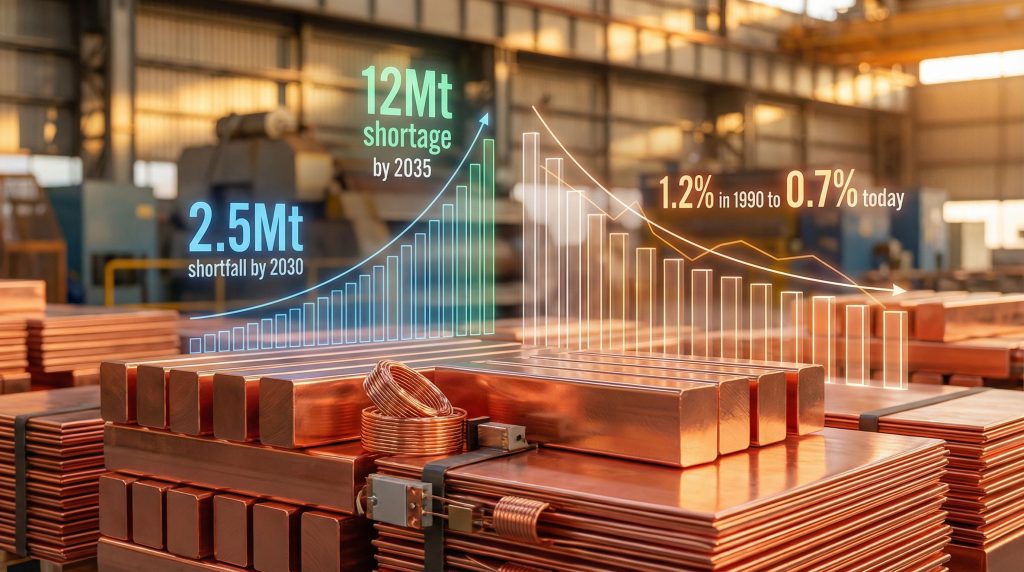
Critical Industry Insight: Global copper ore grades have declined from 1.2% in 1990 to below 0.7% today, requiring significantly more processing for equivalent output while increasing energy costs and environmental impacts.
Declining ore quality forces mining operations to extract and process dramatically larger volumes of rock for equivalent copper production. Lower-grade deposits require more sophisticated processing technologies, increased energy consumption, and expanded waste management systems. These factors substantially increase capital requirements and operational costs per tonne of final copper output.
Deposit depth increases access complexities as near-surface, high-grade deposits become depleted. Deeper mining operations require more sophisticated ventilation, power distribution, and material handling systems. Underground operations face higher safety requirements and operational constraints compared to open-pit mining methods.
Water availability challenges affect processing operations in many major copper-producing regions. Copper processing requires substantial water for ore concentration and metallurgical operations. Water scarcity in Chile, Peru, and other key producing regions limits processing capacity and increases operational costs through water recycling and treatment requirements.
Regulatory and Environmental Compliance Barriers
Permitting processes extending project timelines by 5-7 years substantially delay new production capacity additions relative to demand growth. Environmental impact assessments, community consultation requirements, and regulatory reviews create extended approval processes that discourage speculative investment in exploration and development projects.
Environmental compliance costs increase capital requirements for new mining operations. Modern mining projects must incorporate sophisticated environmental management systems, water treatment facilities, and ecosystem restoration programmes. These requirements can represent 15-25% of total project capital costs.
Community relations and social licence considerations require ongoing investment and engagement throughout mine life cycles. Indigenous rights recognition, local employment requirements, and community benefit sharing agreements create operational constraints and ongoing financial obligations for mining companies.
Capital Investment Constraints
New mine development requiring $15,000-20,000 per tonne of annual production capacity creates substantial barriers to capacity expansion. Large-scale copper mining projects typically require $3-5 billion in initial capital investment with 7-10 year development timelines from discovery to first production.
Risk-averse investment climate following commodity price volatility limits available project financing. Mining companies and their financial partners demand higher returns and more certain project economics following significant losses during previous commodity downturns. This conservative approach reduces speculative investment in early-stage exploration and development projects.
Limited access to project financing affects emerging market operations where political risk premiums increase capital costs. International development finance institutions and commercial banks apply stringent environmental, social, and governance criteria that may exclude projects in certain jurisdictions regardless of geological prospectivity.
Strategic Responses from Major Mining Companies
Consolidation and Acquisition Activity Intensifies
Major mining companies including Anglo American, BHP, Glencore, Rio Tinto, Vale, and Zijin demonstrate renewed capital expenditure and consolidation activity as industry leaders position for long-term copper supply constraints. This consolidation reflects recognition that copper's strategic importance in energy transition justifies substantial investment despite near-term market uncertainties.
According to industry analysis, the surge in mergers and acquisitions reflects copper's growing strategic importance as companies compete for access to high-quality deposits and processing infrastructure. Acquisition activity targets advanced-stage development projects and operating mines with expansion potential rather than early-stage exploration properties.
Vertical integration efforts secure processing capacity as miners seek control over refining and smelting operations. Supply chain integration reduces third-party processing costs while ensuring access to refining capacity during periods of high demand. This strategy becomes particularly important as Chinese refining dominance creates potential supply chain vulnerabilities for Western mining companies.
Technology and Operational Efficiency Improvements
Advanced extraction techniques for low-grade ore processing enable economic production from previously marginal deposits. Heap leaching, in-situ recovery, and enhanced flotation technologies allow mining companies to extract copper from ores that were previously uneconomic. These technologies require significant upfront investment but reduce ongoing operational costs per tonne of copper production.
Automation and digitalisation initiatives reduce operational costs while improving safety and consistency. Autonomous haulage systems, remote-controlled drilling equipment, and predictive maintenance programmes increase operational efficiency while reducing exposure to safety hazards. These technologies also help address skilled labour shortages by reducing workforce requirements for routine operations.
Enhanced recycling systems supplement primary supply as companies invest in urban mining and scrap recovery technologies. Copper recycling can provide up to 30% of global supply by 2030 through improved collection systems and processing technologies. Secondary supply becomes increasingly important as scrap copper requires significantly less energy to process compared to primary ore extraction.
China's Dominant Role in Global Copper Processing
Refining Capacity Concentration Creates Systemic Risk
China controls 50% of global copper refining capacity, creating potential supply chain vulnerabilities for international markets despite diverse mining operations worldwide. Chinese smelting and refining operations process copper concentrate from global mining operations before redistributing refined copper to international markets.
Government emission reduction policies limit smelter expansion capabilities as environmental regulations constrain new capacity additions in China. Air quality improvement initiatives require existing smelters to implement costly emission control systems while limiting permits for new facilities. These policies may gradually reduce China's refining market share over time as production shifts to other jurisdictions.
Strategic mineral policies affect global supply chain stability as Chinese government priorities influence processing capacity allocation and export availability. Trade relationships and geopolitical considerations may impact copper processing and distribution decisions, potentially affecting global market access for refined copper products.
Demand Pattern Evolution
Chinese infrastructure investment cycles historically drove global copper demand through construction and manufacturing sectors. Urbanisation programmes, high-speed rail development, and electrical grid expansion created substantial copper consumption growth through the 2000s and 2010s.
Manufacturing sector transitions impact copper requirements as China shifts from heavy industry toward advanced manufacturing and services. Electric vehicle production, renewable energy equipment manufacturing, and electronics production create new copper demand patterns that may offset declining construction-related consumption.
Export policy considerations affect global copper product availability as China balances domestic consumption needs with international market supply obligations. Processing capacity allocation decisions influence global copper product pricing and availability for international industrial consumers.
The next major ASX story will hit our subscribers first
Price Trajectory and Market Dynamics Assessment
Structural Price Support Mechanisms
| Time Period | Price Projection (USD/tonne) | Primary Market Drivers |
|---|---|---|
| 2025-2026 | $9,500-$12,000 | Supply disruptions, deficit emergence |
| 2027-2030 | $11,000-$15,000 | Structural shortage deepening |
| 2031-2035 | $13,000-$18,000 | Peak deficit period, limited new supply |
Long-term structural support emerges from supply-demand fundamentals rather than speculative financial activity. BloombergNEF's forecast is based on structural supply-demand trends that indicate persistent supply constraints through the 2030s regardless of short-term economic cycles or demand fluctuations.
Inventory depletion creates immediate price support as global copper stocks remain at critically low levels through 2025-2026. London Metal Exchange and Shanghai Futures Exchange warehouse stocks provide minimal buffer against supply disruptions or demand spikes. Low inventory levels amplify price volatility during supply chain disruptions.
Investment fund participation increases price volatility as financial market speculation amplifies fundamental supply-demand imbalances. Exchange-traded funds, commodity index funds, and hedge fund activity can create price movements that exceed those justified by physical market conditions alone.
Risk Factors and Market Uncertainties
Geopolitical tensions affecting major producing regions create supply security concerns that may justify strategic stockpiling by major consuming nations. Political instability in Peru, trade policy changes affecting Chilean exports, or conflict affecting African production could remove substantial supply from global markets.
Economic recession scenarios could temporarily reduce copper demand if global manufacturing activity declines significantly. However, structural electrification trends may provide demand support even during economic downturns as energy transition investment continues regardless of short-term economic cycles.
Currency fluctuations affect copper pricing dynamics as most international transactions occur in US dollars. Dollar strength relative to producing country currencies can impact mining company profitability and investment decisions for new capacity additions.
Alternative Supply Strategies and Mitigation Approaches
Secondary Supply Enhancement Opportunities
Scrap copper recovery potentially provides 30% of global demand by 2030 through improved collection systems and processing technologies that capture copper from end-of-life products. Urban mining initiatives target electronic waste streams, building demolition materials, and industrial scrap sources that historically received limited recovery attention.
Electronic waste processing becomes increasingly important as copper content in smartphones, computers, and other devices accumulates in landfills and recycling streams. Specialised processing facilities can recover high-purity copper from electronic components while managing hazardous materials appropriately.
Industrial process optimisation reduces virgin material requirements through more efficient manufacturing techniques and product design improvements. Electrical equipment manufacturers implement design changes that minimise copper content without compromising performance or safety requirements.
Material Substitution Possibilities
Aluminium replacement in specific electrical applications offers potential demand reduction for copper in certain use cases. Electrical transmission and distribution systems can utilise aluminium conductors where weight advantages offset electrical conductivity differences. However, aluminium substitution requires engineering modifications and may not be feasible for all applications.
Advanced alloy development reduces copper content requirements in specialised applications through enhanced material properties. Copper-nickel, copper-chromium, and other alloy systems provide improved performance characteristics that allow reduced copper content in high-performance applications.
Technological innovations minimising material intensity include improved electrical designs that achieve equivalent performance with reduced copper content. Motor design improvements, power electronics advances, and system-level optimisations can reduce copper requirements without compromising functionality.
Investment Opportunities Emerging from Supply Constraints
Mining Sector Investment Themes
For instance, the major copper system Argentina presents advanced-stage copper projects that offer potential investment opportunities for investors seeking exposure to copper supply constraints. Companies with proven deposits, completed feasibility studies, and secured financing arrangements may benefit from sustained high copper prices and industry consolidation activity.
Similarly, the australia‑canada copper investment landscape demonstrates how technology companies providing extraction efficiency solutions become increasingly valuable as mining companies seek operational improvements. Automation equipment suppliers, ore processing technology developers, and mining software companies may experience increased demand as operators attempt to maximise production from existing operations.
Furthermore, projects like the tamarack nickel‑copper project highlight how infrastructure developers supporting mine-to-market logistics face increased demand as mining companies expand production and develop new operations. Port facilities, rail networks, and specialised transportation equipment become critical bottlenecks that require substantial investment to support increased copper production.
Downstream Sector Implications
Electrical equipment manufacturers with secure copper supply arrangements gain competitive advantages over companies dependent on spot market procurement. Long-term supply contracts, vertical integration, or strategic supplier relationships provide cost stability and supply security during periods of market stress.
Recycling companies with copper processing capabilities benefit from increased scrap values and expanded collection opportunities. Companies with sophisticated sorting, processing, and purification technologies can capitalise on growing secondary supply requirements while providing environmental benefits.
Alternative material developers addressing copper substitution needs may attract investment as industrial consumers seek supply security. Companies developing aluminium conductor technologies, advanced alloys, or material-efficient designs could benefit from increased research and development investment.
Energy Transition Impact Assessment
Infrastructure Development Constraints
Grid modernisation projects face material availability challenges as electrical utilities worldwide plan substantial distribution system upgrades. Smart grid technologies, energy storage integration, and transmission capacity improvements require copper investments that compete with electric vehicle and renewable energy demand.
Renewable energy deployment could slow due to material costs if copper prices increase beyond project economic thresholds. Wind and solar developers operate on thin margins that may not accommodate substantial material cost increases without affecting project viability and investment returns.
Electric transportation adoption rates depend on supply chain security and cost management throughout the automotive industry. If copper supply deficit constraints significantly increase vehicle production costs, electric vehicle adoption could slow relative to current policy targets and industry expectations.
Policy Response Requirements
Strategic reserve considerations for critical mineral security become important policy tools as governments recognise supply chain vulnerabilities. National stockpiling programmes, strategic partnership agreements, and domestic production incentives may help ensure copper availability for critical infrastructure projects.
International cooperation frameworks for supply chain resilience require coordination among major consuming nations to ensure equitable access to copper supplies. Multilateral agreements on trade policies, environmental standards, and investment protection could help stabilise global copper markets.
Investment incentives accelerating domestic production capacity include tax policies, regulatory streamlining, and risk-sharing mechanisms that encourage mining investment in politically stable jurisdictions. Government support for exploration, development, and processing capacity could help diversify global supply chains.
Long-Term Solutions for Structural Supply Challenges
What Are the Key Exploration and Development Acceleration Strategies?
Streamlined permitting processes reducing project timelines from 5-7 years to 3-4 years could substantially increase new supply additions through the 2030s. Regulatory reform initiatives that maintain environmental protection while improving approval efficiency help balance conservation and resource development objectives.
Risk-sharing mechanisms encouraging private investment include government-backed project finance, exploration tax incentives, and international development bank participation in mining projects. Public-private partnerships can help overcome financing barriers for large-scale mining developments in emerging market jurisdictions.
Technology advancement supporting deeper deposit access enables economic extraction from previously unviable copper resources. Advanced drilling techniques, underground mining methods, and ore processing innovations could unlock substantial copper resources that are currently uneconomic to extract.
How Can Supply Chain Diversification Address Regional Risks?
Geographic distribution reducing concentration risks requires investment in copper processing capacity outside China and traditional producing regions. Refining facility development in North America, Europe, and other regions could improve supply chain resilience while reducing transportation costs.
For example, the u.s. copper production overview demonstrates how processing capacity development outside traditional centres includes smelting and refining investments in politically stable jurisdictions. These investments require substantial capital but provide long-term supply security benefits.
Transportation infrastructure supporting new production regions becomes critical as mining companies develop deposits in remote locations. Railway construction, port facility development, and specialised shipping capabilities enable economic transportation from mine sites to global markets.
Disclaimer: This analysis contains forward-looking statements and projections based on current market conditions and industry trends. Commodity prices and supply-demand dynamics are subject to significant volatility and uncertainty. Investment decisions should be made only after careful consideration of individual risk tolerance and consultation with qualified financial advisors.
Looking to Capitalise on Copper's Structural Supply Deficit?
Discovery Alert's proprietary Discovery IQ model delivers real-time alerts on significant copper and mineral discoveries across the ASX, empowering investors to identify actionable opportunities ahead of the broader market during this unprecedented supply shortage. Understand why major mineral discoveries can lead to substantial market returns by exploring Discovery Alert's dedicated discoveries page, showcasing historic examples of exceptional outcomes, then begin your 30-day free trial to position yourself ahead of the market.