July 8, 2026
The Supply Equation Every Copper Investor Should Understand Right Now
Global copper markets do not move in straight lines. They respond to a complex web of mine-level execution, geological surprises, infrastructure constraints, and the compounding effect of large-scale capital investment decisions made years earlier. When one of the world's largest copper operations undergoes a structural step-change in output capacity, the ripple effects extend far beyond a single company's quarterly report.
Understanding why that step-change is happening, and what it reveals about the broader market, is where the real analytical value lies.
The Kamoa-Kakula copper complex in the Democratic Republic of Congo sits at the intersection of all these forces. With Ivanhoe Congo copper output rising in second half 2026, the operational mechanics behind that acceleration deserve serious attention from anyone tracking global copper supply forecast trajectories.
When big ASX news breaks, our subscribers know first
Why Kamoa-Kakula Carries Unusual Weight in Global Supply Models
Not all copper mines are created equal. Kamoa-Kakula consistently ranks among the highest-grade large-scale copper deposits ever brought into production, with ore grades that significantly outperform the global average. This matters because grade is the silent multiplier in mining economics: higher-grade ore means more copper extracted per tonne of rock moved, which translates directly into lower unit costs and stronger margins even during periods of price softness.
The complex sits within the Central African Copperbelt, a geological formation that hosts some of the richest sediment-hosted stratiform copper deposits on Earth. The flat-lying, predictable nature of Kamoa-Kakula's ore bodies allows for highly mechanised, bulk underground mining methods, which is one of the structural reasons the operation can target meaningful throughput increases without proportional capital expenditure.
For global copper supply models, Kamoa-Kakula is not a marginal contributor. Indeed, it is one of a small number of operations — alongside the largest copper mines globally — capable of moving the needle on global supply balances in a single production cycle.
Understanding the Operational Mechanics Behind the H2 2026 Acceleration
The H2 2026 production uplift at Kamoa-Kakula is driven by three converging factors, each of which compounds the others:
- Kakula mining rate increase: Underground mining rates at Kakula are projected to rise by approximately 30% in the second half of 2026 relative to the constrained H1 pace, as the operation recovers from seismic disruptions that required dewatering and access remediation work earlier in the year.
- Kamoa mine ramp: The broader Kamoa underground operation is targeting a throughput rate of approximately 700,000 tonnes per month (roughly 8.5 million tonnes per annum annualised), representing a structural expansion in ore feed capacity.
- Inventory destocking: Up to 10,000 tonnes of accumulated copper inventory are planned for drawdown in H2 2026, adding a supplementary source of reportable production volume on top of mined output.
The table below summarises the key operational inputs across the two halves of 2026:
| Production Input | H1 2026 Status | H2 2026 Target |
|---|---|---|
| Kakula Mining Rate | Constrained post-seismic recovery | ~500,000 t/month (6.0 Mtpa) |
| Kamoa Mining Rate | Ramping progressively | ~700,000 t/month (8.5 Mtpa) |
| Copper Inventory | Accumulating through H1 | Up to 10,000 t destocking planned |
| On-Site Smelter | Ramping from December 2025 start | Targeting full annualised rate by year-end |
The Kahala Box-Cut and Western Kakula Ore: Unlocking New Feed Sources
One of the less-discussed operational developments at Kamoa-Kakula is the progressive opening of new ore access points. The Kahala box-cut development and the integration of Western Kakula ore zones into the mine plan are significant because they diversify the feed sources available to the processing circuit.
In underground mining, having multiple active ore development fronts reduces the operational vulnerability that comes from concentrating extraction in a single area. When one zone experiences a disruption, as Kakula did from seismic events in early 2026, the ability to redirect ore flow from alternative development headings becomes operationally critical.
This structural redundancy in ore sourcing is a key part of why management retains confidence in the H2 production acceleration, rather than treating it as aspirational.
What Actually Happened in H1 2026 and What the Recovery Curve Reveals
The H1 2026 production shortfall was not the result of a structural problem with the deposit or the processing infrastructure. It was a discrete operational event: seismic activity at Kakula caused ground movement that required dewatering of affected workings and a temporary restructuring of the mine's access and extraction schedule.
The production data tells the story clearly:
H1 2026 Production Summary:
- Q1 2026: approximately 71,417 tonnes of copper in anode
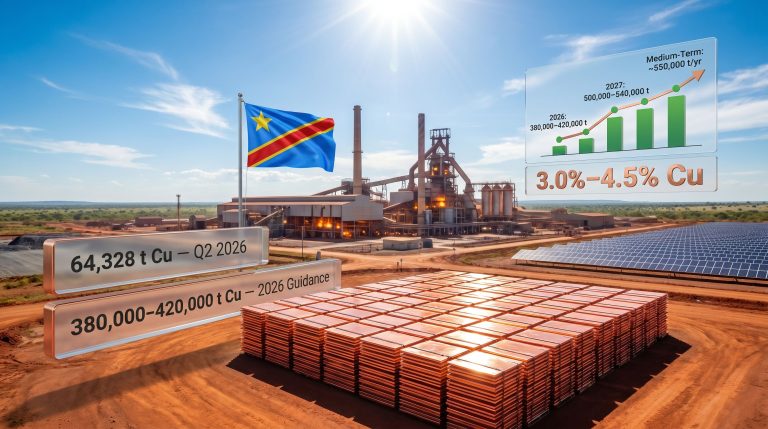
- Q2 2026: 64,328 tonnes of copper in anode, blister, and saleable concentrate
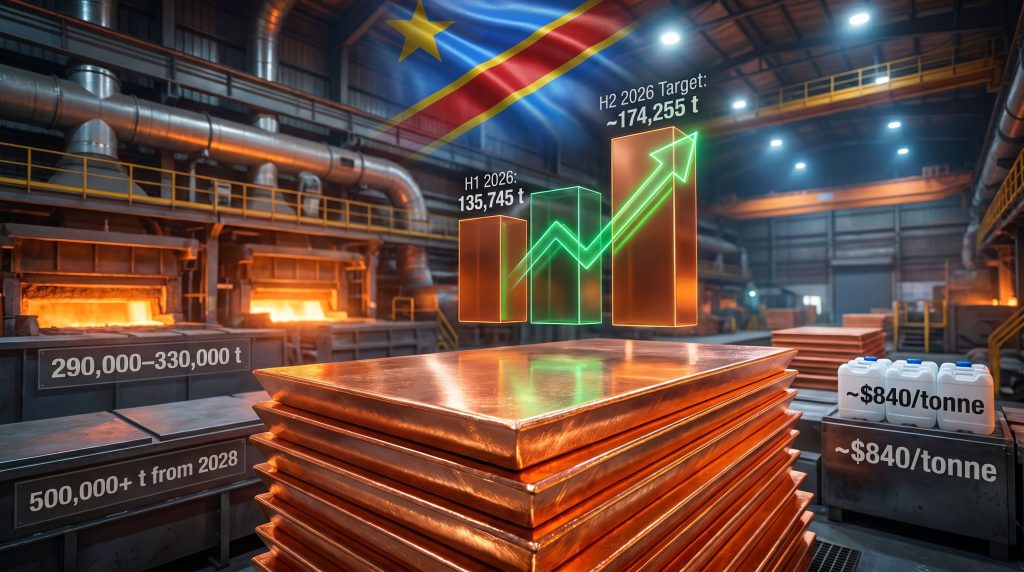
- H1 2026 Combined: 135,745 tonnes
- Implied H2 2026 requirement to hit guidance midpoint: approximately 174,255 tonnes, representing a ~28% step-up versus H1
The Q2 figure being lower than Q1 initially looks concerning, but it reflects the phased nature of the dewatering and recovery work, with some production areas remaining inaccessible deeper into Q2 before access was restored. The recovery trajectory visible in the mining rate data through the back half of Q2 is the leading indicator that matters most for projecting H2 performance.
Guidance Revision in Context: Reading the Numbers Correctly
The reduction in full-year 2026 guidance from the original 380,000 to 420,000 tonne range to the revised 290,000 to 330,000 tonne range represents a variance of approximately 21 to 24 percent. That is a meaningful downward revision, and it should be understood as such. However, context is essential to interpreting what this revision actually signals.
| Guidance Period | Original Forecast | Revised Forecast | Variance |
|---|---|---|---|
| 2026 Full Year | 380,000-420,000 t | 290,000-330,000 t | ~21-24% reduction |
| 2027 Full Year | To be confirmed | 380,000-420,000 t | Recovery to original 2026 target |
| Post-2028 Target | Long-term growth | 500,000+ t annualised | Long-term trajectory intact |
The deferral of the 380,000 to 420,000 tonne output range from 2026 into 2027 is notable. It suggests that management views the seismic disruption as a timing event rather than a permanent impairment to the operation's production capacity. The post-2028 target of more than 500,000 tonnes annualised remains unchanged, which is the number that anchors the long-term investment thesis for the asset.
For investors focused on fundamental value rather than near-term production beats, the guidance revision is best understood as a one-year delay in a production growth trajectory that otherwise remains structurally intact. Furthermore, the copper price growth drivers underpinning long-term demand have not diminished during this period of operational adjustment.
The On-Site Smelter: Where Margin Architecture Gets Interesting
One of the most significant and underappreciated developments at Kamoa-Kakula is the commissioning of the on-site direct-to-blister copper smelter, which began operations in late December 2025. The smelter is designed to produce 99.7%-pure copper anode at an annualised throughput rate of 500,000 tonnes, and it represents a fundamental shift in the value capture model for the operation.
Traditional copper mine economics involve selling copper concentrate to third-party smelters under terms that include treatment charges, refining charges, and penalties for impurities. These costs can be substantial, often representing a significant deduction from the gross copper price received. By processing concentrate into anode on-site, Kamoa-Kakula eliminates this cost layer entirely.
The practical implications for the margin profile are meaningful:
- Elimination of third-party treatment and refining charges
- Reduced concentrate transport costs (anode is more compact and stable than concentrate)
- Improved realised copper prices relative to concentrate sales
- Greater control over product quality and delivery timing
As the smelter ramps toward full annualised capacity through the second half of 2026, the margin improvement from vertical integration will compound progressively with the volume increase from the mining rate acceleration, creating a dual tailwind for the operation's financial performance.
The next major ASX story will hit our subscribers first
Sulphuric Acid: The Byproduct Revenue Stream Rewriting the Economics
Copper smelting using flash furnace or similar pyrometallurgical processes generates sulphur dioxide as a byproduct of burning off sulphide minerals in the concentrate. When captured and processed, this sulphur dioxide is converted into sulphuric acid, a commodity with significant industrial demand.
What makes Kamoa-Kakula's acid position particularly interesting in mid-2026 is the pricing environment:
| Metric | Q2 2026 Figure | Market Context |
|---|---|---|
| Acid Production Volume | 112,307 tonnes | Generated as smelter byproduct |
| July 2026 Contract Price | ~$840 per tonne | Described as a record level |
| Revenue Contribution | Material incremental upside | Diversifies revenue beyond copper |
Sulphuric acid at $840 per tonne represents exceptional pricing by historical standards. The primary demand driver in the DRC context is the region's copper and cobalt hydrometallurgical processing industry, which consumes large volumes of acid for leaching operations.
As the broader Congolese mining sector expands, local acid demand has tightened supply, and Kamoa-Kakula's on-site production positions the operation to capture this pricing strength directly.
At 112,307 tonnes produced in a single quarter, acid revenue is no longer a minor footnote. It is a meaningful contributor to overall revenue diversification and a structural feature of the smelter's economics that many copper-focused analysts may underweight in their models.
Kipushi Zinc: A Record Quarter That Deserves More Attention
While the copper narrative dominates the Ivanhoe story, the Kipushi mine delivered a record 70,177 tonnes of zinc in concentrate during Q2 2026, an increase of 8% quarter-on-quarter. Kipushi is one of the world's highest-grade zinc operations, and its consistent output growth provides meaningful portfolio diversification alongside the copper-dominant Kamoa-Kakula asset.
Zinc market dynamics in 2026 have been shaped by supply constraints from several major European and Asian producers, which has consequently supported pricing. A high-grade, low-cost African zinc producer generating record quarterly output into this environment represents a material asset contribution that the headline copper numbers can obscure.
Scenario Analysis: What the H2 2026 Ramp Means for Global Supply
Three scenarios bracket the range of plausible H2 2026 outcomes:
Scenario A: Guidance midpoint achieved (310,000 t full year)
- H2 contribution of approximately 174,000 tonnes
- Represents a significant volume injection into a supply-constrained market
- Most likely scenario if mining rate ramp proceeds as planned
Scenario B: Upper guidance band achieved (330,000 t full year)
- H2 contribution of approximately 194,000 tonnes
- Would position Kamoa-Kakula as one of the most significant H2 supply growth contributors globally
- Requires clean execution on both the Kakula rate increase and the inventory drawdown
Scenario C: Operational headwinds persist (290,000 t lower band)
- H2 contribution of approximately 154,000 tonnes
- Still a material recovery from the H1 annualised pace
- Leaves the global market tighter than central-case forecasts anticipate
In the context of an ongoing copper supply crunch, even the lower-band scenario represents a meaningful contribution to global refined copper availability.
Key Risks That Could Affect the H2 Trajectory
No production forecast is without risk, and investors tracking this operation should monitor several specific variables:
- Geological and seismic risk: The Kakula mine has demonstrated susceptibility to seismic activity. While dewatering and remediation work has addressed the H1 disruption, the underlying geological environment remains a variable to monitor.
- Infrastructure constraints: The DRC's logistics infrastructure, including road, rail, and border crossing capacity, can introduce variability in concentrate and product movement timelines.
- Acid supply chain dependencies: The smelter's performance is partly linked to the reliable supply of inputs and the smooth off-take of acid byproduct. Demand-side disruptions in the regional acid market could affect the economic profile of the byproduct stream.
- Smelter ramp-up execution: Reaching full annualised smelter capacity by year-end 2026 is an ambitious timeline for an operation that commenced commissioning only in late 2025. Any delays in achieving nameplate throughput would affect both copper anode output and acid production volumes.
In addition, the broader question of copper capital allocation across the industry will influence how quickly any supply gaps can be addressed if Kamoa-Kakula's ramp encounters further headwinds.
Frequently Asked Questions
What is Kamoa-Kakula's total copper production guidance for 2026?
The revised full-year 2026 guidance is 290,000 to 330,000 tonnes of copper in anode, blister, and saleable concentrate, implying a production acceleration of approximately 28% in H2 relative to the 135,745 tonnes recorded in H1.
Why was the original 2026 production forecast reduced?
Seismic activity at the Kakula underground mine caused operational disruptions requiring dewatering and access remediation, which constrained mining rates during the first half of 2026.
What is driving the expected H2 2026 production increase?
Three factors are converging: a 30% increase in Kakula underground mining rates, the ramp of Kamoa mines toward 700,000 tonnes per month throughput, and the planned drawdown of up to 10,000 tonnes of accumulated copper inventory.
When is Kamoa-Kakula expected to reach 500,000 tonnes of annual production?
Management has indicated that annualised production exceeding 500,000 tonnes is targeted from 2028 onwards, following a recovery to 380,000 to 420,000 tonnes in 2027.
What is the significance of sulphuric acid production at Kamoa-Kakula?
Sulphuric acid is produced as a byproduct of the on-site smelting process. With July 2026 sales contracts priced at approximately $840 per tonne — a record level — acid sales represent a material incremental revenue stream that improves the overall economics of the smelter and diversifies revenue beyond copper alone.
Strategic Takeaways for Investors Monitoring the Copper Supply Landscape
The Ivanhoe Congo copper output rising in second half 2026 story is ultimately about the difference between a timing disruption and a structural impairment. The evidence from the production data, the mining rate trajectory, the smelter ramp, and the unchanged long-term production targets all point toward the former rather than the latter.
For investors analysing copper supply growth, the milestones worth tracking through H2 2026 and into 2027 include the Kakula mining rate confirmation, the smelter's progress toward nameplate capacity, the pace of inventory drawdown, and whether the Kamoa throughput target of 700,000 tonnes per month is sustained consistently across multiple months rather than achieved episodically.
The DRC's copper belt is becoming structurally more important to global decarbonisation supply chains as electric vehicle adoption, grid infrastructure build-out, and renewable energy deployment all drive long-cycle copper demand growth. Kamoa-Kakula, as the highest-grade large-scale operation within that belt, sits at the centre of that structural story regardless of any single quarter's production result.
This article is for informational purposes only and does not constitute financial or investment advice. Production forecasts, market projections, and operational timelines are subject to change based on geological, operational, and market conditions. Readers should conduct their own due diligence before making any investment decisions. Further context on global copper market dynamics can be found via Reuters.com and Kitco News.
Want to Capitalise on the Next Major Copper Discovery Before the Broader Market?
Discovery Alert's proprietary Discovery IQ model scans ASX announcements in real time, instantly identifying significant mineral discoveries across copper and more than 30 other commodities — turning complex data into clear, actionable investment opportunities for both short-term traders and long-term investors. Explore how historic discoveries have generated substantial returns on Discovery Alert's dedicated discoveries page, and begin your 14-day free trial today to position yourself ahead of the market.