June 19, 2026
The Capital Market Architecture Reshaping African Copper Production
The global mining industry has entered a structural inflection point that few analysts predicted with precision. Decades of underinvestment in base metal infrastructure across sub-Saharan Africa, combined with an accelerating electrification supercycle, have created a unique convergence: deep-ore copper assets that were once considered marginal are now among the most strategically valuable resources on the planet. Against this backdrop, the mechanics of how capital reaches these assets matters enormously, and the architecture of the CopperTech IPO Zambia expansion project represents one of the most instructive case studies in modern mining finance.
When big ASX news breaks, our subscribers know first
Zambia's Copper Sector: A Production Gap That Demands Capital Solutions
Understanding the CopperTech IPO requires first grasping the scale of Zambia's production ambitions relative to its current output. Zambia ranks as Africa's second-largest copper producer, yet its 2025 national output of approximately 890,346 metric tons stands at less than one-third of the 3 million metric ton target set for 2031. Closing that gap demands not incremental improvements but transformational capital deployment across multiple operations simultaneously. The Zambia copper growth forecast makes clear just how ambitious this trajectory truly is.
Copper's reclassification as a critical mineral within Western policy frameworks has intensified this urgency. The metal underpins everything from EV battery systems and wind turbine windings to grid-scale transmission infrastructure. Analysts project sustained structural demand that outpaces supply additions from existing operations, making greenfield and brownfield expansion in established Copperbelt geology a priority for institutional capital. Indeed, the emerging copper supply crunch is reshaping how producers and investors alike approach long-term project planning.
The Central African Copperbelt: Geological Context Investors Should Understand
The Zambian Copperbelt sits within one of the world's most significant sediment-hosted stratiform copper provinces, a geological system stretching across northern Zambia and the Democratic Republic of Congo. What makes this region distinctive is the combination of high copper grades within relatively predictable ore body geometries, which lowers exploration risk compared to porphyry copper systems common in South America. The ore bodies at depth within the Copperbelt tend to carry elevated cobalt credits alongside copper, adding a secondary revenue stream that is increasingly valued given cobalt's role in battery cathode chemistry.
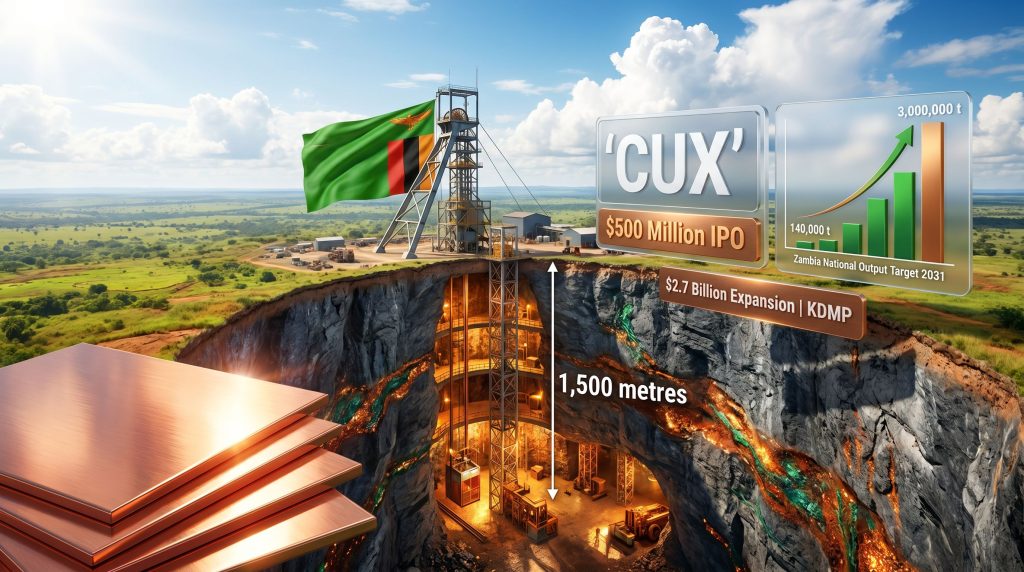
For the Konkola Deep Mining Project specifically, descending to 1,500 metres is not merely an engineering challenge but a deliberate geological strategy. Shallower ore bodies across the Copperbelt have faced progressive grade dilution as mining has moved outward from high-grade core zones. At greater depths, the ore body geometry at Konkola maintains grades that support economically compelling processing outcomes, a factor that distinguishes KDMP from many expansion projects globally that chase volume at the expense of grade quality.
CopperTech Metals: Corporate Structure as a Capital Access Strategy
The decision to incorporate CopperTech Metals in the United States in November 2025 rather than listing directly on a regional African exchange or the London Stock Exchange reflects a deliberate capital architecture decision. U.S. institutional investors, including large pension funds, sovereign wealth vehicles, and critical mineral-focused ETFs, operate under mandate frameworks that frequently require U.S.-domiciled entities or NYSE/NASDAQ listings as a condition of participation.
By creating CopperTech as a U.S.-domiciled holding company for Vedanta's 79% stake in Konkola Copper Mines, the structure bypasses several traditional barriers that have historically limited African mining assets from accessing deep American institutional liquidity pools. The proposed NYSE ticker "CUX" signals an intent to position the company as a benchmark vehicle for copper exposure within U.S. markets, where comparable Africa-focused copper listings have been virtually absent. Furthermore, those evaluating copper investment strategies for 2025 and beyond will find the CopperTech structure particularly relevant to their analysis.
Underwriter Composition: What the Syndicate Signals to Institutional Investors
The IPO syndicate assembled for the CopperTech offering includes Citigroup, Cantor, BMO Capital Markets, and RBC Capital Markets. This combination is analytically interesting. Citigroup's presence signals access to its deep global institutional distribution network, while BMO and RBC bring significant expertise in metals and mining from their established Canadian mining investment banking practices. Cantor's inclusion suggests targeted outreach to mid-tier institutional and family office capital.
For investors evaluating the offering, the quality of the underwriting syndicate functions as an indirect signal of deal confidence. Banks with strong secondary market-making capabilities reduce the liquidity risk premium that institutional buyers price into illiquid emerging market mining listings. According to Reuters reporting on the CopperTech filing, the transaction has attracted considerable attention from both resource-focused and generalist U.S. institutional investors.
The $2.7 Billion KDMP: Phasing, Technical Complexity, and the Timeline Compression Thesis
The Konkola Deep Mining Project is the financial and operational centrepiece of the CopperTech IPO Zambia expansion narrative. The project targets a shaft depth of 1,500 metres, making it one of the deepest underground copper mining operations in Zambia. At this depth, the engineering requirements scale dramatically compared to shallower operations.
Three interconnected infrastructure systems define the project's technical complexity:
- Shaft sinking and hoisting infrastructure capable of operating efficiently at extreme depth, requiring specialised winder systems and materials handling logistics
- Large-scale dewatering operations to manage groundwater ingress, which intensifies significantly below 1,000 metres in Copperbelt geology due to the proximity of major aquifer systems
- Upgraded ore processing facilities at surface, including the planned second tailings leach plant designed to extract additional copper value from historically deposited process residues
The total capital programme is budgeted at $2.7 billion across the 2027 to 2031 period. Prior to the IPO announcement, Vedanta had committed $1.1 billion over five years following its reinstatement as operator. The critical insight from ZCCM's capital markets day in Paris is that IPO proceeds fundamentally alter the cash availability profile: rather than deploying capital incrementally as cash flow permits, the listing mechanism makes the full capital allocation available at the outset, compressing the timeline to a 2028 completion target, approximately three years ahead of the original schedule.
Capital Deployment Scenarios: A Scenario Analysis Framework
| Scenario | IPO Outcome | KDMP Completion | KCM Production Target | Capital Available |
|---|---|---|---|---|
| Full subscription | ~$500M raised | 2028 | 300,000 t/year | $670M earmarked |
| Partial subscription | Below target | 2029-2030 | Delayed ramp | Reduced allocation |
| IPO withdrawn | Not completed | 2031 | Original schedule | $1.1B over 5 years |
Disclaimer: The scenarios above are analytical frameworks based on publicly disclosed information. They are not investment advice, and actual outcomes will depend on market conditions, regulatory developments, and operational execution.
KCM's Production History: Why the 2019 Seizure Still Matters
Institutional investors conducting due diligence on the CopperTech IPO will inevitably interrogate the political history of Konkola Copper Mines. In 2019, the Zambian government under former President Edgar Lungu initiated the seizure of KCM, citing alleged non-compliance with mining and environmental obligations. The asset transitioned to state administration, during which period production deteriorated significantly.
KCM's 2025 annual production figure was 80,215 metric tons, a number that reflects years of underinvestment and operational disruption rather than the geological potential of the asset. Vedanta formally regained operational control in 2023-2024 following a negotiated resolution with the Zambian government, accompanied by a $1 billion reinvestment commitment that now forms the baseline of the broader KDMP expansion programme.
For investors, this history introduces a baseline of sovereign risk that must be priced. Zambia's regulatory environment has undergone meaningful reform since 2023, with successive policy signals designed to attract foreign direct investment. However, the ownership dispute at KCM remains a documented reference point that institutional risk committees will weight when allocating capital to the CopperTech offering. In addition, broader African mining finance trends suggest that sovereign risk premiums across the continent are gradually compressing as governance frameworks mature.
ZCCM Investment Holdings: The State Participation Dimension
ZCCM Investment Holdings, which retains a 21% minority stake in KCM, plays a dual role in the CopperTech IPO narrative. As a state-linked entity listed on the Lusaka, London, and Euronext stock exchanges, ZCCM functions as both a governance anchor and a signal of the Zambian government's alignment with the expansion thesis.
The disclosure that ZCCM is evaluating a share buyback programme in response to what it characterises as significant undervaluation on European exchanges is a strategically meaningful signal. Share buybacks in the mining sector typically indicate management confidence in the underlying asset value at current market prices. If ZCCM's board believes its equity is materially undervalued, this may reflect a conviction that the market has not yet priced in the full optionality embedded in the KDMP acceleration timeline. Bloomberg's coverage of the Vedanta NYSE IPO ambitions offers additional context on how international markets are interpreting this state participation dynamic.
Key Risks Every Investor in the CopperTech IPO Must Evaluate
No analysis of the CopperTech IPO Zambia expansion project would be complete without a structured examination of the principal risk factors that could materially affect outcomes.
Infrastructure and Operational Constraints
- Power supply reliability is the single most frequently cited operational constraint for deep mining in Zambia. The national grid relies heavily on hydroelectric generation, which is subject to seasonal variability linked to rainfall patterns. Extended dry seasons have historically triggered load curtailment across the Copperbelt, directly impacting production volumes.
- Underground water management at 1,500-metre depths requires continuous dewatering at industrial scale. Any interruption to dewatering operations risks shaft flooding, which at this depth could cause significant damage and extended production downtime.
- Processing capacity constraints must scale in parallel with ore extraction increases. A production ramp to 300,000 tonnes per year that outpaces processing infrastructure upgrades creates bottlenecks that erode financial returns.
Geopolitical and Regulatory Risk Dimensions
- The KCM ownership dispute history creates a measurable sovereign risk premium that investors must factor into their required return calculations.
- Multi-year capital programmes of this scale are exposed to policy continuity risk across election cycles, particularly in jurisdictions where mining fiscal regimes have been subject to periodic revision.
- The compressed 2028 timeline increases execution risk relative to the original five-year programme, as a faster deployment schedule reduces the buffer available to absorb construction delays or cost overruns.
Furthermore, the development of copper funding partnerships between majors and junior operators may offer a complementary risk-mitigation mechanism for projects of this complexity and scale.
The next major ASX story will hit our subscribers first
KCM's Long-Term Production Potential Within Zambia's National Target
If the KDMP reaches its near-term target of 300,000 metric tons per year by 2028, KCM would account for approximately 10% of Zambia's 3 million tonne national target from a single operation. At the longer-term production potential of 500,000 tonnes per year, KCM's contribution rises to approximately 17% of national output, making it arguably the single most consequential mine in Zambia's 2031 production ambition.
| KCM Milestone | Production Volume | Share of Zambia's 3Mt Target |
|---|---|---|
| Current (2025) | ~80,215 t/year | ~2.7% |
| Near-term target (2028) | 300,000 t/year | ~10% |
| Long-term potential | 500,000 t/year | ~17% |
The arithmetic underscores why the CopperTech IPO Zambia expansion project carries significance beyond a single corporate transaction. Its success or failure has direct implications for whether Zambia's national production targets are achievable within the stated timeframe.
The Broader Template: What a Successful NYSE Listing Could Mean for African Mining
If CopperTech completes a successful NYSE listing, it would establish a replicable framework for other African mining assets seeking access to U.S. institutional capital. The structural innovation of a U.S.-domiciled holding company layered over a Zambian operating entity could serve as a template for other Copperbelt operators, as well as producers of critical minerals such as cobalt, lithium, and manganese across the continent.
The implications extend beyond individual transactions. A deepening of the capital market relationship between U.S. institutional investors and African critical mineral producers would increase the velocity of investment into the continent's resource base, reduce the financing cost premium that has historically been attached to African mining projects, and consequently accelerate production timelines across multiple operations simultaneously.
This article is intended for informational purposes only and does not constitute financial or investment advice. All forward-looking statements, production targets, and financial projections discussed are based on publicly available disclosures and are subject to material risks and uncertainties. Readers should conduct their own independent research before making any investment decisions.
Key Statistics and Reference Data
| Data Point | Figure |
|---|---|
| CopperTech IPO target raise | ~$500 million |
| Capital allocated to KCM capex | ~$670 million |
| Total KDMP expansion budget | $2.7 billion |
| Vedanta's original 5-year commitment | $1.1 billion |
| KCM current annual production (2025) | ~80,215 tonnes |
| KCM near-term production target | 300,000 tonnes by 2028 |
| KCM long-term production potential | 500,000 tonnes |
| KDMP shaft depth | 1,500 metres |
| Zambia national output target (2031) | 3 million tonnes |
| Zambia 2025 national output | ~890,346 tonnes |
| Vedanta's KCM ownership stake | 79% |
| ZCCM's KCM ownership stake | 21% |
| CopperTech incorporation date | November 2025 |
| Proposed NYSE ticker | CUX |
| IPO underwriters | Citigroup, Cantor, BMO Capital Markets, RBC Capital Markets |
Further reporting on Zambia's mining investment landscape and the Konkola Copper Mines expansion programme is available through Mining Weekly at miningweekly.com, which provides ongoing coverage of African base metals and project finance developments.
Want to Track the Next Major Copper Discovery Before the Market Does?
Discovery Alert's proprietary Discovery IQ model delivers real-time alerts on significant ASX mineral discoveries — instantly translating complex geological data into actionable investment insights for both short-term traders and long-term investors. Explore how historic mineral discoveries have generated substantial returns on Discovery Alert's dedicated discoveries page, and begin your 14-day free trial today to position yourself ahead of the next major find.