June 19, 2026
When Sovereign Policy Becomes Sovereign Debt: Zimbabwe's Foreign Currency Crisis
Across resource-rich frontier markets, the mechanics of mandatory export proceeds rules are rarely examined until they break. Most commodity analysts focus on price cycles, grade profiles, and capital costs when assessing mining project economics. Far less attention is directed at the regulatory plumbing underneath — the currency conversion frameworks that determine how much of a miner's gross revenue actually translates into usable cash. In Zimbabwe, that plumbing has developed a serious leak, and Zimbabwe platinum producers owed unpaid export earnings now face a bill approaching a quarter of a billion dollars.
The situation confronting Zimbabwe's platinum group metal (PGM) producers in 2026 is not simply a payment dispute. It represents the collision of a sovereign liquidity constraint with an industry already navigating depressed commodity prices, rising operating costs, and unreliable power infrastructure. Understanding why this matters requires examining the architecture of Zimbabwe's foreign currency system, the scale of accumulated arrears, and what the precedent means for mining investment across the broader region. Furthermore, the wider Zimbabwe debt dispute context adds another layer of urgency to these concerns.
When big ASX news breaks, our subscribers know first
How Zimbabwe's 70/30 Export Proceeds Framework Operates
Zimbabwe's foreign currency retention system is built on a mandatory conversion rule: exporters across all commodity categories are required to surrender 30% of their export proceeds through government-controlled channels. In exchange, those exporters are supposed to receive the local currency equivalent of the surrendered hard currency, with the government retaining the foreign exchange to fund critical imports, infrastructure commitments, and external debt repayments.
In theory, the arrangement is a structured liquidity transfer. In practice, the system functions as an involuntary credit facility extended to the sovereign whenever the government falls behind on its disbursement obligations.
The policy's stated rationale reflects Zimbabwe's chronic hard currency scarcity. As a country with limited access to international capital markets and significant external financing requirements, the government depends on the foreign exchange generated by commodity exports to keep essential supply chains functioning. Platinum and gold producers are effectively the primary conduits through which Zimbabwe accesses the US dollars it needs.
Key Structural Risk: When export proceeds are mandatorily surrendered but the corresponding local-currency payment is delayed indefinitely, the exporter transitions from being a regulatory compliance participant to an unsecured creditor of the state. This risk is rarely modelled explicitly in project feasibility assessments for frontier market mining operations.
The distinction between policy intent and operational execution is where the current crisis originates. The framework was designed as a revenue-sharing mechanism, not a financing instrument. However, the cumulative effect of recurring payment delays is precisely that: the mining sector is financing a portion of the government's liquidity gap on an involuntary and uncompensated basis.
The Scale of Unpaid Export Earnings Owed to Zimbabwe's Platinum Producers
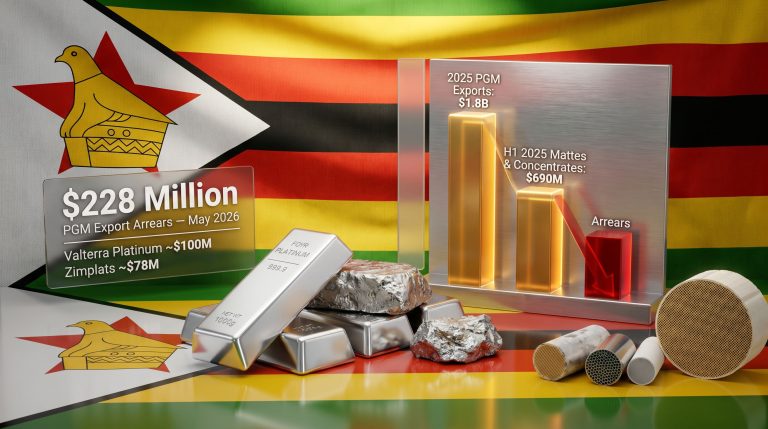
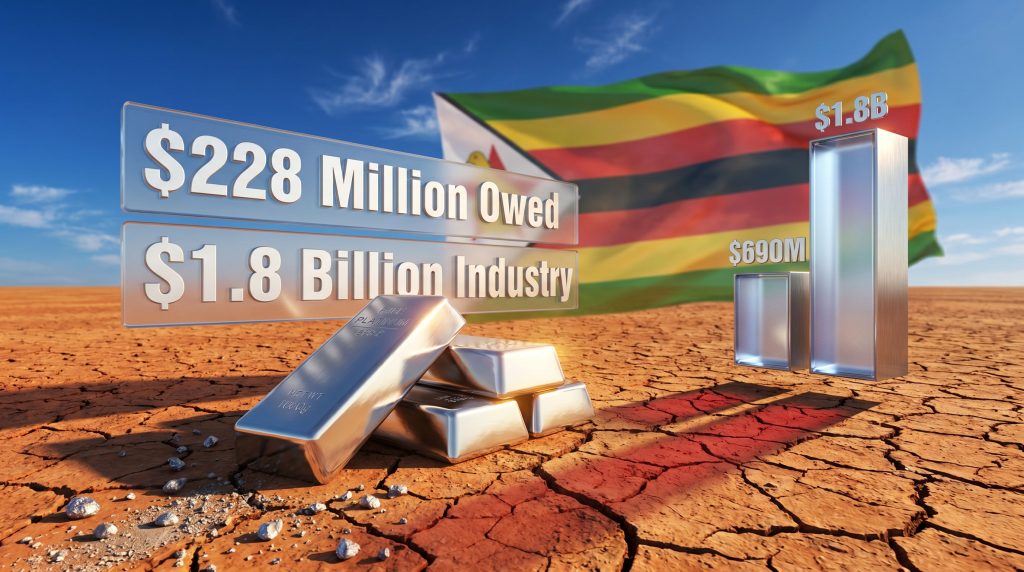
The numbers involved are not trivial. As of May 2026, Zimbabwe platinum producers owed unpaid export earnings collectively exceed more than $228 million in outstanding local-currency payments under the foreign currency retention system, according to figures presented by Platinum Producers' Association chairman Alex Mhembere at a mining industry conference. Mhembere confirmed that despite ongoing engagement with government, the situation had produced no material improvement in payment timelines.
The breakdown of individual company exposures illustrates the concentrated nature of the exposure:
| Producer | Estimated Arrears Owed | Operations Affected |
|---|---|---|
| Valterra Platinum | ~$100 million | Unki Mine |
| Impala Platinum (Zimplats) | ~$78 million | Zimplats operations |
| Mimosa Mining (joint venture) | Undisclosed | Mimosa Mine |
| Sector Total (May 2026) | $228 million+ | Zimbabwe-wide |
To contextualise the magnitude of that figure: South African-owned platinum producers operating in Zimbabwe generated combined export revenues of $1.8 billion in 2025. The $228 million in unpaid proceeds therefore represents roughly 12.7% of a single year's total export revenue sitting as an unrecovered receivable on producers' balance sheets.
According to Reuters, Zimbabwe's Finance Ministry has publicly confirmed the arrears, attributing the delays to government revenue constraints rather than disputing the underlying obligation. That acknowledgement is significant because it transforms the conversation from a regulatory dispute into a sovereign fiscal problem — one with direct implications for how mining investment in Zimbabwe is risk-assessed going forward.
Valterra Platinum reported in February 2026 that it had received partial payments, but at a pace that was materially insufficient to address the full outstanding liability. Consequently, the gap between what has been paid and what remains outstanding continues to widen as new export proceeds accumulate under the same framework.
Zimbabwe's Strategic Position in Global PGM Supply
Understanding the stakes of this crisis requires appreciating Zimbabwe's structural importance to the global platinum supply chain. The country ranks as the world's third-largest producer of platinum group metals, behind South Africa and Russia, two countries that together account for the vast majority of the world's PGM output.
PGMs are not a niche commodity. They serve as the active catalytic material in autocatalysts, the emissions control systems fitted to internal combustion vehicles. Every petrol and diesel car manufactured globally requires a catalytic converter loaded with platinum, palladium, or rhodium. Demand is also growing in hydrogen fuel cell technology, where platinum is a core component of the proton exchange membrane systems used in both stationary power generation and fuel cell electric vehicles.
Within Zimbabwe's own export portfolio, platinum group metals hold a position of strategic importance:
- PGMs are Zimbabwe's second most valuable mineral export, behind gold
- The platinum belt produces a basket of metals including platinum, palladium, rhodium, and ruthenium
- South African mining groups including Impala Platinum and the Valterra Platinum entity control the dominant share of Zimbabwean PGM output
- Combined PGM export revenues of $1.8 billion in 2025 represent a critical source of hard currency inflow for the country
The concentration of ownership within South African mining groups creates cross-border financial interdependencies that amplify the risk. These producers allocate capital across portfolios that include both South African and Zimbabwean operations, and any persistent drag on Zimbabwean returns will ultimately influence how those groups prioritise future investment between the two jurisdictions. This is a pattern consistent with broader mining geopolitical risks observed across resource-dependent frontier markets.
Three Simultaneous Headwinds Compressing the Sector
The payment arrears crisis does not exist in isolation. Zimbabwe's platinum producers entered 2026 already managing a set of compounding operational challenges:
- Prior PGM price weakness reduced financial buffers across the sector, limiting the degree to which companies could absorb payment delays without direct operational impact
- Elevated operating costs driven by energy price volatility, infrastructure maintenance requirements, and logistics constraints specific to Zimbabwe's landlocked geography
- Erratic electricity supply across multiple operations, disrupting production schedules and increasing reliance on costly diesel backup generation
The intersection of these pressures with a $228 million receivable that cannot be collected creates a compounded liquidity problem. Companies that would ordinarily deploy surplus cash into sustaining capital expenditure or expansion projects instead find themselves managing working capital deficits created by the government's payment delays.
Sector Insight: Industries recovering from commodity price downturns carry reduced cash reserves by definition. When sovereign payment delays arrive in this context, the choice between maintaining operational continuity and funding capital reinvestment becomes acute. Zimbabwe's producers are navigating exactly this trade-off in 2026.
It is also worth noting that gold producers in Zimbabwe face an identical structural problem under the same foreign currency retention framework. Their complaints mirror those of the platinum sector: mandatory conversion of export proceeds into a local currency that has at various points traded at a significant premium to market rates, combined with delayed disbursements that compound the effective cost of compliance. This is not a PGM-specific issue — it is a system-wide policy risk affecting Zimbabwe's entire commodity export sector. Recognising these as investment red flags is essential for any investor evaluating frontier market exposure.
How Zimbabwe's Export Retention Framework Compares Regionally
Zimbabwe's mandatory 30% conversion requirement stands in sharp contrast to the direction most southern African jurisdictions have taken over the past decade. Zambia abolished its export surrender requirements in 2023, explicitly citing the competitive disadvantage imposed on its mining sector. South Africa operates without any mandatory conversion framework, allowing producers to manage currency exposure through market-based hedging instruments. The contrast is striking:
| Country | Mandatory Surrender Rate | Payment Mechanism | Known Delays? |
|---|---|---|---|
| Zimbabwe | 30% converted to local currency | Government-intermediated | Yes, systemic |
| South Africa | None | Market-based conversion | No |
| Zambia | Abolished (2023) | Liberalised | No |
| Democratic Republic of Congo | Partial repatriation requirements | Banking system | Occasional |
| Russia | Variable (historically 80%, subsequently reduced) | Central bank managed | Situational |
The divergence matters for capital allocation. When South African mining groups weigh incremental investment in Zimbabwe against expansion within South Africa itself, the absence of mandatory conversion risk in the latter is a structural advantage that compounds over time. Repeated payment delays in Zimbabwe sharpen that comparison. For further context, the DRC resource landscape demonstrates how neighbouring jurisdictions manage similar regulatory tensions with competing outcomes.
For institutional investors and project financiers evaluating Zimbabwe exposure, the effective net revenue calculation is considerably more complex than headline export prices suggest. A simplified framework for modelling net hard-currency realisation in Zimbabwe looks like this:
- Gross export revenue (USD)
- Less: 30% surrendered to government channels
- Less: Timing loss on local-currency disbursements (delayed or partial)
- Less: Overvaluation discount if local proceeds are received in an overvalued currency
- = Effective net hard-currency realisation
The gap between step one and step five can be material, and it is not consistently reflected in headline revenue figures reported by publicly listed mining groups.
The next major ASX story will hit our subscribers first
Operational Consequences: Capital Distortion and Community Exposure
The $228 million sitting as unpaid receivables is not simply a balance sheet entry. It represents real constraints on operational decision-making across several producing operations:
- Working capital compression forces producers to draw on existing credit facilities or reduce discretionary spending to maintain liquidity
- Sustaining capital deferrals create longer-term production reliability risks as equipment maintenance schedules slip under budget pressure
- Growth capital allocation shifts toward shareholder returns rather than expansion, a dynamic already observable in South African PGM producers prioritising dividends over project investment during periods of financial uncertainty
The community dimension adds further complexity. Zimbabwe's platinum belt supports tens of thousands of direct mining jobs and a substantially larger pool of indirect employment in supporting industries, transport, and local services. Operational cutbacks driven by cash flow constraints from sovereign payment delays cascade well beyond the mine gate.
There is also a legal risk dimension that has already been tested in Zimbabwe's mining sector. Anglo American Platinum's Zimbabwean unit previously initiated legal proceedings against the Zimbabwe Revenue Authority over a $24 million royalty dispute, demonstrating that mining companies operating in the country are prepared to pursue formal dispute resolution mechanisms when financial disagreements cannot be resolved through industry advocacy. Should payment arrears escalate further without resolution, formal legal or international arbitration proceedings under bilateral investment treaty frameworks remain an available avenue for affected producers.
The Policy Paradox at the Centre of Zimbabwe's Arrears Problem
The most structurally challenging aspect of Zimbabwe's situation is the circular dependency embedded in the policy itself. The government relies on the hard currency surrendered by platinum and gold exporters to fund its critical import obligations and service external debt. Yet by delaying the local-currency payments owed to those same exporters, it risks undermining the financial health of the sector that generates the foreign exchange the government needs most.
Policy Paradox: Suppressing the investment capacity of the country's primary hard currency earners in order to preserve short-term government liquidity is a strategy that deteriorates the very foundation it is designed to protect. Without sustained capital investment, production volumes decline, export revenues fall, and the hard currency available to the government contracts further.
Potential reform pathways that could interrupt this cycle include:
Short-term measures:
- Formalised structured payment schedules with transparent milestones to clear existing arrears
- Temporary increases to the retention ratio, reducing the volume of proceeds subject to delayed local-currency conversion
- Introduction of independent escrow mechanisms to manage conversion payments outside direct government discretion
Medium-term structural reforms:
- Reducing the mandatory conversion rate from 30% toward regional norms
- Establishing a dedicated mineral export proceeds fund, ring-fenced from general government revenue pressures
- Creating legally enforceable disbursement timelines linked to export registration dates
- Aligning Zimbabwe's framework with SADC best practices for mineral revenue management
The IMF and World Bank's ongoing fiscal engagement with Zimbabwe represents an external lever through which systemic reform of the retention framework could be encouraged. In addition, any changes to the critical minerals trade environment internationally could further accelerate pressure on Zimbabwe to modernise its policy settings. However, any domestic changes would ultimately depend on Zimbabwe's own fiscal capacity to absorb the transition.
Frequently Asked Questions: Zimbabwe Platinum Export Earnings
What is Zimbabwe's foreign currency retention rule for platinum exporters?
Zimbabwe requires all commodity exporters, including platinum producers, to surrender 30% of their export proceeds through government-controlled channels. In return, exporters should receive the local currency equivalent of those proceeds. The government retains the foreign currency to fund essential imports, infrastructure expenditure, and debt servicing obligations.
How much are Zimbabwe's platinum producers owed in unpaid export earnings?
As of May 2026, Zimbabwe platinum producers owed unpaid export earnings exceed $228 million in outstanding local-currency payments across the sector. Individual exposures include approximately $100 million owed to Valterra Platinum and $78 million owed to Zimplats, according to reporting from NewsDay Zimbabwe.
Why is Zimbabwe not paying platinum miners their owed export earnings?
Zimbabwe's Finance Ministry has confirmed the arrears and attributed the delays to government cash-flow constraints. The government's dependence on surrendered hard currency for essential imports creates a fiscal bottleneck that delays local-currency disbursements back to producing companies.
Which companies are most exposed?
The primary affected operations are Valterra Platinum's Unki Mine, Impala Platinum's Zimplats operations, and Mimosa Mining. All three are predominantly owned by South African mining groups and operate across Zimbabwe's Great Dyke platinum belt.
Could legal action follow?
Legal escalation is possible. Precedent exists for litigation between platinum mining entities and Zimbabwean government agencies over financial disputes, including Anglo American Platinum's unit pursuing proceedings against the Zimbabwe Revenue Authority over a $24 million royalty matter. Foreign-owned producers may also have recourse through bilateral investment treaty arbitration frameworks depending on applicable agreements.
Monitoring Resolution: Key Indicators to Watch
For investors and analysts tracking the trajectory of this issue, the following indicators provide the clearest signal of whether the situation is improving or deteriorating:
- Monthly arrears balance reported through the Platinum Producers' Association
- Frequency and cumulative volume of partial payment disbursements from the government
- Any formal revision to the 30% mandatory conversion rate through regulatory or legislative change
- Announcements from Zimbabwe's Finance Ministry regarding restructured payment commitments
- IMF Article IV consultation findings on Zimbabwe's overall fiscal position and reform trajectory
- Capital expenditure guidance from Zimplats, Valterra Platinum, and Mimosa in upcoming company reporting periods
The resolution of Zimbabwe's platinum payment arrears is not merely a domestic fiscal management question. It is a test case for how the country manages the relationship between sovereign liquidity needs and the commercial sustainability of the industries that underpin its export economy. The outcome will influence capital allocation decisions by South African mining groups for years beyond the immediate crisis.
Want to Know Which ASX Mining Discoveries Could Deliver Major Returns?
Discovery Alert's proprietary Discovery IQ model scans ASX announcements in real time, instantly identifying significant mineral discoveries across more than 30 commodities — including the platinum and critical minerals sectors shaping global supply chains — and converting complex data into clear, actionable investment insights. Explore historic discoveries and their remarkable market returns, then begin your 14-day free trial to position yourself ahead of the broader market.