July 18, 2026
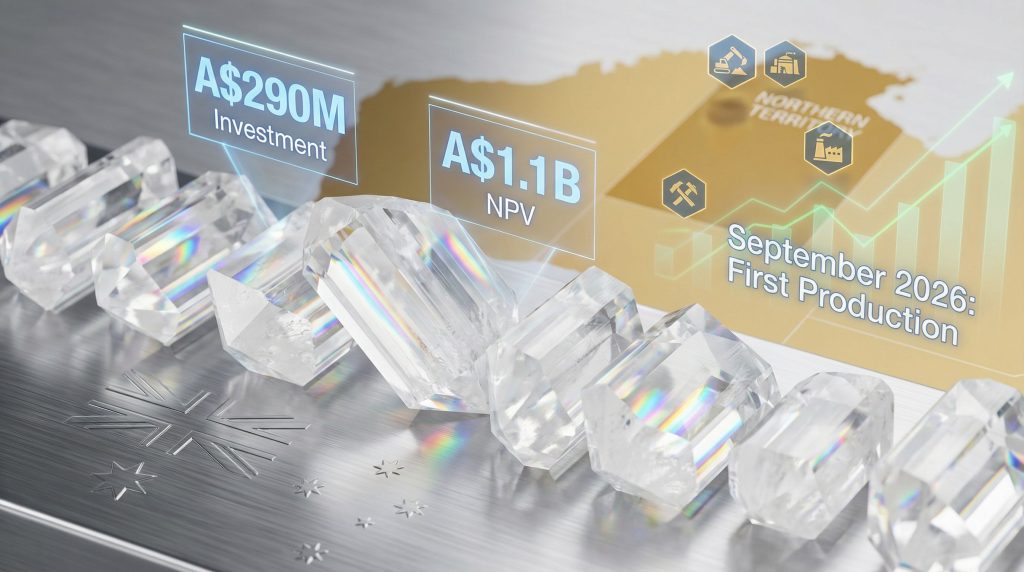
Australia's lithium sector stands at a critical inflection point as global battery demand fundamentals reshape investment strategies across the critical minerals landscape. The convergence of supply chain diversification imperatives, technological advancement in energy storage, and geopolitical considerations has created an environment where strategic positioning determines long-term value creation potential for mining operations. Furthermore, the Core Lithium Finniss restart with A$290m backing exemplifies how sophisticated critical minerals strategy development can unlock previously stalled projects through innovative funding structures.
Within this context, sophisticated funding structures and operational optimization approaches have emerged as key differentiators for projects seeking to capitalise on the evolving market dynamics that characterise the current lithium investment cycle.
Strategic Capital Architecture Driving Project Revival
The sophisticated funding structure underlying Core Lithium's Finniss restart demonstrates how contemporary mining finance has evolved beyond traditional debt-equity models toward strategic consortium approaches that distribute risk whilst maximising operational synergies. Moreover, these capital raising methods reflect broader trends across the mining sector.
Multi-Tiered Investment Framework Analysis
The comprehensive A$290 million funding package represents a carefully constructed capital structure designed to optimise risk distribution across multiple investor categories. The arrangement encompasses A$170 million equivalent in strategic consortium investment, A$120 million in planned equity capital, A$70 million in convertible instruments, and A$50 million in senior secured debt facilities.
This financing architecture reflects sophisticated risk management principles where each capital component serves distinct strategic purposes:
• Strategic consortium funding provides operational expertise and market access capabilities
• Equity capital maintains management control and upside participation
• Convertible instruments offer flexible conversion triggers aligned with performance milestones
• Senior secured debt reduces overall cost of capital through asset-backed security
Partner Ecosystem Strategic Value
The consortium composition featuring Glencore, InfraVia, and Nebari Natural Resources creates a complementary capability framework that extends beyond pure financial contribution. Glencore's global trading platform provides immediate market access and pricing optimisation, whilst InfraVia contributes infrastructure development expertise critical for operational efficiency enhancement.
Nebari Natural Resources brings specialised lithium sector knowledge and debt structuring capabilities that align financing terms with commodity price cycles and operational cash flow patterns. Additionally, this partnership approach demonstrates how modern mining industry evolution prioritises collaborative value creation over traditional standalone development models.
| Funding Component | Amount (A$M) | Strategic Purpose | Risk Profile |
|---|---|---|---|
| Strategic Consortium | 170 | Operational synergies | Medium-term equity |
| Planned Equity Raise | 120 | Development capital | Long-term equity |
| Convertible Notes | 70 | Flexible financing | Hybrid instrument |
| Senior Secured Debt | 50 | Low-cost capital | Asset-backed |
When big ASX news breaks, our subscribers know first
Operational Transformation Through Phased Development Strategy
The staged production approach represents a fundamental shift in mining project execution philosophy, prioritising cash generation velocity whilst maintaining long-term expansion optionality. This methodology aligns with current lithium industry innovations focused on operational efficiency and risk mitigation.
Phase 1: Grants Deposit Open-Pit Operations
Initial production from the Grants deposit leverages existing infrastructure to achieve rapid cash flow generation beginning in September 2026. Open-pit operations deliver several strategic advantages over underground alternatives during the initial production phase:
• Lower capital intensity requirements for equipment and infrastructure
• Simplified logistics and material handling processes
• Higher productivity rates through large-scale mining equipment deployment
• Reduced technical complexity minimising operational ramp-up risks
Phase 2: BP33 Underground Development
The transition to underground mining at BP33 represents the long-term sustainable production foundation, with full 1.2 million tonnes per annum nameplate capacity targeted by mid-2028. This timeline provides approximately 21 months for production optimisation and workforce development.
Underground operations access higher-grade ore bodies whilst extending reserve life significantly beyond open-pit limitations. The phased approach allows operational learning and infrastructure optimisation before committing to the higher capital requirements of underground development.
| Development Phase | Timeline | Production Method | Capacity Target |
|---|---|---|---|
| Phase 1 – Grants | Q3 2026 | Open-pit mining | Initial production |
| Phase 2 – BP33 | Mid-2028 | Underground development | 1.2M tonnes/year |
| Steady State | 2029+ | Integrated operations | Full capacity |
Economic Performance Benchmarking and Market Positioning
The financial metrics underlying the Finniss restart reflect conservative assumptions that provide downside protection whilst maintaining significant upside exposure to commodity price appreciation. However, these projections must be considered within the broader context of energy transition dynamics that continue to drive lithium demand fundamentals.
Fundamental Economic Drivers
The A$1.1 billion pre-tax NPV calculation incorporates a A$1,500 per tonne long-term spodumene price assumption that represents a moderate baseline relative to recent market volatility patterns. This pricing foundation supports the projected A$1.7 billion forecast free cash flow over the mine life.
These assumptions demonstrate disciplined financial modelling that prioritises sustainable returns over aggressive growth projections. The pricing methodology accounts for lithium market cycles whilst maintaining sufficient margin for debt service coverage and equity returns.
Competitive Positioning Analysis
Core Lithium's operational advantages stem from existing infrastructure that reduces both capital requirements and development timelines compared to greenfield alternatives. The shortened path to production referenced in company communications reflects tangible cost savings through:
• Processing facility optimisation reducing capital expenditure requirements
• Established environmental baselines accelerating permitting processes
• Proven ore body characteristics minimising geological risk factors
• Existing workforce capabilities in the Northern Territory region
| Economic Metric | Value | Assumption Basis | Market Context |
|---|---|---|---|
| Pre-tax NPV | A$1.1B | Conservative modelling | Downside protection |
| Free Cash Flow | A$1.7B | Life-of-mine projection | Long-term returns |
| Spodumene Price | A$1,500/t | Long-term assumption | Market cycle buffer |
Market Access Strategy and Distribution Framework
The Glencore marketing arrangement represents a sophisticated approach to commodity sales that balances price optimisation with strategic flexibility. According to industry analysts, this type of arrangement has become increasingly common among Australian lithium producers.
Global Platform Integration
Leveraging Glencore's established trading infrastructure provides immediate access to Asia-Pacific battery manufacturing hubs whilst maintaining flexibility over long-term offtake commitments. This arrangement contrasts with rigid offtake agreements that can constrain pricing optimisation during favourable market conditions.
The distribution framework allows Core Lithium to:
• Optimise pricing across multiple geographic markets
• Maintain strategic flexibility without long-term constraints
• Access global demand sources through established trading relationships
• Reduce marketing costs through shared infrastructure utilisation
Supply Chain Positioning Benefits
Australia's strategic position within the lithium supply chain provides geographic diversification advantages for battery manufacturers seeking to reduce dependence on concentrated supply sources. The Northern Territory location offers:
• Proximity to Asian markets reducing transportation costs and lead times
• Political stability supporting long-term supply security
• Established mining jurisdiction with transparent regulatory frameworks
• Skilled workforce availability supporting operational efficiency
Risk Assessment and Mitigation Framework
Contemporary lithium investment requires sophisticated risk management approaches that address commodity price volatility, operational execution challenges, and evolving technology landscapes. Consequently, the Core Lithium Finniss restart with A$290m backing incorporates multiple risk mitigation strategies.
Market Volatility Management
The funding structure provides multiple layers of protection against adverse market conditions through:
• Diversified capital sources reducing dependence on single investor categories
• Convertible instrument flexibility allowing adaptation to changing market conditions
• Conservative pricing assumptions creating buffer against commodity price declines
• Strategic partner support providing market access during challenging periods
Operational Risk Mitigation
The phased development approach inherently reduces execution risk by:
• Testing operational assumptions through initial production phases
• Validating processing efficiency before full capacity commitment
• Developing workforce capabilities progressively through expanded operations
• Optimising infrastructure utilisation based on operational learning
The restart plan delivers a de-risked, lower cost, long-life operation with robust economics supported by valued strategic partners, according to Core Lithium's management assessment.
Financial Covenant Structure
Senior secured debt facilities typically incorporate financial covenants designed to protect lender interests whilst maintaining operational flexibility. These arrangements generally include:
• Debt service coverage ratios ensuring cash flow adequacy
• Minimum liquidity requirements supporting operational continuity
• Capital expenditure limitations preventing excessive spending
• Reserve reporting obligations maintaining asset value transparency
Australian Critical Minerals Strategy Integration
The Finniss restart operates within broader national resource security objectives that position Australia as a reliable supplier of battery metals to allied nations and strategic partners. Furthermore, this project demonstrates practical implementation of government policy initiatives supporting domestic lithium production capabilities.
National Economic Impact
Beyond direct operational benefits, the project contributes to several strategic national objectives:
• Employment generation in the Northern Territory supporting regional economic development
• Export revenue diversification reducing dependence on traditional commodity exports
• Technology transfer opportunities advancing domestic battery metals processing capabilities
• Supply chain security enhancement for allied nations seeking reliable lithium sources
Regional Development Catalyst
The project's success could catalyse additional investment in Northern Territory lithium resources through:
• Infrastructure sharing with adjacent exploration projects
• Skilled workforce development benefiting the broader mining sector
• Service industry expansion supporting multiple mining operations
• Research and development initiatives advancing Australian lithium processing technology
| National Benefit | Direct Impact | Indirect Benefits | Strategic Value |
|---|---|---|---|
| Employment | Direct mining jobs | Service sector growth | Regional development |
| Export Revenue | Foreign currency earnings | Economic diversification | Trade balance improvement |
| Technology | Processing advancement | Innovation spillovers | Competitive advantage |
| Security | Supply reliability | Allied partnerships | Geopolitical positioning |
The next major ASX story will hit our subscribers first
Investment Thesis and Strategic Implications
The Core Lithium Finniss restart with A$290m backing represents more than an individual project success; it demonstrates the viability of sophisticated financing structures and operational optimisation strategies within Australia's evolving lithium sector. Additionally, recent reporting from Mining Weekly suggests this model may influence future project development across the region.
Sector Confidence Indicator
The willingness of major international investors to commit substantial capital signals broader confidence in lithium demand fundamentals despite recent market volatility. This confidence reflects:
• Battery demand growth driven by electric vehicle adoption and energy storage expansion
• Supply chain security priorities among major economies
• Australian mining jurisdiction advantages compared to alternative lithium sources
• Technology advancement opportunities in lithium processing and extraction
Replication Potential
The funding and operational model developed for Finniss could provide a template for other Australian lithium projects seeking to optimise capital efficiency and operational risk management. Key elements include:
• Strategic consortium approaches combining financial and operational capabilities
• Phased development strategies prioritising cash generation and risk reduction
• Marketing arrangement flexibility balancing price optimisation with strategic relationships
• Infrastructure optimisation leveraging existing assets to reduce development costs
Long-term Value Creation
The project establishes a sustainable production platform capable of adapting to evolving market conditions whilst maintaining expansion optionality for future growth opportunities. This approach preserves strategic value through multiple market cycles whilst generating immediate cash returns.
The sophisticated risk management and operational optimisation demonstrated through the Core Lithium Finniss restart with A$290m backing positions Core Lithium as a reference case for contemporary lithium project development, potentially influencing industry best practices and investor expectations across Australia's critical minerals sector.
Investment decisions should be based on comprehensive due diligence and professional financial advice. Commodity price assumptions and production forecasts involve inherent uncertainty and may not reflect actual future performance. Past performance of mining projects does not guarantee future results.
Looking for the Next Major Lithium Discovery?
Discovery Alert's proprietary Discovery IQ model delivers real-time alerts on significant lithium and critical minerals discoveries across the ASX, transforming complex geological announcements into actionable investment insights before the broader market reacts. Explore how major mineral discoveries can generate substantial returns by visiting Discovery Alert's dedicated discoveries page and begin your 14-day free trial today to position yourself ahead of the market.