
August 14, 2026
What's Driving the Corporate Nuclear Renaissance in 2026?
The convergence of artificial intelligence workloads and decades of underinvestment in nuclear infrastructure has created an unprecedented opportunity for big tech investment in nuclear energy. Exponential computational demands of machine learning operations require consistent, uninterrupted electricity supply that exists far beyond conventional data center requirements. This transformation has fundamentally reshaped global energy architecture in ways that traditional forecasting models never anticipated.
The uranium market volatility reflects structural supply-demand imbalances as technology companies seek dedicated nuclear capacity. Furthermore, recent legislative actions including the Russian uranium import ban have created additional supply chain pressures that technology companies must navigate when securing reactor fuel supplies.
The AI Data Center Energy Crisis
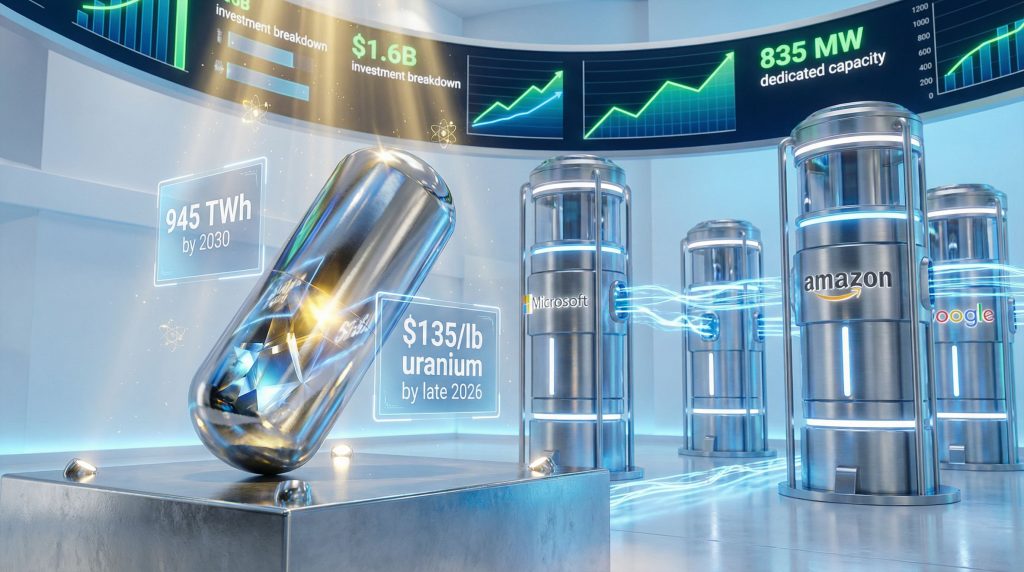
The scale of electricity consumption projected for AI infrastructure represents an unprecedented industrial challenge. Current projections from the International Energy Agency indicate that global data center electricity consumption will exceed 945 terawatt-hours by 2030, effectively doubling from current levels. This figure equals approximately the total annual electricity consumption of Japan, illustrating the magnitude of new baseload power requirements entering the market.
The technical specifications of AI workloads create unique energy demands that distinguish them from traditional computing operations. Processing intensity means machine learning model training can consume 100-1000 times more electricity per computational operation than conventional data processing.
Continuous operation requirements mean AI inference engines must maintain 24/7 availability with zero tolerance for power interruptions. However, traditional renewable energy sources cannot address these requirements due to fundamental intermittency issues. Solar and wind power generation creates variability that directly conflicts with AI operational demands.
Battery storage systems, while improving, cannot economically provide the multi-day backup power that nuclear baseload capacity delivers inherently. Consequently, major technology companies are turning to nuclear solutions to meet their growing computational demands.
Corporate Energy Security vs. Grid Dependency
The traditional utility procurement model operates on timelines that fundamentally conflict with technology sector expansion requirements. Conventional power purchase agreements typically involve lengthy regulatory processes, interconnection studies, and grid integration analyses that can extend project timelines by years.
Corporate direct investment in nuclear facilities represents a strategic bypass of these traditional constraints. By funding reactor restarts, advanced reactor development, and dedicated power purchase agreements, technology companies gain several critical advantages.
Risk mitigation benefits include elimination of grid reliability dependencies for critical AI operations. Price stability through long-term contract structures provides predictable energy costs, whilst reduced exposure to regional electricity market volatility enhances overall operational security.
Operational advantages encompass dedicated capacity allocation eliminating competition with other industrial users. Direct influence over facility maintenance schedules and operational priorities ensures AI workloads receive priority treatment during critical operational periods.
When big ASX news breaks, our subscribers know first
How Are Tech Giants Restructuring Global Nuclear Investment?
The Microsoft Blueprint: Reactor Restart Economics
The Microsoft Three Mile Island Power Purchase Agreement represents a fundamental restructuring of nuclear project financing that extends far beyond traditional utility models. The arrangement involves Microsoft exclusively underwriting a $1.6 billion reactor restart program through a 20-year power purchase agreement, effectively creating a dedicated nuclear facility for artificial intelligence operations.
The financial architecture of this agreement redistributes traditional nuclear project risks in unprecedented ways. Under the traditional model, utilities absorbed demand risk whilst ratepayers bore price burdens. In contrast, Microsoft's model features guaranteed corporate demand with fixed PPA structures.
The 835-megawatt capacity dedicated exclusively to Microsoft's infrastructure provides several strategic advantages. Unlike traditional utility arrangements where capacity is shared across multiple customer classes, this dedicated model ensures Microsoft receives uninterrupted power supply for AI operations.
The 2028 deployment timeline represents significant acceleration compared to traditional nuclear development cycles, which typically require 10-15 years from conception to commercial operation. This expedited schedule demonstrates how big tech investment in nuclear energy can overcome traditional project financing constraints.
Amazon's Multi-Vector Nuclear Strategy
Amazon's nuclear investment approach demonstrates sophisticated risk diversification across multiple reactor technologies and geographic regions. The company's strategy encompasses both established reactor restart models and advanced Small Modular Reactor development, providing exposure to different technological pathways in nuclear energy deployment.
The Cascade Advanced Energy Facility partnership with Energy Northwest represents large-scale commitment to advanced reactor technology. This arrangement positions Amazon to access up to 12 Small Modular Reactors developed by X-energy, potentially providing nearly one gigawatt of scalable capacity throughout the 2030s.
Amazon's $500 million Series C-1 funding commitment to X-energy provides several strategic benefits. Technology development influence enables direct input into reactor design specifications and operational characteristics, while deployment priority ensures preferred access to early commercial reactor units.
The Washington State deployment location offers additional strategic advantages, including established nuclear regulatory infrastructure, existing skilled workforce, and proximity to major Amazon operational facilities. Moreover, this approach aligns with broader energy security trends affecting technology sector infrastructure planning.
Google's Advanced Reactor Diversification
Google's partnership with Kairos Power represents the first corporate power purchase agreement specifically focused on advanced molten-salt reactor technology. This arrangement targets 500 megawatts of distributed capacity beginning in 2030, demonstrating corporate willingness to invest in unproven reactor designs to secure long-term competitive advantages.
The molten-salt reactor technology offers several theoretical advantages over conventional nuclear designs. Enhanced safety characteristics through passive cooling systems provide operational benefits, whilst higher thermal efficiency compared to traditional pressurised water reactors improves overall performance.
Reduced water consumption requirements for cooling operations address environmental concerns, while modular construction enables faster deployment timelines compared to traditional nuclear facilities. These innovations represent significant advances in the broader mining industry evolution.
Google's risk mitigation strategy involves deploying multiple smaller reactor installations rather than concentrating capacity in single large facilities. This approach reduces individual project risk while maintaining overall capacity targets, providing operational flexibility if specific reactor units experience delays.
What Economic Forces Are Reshaping Nuclear Supply Chains?
Uranium Market Structural Analysis
The uranium market is experiencing fundamental supply-demand restructuring that extends beyond traditional nuclear fuel cycle economics. Bank of America Global Research maintains forecasts indicating uranium spot prices could reach $135 per pound by late 2026, representing potential increases of over 150% from historical averages.
Primary uranium supply faces several critical constraints that limit rapid production expansion. Geographic concentration risks include Kazakhstan controlling approximately 40% of global primary uranium production, whilst political stability concerns in major producing regions affect long-term supply security.
Operational limitations include existing mines approaching depletion requiring significant capital investment for expansion. New mine development timelines typically exceed 10 years from discovery to production, whilst environmental permitting processes create additional regulatory delays.
Kazatomprom, the world's largest uranium producer, recently indicated production capacity will remain below maximum technical capability throughout 2026. This decision reflects company assessment that current market fundamentals do not justify full capacity utilization, despite growing demand from technology sector nuclear investments.
Enrichment Bottleneck Economics
The uranium enrichment sector represents a critical chokepoint in nuclear fuel supply chains that technology companies must navigate when securing reactor fuel. Historical dependence on Russian enrichment services created vulnerabilities that recent legislative actions have exposed and exacerbated.
Supply chain restructuring requirements mean Western utilities must secure alternative enrichment capacity for approximately 20% of historical supply. Existing enrichment facilities require capacity expansion to meet displaced Russian supply, whilst new enrichment infrastructure development requires substantial capital investment.
The 2028 timeline for full Russian uranium import elimination creates urgency for utilities and technology companies securing nuclear fuel supplies. Companies investing in reactor capacity must account for potentially higher fuel costs when evaluating project economics.
Furthermore, enrichment service costs are increasing due to supply constraints and infrastructure investment requirements. Long-term contract premiums reflect supply security concerns, whilst transportation and logistics cost increases affect alternative supply sources.
Which Investment Opportunities Are Emerging from This Nuclear Shift?
Nuclear Utility Stock Performance Analysis
Constellation Energy represents the most direct exposure to technology sector nuclear investment trends among publicly traded utilities. The company's reactor restart capabilities and existing fleet provide immediate capacity to serve growing corporate demand for dedicated nuclear power purchase agreements.
Several factors contribute to Constellation Energy's strategic positioning in the corporate nuclear market. Operational advantages include extensive experience with reactor restart procedures and regulatory requirements, whilst existing relationships with Nuclear Regulatory Commission facilitate licensing processes.
Financial benefits encompass long-term contract structures providing revenue stability and predictability. Premium pricing for dedicated capacity arrangements with technology companies reduces market risk through corporate counterparty credit quality.
Talen Energy represents another significant beneficiary of corporate nuclear investment trends through its partnership arrangements with major technology companies. The company's existing nuclear assets provide immediate capacity availability whilst its development pipeline offers scalable expansion opportunities.
Advanced Reactor Technology Investments
Small Modular Reactor development represents a distinct investment category with substantially different risk-return profiles compared to traditional nuclear utilities. These investments involve earlier-stage technology development with potentially higher returns but correspondingly elevated technical and regulatory risks.
Technology development risks include unproven reactor designs requiring extensive testing and validation. Regulatory approval processes for advanced reactor technologies remain uncertain, whilst manufacturing scalability challenges affect modular reactor components. Additionally, skilled workforce development requirements for new reactor technologies create operational constraints.
Market opportunity factors include corporate demand for distributed nuclear capacity creating substantial addressable market. Government policy support through development funding and regulatory streamlining provides additional tailwinds, whilst international export opportunities exist for successful SMR technology platforms.
The $500 million private investment committed by Amazon to X-energy illustrates corporate willingness to fund advanced reactor development directly. This funding approach provides technology developers with patient capital whilst offering corporate investors potential access to breakthrough energy technologies.
How Do These Investments Compare to Traditional Energy Procurement?
Corporate PPA Structure Evolution
The power purchase agreements emerging from technology sector nuclear investments represent fundamental evolution from traditional utility contract structures. These arrangements typically feature 20-year terms with dedicated capacity allocation, providing both parties with substantially different risk profiles compared to conventional energy procurement.
Traditional utility PPAs typically include shared capacity across multiple customer classes, variable pricing structures linked to fuel costs, and limited corporate influence over facility operational decisions. In contrast, technology sector nuclear PPAs feature dedicated capacity allocation for specific corporate operations and fixed pricing structures providing long-term cost predictability.
These structural differences create distinct advantages for technology companies seeking reliable power supply for AI operations. Dedicated capacity ensures energy availability during peak demand periods without competition from other users, whilst fixed pricing provides budget predictability for long-term AI infrastructure planning.
The enhanced control over operational decisions enables technology companies to align nuclear facility operations with their specific computational requirements. Consequently, this approach represents a significant departure from traditional utility procurement models.
Capital Deployment Strategy Analysis
Technology companies investing directly in nuclear facilities are fundamentally altering corporate energy procurement strategies. Rather than purchasing electricity from utilities through traditional rate structures, these companies are deploying capital to secure dedicated power generation assets.
The capital intensity of nuclear investments requires sophisticated analysis of opportunity costs compared to alternative energy procurement strategies. Traditional models require minimal capital requirements as utilities bear infrastructure costs, whilst direct nuclear investment involves high capital requirements of $1-2 billion+ per reactor.
Energy cost structures shift from variable market rates under traditional models to fixed contract pricing under direct investment approaches. Capacity availability changes from shared grid resources to dedicated facility access, whilst long-term cost predictability increases substantially under corporate nuclear investment models.
However, the strategic value of guaranteed power supply for AI operations may justify premium investment levels that purely financial analysis might not support. This represents a fundamental shift in corporate energy procurement philosophy.
What Are the Geopolitical Implications of Corporate Nuclear Investment?
Energy Security and Supply Chain Resilience
Corporate nuclear investments by major technology companies create new dimensions of energy security that extend beyond traditional utility planning frameworks. These investments establish dedicated energy infrastructure that operates independently from regional grid reliability concerns, providing strategic advantages during geopolitical tensions or natural disasters.
The concentration of AI computational power in nuclear-powered facilities creates several national security considerations. Critical AI capabilities protected by enhanced physical security measures typical of nuclear facilities reduce vulnerability to cyber attacks on regional electrical grids.
Enhanced resilience against foreign interference in energy supply chains provides additional security benefits. Protected computational infrastructure supporting defence and intelligence applications represents strategic national assets requiring enhanced protection measures.
International competitive dynamics include advanced reactor technology development providing potential export advantages. Domestic nuclear fuel supply chain development reduces foreign dependencies, whilst technology leadership in nuclear-AI integration creates competitive barriers.
The establishment of allied uranium supply chains becomes increasingly important as technology companies require fuel security for their nuclear investments. This requirement aligns corporate energy procurement strategies with broader national security objectives related to critical resource access.
International Nuclear Technology Competition
The success of US technology companies in nuclear-AI integration provides potential competitive advantages in international markets where similar energy-intensive AI infrastructure will be required. Advanced reactor technologies developed through corporate partnerships may become export opportunities, supporting both commercial interests and strategic technology leadership objectives.
Global nuclear technology competition factors include Chinese nuclear technology advancement creating alternative reactor suppliers for international markets. European Union responses to US corporate nuclear investment strategies affect competitive dynamics, whilst international regulatory harmonisation affects advanced reactor deployment globally.
The integration of nuclear power with AI infrastructure may establish technical standards and operational practices that influence international development patterns. Companies achieving successful nuclear-AI integration could potentially export both technologies and operational expertise to other regions developing similar capabilities.
Technology transfer restrictions affecting nuclear-AI integration knowledge sharing create additional competitive considerations. Consequently, early movers in nuclear-AI integration may establish lasting competitive advantages in global technology markets.
The next major ASX story will hit our subscribers first
Which Regulatory Changes Are Enabling This Nuclear Renaissance?
DOE Policy Support and Funding Mechanisms
The Department of Energy has established multiple funding mechanisms specifically designed to support advanced reactor development and deployment. The $900 million SMR development program provides critical early-stage funding for reactor technology validation and regulatory preparation, reducing private sector investment risks during technology development phases.
Federal nuclear policy initiatives supporting corporate investment include Advanced Reactor Development Program providing cost-shared funding for SMR technologies. Nuclear Power Production Credit offers financial incentives for new nuclear capacity, whilst regulatory streamlining initiatives reduce licensing timeline uncertainty.
Risk-sharing mechanisms for first-of-a-kind reactor deployments create favourable investment environments for corporate nuclear projects. These policy initiatives address traditional barriers to nuclear development, including regulatory uncertainty, high capital costs, and technology development risks.
The alignment of federal policy with corporate energy security objectives facilitates larger-scale private sector nuclear investment. Furthermore, this coordinated approach accelerates deployment timelines whilst reducing overall project risks for corporate investors.
State-Level Nuclear Policy Evolution
State governments in regions hosting corporate nuclear investments have implemented supportive regulatory frameworks that facilitate project development and operation. Pennsylvania's approach to the Three Mile Island restart provides a regulatory template that other states may adopt for similar projects.
State-level policy developments include expedited permitting processes for reactor restart projects, property tax incentives for nuclear facility investments, and workforce development programs supporting nuclear operations. Grid interconnection streamlining for corporate nuclear facilities reduces regulatory complexity.
Washington State's collaboration with Amazon on SMR deployment illustrates state-level engagement with advanced reactor technology. The state's existing nuclear regulatory infrastructure and workforce provide advantages for SMR development whilst corporate investment provides economic development benefits.
Illinois represents another example of state policy evolution supporting corporate nuclear investment. The state's existing nuclear fleet and regulatory experience create opportunities for additional corporate partnerships whilst providing models for other states seeking similar economic development opportunities.
These state-level initiatives complement federal policy support whilst addressing regional regulatory requirements. Consequently, the regulatory environment for corporate nuclear investment continues improving across multiple jurisdictions.
What Does This Mean for Global Energy Market Dynamics?
Nuclear Capacity Addition Forecasts
The nuclear capacity additions expected from corporate technology sector investments represent substantial changes to global electricity generation mix projections. Current corporate commitments indicate potential for several gigawatts of new nuclear capacity dedicated specifically to AI operations, with additional capacity likely as other technology companies develop similar strategies.
Projected capacity timeline includes 835 MW from Three Mile Island restart providing dedicated Microsoft capacity by 2028. Google advanced reactor deployment targets 500 MW distributed capacity between 2030-2032, whilst Amazon SMR deployment potentially approaches 1,000 MW scalable capacity in the early 2030s.
Additional corporate nuclear investments are expected in the mid-2030s as AI energy demands continue expanding. These capacity additions occur alongside traditional utility nuclear development, creating unprecedented growth in nuclear electricity generation.
The dedicated nature of corporate nuclear capacity means this generation primarily serves AI operations rather than general grid supply. This approach potentially creates parallel energy infrastructure serving different industrial applications, representing a fundamental shift in energy market dynamics.
Competitive Response from Other Sectors
The success of technology sector nuclear investment strategies will likely stimulate similar approaches in other energy-intensive industries. Manufacturing operations requiring reliable baseload power, cryptocurrency mining operations, and other computational applications may adopt comparable dedicated nuclear capacity strategies.
Potential sectoral adoption includes data processing industries requiring cloud computing providers and data analytics companies seeking reliable power supply. Manufacturing operations may pursue industries requiring consistent electricity supply for automated production systems.
Cryptocurrency mining operations seeking cost-effective, reliable power sources for computational workloads represent another potential adoption sector. Industrial processes involving energy-intensive manufacturing requiring predictable electricity costs may also pursue similar strategies.
Traditional utilities may respond by developing their own dedicated capacity offerings, attempting to retain large industrial customers who might otherwise pursue direct nuclear investments. This competitive dynamic could accelerate broader nuclear capacity development beyond corporate technology sector investments.
How Should Investors Position for This Nuclear Investment Wave?
Direct Nuclear Exposure Strategies
Investors seeking direct exposure to corporate nuclear investment trends should evaluate companies based on their ability to benefit from increased demand for nuclear facilities, fuel, and related services. Several categories of nuclear sector investments provide different risk-return profiles and exposure to various aspects of the nuclear fuel cycle.
Nuclear utility investment considerations include existing reactor fleet providing immediate capacity for corporate partnerships. Reactor restart capabilities enable rapid capacity additions, whilst regulatory experience reduces project development risks. Geographic positioning in regions suitable for corporate nuclear partnerships provides additional advantages.
Advanced reactor technology investments offer early-stage technology development with potentially high returns but elevated risks. Corporate partnership opportunities provide validation and funding for reactor designs, whilst international export potential exists for successful reactor technologies.
Uranium sector investment factors include primary mining operations positioned to benefit from increased demand. Geographic diversification reduces geopolitical supply risks, whilst production cost structures enable profitability across various uranium price scenarios. Reserve quality and quantity support long-term production capabilities.
Indirect Beneficiary Analysis
The nuclear investment wave creates opportunities beyond direct nuclear sector exposure, as supporting industries experience increased demand for specialised equipment, services, and infrastructure. These indirect beneficiaries may offer attractive investment opportunities with potentially lower risks than direct nuclear investments.
Grid infrastructure requirements include transmission equipment needed for nuclear facility grid connections. Grid stability technologies required for large-scale nuclear capacity additions create additional opportunities, whilst energy storage systems complement nuclear baseload capacity.
Nuclear services and construction encompass specialised construction companies with nuclear facility experience. Nuclear engineering and consulting services support project development, whilst regulatory compliance services assist advanced reactor licensing. Nuclear security and safety equipment manufacturers benefit from increased facility development.
Advanced manufacturing opportunities include precision manufacturing required for advanced reactor components. Quality assurance technologies for nuclear equipment production create specialised market opportunities, whilst specialised materials and alloys used in reactor construction benefit from increased demand.
The increasing focus on uranium ban policy in various jurisdictions affects investment considerations across the nuclear supply chain. Investors must carefully evaluate regulatory environments when assessing nuclear sector opportunities.
What Are the Long-Term Strategic Implications?
AI Infrastructure Energy Architecture
The integration of nuclear power with AI infrastructure represents fundamental changes to data center design, geographic distribution, and operational characteristics. Future AI facilities may co-locate with nuclear reactors to minimise transmission losses and maximise operational efficiency, creating new models for computational infrastructure deployment.
Nuclear-AI integration design considerations include physical proximity reducing electrical transmission losses and infrastructure requirements. Shared security infrastructure protects both nuclear and computational assets, whilst heat recovery systems utilise nuclear facility thermal output for data center cooling.
Grid independence enables AI operations during regional electrical system disruptions, providing operational advantages during emergency situations. This approach represents a significant evolution in data center design philosophy and operational requirements.
Distributed vs. centralised deployment models encompass Small Modular Reactors enabling distributed AI capacity deployment. Centralised gigawatt-scale facilities support major AI training operations, whilst hybrid approaches combine multiple reactor sizes for operational flexibility.
Geographic distribution strategies balance operational efficiency with redundancy requirements, ensuring continued operations despite regional disruptions. The evolution toward nuclear-powered AI infrastructure may create competitive advantages for early implementers.
Global Technology Competition Dynamics
The successful integration of nuclear power with AI infrastructure provides potential strategic advantages in international technology competition. Countries and companies achieving reliable, cost-effective nuclear-AI integration may gain substantial competitive benefits in global markets requiring advanced computational capabilities.
Strategic resource dependencies include uranium supply chain security affecting national AI capabilities. Advanced reactor technology control influences international competitiveness, whilst nuclear-qualified workforce development supports technology leadership. Regulatory frameworks enabling rapid nuclear-AI deployment create competitive advantages.
International technology leadership implications encompass export opportunities for successful nuclear-AI integration technologies. Strategic partnership opportunities with allied nations developing similar capabilities provide geopolitical benefits, whilst technology transfer restrictions affect global nuclear-AI knowledge sharing.
Competitive barriers created by advanced nuclear-AI integration capabilities may establish lasting advantages in global technology markets. The long-term trajectory of nuclear-powered artificial intelligence infrastructure represents a fundamental shift in global technology competition dynamics.
According to industry analysts, tech giants are investing billions in nuclear to secure energy supplies for AI operations. Additionally, big tech's nuclear energy bets reflect structural changes in energy procurement strategies across the technology sector.
Investment Disclaimer: The information provided in this analysis is for educational purposes only and should not be construed as financial advice. Nuclear energy investments involve substantial risks, including regulatory uncertainty, technological development challenges, and market volatility. Corporate nuclear investment strategies represent relatively new approaches with limited historical performance data. Investors should conduct thorough due diligence and consult with qualified financial advisors before making investment decisions related to nuclear energy or technology sector securities. Past performance does not guarantee future results, and all investments carry the risk of loss.
Ready to Invest in the Next Major Mineral Discovery?
Discovery Alert instantly alerts investors to significant ASX mineral discoveries using its proprietary Discovery IQ model, turning complex mineral data into actionable insights. Understand why historic discoveries can generate substantial returns by exploring major mineral finds that have delivered exceptional outcomes, then begin your 14-day free trial today to position yourself ahead of the market.