
June 20, 2026
Corporate Strategy Evolution in African Mining Markets
The mining industry across Africa continues experiencing fundamental shifts as companies reassess their asset portfolios against evolving commodity demand patterns. The Jubilee Metals South Africa exit represents a significant strategic repositioning that reflects broader transformation in how mining companies approach geographic diversification and commodity focus. Traditional approaches to portfolio management are giving way to focused strategies that concentrate resources on specific metals aligned with long-term structural growth trends.
Mining companies increasingly face pressure to optimise capital allocation between mature processing operations and growth-stage development projects. The decision matrix involves complex evaluations of asset lifecycles, reinvestment requirements, and forward-looking demand trajectories across different commodity sectors. Strategic repositioning often requires divesting established operations to fund expansion in markets with superior growth prospects.
When big ASX news breaks, our subscribers know first
Strategic Drivers Behind Major Asset Restructuring Decisions
Asset Lifecycle Economics and Capital Reallocation
The fundamental economics of mature mining operations create compelling cases for portfolio restructuring when reinvestment requirements exceed expected returns. Chrome and platinum group metals processing infrastructure, while historically profitable, often requires substantial capital expenditure to maintain competitive positioning as ore grades decline and processing equipment ages.
Management teams increasingly recognise that capital deployed in mature asset maintenance generates lower risk-adjusted returns compared to development-stage projects in high-growth commodity sectors. Furthermore, the assessment methodology involves detailed analysis of:
• Reserve depletion curves and remaining mine life calculations
• Capital intensity requirements for equipment upgrades and capacity maintenance
• Operating leverage potential in mature versus growth markets
• Competitive positioning relative to larger, established producers
Geographic Consolidation Benefits
Operating mining assets across multiple jurisdictions creates inherent complexity in resource allocation, regulatory compliance, and operational management. Companies pursuing geographic consolidation achieve several strategic advantages including simplified corporate governance structures, reduced administrative overhead, and concentrated management attention on single-jurisdiction opportunities.
The consolidation approach particularly benefits smaller mining companies that lack the scale to efficiently manage dispersed operations. For instance, concentrated geographic exposure, while increasing country-specific risk, enables deeper market knowledge, stronger government relationships, and more effective supply chain optimisation.
Financial Structure Transformation Through Strategic Divestiture
Transaction Mechanics and Capital Optimisation
The $90 million transaction structure demonstrates sophisticated capital deployment planning designed to maximise immediate liquidity while maintaining future cash flow streams. With $25 million received through initial and subsequent payments, the staged approach provides working capital for Zambian operations while creating accountability mechanisms for the purchasing entity.
| Financial Metric | Pre-Transaction | Post-Transaction |
|---|---|---|
| Geographic Exposure | Multi-country diversified | Single-country focused |
| Revenue Streams | Chrome/PGM + Copper | Pure copper operations |
| Capital Requirements | Dual operational management | Consolidated operations |
| Investment Positioning | Multi-metal processor | Specialised copper producer |
The transaction structure addresses several critical financial considerations. The immediate $25 million liquidity injection provides sufficient working capital to address historical operational constraints, particularly power supply disruptions that have impacted Zambian mining operations. Consequently, the remaining $65 million payment schedule creates ongoing cash flow while transferring operational control to the purchasing entity.
Share Price Response and Market Validation
Market reaction to the strategic repositioning demonstrates investor approval of the focused approach. The 25% monthly share price appreciation reflects multiple factors including immediate liquidity improvement, strategic clarity, and alignment with copper market momentum. This performance indicates that equity markets reward clear strategic positioning over diversification in the current mining investment environment.
The share price response validates management's thesis that pure-play positioning commands valuation premiums relative to diversified mining operations. Investors increasingly prefer simplified investment narratives that provide direct exposure to specific commodity themes rather than complex multi-metal portfolios.
Zambian Copper Assets Versus South African Operations
Structural Demand Growth Comparison
Copper market fundamentals reflect genuine structural transformation driven by energy transition requirements, contrasting sharply with the mature demand profiles of chrome and platinum group metals. The convergence of multiple secular growth trends creates a compelling investment thesis for copper-focused operations, particularly when considering the global copper supply forecast and emerging market dynamics.
Primary copper demand drivers include:
• Data center expansion requiring extensive electrical infrastructure and cooling systems
• Electric vehicle manufacturing with copper-intensive powertrains and charging infrastructure
• Renewable energy projects demanding copper for grid integration and transmission
• Defence applications accelerating due to geopolitical tensions and military modernisation
• Artificial intelligence infrastructure creating unprecedented power and cooling demands
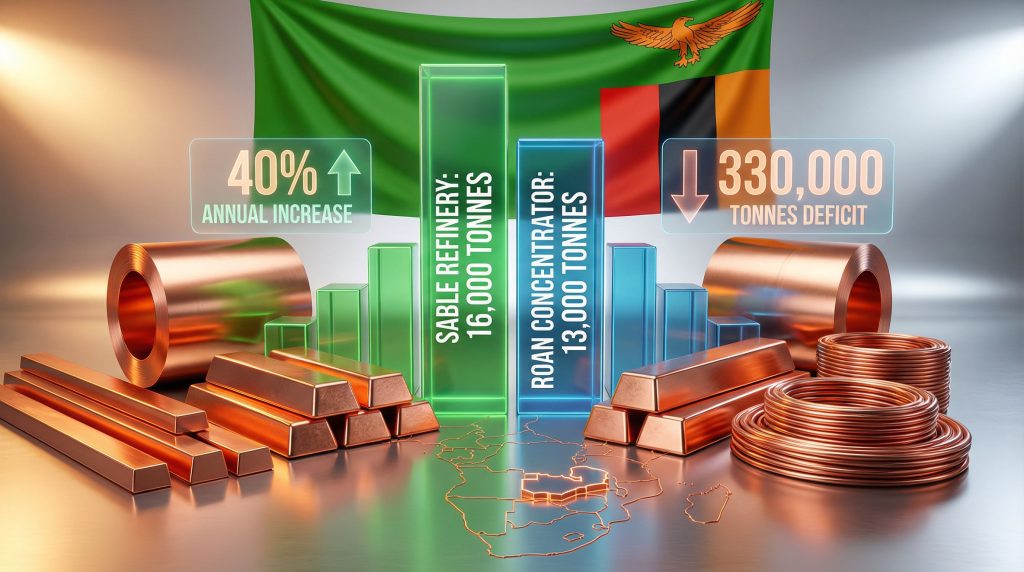
The 40% copper price appreciation during 2025 reflects supply constraints meeting this accelerating demand growth. JPMorgan's projection of a 330,000-tonne global refined copper deficit in 2026 indicates structural undersupply rather than cyclical tightness, supporting sustained price levels and operational margin expansion.
Resource Base and Processing Infrastructure Advantages
The Zambian asset portfolio creates vertical integration opportunities from mining through processing, establishing a consolidated value chain within a single operational jurisdiction. This integrated structure contrasts with fragmented South African operations requiring separate management across multiple processing facilities.
Core Zambian infrastructure components:
• Multiple mine operations providing diversified ore sources and operational flexibility
• 240 million tonnes of copper-bearing tailings enabling dual-feed processing strategies
• Roan concentrator capacity of 13,000 tonnes yearly processing throughput
• Sable refinery capability targeting 16,000 tonnes annual copper production
• Molefe open-pit operations with demonstrated expansion potential
The tailings resource represents significant value creation potential, effectively providing a second mining operation without traditional extraction costs. Historical mining operations accumulated massive volumes of copper-bearing material that can be reprocessed using modern technology to achieve higher recovery rates than originally achieved.
Market Dynamics Supporting Copper-Focused Strategy
Supply Chain Constraints and Deficit Projections
Global copper supply faces mounting challenges from aging infrastructure, declining ore grades, and limited new project development. These supply constraints coincide with accelerating demand from multiple industrial sectors, creating favourable conditions for existing producers and informing strategic copper investment strategies across the sector.
"The refined copper market deficit projections from major investment banks reflect genuine structural imbalances rather than temporary disruptions, indicating sustained support for copper prices throughout the medium term."
Key supply constraint factors:
- Aging mine infrastructure requiring substantial capital investment for maintenance
- Declining ore grades at established operations increasing processing costs
- Limited new project pipeline due to long development timelines and capital intensity
- Geopolitical supply risks in major copper-producing regions
- Environmental regulations constraining expansion at existing operations
Investment Positioning and Pure-Play Appeal
The transformation from diversified mining operation to pure-play copper specialist aligns with investor preferences for focused commodity exposure. Equity markets increasingly reward companies that provide clear, concentrated exposure to specific themes rather than complex multi-metal portfolios requiring detailed analysis across multiple commodity markets.
Pure-play positioning offers several investor relations advantages including simplified financial modelling, clearer growth narratives, and direct alignment with energy transition investment themes. This strategic clarity typically commands valuation premiums relative to diversified operations where individual commodity exposures become diluted within broader corporate structures.
Risk Assessment and Strategic Considerations
Geographic Concentration Risks
The strategic pivot toward concentrated Zambian exposure creates several risk considerations that must be balanced against operational and financial advantages. Single-country operations increase dependency on local political stability, regulatory frameworks, and economic conditions. However, this mirrors challenges seen in other African jurisdictions, including Zimbabwe mining asset challenges that highlight regional complexities.
Primary risk factors include:
• Power supply disruptions historically impacting mining operations in Zambia
• Infrastructure limitations in landlocked operations affecting transportation costs
• Political and regulatory risks from concentrated government dependency
• Currency volatility impacting operational costs and revenue conversion
• Labour relations and skills availability in specialised mining operations
Commodity Concentration Considerations
Transitioning to single-commodity exposure eliminates diversification benefits while creating direct sensitivity to copper price movements. This concentration amplifies both upside potential during favourable market conditions and downside risk during copper price declines.
| Risk Category | Mitigation Strategy | Implementation Timeline |
|---|---|---|
| Power Supply | Alternative energy partnerships | 12-18 months |
| Political Stability | Government relations programme | Ongoing |
| Price Volatility | Strategic hedging instruments | 6-12 months |
| Operational Efficiency | Technology infrastructure upgrades | 18-24 months |
The next major ASX story will hit our subscribers first
Broader Industry Transformation Patterns
Regional Investment Flow Dynamics
The Jubilee Metals South Africa exit reflects broader patterns of foreign investment reallocation across African mining jurisdictions. Multiple multinational corporations have reduced South African exposure while increasing focus on politically stable, resource-rich alternatives throughout the region. This trend aligns with wider industry evolution trends shaping global mining strategies.
Recent data indicating R73.5 billion in foreign investment outflows during Q2 2025 demonstrates systematic capital reallocation rather than isolated corporate decisions. According to Business Day, this trend suggests fundamental shifts in risk assessment methodologies and return expectations for African mining investments.
Strategic Focus Evolution in Mining
The mining industry increasingly embraces portfolio simplification strategies that concentrate resources on specific commodities aligned with long-term structural trends. This evolution reflects several interconnected factors, including industry consolidation and asset sales becoming more prevalent across the sector:
• Investor preference clarity for focused commodity exposure over diversification
• Capital allocation efficiency through concentrated rather than dispersed investments
• Operational expertise development in specialised rather than generalist approaches
• Market positioning advantages from pure-play investment narratives
Future Strategic Trajectory and Asset Optimisation
Remaining South African Asset Management
The retention of the undeveloped Tjate platinum project provides optionality for future value realisation while maintaining minimal operational complexity. This strategic approach allows management to focus primarily on Zambian copper development while preserving the ability to monetise South African platinum resources during favourable market conditions.
Strategic options for Tjate include:
- Joint venture development with established platinum producers
- Outright sale to platinum-focused mining companies
- Independent development during optimal market timing
- Strategic partnership for technical expertise and capital sharing
Transaction Completion and Capital Deployment
The remaining $65 million payment schedule from the South African asset disposal provides predictable cash flow for Zambian expansion initiatives. This staged approach creates accountability mechanisms while ensuring sufficient capital availability for operational requirements and growth investments.
Optimal capital deployment strategies focus on maximising production capacity from existing infrastructure while exploring expansion opportunities through additional tailings processing and mine development. As reported by Sharecast, the integrated processing infrastructure provides operational leverage for incremental production increases without proportional capital investment requirements.
The Jubilee Metals South Africa exit represents a definitive shift towards focused commodity exposure in response to structural market changes. This strategic transformation demonstrates how mining companies are adapting to investor preferences for clarity whilst positioning themselves to capitalise on emerging demand trends in the global energy transition.
Disclaimer: This analysis contains forward-looking statements and projections based on current market conditions and available information. Mining operations involve inherent risks including commodity price volatility, operational disruptions, and regulatory changes. Investment decisions should consider comprehensive risk assessments and individual financial circumstances. Copper price forecasts and demand projections represent analyst opinions and may not reflect actual market developments.
Ready to Capitalise on Mining Asset Restructuring Opportunities?
Discovery Alert's proprietary Discovery IQ model delivers real-time notifications on significant ASX mineral discoveries, enabling subscribers to identify actionable opportunities as companies complete strategic transformations like the Jubilee Metals repositioning. Begin your 30-day free trial today and secure your market-leading advantage by staying ahead of major discoveries that can transform portfolios.