June 16, 2026
The Tungsten Supply Crisis Western Markets Can No Longer Ignore
For decades, the global tungsten market has operated under a structural imbalance that most Western policymakers preferred not to examine too closely. China controls roughly 80% of global tungsten production, a concentration that leaves defence contractors, semiconductor manufacturers, and industrial toolmakers across North America and Europe exposed to supply disruptions that could materialise with little warning. Tungsten's strategic importance cannot be overstated — its extraordinary melting point of 3,422 degrees Celsius, the highest of any element, makes it irreplaceable in armour-piercing ammunition, cutting tools, aerospace components, and electronics. When a single nation dominates production of a material with those properties, the strategic risk is self-evident.
It is against this backdrop that the Cove Kaz Skyline merger agreement deserves serious analysis, not merely as a corporate transaction, but as a calculated response to one of the most pressing resource security challenges facing Western industrial economies today.
When big ASX news breaks, our subscribers know first
What the Cove Kaz Skyline Merger Agreement Actually Creates
The core of this transaction involves Cove Kaz Capital Group LLC, a geological exploration and mining company operating in Kazakhstan, combining its business with Skyline Builders Group Holding Ltd through a reverse merger structure executed via a newly formed US holding company. The surviving entity, Kaz Resources Inc., will carry the Nasdaq ticker KAZR, replacing Skyline's existing listing under SKBL.
The merger incorporates the acquisition of Kaz Critical Minerals LLP and its portfolio of 15 mining licences across Kazakhstan, covering a range of advanced-exploration and late-stage critical minerals projects. Both company boards have approved the transaction, with a closing window targeting Q4 2026 or early Q1 2027, subject to Skyline shareholder approval, regulatory clearances, and effectiveness of a registration statement filed with the US Securities and Exchange Commission.
The investment is being led by American Ventures, though full details of the investment structure and capital commitment from that entity remain subject to further disclosure.
Why a Reverse Merger? Understanding the Structure
The decision to execute this combination through a reverse merger rather than a traditional IPO or direct listing reflects both speed-to-market considerations and the practicalities of listing an internationally operating mining asset on a US exchange. In a reverse merger, the target company (Cove Kaz) merges into an existing publicly listed shell or company (Skyline), effectively inheriting its exchange listing while creating the new combined entity.
This approach can compress the timeline required for a full Nasdaq debut, avoiding the lengthy SEC review process associated with a conventional IPO. For a company in the critical minerals space where capital deployment timing matters, this structural efficiency carries real strategic value.
Key transaction terms at a glance:
| Deal Element | Detail |
|---|---|
| Surviving Entity | Kaz Resources Inc. |
| Post-Merger Nasdaq Ticker | KAZR |
| Skyline Pre-Merger Ticker | SKBL |
| Licence Portfolio Acquired | 15 licences across Kazakhstan |
| Holding Entity | Kaz Critical Minerals LLP |
| Bridge Financing | $23.1 million at 10% annual simple interest |
| Loan Treatment | Repayable or convertible under separate agreement |
| Transaction Type | Reverse merger via US holding company |
| Expected Closing | Q4 2026 or early Q1 2027 |
The Severniy Katpar Joint Venture: Kazakhstan's Anchor Asset
Before the merger announcement, Cove Kaz completed a separate but directly related transaction: the acquisition of a 70% ownership stake in the Severniy Katpar joint venture from Kazakhstan's national mining company, Tau-Ken Samruk, which retains the remaining 30% interest.
Severniy Katpar holds the licences for the Northern Katpar and Upper Kairakty projects, both located in Kazakhstan's Karaganda mining district in the central part of the country. Karaganda has a long history as a resource extraction region, and its geology supports large-scale mineralisation across multiple commodity types. Furthermore, the broader critical minerals demand surge across Western markets has made projects of this nature increasingly attractive to institutional investors.
Why Karaganda Matters Geologically
The Karaganda region sits within the Central Kazakhstan metallogenic belt, a geological province known for hosting substantial polymetallic and tungsten-bearing skarn deposits. Skarn deposits, formed through contact metamorphism between igneous intrusions and carbonate rocks, are among the most geologically reliable hosts for high-grade tungsten mineralisation globally. The structural setting of Northern Katpar and Upper Kairakty within this belt provides geological context for why these projects have attracted attention as potentially significant resource assets.
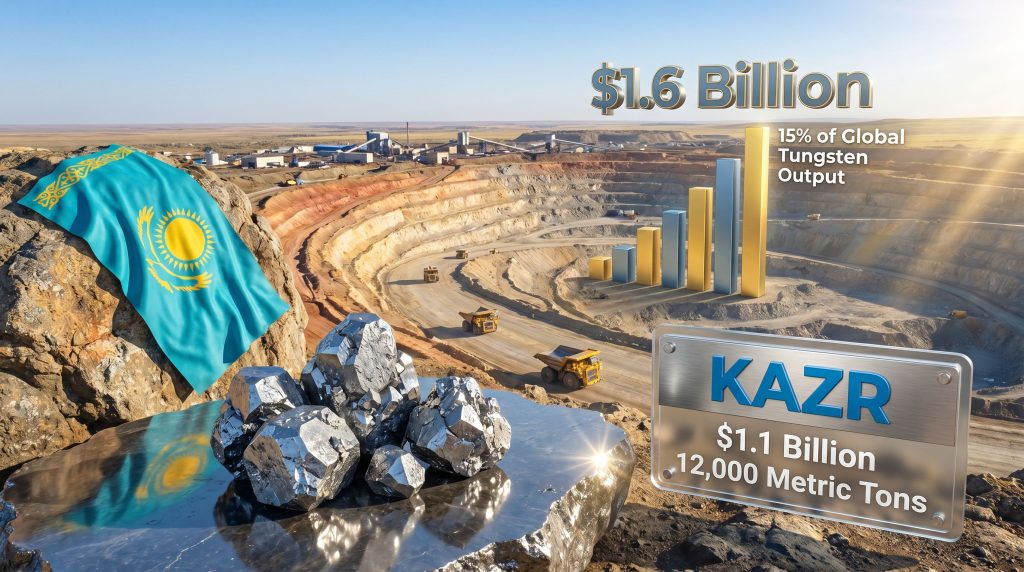
Production Target: The Severniy Katpar venture is targeting annual tungsten production of approximately 12,000 metric tons, which, based on current global output levels, would represent roughly 15% of total worldwide tungsten production.
Achieving that output would not merely add supply to a tight market. At that scale, Kaz Resources would become one of the most consequential single sources of tungsten outside Chinese jurisdiction, fundamentally altering the Western supply landscape for a commodity with no practical substitute in defence and aerospace tungsten applications and advanced manufacturing.
The Strategic Significance of Tau-Ken Samruk's Retained 30% Stake
The decision by Kazakhstan's state mining entity to retain a 30% stake rather than divest entirely is worth examining from an investor perspective. This structure is consistent with Kazakhstan's broader resource nationalism framework, where state participation in major mineral developments is standard practice rather than exceptional. For Kaz Resources, this has dual implications:
-
Operational stability: Government alignment through Tau-Ken Samruk's participation reduces the risk of regulatory friction or licence complications during the development phase.
-
Revenue sharing obligation: The 30% retention means Kaz Resources operates its 70% share within a joint venture framework, with governance and profit distribution terms that investors should review carefully once disclosed.
Financing Architecture: How $1.6 Billion in US Institutional Capital Is Being Mobilised
The financing picture around the Northern Katpar and Upper Kairakty projects is what elevates this transaction from a standard mining deal to something with considerably broader implications. Two separate US government-backed financing institutions have issued letters of interest for facilities that collectively exceed the project's estimated total development cost. Notably, mining.com has reported that prominent American investors have also taken an interest in the Kazakhstan tungsten development landscape, underscoring the geopolitical dimensions at play.
Breaking Down the Financing Structure
| Financing Source | Facility Size | Instrument Type | Status |
|---|---|---|---|
| US Export-Import Bank | Up to $900 million | Project Financing | Letter of Interest |
| US International Development Finance Corporation (DFC) | Up to $700 million | Development Finance | Letter of Interest |
| Combined Potential Exposure | Up to $1.6 billion | Combined | Conditional |
| Estimated Total Development Cost | Approximately $1.1 billion | Capital Budget | Estimated |
The combined letters of interest total $1.6 billion against an estimated development budget of approximately $1.1 billion. This overlap is not necessarily unusual; competing facilities from different institutions with different disbursement terms, risk appetites, and mandate conditions can exist simultaneously while the project team works toward binding commitments from one or both sources.
Critical Investor Caution: Letters of interest issued by government-backed financing institutions are formal but non-binding expressions of intent. They signal institutional appetite and preliminary eligibility, but final commitments require completion of due diligence, feasibility confirmation, regulatory review, and compliance assessment. Investors should not treat these letters as guaranteed funding.
What These Institutions Actually Do
Understanding the distinct mandates of these two bodies provides important context:
-
US Export-Import Bank (EXIM): EXIM exists to support US exports and the employment they generate. In a mining context, EXIM financing is typically structured around ensuring that project development creates demand for US-manufactured goods, services, and engineering expertise. An EXIM facility for a Kazakhstani mining project would likely require meaningful US supply chain involvement.
-
US International Development Finance Corporation (DFC): The DFC operates with a development finance mandate, investing in projects in emerging markets that advance US foreign policy objectives. Critical mineral supply chain security falls squarely within its current priorities. DFC involvement signals a foreign policy dimension to the transaction beyond pure commercial considerations.
The participation of both institutions simultaneously reflects the breadth of strategic interest in developing non-Chinese tungsten supply, spanning both commercial trade policy and foreign policy objectives. In addition, securing tungsten offtake agreements from Western end-users would further strengthen the project's commercial foundation ahead of construction.
The Role of the $23.1 Million Bridge Loan
As part of the pre-merger arrangements, Skyline has extended a $23.1 million bridge loan to Cove Kaz, carrying 10% annual simple interest. This facility serves a practical function: providing Cove Kaz with working capital to sustain operations through the period between merger announcement and closing.
The conversion option attached to the loan is a technically important feature. Rather than requiring cash repayment at closing, the parties have reserved the right to convert this debt into equity under a separate agreement. In practical terms, this means the $23.1 million could ultimately become part of the combined company's equity structure rather than representing a cash outflow at a moment when capital is better deployed toward project development.
Simple interest, rather than compound, is the preferred structure for bridge facilities of this nature because it limits the cost escalation risk if the closing timeline extends beyond initial projections.
Tungsten's Market Dynamics: Why Timing Matters
The timing of the Cove Kaz Skyline merger agreement is not coincidental. The global tungsten market has been under increasing supply pressure as Western nations reassess their critical mineral dependencies with growing urgency. A few structural realities define the current market:
-
China's dominance in tungsten extends beyond mining into processing, with the majority of global ammonium paratungstate (APT) production, the primary intermediate product in the tungsten supply chain, also concentrated there.
-
Western demand for tungsten is growing, driven by defence spending increases across NATO members, expansion of advanced manufacturing, and the proliferation of electric vehicle components requiring tungsten-based tooling.
-
The number of credible, large-scale, non-Chinese tungsten development projects globally is extremely limited, meaning the competitive landscape for what Kaz Resources is attempting to build is relatively uncrowded.
For context on why 12,000 metric tons of annual production carries such weight: current estimates of global tungsten mine production sit in the range of 80,000 to 85,000 metric tons per year of tungsten concentrate equivalent, with China alone accounting for the bulk of that figure. A single project delivering 12,000 metric tons of Western-aligned supply would represent a structurally meaningful shift in the availability of non-Chinese product.
The next major ASX story will hit our subscribers first
What Nasdaq Listing Under KAZR Could Mean for Market Positioning
The decision to list Kaz Resources on Nasdaq rather than a London, Toronto, or Australian exchange reflects a deliberate strategic calculation. US institutional investors have demonstrated increasing appetite for critical mineral equities, particularly those with documented links to US supply chain security objectives. A Nasdaq listing provides access to that institutional capital pool and aligns the company's investor base with the end-market it is seeking to supply.
From a comparative positioning standpoint, there are very few pure-play tungsten-focused equities available to US investors. Most Western tungsten exposure exists within diversified mining companies where tungsten represents only a portion of total operations. If Kaz Resources executes on its development timeline, KAZR would occupy a relatively distinctive niche within the critical minerals equity universe.
Investors approaching this opportunity should weigh several risk dimensions carefully:
-
Execution risk: Developing a project of this scale in a Central Asian jurisdiction involves infrastructure, logistics, workforce, and regulatory variables that can extend timelines significantly.
-
Financing risk: The transition from letters of interest to binding commitments from EXIM and the DFC involves extensive conditions that may not be fully met or may require project modifications.
-
Jurisdiction risk: Kazakhstan's investment climate, while generally considered more stable than some regional peers, carries its own regulatory and political risk profile that due diligence must address thoroughly.
-
Timeline risk: The Q4 2026 closing target for the merger itself is subject to SEC review timing, shareholder vote outcomes, and regulatory clearances that are inherently difficult to predict precisely.
Key Milestones Between Now and Anticipated Closing
For investors tracking this transaction, the following sequence of events defines the path from announcement to operational reality:
- SEC Registration Statement filing and review process for the Kaz Resources Inc. entity
- Skyline Shareholder Vote to approve the merger and associated transaction terms
- Regulatory Clearances across relevant jurisdictions
- Merger Closing targeted for Q4 2026 or early Q1 2027
- A definitive feasibility study for Northern Katpar and Upper Kairakty, anticipated in the second half of 2026
- Binding Financing Commitments from EXIM and/or the DFC, contingent on DFS outcomes and due diligence completion
- Construction Decision and capital mobilisation, timing dependent on feasibility results and financing finalisation
The DFS is arguably the most consequential near-term milestone. Feasibility studies at this stage define bankable project economics, providing the technical and financial foundation that lenders and institutional investors require before committing capital at scale. If the DFS delivers strong project economics, the path toward binding financing from the two US institutions becomes substantially clearer. As Business Wire's official announcement confirms, both boards have already aligned on the core transaction terms, which removes one significant layer of uncertainty from the process.
Frequently Asked Questions: Cove Kaz Skyline Merger Agreement
What is the Cove Kaz Skyline merger agreement?
The Cove Kaz Skyline merger agreement is a transaction between Cove Kaz Capital Group LLC and Skyline Builders Group Holding Ltd to combine their businesses into a single entity called Kaz Resources Inc. The deal incorporates Kaz Critical Minerals LLP and its 15 Kazakhstani mining licences, with the combined company to list on Nasdaq under the ticker KAZR.
When is the merger expected to close?
The transaction is anticipated to finalise during Q4 2026 or early Q1 2027, subject to Skyline shareholder approval, regulatory clearances, and an effective SEC registration statement. These conditions introduce timeline uncertainty that investors should factor into their analysis.
What is the primary asset underpinning the deal?
The cornerstone asset is the Severniy Katpar joint venture, specifically the Northern Katpar and Upper Kairakty projects within Kazakhstan's Karaganda mining district. Cove Kaz holds a 70% interest in this venture, with Tau-Ken Samruk retaining 30%.
What minerals will Kaz Resources produce?
Tungsten is the primary target commodity, with an annual production goal of approximately 12,000 metric tons. The company's broader licence portfolio also covers rare earths and other critical minerals aligned with US industrial and defence supply chain requirements.
Are the US government financing facilities confirmed?
No. The Export-Import Bank's $900 million facility and the DFC's $700 million facility exist as letters of interest, which are non-binding expressions of intent. Final commitment requires completing due diligence, feasibility review, and regulatory processes. Investors should not treat these as secured funding.
What is the purpose of the $23.1 million bridge loan?
Skyline has extended this loan to Cove Kaz at 10% annual simple interest as a pre-closing working capital facility. The loan may be repaid in cash or converted to equity under a separate agreement, providing flexibility in how the capital is ultimately treated within the combined entity's structure.
This article is intended for informational purposes only and does not constitute financial or investment advice. All forecasts, project timelines, and financing figures referenced are subject to change and involve material risks and uncertainties. Readers should conduct their own due diligence and consult a qualified financial adviser before making investment decisions. Letters of interest from government-backed institutions are non-binding and do not guarantee project financing.
Want to Stay Ahead of the Next Major Critical Minerals Discovery?
Discovery Alert's proprietary Discovery IQ model delivers real-time alerts on significant ASX mineral discoveries — instantly transforming complex geological and market data into actionable investment insights for both short-term traders and long-term investors. Explore historic examples of major mineral discoveries and their market returns, then begin your 14-day free trial at Discovery Alert to position yourself ahead of the broader market.