August 7, 2026
Understanding the Mechanics of Critical Energy Infrastructure
The global energy system operates through an intricate network of pipelines, terminals, and processing facilities that collectively form the backbone of modern economic activity. When these critical nodes experience disruption, the effects ripple through markets with surprising speed and complexity. Infrastructure vulnerabilities in energy systems represent one of the most underappreciated risks facing commodity markets today, where single facilities can control substantial portions of regional or global supply flows.
Loading terminals serve as crucial bottlenecks in the oil supply chain, where crude oil transitions from pipeline networks to seaborne transportation. These facilities typically feature sophisticated loading arm configurations designed to transfer massive volumes of oil from storage tanks to tankers in a matter of hours. The operational efficiency of these terminals directly influences global oil pricing mechanisms, as any reduction in capacity creates immediate supply constraints that traders factor into market calculations.
When big ASX news breaks, our subscribers know first
How Terminal Infrastructure Shapes Global Oil Markets
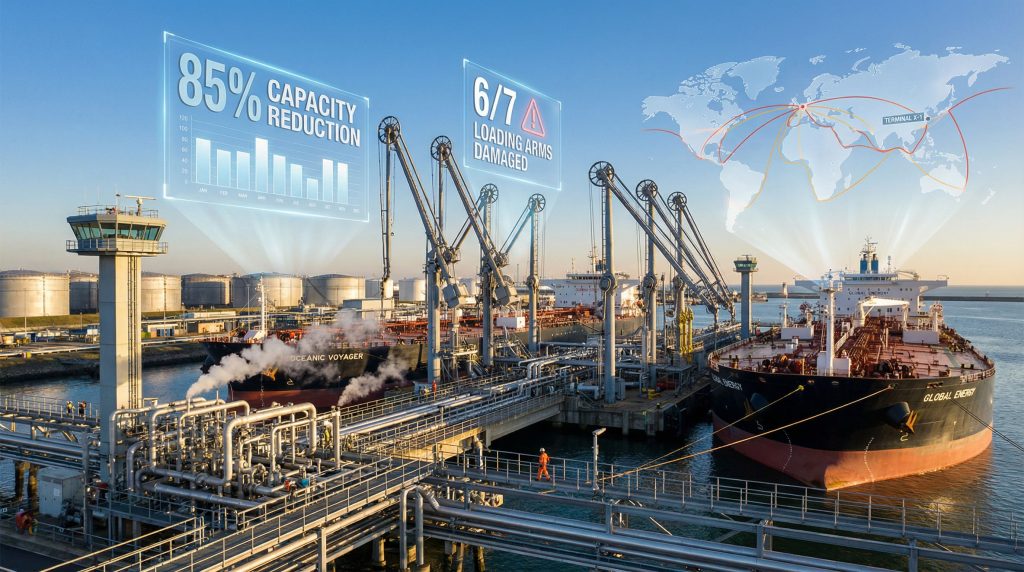
Modern oil loading facilities represent significant engineering achievements, with the largest terminals capable of handling multiple supertankers simultaneously. The Novorossiysk oil loading disruption serves as a prime example of how concentrated infrastructure creates systemic vulnerabilities in global energy markets. When six of seven loading arms at major terminals sustain damage, the immediate operational impact reduces export capacity by approximately 85 percent, forcing operators to reroute massive volumes through alternative facilities.
The technical specifications of major loading terminals reveal their critical importance to global supply chains. These facilities typically feature:
- High-capacity loading arms capable of transferring 50,000 to 100,000 barrels per hour
- Integrated pipeline systems connecting to multiple oil fields and refineries
- Storage tank farms with capacity measured in millions of barrels
- Sophisticated vessel scheduling systems managing supertanker traffic
- Advanced safety and monitoring equipment for hazardous material handling
When infrastructure attacks target these components, the cascade effects extend far beyond the immediate facility. Furthermore, the OPEC meeting impact on global pricing becomes more pronounced during such disruptions. Pipeline control nodes become inoperable, creating upstream bottlenecks that affect production from multiple oil fields.
Operational Impact Assessment During Infrastructure Events
The immediate aftermath of terminal disruptions follows predictable patterns that commodity traders have learned to anticipate. Recovery timelines vary significantly based on the specific infrastructure components affected, with loading arm damage typically requiring four to eight weeks for complete restoration. Pipeline control system repairs generally take two to four weeks, while storage tank access issues may resolve within one to three weeks.
| Infrastructure Component | Typical Damage Impact | Recovery Timeline | Market Effect |
|---|---|---|---|
| Loading Arms | 80-90% capacity loss | 4-8 weeks | Immediate price spike |
| Pipeline Controls | Flow disruption | 2-4 weeks | Regional premium |
| Storage Access | Inventory constraints | 1-3 weeks | Quality differentials |
| Port Navigation | Vessel delays | 1-2 weeks | Transportation costs |
Alternative routing strategies emerge rapidly during terminal closures, though these options typically involve higher transportation costs and reduced efficiency. Baltic port facilities often absorb diverted volumes, but their combined capacity rarely matches that of major disrupted terminals. Consequently, the recent oil price rally has been further exacerbated by such infrastructure constraints.
Market Psychology and Price Formation During Disruptions
Oil markets exhibit heightened sensitivity to infrastructure disruptions due to the psychology of supply shock scenarios. Traders immediately incorporate risk premiums into pricing models when critical facilities face operational constraints. The Novorossiysk oil loading disruption demonstrates how markets react to physical supply limitations, with futures contracts reflecting both immediate capacity reductions and uncertainty about restoration timelines.
Risk premium calculations during infrastructure events typically consider several factors:
- Immediate supply reduction: Quantifying actual barrels removed from global markets
- Duration uncertainty: Estimating realistic repair and restoration timelines
- Alternative capacity: Assessing available backup infrastructure and routing options
- Geopolitical escalation: Evaluating potential for additional facility targeting
- Seasonal demand patterns: Considering timing relative to peak consumption periods
The commodity trading community has developed sophisticated models for pricing infrastructure risk, though these calculations often prove inadequate during actual events. Moreover, understanding oil price movements during such crises requires analysis of multiple interconnected factors.
Regional Vulnerability Mapping and Supply Chain Resilience
Geographic concentration of export infrastructure creates systemic vulnerabilities that extend beyond individual facilities. Major oil-producing regions often funnel substantial portions of their output through single terminal complexes, creating potential for widespread supply disruptions from localised incidents. The Novorossiysk oil loading disruption highlights these concentration risks, where a single facility handles significant portions of regional crude oil exports.
Backup facility capacity analysis reveals critical gaps in many regions where primary terminals handle volumes far exceeding secondary facility capabilities. Emergency response protocols exist for infrastructure disruptions, though their effectiveness depends heavily on advance planning and coordination between multiple operators and government agencies.
Strategic petroleum reserve utilisation becomes crucial during extended infrastructure outages. However, the global oil market influence of such reserves remains limited during prolonged disruptions.
Recovery Strategies and Infrastructure Hardening
Restoration of damaged loading infrastructure follows established prioritisation methodologies that focus on critical path components. Emergency repair teams typically concentrate first on loading arm functionality, as these systems represent the primary bottleneck in export operations. Temporary capacity restoration techniques may involve portable loading equipment, though these solutions generally operate at reduced efficiency compared to permanent installations.
"Insurance and risk management considerations have evolved significantly following recent infrastructure disruptions, with coverage terms now explicitly addressing geopolitical attack scenarios and extended business interruption periods," notes a recent industry analysis from Reuters.
Long-term infrastructure hardening measures include physical security enhancements designed to withstand various attack scenarios. Redundancy planning for critical components has become standard practice, with backup loading arms and alternative pipeline routing built into new facility designs. Investment in distributed infrastructure reduces single-point-of-failure risks, though this approach typically involves higher capital costs and operational complexity.
The next major ASX story will hit our subscribers first
Trading Implications and Market Intelligence
Professional commodity traders have developed specialised strategies for infrastructure uncertainty periods that capitalise on volatility while managing downside risk. Position sizing during disruption events requires careful balance between opportunity capture and capital preservation. Volatility trading strategies often focus on options markets where implied volatility typically spikes during supply shock scenarios.
Regional price differential exploitation represents another sophisticated trading approach during infrastructure disruptions. When major terminals face operational constraints, alternative export routes often trade at significant premiums, creating arbitrage opportunities for traders with access to diverse transportation networks.
Early warning indicators for infrastructure vulnerabilities include:
- Satellite monitoring of critical facility activity levels and security preparations
- Insurance market pricing changes for energy infrastructure coverage
- Geopolitical tension escalation patterns in key producing regions
- Vessel positioning data indicating unusual routing or delays
- Pipeline flow rate variations suggesting operational constraints
Risk management approaches for energy portfolios must account for infrastructure vulnerability as a distinct risk factor requiring specific hedging strategies. Additionally, periods of oil price stagnation often precede significant infrastructure-related market shocks.
What Are the Key Market Indicators?
Traditional supply-demand models often fail to capture the full impact of infrastructure disruptions, necessitating more sophisticated risk assessment frameworks. Market intelligence gathering has become increasingly crucial for identifying potential vulnerabilities before they manifest in actual disruptions.
How Do Insurance Markets React?
Insurance providers have significantly adjusted their risk models following recent infrastructure attacks. Coverage premiums for critical energy infrastructure have increased substantially, reflecting the elevated threat environment and potential for catastrophic losses.
Lessons from the Novorossiysk Case Study
The Novorossiysk oil loading disruption provides valuable insights into infrastructure resilience and market response mechanisms. This facility's strategic importance to regional oil exports meant that even temporary capacity reductions created immediate supply chain stress extending throughout European and global markets. The incident demonstrates how single infrastructure nodes can influence global commodity pricing despite their relatively small share of total world production.
Recovery efforts at Novorossiysk involved coordinated response from multiple stakeholders, including facility operators, government agencies, and international shipping companies. For instance, Al Jazeera reported extensive coordination efforts during the restoration process.
Market participants learned important lessons about infrastructure risk assessment from this event. Traditional risk models that focused primarily on production disruptions proved inadequate for evaluating transportation and logistics vulnerabilities. The incident prompted widespread reevaluation of supply chain risk management practices throughout the energy industry.
Strategic Implications for Global Energy Security
Infrastructure vulnerabilities in critical energy facilities represent a growing concern for energy security planners worldwide. The concentration of export capacity in relatively few facilities creates systemic risks that extend far beyond individual companies or regions. Diversification strategies for importing nations now increasingly focus on supplier infrastructure resilience rather than simply source country diversity.
Emergency response protocols continue evolving based on lessons learned from infrastructure disruption events. Coordination mechanisms between government agencies, private operators, and international partners require regular testing and refinement to ensure effectiveness during actual crisis situations. The Novorossiysk oil loading disruption revealed gaps in communication and response coordination that have since prompted protocol improvements.
Long-term energy security planning must account for infrastructure vulnerability as a permanent feature of global energy markets. Investment in resilient infrastructure, backup systems, and alternative transportation routes represents essential components of comprehensive energy security strategies for both producing and consuming nations.
Ready to Stay Ahead of Critical Energy Market Disruptions?
Discovery Alert's proprietary Discovery IQ model provides real-time alerts on significant ASX mineral discoveries, helping investors identify actionable opportunities before broader market awareness develops. Whether you're monitoring energy infrastructure impacts on commodity markets or seeking the next major discovery, begin your 14-day free trial today to gain a decisive market-leading advantage powered by advanced AI technology.