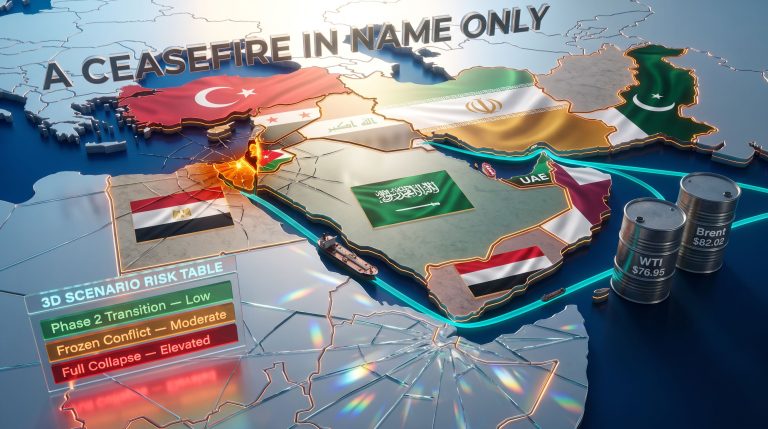
August 7, 2026
When Diplomacy Moves Faster Than Tankers: The Hormuz Paradox
Energy markets have a well-documented tendency to price expected outcomes rather than confirmed realities. This behavioural pattern sits at the heart of one of the most structurally important chokepoints on earth: the Strait of Hormuz. When diplomatic signals suggest that restricted waterways might reopen, crude futures often react within hours, compressing risk premiums that took weeks to build. The problem is that a negotiating headline and a fully operational shipping lane are separated by an enormous physical and political gap. Understanding that gap is the key to interpreting what oil prices and the Strait of Hormuz breakthrough talks actually mean for global energy markets right now.
When big ASX news breaks, our subscribers know first
The Strait of Hormuz: More Than a Shipping Lane
Why This 33-Kilometre Passage Controls Global Energy Pricing
The Strait of Hormuz is arguably the most consequential geographical feature in global energy economics. Approximately one-fifth of all globally traded oil and liquefied natural gas transits this passage annually, connecting the Persian Gulf to the Arabian Sea and serving as the only maritime exit for crude exports from Saudi Arabia, Iraq, Iran, Kuwait, and the UAE.
What makes this corridor uniquely vulnerable is its extreme narrowness. At its tightest point, the strait spans roughly 33 kilometres, with only two navigable shipping channels, each approximately 3 kilometres wide. There is no commercially viable alternative that can substitute its capacity at scale. A partial closure does not redirect trade; it structurally removes millions of barrels per day from accessible global supply simultaneously.
Furthermore, this physical reality produces an important market dynamic: futures prices respond to expected supply changes, not just actual ones. When tension rises around Hormuz, traders embed a risk premium into forward contracts. When diplomatic signals suggest easing, that premium evaporates rapidly, often before a single additional barrel has moved through the strait. Understanding crude oil price trends helps contextualise just how sensitive these markets are to geopolitical signals.
How Forward Pricing Amplifies Hormuz Sensitivity
The mechanism linking Hormuz diplomacy to crude price volatility operates through the futures market's forward-looking architecture. WTI and Brent contracts trade on probabilities, not certainties, meaning that a credible-sounding diplomatic report can shift prices by several dollars per barrel within a single trading session.
This creates a structural irony: markets frequently price the resolution before it materialises, then must partially reverse when physical confirmation fails to follow. The result is sharp, headline-driven volatility that experienced traders attempt to exploit while long-only investors absorb the turbulence. The phrase used among commodity trading desks is instructive: sell the rumour, buy back when reality disappoints.
Mapping the Iran-Oman-U.S. Negotiation Framework
What the Trilateral Talks Actually Involve
The diplomatic process currently underway involves Iran, Oman, and the United States working toward a managed framework for vessel transit through the strait. Oman has historically served as a back-channel intermediary between Tehran and Western governments, lending institutional credibility to the discussions. The trade war impact on oil adds another layer of complexity to these already delicate negotiations.
Iran's stated position centres on obtaining oversight authority over vessels entering and departing the Gulf. A draft framework has reportedly been prepared, though final ratification requires approval from Iran's supreme leadership. As of early August 2026, that approval has not been confirmed.
"A managed transit arrangement operating under Iranian oversight conditions is fundamentally different from a return to pre-conflict shipping norms. Commercial refiners and logistics operators require schedule reliability and cargo security. Conditional access, no matter how diplomatically framed, does not deliver either."
How Markets Responded to the Breakthrough Signals
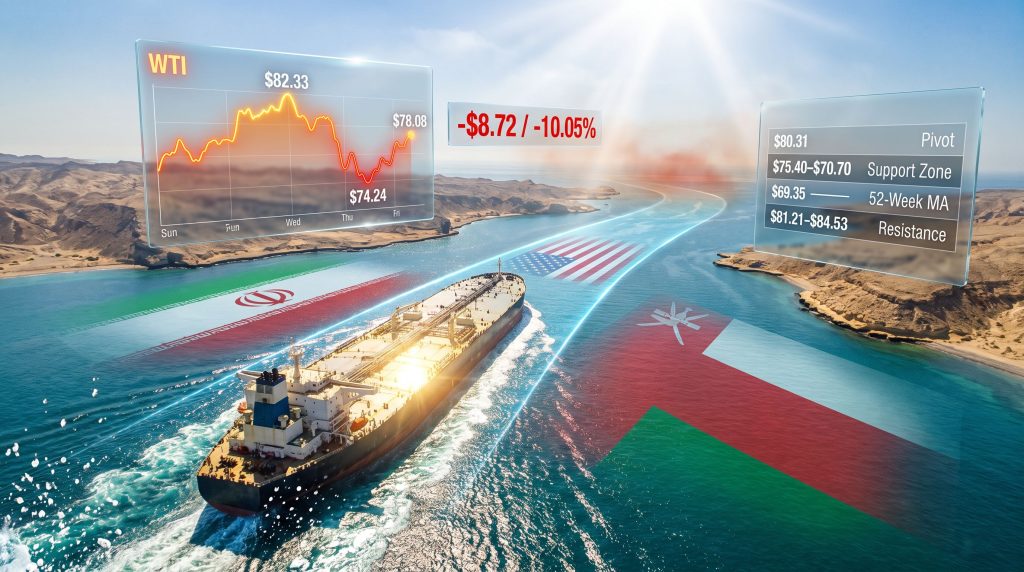
The price action during the week of these diplomatic reports tells the full story of how oil markets are interpreting progress on the Strait of Hormuz breakthrough. According to reporting from The Guardian, oil prices fell sharply as Hormuz reopening hopes gained traction.
| Market Event | WTI Price Level | Market Interpretation |
|---|---|---|
| Weekly open | $80.10 per barrel | Baseline with risk premium embedded |
| Weekly high | $82.33 per barrel | Maximum risk premium before talks reported |
| Weekly low | $74.24 per barrel | Peak diplomatic optimism priced in |
| Partial rebound | $78.08 per barrel | Market recalibrates as deal unconfirmed |
| Weekly net change | Down approximately $8.72 (10.05%) | Largest weekly loss in recent months |
The sequence is textbook. Traders sold crude aggressively on the prospect of Hormuz reopening, compressing the supply risk premium embedded in futures. The subsequent partial recovery reflected the market realising that Iran's oversight conditions do not constitute restored shipping access, and that tanker traffic data had not improved in any measurable way.
The Physical Evidence Gap: Why Export Data Is Lagging the Headlines
What Gulf Export Volumes Are Actually Showing
The critical distinction between diplomatic progress and supply restoration lies in the physical data. Gulf crude and condensate export volumes remain substantially below pre-conflict levels. Tanker traffic through Hormuz has stalled at multi-month lows, a pattern confirmed by vessel tracking data that contradicts the optimistic narrative embedded in recent futures pricing.
Commercial operators have not restored normal scheduling. Ships have not returned to predictable transit patterns. Until these physical indicators shift, the futures market faces an ongoing reconciliation problem: prices have already discounted a reopening that the barrels-in-the-water data have not confirmed.
The EIA Inventory Report: A Bearish Amplifier
Adding downward pressure to an already-selling market, the U.S. Energy Information Administration reported a commercial crude inventory build of approximately 2.5 million barrels for the week ending July 31. This arrived against market expectations for a draw, amplifying the bearish momentum already generated by Hormuz optimism.
Contributing factors included:
- Increased import volumes arriving at U.S. ports
- Reduced refinery utilisation rates across major processing hubs
- A sharp increase in stocks at the Cushing, Oklahoma delivery hub, the delivery point for WTI futures contracts
However, the inventory report was not uniformly bearish. Gasoline stocks fell, and distillate inventories posted a larger-than-expected drawdown. This internal split within the same weekly report reveals an important structural truth: the crude headline and the product market are telling different stories.
Why Diesel Markets Are Operating Under Separate Pressure
Distillate markets, particularly diesel and heating oil, remain structurally tighter than crude benchmark prices would suggest. This tightness is not a function of Hormuz restriction alone. Russian refinery disruptions, following sustained attacks on processing infrastructure, have curtailed petroleum product output from a major global supplier. Reduced Middle Eastern product exports compound this pressure.
U.S. diesel exports have reached record highs as domestic stockpiles decline, indicating that global product demand is drawing American supply outward even as domestic crude inventories build. This bifurcation between crude and product markets is a lesser-known dynamic that creates complexity for traders attempting to read the overall petroleum market from headline crude prices alone. The broader LNG supply outlook further complicates the picture for energy planners worldwide.
The Red Sea Complication: The Backup Route Is Also Under Threat
How Houthi Activity Is Eliminating the Alternative Corridor
Saudi Arabia's East-West Pipeline, known as Petroline, offers a partial bypass of Hormuz by transporting crude to Red Sea export terminals at Yanbu. This route had become the primary alternative corridor for Saudi barrels while Hormuz traffic remained restricted. That alternative is now under its own threat.
Houthi forces have claimed missile strikes against Saudi oil tankers operating near Yanbu and in the Gulf of Aden. Saudi Arabia has not officially confirmed the strikes, but the claims arrived at a moment when markets were already reassessing the reliability of alternative routing. The result was a reintroduction of risk premium that the Hormuz optimism had briefly compressed.
"If both Hormuz and the Red Sea route face sustained simultaneous disruption, global crude markets would lose their two primary Middle Eastern export pathways without any near-term logistical substitute capable of replacing comparable volumes."
Alternative Infrastructure and Its Limitations
The available bypass options are real but constrained:
| Alternative Route | Capacity | Current Status |
|---|---|---|
| Saudi East-West Pipeline (Petroline) | Approximately 5 million bpd | Operational but under Houthi threat |
| UAE Habshan-Fujairah Pipeline | Approximately 1.5 million bpd | Operational, limited to UAE volumes only |
| Iraq-Syria Pipeline Revival | Requires 3+ years of reconstruction | Medium-term project only |
| LNG re-routing via longer sea lanes | Significant cost and scheduling impact | Partially operational with freight premiums |
No combination of these alternatives can replace full Hormuz throughput at comparable cost and scheduling reliability. This infrastructure reality is why physical supply data continues to disappoint even as diplomatic headlines generate optimism. Consequently, OPEC's market influence becomes all the more critical during periods of sustained chokepoint disruption.
How Major Importers Are Restructuring Their Supply Chains
India's Strategic Pivot to West African Crude
Indian state refiners, including Hindustan Petroleum Corporation Limited, have actively redirected crude purchasing toward West African grades, particularly Nigerian and Angolan crude, to reduce their exposure to Hormuz transit risk. This shift carries genuine cost implications. West African crude commands different freight economics and quality differentials compared to the Middle Eastern grades these refiners were optimised to process.
Simultaneously, India is expanding its domestic strategic petroleum reserve capacity following the supply disruption shock, a programme reportedly requiring a $42 billion longer-term investment commitment across storage infrastructure. India also hopes to diversify further into Venezuelan field operations as a supply hedge.
China's Accelerated Pivot to Russian Barrels
China's largest refiners have increased reliance on Russian crude as a Hormuz-independent supply source. Chinese crude imports rebounded after a historically weak June, with Russian barrels filling a growing share of the import mix. China eased fuel export restrictions as the global supply crunch deepened, a signal that Beijing is actively managing both its import and export positioning simultaneously.
Compounding this supply-side complexity, China's power demand hit record highs during a regional heatwave, which compressed the demand-side relief that lower prices might otherwise have provided. Record electricity consumption absorbs refinery output that might otherwise reduce product market tightness.
Saudi Aramco's Pricing Signal
Saudi Aramco's decision to deepen its official selling price discount for Asian customers ahead of potential Hormuz deal announcements reveals a commercially significant strategic calculation. The Kingdom appears to be competing aggressively to preserve long-term Asian refinery relationships during the disruption period, absorbing near-term margin pressure to protect market share.
Despite these discounts, Saudi Aramco's adjusted profit surged approximately 33% as elevated benchmark prices generated strong margins even on discounted volumes. BP similarly reported earnings of $5.7 billion for the most recent reporting period, with the oil price and refining environment driving outperformance across integrated majors.
The next major ASX story will hit our subscribers first
Technical Price Structure: Where WTI Goes From Here
Key Support and Resistance Levels
September WTI futures are testing a critical long-term Fibonacci retracement zone spanning $75.40 to $70.70. Below that, the 52-week moving average at $69.35 provides the next structural support layer, with the major swing low at $67.12 defining the primary market floor.
On the upside, resistance clusters are positioned at:
- $81.21 to $84.53: immediate short-term retracement zone
- $93.50 and $95.30: May and July swing highs respectively
- $100.00: psychological threshold that would signal a shift to bullish trend
- $105.21 and $110.00: extended targets contingent on confirmed supply restoration failure
The $80.31 Pivot: The Week's Directional Decision Gate
Trader positioning relative to $80.31 will determine directional momentum for the week ending August 14. A sustained close above this level signals genuine buyer conviction rather than short-covering, opening a pathway toward the $81 to $85 resistance band. Sustained trading below $80.31, however, reactivates downside exposure toward the $75.40 to $70.70 support zone.
"WTI is currently operating within a wide consolidation range between $55.49 and $95.30, with the midpoint at $75.40 acting as the structural pivot. The market is in classic sell-the-rally, buy-the-dip mode, characteristic of headline-driven geopolitical trading environments where neither bull nor bear can claim definitive confirmation."
An important nuance for investors: the distinction between fresh demand and short-covering in any WTI bounce will determine whether upside momentum is sustainable. Short-covering rallies can be substantial but tend to exhaust quickly once the covering is complete, while fresh demand signals genuine positioning for sustained price recovery.
Three Strategic Scenarios for Oil Prices
Scenario 1: Hormuz Deal Confirmed, Tanker Traffic Normalises (Bearish for Crude)
If a binding Iran-Oman-U.S. framework is ratified and tanker traffic measurably recovers within 30 to 60 days, WTI could test the $70 to $75 range. This scenario requires not just a diplomatic announcement but verifiable, sustained vessel transit data confirming operational restoration. The probability remains moderate. Iran's conditional oversight requirements create ongoing friction that could delay or complicate physical implementation even if a framework is signed.
Scenario 2: Talks Continue Without Resolution, Partial Disruption Persists (Range-Bound)
The most likely near-term outcome: diplomatic progress generates headlines without producing measurable physical supply restoration. In this case, WTI oscillates between $74 and $85, driven by alternating cycles of optimism and disappointment. Product markets, particularly diesel and heating oil, remain structurally tighter than crude benchmarks suggest. This is precisely the kind of environment where oil and geopolitics analysis proves most valuable for investors navigating uncertainty.
Scenario 3: Red Sea and Hormuz Simultaneously Disrupted (Strongly Bullish for Crude)
Sustained Houthi pressure on Red Sea shipping combined with a Hormuz deal collapse could push Brent back above $90 to $95 rapidly. Strategic Petroleum Reserve releases provide only a partial buffer. Each release represents a one-time injection that progressively reduces the emergency cushion available for future escalation scenarios, a structural vulnerability that markets have not yet fully priced. Al Jazeera's coverage of ongoing price movements highlights how quickly sentiment can shift in either direction.
The Signals That Will Determine Whether the Breakthrough Is Real
Three data points will confirm or contradict the diplomatic narrative over the coming weeks:
- Weekly tanker traffic counts through Hormuz: the most direct physical confirmation of any agreement's operational impact
- Month-on-month Gulf crude export volumes from Saudi Arabia, Iraq, Kuwait, and the UAE: the barrels-in-the-water evidence futures markets ultimately require
- Iranian supreme leadership ratification: the conversion of a draft framework into an enforceable arrangement that commercial operators can rely upon for scheduling
Until all three data streams shift materially, the gap between diplomatic optimism and physical supply reality will continue to generate the volatile, headline-sensitive trading environment that has defined crude pricing through this period. The supply risk embedded in oil prices and the Strait of Hormuz breakthrough negotiations has not disappeared. It has simply become harder to price with precision.
This article is intended for informational and educational purposes only. It does not constitute financial, investment, or trading advice. Commodity markets involve substantial risk of loss, and past price patterns are not indicative of future outcomes. Readers should seek independent professional advice before making any investment decisions.
Want to Stay Ahead of the Next Major Resource Discovery?
While geopolitical disruptions reshape global energy markets, Discovery Alert's proprietary Discovery IQ model scans ASX announcements in real time, delivering instant alerts on significant mineral discoveries so subscribers can identify actionable opportunities before the broader market reacts — explore historic discovery returns to see what early positioning has meant for investors, then begin your 14-day free trial today.