August 7, 2026
The Phased Agreement Trap: Why Sequential Ceasefires Break Down in Asymmetric Conflicts
Diplomats and conflict resolution theorists have long understood that phased peace agreements carry an inherent structural vulnerability. When each phase depends on the completion of the one before it, a single failure point can render the entire architecture functionally inert. This is not a new observation. From the Oslo Accords to the Minsk framework to the Doha Taliban agreement, history is littered with phased agreements that collapsed not from bad faith alone, but from the compounding effect of sequential dependency in environments where trust never existed to begin with.
The Gaza ceasefire unravels in the Israel and Hamas conflict as a near-textbook example of this dynamic. The agreement's phased design required each party to take verifiable, trust-building actions before the next stage could proceed. Without an enforcement mechanism, without independent monitoring with teeth, and without political conditions on either side conducive to compromise, the architecture was always fragile. The question was never whether it would hold under pressure, but how long the pressure would take to arrive.
When big ASX news breaks, our subscribers know first
How the Agreement Was Built, and Where It Fractured
The U.S.-mediated framework that took effect in October was structured around a three-stage dependency chain. Phase 1 required Israel to withdraw from designated zones within Gaza, Hamas to cease all hostilities, and humanitarian aid flows to reach treaty-mandated thresholds. Phase 2 would then see Hamas undertake disarmament and Israeli forces complete a full military exit from Gaza. Phase 2 cannot be initiated without Phase 1 compliance from both parties. That dependency is not a technicality. It is the load-bearing wall of the entire structure.
More than nine months after the agreement took effect, Phase 1 remains contested on every dimension. Israeli forces have re-entered areas designated for withdrawal under the agreement. Humanitarian aid delivery has remained below treaty-mandated thresholds. Furthermore, over 1,200 Palestinian fatalities have been recorded by Gaza health authorities since the ceasefire came into force, a figure that both parties interpret differently in terms of causation and accountability.
Israel's position centres on documented allegations that Hamas has used the ceasefire period to rebuild tunnel infrastructure, recruit additional fighters, and conduct weapons resupply operations. From Jerusalem's perspective, completing the withdrawal called for in Phase 1 before Hamas disarms would create a security vacuum that permanently surrenders Israeli leverage. Critics have called this a circular trap: Israel will not withdraw until Hamas disarms, and Hamas will not disarm without security guarantees that Israel's continued military presence makes impossible to provide.
A Multi-Actor Accountability Breakdown: Who Is Saying What
The Israeli Position
Israel's stated preconditions reflect a coherent, if contested, strategic logic. The argument runs as follows: any military withdrawal completed before verifiable disarmament leaves Hamas structurally intact, free to reconstitute offensive capability and claim a political victory from the agreement's failure. Israeli domestic coalition dynamics reinforce this position, with significant internal political opposition to any concessions that could be characterised as rewarding Hamas for the October attacks that preceded the conflict.
The Hamas Position
Gaza authorities have documented continued Israeli airstrikes on civilian infrastructure, healthcare facilities, and populated zones since the ceasefire's initiation. These are not described as isolated incidents but as a systematic pattern of non-compliance that, in Hamas's framing, renders Israel's demands for disarmament diplomatically illegitimate. The contested re-entry of Israeli forces into withdrawal-designated areas is cited as the central compliance failure. For further context on the conflict's full timeline, the scale of the humanitarian situation has been documented extensively.
The Mediators' Dilemma
Qatar-hosted negotiations face a structural problem that no amount of diplomatic skill can fully resolve: the agreement has no enforcement mechanism. Qatar's leverage as a mediator derives from its role as a communication channel, not from any capacity to compel compliance. Egypt's role as a border-access broker through the Rafah crossing gives it some leverage over humanitarian flows, but not over military conduct. Palestinian officials have described the Doha talks as approaching a failure threshold, with major gaps across all Phase 1 compliance indicators remaining unresolved.
The structural weakness of U.S.-mediated agreements in asymmetric conflicts is not a matter of diplomatic skill. It is a matter of enforcement architecture. Without binding compliance mechanisms, phased agreements in low-trust environments rely entirely on the continued political will of parties who entered the agreement with divergent objectives.
Eight Nations Speak: What the Joint Condemnation Actually Signals
The joint condemnation issued by eight Arab and Muslim states represents the most geographically significant multilateral censure of Israeli conduct since the conflict began. The signatories and their strategic significance are mapped below.
| Country | Regional Bloc | Strategic Significance |
|---|---|---|
| Saudi Arabia | Gulf / Arab League | Normalization pivot point |
| UAE | Gulf | Abraham Accords signatory |
| Qatar | Gulf | Primary ceasefire mediator |
| Egypt | North Africa / Arab League | Gaza border controller |
| Jordan | Levant | Palestinian Authority ally |
| Turkey | NATO / Muslim World | Regional geopolitical ambitions |
| Pakistan | South Asia / OIC | Nuclear state, symbolic weight |
| Indonesia | Southeast Asia / OIC | World's largest Muslim democracy |
The inclusion of the UAE carries particular analytical weight. As an Abraham Accords signatory, the UAE's willingness to co-sign a condemnation of Israeli conduct signals that even the states most invested in the normalization framework are experiencing domestic and diplomatic pressure that makes unconditional support untenable.
Saudi-Israeli Normalisation: How Much Damage Has Been Done?
The Gaza conflict has introduced significant friction into what had been a carefully managed momentum toward Saudi-Israeli normalisation. Gulf monarchies face genuine domestic political pressure as civilian casualty figures accumulate, and the visible failure of humanitarian aid thresholds makes it harder for leadership to justify diplomatic engagement with Israel as a productive strategic posture.
The scenario in which normalisation survives an extended Gaza military campaign exists, but it requires either a credible ceasefire restoration or a dramatic reduction in civilian casualties that currently appears structurally blocked. The more likely near-term trajectory is a prolonged freeze on normalisation momentum rather than a formal reversal.
The Hezbollah Variable: A New Diplomatic Dimension
Hezbollah's public offer to engage in direct talks with Damascus represents the first such overture of its kind and introduces a complicating layer into what had been a relatively contained bilateral dynamic. The significance lies in its timing: the offer emerged precisely as the United States was reportedly pressuring Syria to adopt a more assertive posture against Hezbollah, following suggestions from Washington that Damascus could serve as a lever for disarming the group.
Syria has rejected the idea of military intervention against Hezbollah. Damascus does support Lebanese state authority over weapons, and would likely endorse efforts to intercept arms shipments directed toward the group. However, there is a fundamental difference between passive diplomatic support for Lebanese sovereignty and active military operations against a heavily armed non-state actor operating across its border.
Forcing Syria into a military posture against Hezbollah risks destabilising both Lebanon and Syria simultaneously, creating precisely the security vacuum that the Islamic State has historically exploited to expand recruitment and operational capacity.
The more strategically durable path, from Damascus's perspective, is expanding intelligence cooperation with Beirut. This approach addresses Hezbollah's capabilities incrementally without reopening Sunni-Shia fault lines that the Islamic State, which remains Syria's more immediate security threat, could capitalise on. Washington's pressure for military action may be strategically counterproductive for the same reason.
Scenario Modelling: Three Pathways Forward
Scenario 1: Negotiated Phase 2 Transition (Low Probability)
This pathway requires Hamas to offer a partial disarmament concession, Israel to accept partial withdrawal as a first step, and U.S. guarantees sufficient to give both parties confidence in compliance. The obstacles are formidable: Israel's domestic coalition politics, Hamas's internal factional divisions, and the absence of any third-party enforcement capacity make the conditions for this scenario exceptionally difficult to achieve simultaneously. If talks resume constructively, a timeline of 6 to 18 months is the most optimistic credible estimate.
Scenario 2: Frozen Conflict (Moderate Probability)
A frozen conflict describes a state in which neither active war nor a functional ceasefire exists. Low-intensity confrontation persists without resolution. Historical precedents include Lebanon post-2006, Cyprus, and the Korean DMZ. For Gaza, this scenario implies sustained humanitarian deterioration, the absence of reconstruction financing, and a permanent geopolitical risk premium embedded in regional stability assessments.
Scenario 3: Full Ceasefire Collapse and Resumed Hostilities (Elevated Probability)
A single high-casualty incident, a hostage crisis escalation, or a domestic political shift within Israel's governing coalition could trigger rapid transition from frozen conflict to active hostilities. Regional escalation pathways in this scenario include Hezbollah re-engagement, intensified Houthi activity, and Iranian proxy mobilisation across multiple theatres.
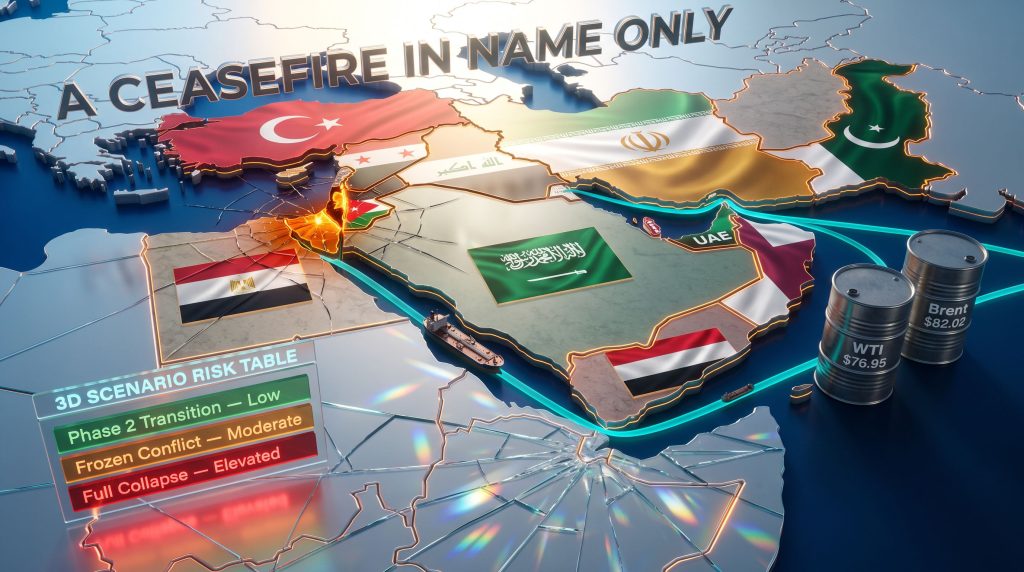
| Scenario | Probability Assessment | Regional Stability Impact | Energy Market Impact |
|---|---|---|---|
| Phase 2 Transition | Low | Stabilising | Neutral to positive |
| Frozen Conflict | Moderate | Neutral to negative | Moderate risk premium |
| Full Collapse | Elevated | Highly destabilising | Significant upside price pressure |
The next major ASX story will hit our subscribers first
Energy Market Exposure: The Hormuz and Red Sea Dimensions
The Gaza conflict's intersection with global energy markets operates through two primary chokepoints. The Strait of Hormuz carries approximately 20% of global daily oil supply, making it the single most consequential maritime passage in the world energy system. Any escalation pathway that draws Iran directly into the conflict raises the probability of Hormuz disruption exponentially. The broader relationship between oil prices and geopolitics in the current environment makes this exposure particularly significant for investors and analysts alike.
WTI crude is currently trading at approximately $76.95 per barrel and Brent at approximately $82.02 per barrel. These benchmarks already reflect a geopolitical risk premium tied to Middle East instability, but the current pricing does not fully embed a Hormuz disruption scenario. Historical analysis of previous Middle East escalation cycles suggests that a credible Hormuz closure threat can move Brent benchmarks by $15 to $25 per barrel within days.
The Red Sea dimension is already actively affecting markets. Houthi activity has disrupted shipping lanes, raised freight costs, and pushed insurance premiums to multi-year highs. Indian refiners have been pivoting toward West African crude grades, particularly Nigerian grades, as a Hormuz hedge. India's HPCL has been actively purchasing Nigerian crude to reduce exposure to Persian Gulf supply disruption risk, a shift that reflects a fundamental reordering of crude procurement strategy driven directly by the regional instability the Gaza conflict has amplified.
The Iraq-Turkey Kirkuk-Ceyhan pipeline adds another dimension. Iraq and Turkey have signed an agreement to move up to 750,000 barrels per day through the Kirkuk-Ceyhan pipeline, replacing an expired decades-old bilateral arrangement. The pipeline currently carries approximately 170,000 barrels per day, well below its 1.5 million bpd design capacity, largely from Kurdistan region fields. Iraq's Gulf export revenues collapsed after Hormuz disruption earlier this year, falling from approximately $6 billion per month to under $2 billion at the worst point. Reviving the northern pipeline route as a permanent alternative represents a structural hedge against Gulf export vulnerability that the Gaza conflict's continued escalation risk makes strategically urgent.
Saudi Arabia's Compounding Strategic Position
Saudi Arabia faces a particularly complex set of competing pressures. OPEC's market influence requires coordination with Russia and other partners within the broader OPEC+ framework. Geopolitical pressure from the joint condemnation aligns Riyadh publicly against Israeli conduct while Saudi Arabia continues to manage its own energy security calculus. How Riyadh balances these pressures, especially if Hormuz risk intensifies, will be a key variable in crude price dynamics through the second half of the year.
Humanitarian Aid as a Ceasefire Compliance Metric
One of the less-discussed dimensions of the Gaza ceasefire breakdown is the role of humanitarian aid delivery as a structural compliance indicator. The agreement included specific thresholds for aid volume that were intended to function as measurable benchmarks of good faith. Reported delivery volumes have remained below treaty-mandated levels throughout the ceasefire's operation.
Control of the Rafah crossing is not merely a humanitarian issue. It is a core compliance variable that directly affects whether Phase 1 can be declared functionally operational. The joint condemnation issued by the eight-nation coalition specifically cited attacks on healthcare facilities and civilian infrastructure, framing humanitarian access failures not as collateral outcomes but as deliberate violations of the agreement's terms. The geopolitical risk landscape across the region has consequently deteriorated, affecting sectors well beyond the immediate conflict zone.
FAQ: Key Questions About the Gaza Ceasefire Breakdown
Is the Gaza Ceasefire Still Technically in Effect?
Neither party has formally declared the agreement void, but mutual accusations of violations and continued hostilities have rendered its functional status deeply contested. It exists on paper while failing in practice.
What Are the Main Sticking Points Preventing Phase 2?
The two primary obstacles are Hamas's refusal to disarm without prior security guarantees and Israel's refusal to complete its Phase 1 withdrawal until disarmament occurs. Each condition makes the other impossible to satisfy first, creating a structural deadlock.
How Many Countries Have Formally Condemned Israel's Conduct?
Eight nations, specifically Saudi Arabia, the UAE, Qatar, Egypt, Jordan, Turkey, Pakistan, and Indonesia, issued a joint condemnation citing attacks on civilians, healthcare facilities, and civilian infrastructure. Brookings has analysed what such agreement frameworks mean in practical terms for the parties involved.
What Role Does Hezbollah Play in the Broader Regional Picture?
Hezbollah's offer to engage with Syria for the first time introduces a diplomatic layer that complicates U.S. efforts to use Damascus as leverage against the group, potentially expanding the conflict's regional diplomatic footprint even if it reduces the immediate risk of military escalation.
How Does the Gaza Conflict Affect Global Oil Prices?
Escalation risk raises the geopolitical risk premium embedded in crude benchmarks, particularly when it increases the probability of drawing Iran into the conflict and threatening Strait of Hormuz transit flows. The trade war impact on oil compounds these pressures, as does the market volatility from tariffs that has already introduced additional uncertainty into energy pricing models.
What the Breakdown Reveals About the Limits of U.S.-Mediated Frameworks
The Gaza ceasefire unravels as a story not primarily about the personalities involved in the negotiations. It is, however, a story about the structural limitations of phased agreement frameworks in asymmetric conflicts between parties with fundamentally incompatible political objectives.
The enforcement gap is the critical variable. U.S.-mediated agreements carry significant convening authority and diplomatic weight, but they lack the binding compliance architecture that would allow either party to be held accountable for violations in a way that creates meaningful consequences. The Oslo process failed for comparable reasons. The Minsk Agreements collapsed under similar structural pressures. The Doha Taliban deal demonstrated that phased frameworks dependent on sequential trust-building can be gamed by parties with no intention of fulfilling later-stage obligations.
A durable resolution to the Gaza ceasefire unravels scenario would require the simultaneous presence of multiple preconditions that do not currently exist:
- Israeli domestic coalition realignment enabling genuine withdrawal commitments
- Hamas internal governance capable of delivering a credible disarmament offer
- Arab state security guarantees with substantive enforcement capacity
- Saudi normalisation leverage sufficient to create credible incentives for Israeli compliance
- A UN Security Council resolution establishing multilateral monitoring infrastructure
- A third-party military or civilian monitoring force with genuine compliance authority
None of these preconditions currently exist in aligned form. The frozen conflict scenario, characterised by persistent low-intensity confrontation without resolution, remains the most probable near-term trajectory. Full ceasefire collapse carries an elevated probability that the current diplomatic environment has not substantially reduced.
The Gaza ceasefire has not been formally terminated. But a ceasefire that exists only as a legal instrument while failing as an operational reality is not a ceasefire. It is a documented record of the conditions under which the next escalation will occur.
Disclaimer: This article contains forward-looking scenario analysis, geopolitical assessments, and energy market projections. These represent analytical frameworks based on available information and should not be construed as investment advice or predictions of specific outcomes. Energy market figures cited reflect pricing data at the time of writing and are subject to change. Readers should consult independent financial and geopolitical advisors before making decisions based on any analysis contained herein.
Want to Track the Commodity and Energy Market Impacts of Geopolitical Flashpoints in Real Time?
As escalation risks in the Middle East continue to reshape crude benchmarks, freight costs, and regional supply chains, Discovery Alert's proprietary Discovery IQ model delivers real-time alerts on significant ASX mineral and energy-related discoveries, turning complex market signals into actionable investment insights — explore historic examples of major discovery returns and begin your 14-day free trial to position yourself ahead of the market.