
August 7, 2026
The Invisible Chokepoint Reshaping European Secondary Metals Markets
Bulk commodity logistics rarely commands headlines the way spot prices do. Traders watch price screens, mills track scrap generation statistics, and recyclers monitor collection volumes. Yet some of the most disruptive forces in secondary metals markets arrive not from demand shifts or supply squeezes, but from the physical infrastructure that moves material between one point and another. When that infrastructure fails, no amount of available scrap in a yard can resolve a shortage at a consuming plant.
That is precisely the situation unfolding across European scrap markets right now. Rhine low water scrap transport Europe has become the dominant operational variable shaping delivered costs, price dynamics, and forward supply outlooks for both ferrous and non-ferrous recycled metals in summer 2026. Furthermore, the conditions driving this disruption carry implications that reach well beyond a single season.
When big ASX news breaks, our subscribers know first
The Rhine as Europe's Scrap Superhighway
To understand the scale of the current disruption, it helps to appreciate how deeply European secondary metals markets depend on inland waterway transport. The Rhine river system functions as the primary bulk freight artery connecting scrap collection networks across Germany, Switzerland, and Austria with the steelmaking and secondary aluminium remelting facilities concentrated in the Ruhr, the Netherlands, and Belgium.
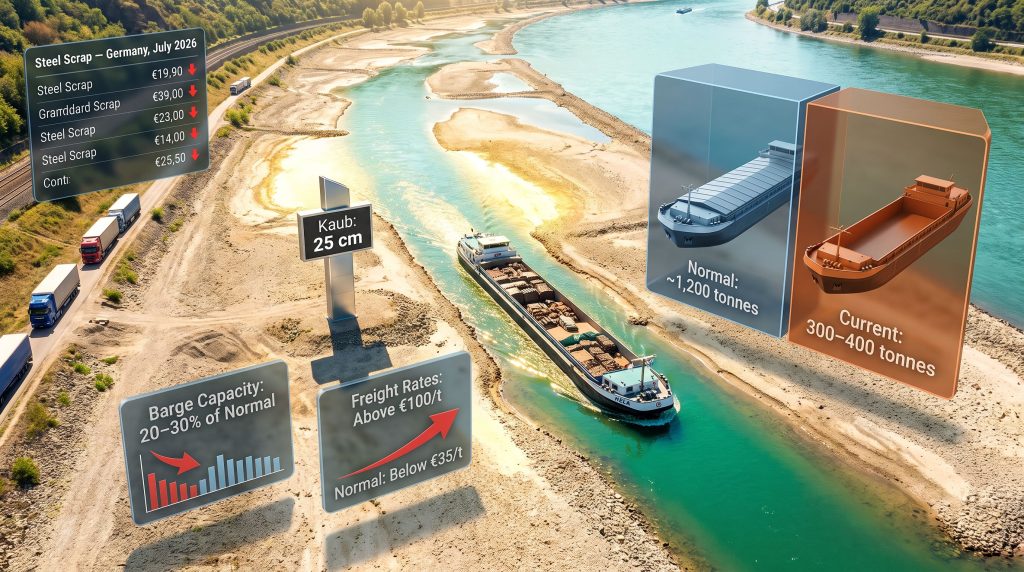
Unlike road or rail, barge transport offers the lowest cost-per-tonne movement for heavy bulk commodities. A single Rhine barge under normal operating conditions carries approximately 1,200 tonnes of cargo. To replicate that capacity by road requires roughly 80 truckloads. When the river works, the economics are compelling. When it does not, the substitution problem becomes almost mathematically intractable.
The Kaub gauge on the Middle Rhine is the commercial reference point that barge operators across the entire river system watch most closely. Water levels at Kaub have declined to approximately 25 centimetres, approaching the historic lows recorded during the 2018 drought event. Industry data indicates that every centimetre drop at the Kaub gauge removes approximately 30 to 40 tonnes of cargo capacity per vessel, meaning the current level translates to vessels operating at just 20 to 30 percent of their standard carrying capacity on the worst-affected stretches.
Freight Rate Escalation: The Numbers Behind the Squeeze
The financial consequences of this capacity compression are severe and are being felt across the entire supply chain.
| Metric | Normal Conditions | Current Low-Water Conditions |
|---|---|---|
| Barge carrying capacity | ~1,200 tonnes per vessel | 300–400 tonnes per vessel |
| Spot freight rates (Rhine) | Below €35/t (estimated) | Above €100/t (~$115/t) reported |
| Rate increase range | Baseline | +40% to +300% depending on route |
| Road substitution equivalent | 1 barge | ~80 truckloads |
Freight rates on the most severely affected Rhine routes have more than tripled since late June 2026, according to market reporting from Fastmarkets. Spot rates on some movements are now reported above €100 per tonne as operators spread cargo across multiple partially laden barges to maintain trade flows at all. The underlying mathematics are brutal: fixed vessel operating costs do not fall when cargo loads shrink by 70 to 80 percent, so those costs are simply redistributed across whatever tonnage is being carried.
Why Substitution Remains Commercially Unworkable
The practical inability to replace barge capacity with road or rail at meaningful scale is one of the least-understood aspects of this crisis for observers outside the logistics sector. These commodity price impacts ripple across the entire supply chain in ways that are difficult to hedge:
-
Rail network saturation: Ongoing infrastructure maintenance works across the German and broader European rail network have substantially reduced available capacity for emergency bulk commodity rerouting, leaving little headroom to absorb displaced barge freight.
-
Road transport arithmetic: Replacing a single full barge cargo with truck movements requires approximately 80 vehicles. Even setting aside cost considerations, coordinating that volume of truck movements at short notice and at scale is logistically implausible for most yard operators.
-
Driver availability: Structural labour shortages in European road haulage compound the problem. The industry has faced persistent driver deficits for years, meaning the surge capacity that would theoretically be needed simply does not exist in practice.
-
Cost differential: Even under normal river conditions, road freight is structurally more expensive per tonne than barge transport for bulk scrap movements. With surcharges already compressing margins at every point in the supply chain, absorbing additional road freight premiums is commercially unviable for most operators.
"The inability to substitute barge capacity at scale means Rhine low water conditions function as a hard ceiling on physical scrap throughput, regardless of how much material exists in collection yards."
Scrap Price Movements: A Market Pulled in Two Directions
The current market is exhibiting a structural anomaly. Under conventional conditions, weak summer demand would compress both scrap prices and freight costs simultaneously, leaving delivered economics broadly stable. However, what is occurring instead is a divergence: scrap commodity values are softening due to seasonal mill maintenance shutdowns, while delivered costs are rising because freight surcharges are outpacing the price decline. Base metal price delays are further complicating traders' ability to respond dynamically to these shifting conditions.
Steel Scrap: Modest Price Declines Masked by Logistics Inflation
Fastmarkets assessed steel scrap E40 shredded domestic, delivered consumer Germany at €320–335 per tonne in July 2026, down €10–20 per tonne from June's assessment of €330–355 per tonne. Steel scrap E8 thin new production steel domestic, delivered consumer Germany was assessed at €330–340 per tonne at the end of July, compared with €330–355 per tonne the prior month.
| Grade | June Assessment (€/t) | July Assessment (€/t) | Month-on-Month Change |
|---|---|---|---|
| E40 Shredded, delivered consumer Germany | €330–355 | €320–335 | -€10 to -€20/t |
| E8 Thin New Production Steel, delivered consumer Germany | €330–355 | €330–340 | Flat to -€15/t |
These declines appear modest in isolation. Placed against freight surcharges exceeding €100 per tonne on certain Rhine routes, however, the delivered economics facing consuming plants look considerably more difficult than the headline scrap price movements suggest. Consequently, broader green steel pricing trends are also being reshaped as mills reassess their cost structures for the remainder of the year.
Aluminium Scrap: Secondary Remelters Under Compound Margin Pressure
Secondary aluminium markets are experiencing a compounded squeeze. Falling assessed values reduce revenue per tonne processed, while simultaneously rising inbound freight costs inflate delivered input costs. Fastmarkets' assessments for July 2026 reflect this pressure:
| Grade | Prior Assessment (€/t) | Latest Assessment (€/t) | Change |
|---|---|---|---|
| Floated Frag, delivered consumer Europe | €2,150–2,350 | €2,150–2,250 | Upper end -€100/t |
| Mixed Turnings, delivered consumer Europe | €1,840–2,050 | €1,800–2,000 | -€40 to -€50/t |
| Cast Scrap, delivered consumer Europe | €2,050–2,250 | €2,050–2,200 | Upper end -€50/t |
The operational consequence of this margin compression is significant. When inland freight surcharges exceed €100 per tonne on Rhine routes, the economic advantage that secondary scrap holds over primary aluminium ingot narrows substantially. Secondary remelters derive their commercial rationale from being able to produce finished aluminium at a lower input cost than primary smelters. In addition, the aluminium market structure across Europe is coming under fresh scrutiny as sustained logistics inflation threatens that rationale at its foundation.
One German secondary aluminium remelter noted it was absorbing higher freight costs to maintain production continuity, but acknowledged that prolonged disruption could eventually require operating rate adjustments, according to Fastmarkets' market reporting.
The Widening Gap Between Scrap Values and Delivered Costs
Perhaps the most consequential dynamic emerging from this situation is the structural disconnect forming between underlying scrap commodity values and all-in delivered costs at consuming plants. This wedge has important implications for how recyclers, traders, and mills need to think about market positioning.
Scrap yard operators in Germany are reporting weakening inbound material flows as collection and transport scheduling becomes increasingly unstable under volatile water level conditions. Some operators have indicated a willingness to restrict inbound scrap acceptance if barge capacity does not recover, effectively creating artificial supply constraints at the yard level that have nothing to do with the actual availability of recyclable material in the economy.
Sellers are becoming reluctant to commit material to forward shipment contracts while water levels remain unpredictable, reducing forward trading activity and increasing spot market volatility. This behavioural shift is itself a market-shaping force, independent of any physical scrap shortage.
Geographic Scope: Where the Pressure Is Concentrated
| Country | Primary Exposure | Key Vulnerability |
|---|---|---|
| Germany | Largest Rhine scrap origination market; EAF mills dependent on barge delivery | Scrapyard inbound flows weakening; outbound logistics constrained |
| Netherlands | Major scrap hub and steel production centre; Rotterdam-Rhine corridor critical | Both import and export flows disrupted |
| Belgium | Steelmakers reliant on Rhine-connected waterway supply | Delivered scrap costs rising; alternative routing limited |
| Switzerland | Upper Rhine scrap origination; exports to German consumers restricted | Outbound movement severely curtailed at low water |
Critically, the disruption extends beyond the Rhine. The Danube has also experienced reduced navigation capacity, extending logistics pressure into Central and Eastern European scrap markets. Italy's Po basin has similarly seen constrained inland transport capacity, adding pressure to secondary aluminium supply chains serving northern Italian remelters. The concurrent failure across multiple European river systems points to a systemic climate-driven logistics vulnerability rather than a localised Rhine-specific event.
The next major ASX story will hit our subscribers first
September: The Real Test Is Still Ahead
The summer slowdown has, in some respects, masked the full potential severity of this disruption. Mill maintenance shutdowns have suppressed buying activity, which means that constrained barge supply has not yet been tested against full operating-rate demand.
That test arrives in September, when steel mills and secondary aluminium remelters typically return from August shutdowns and initiate fresh procurement cycles. If Rhine water levels remain near current lows through the August-to-September transition, the combination of recovering mill demand and constrained transport capacity could create a supply delivery crunch that no amount of yard inventory can resolve without the physical means to move material.
The critical insight from market participants is that the September risk is logistical, not generational. Scrap exists in European yards in broadly adequate quantities. The constraint is the infrastructure available to deliver it. As one European scrap consumer warned in market reporting from Fastmarkets, the situation by September could be characterised not by recyclers lacking material, but by consumers being unable to receive it because it cannot be physically moved to them.
Two scenarios for the post-summer period:
Scenario A: Water levels recover. Freight surcharges normalise, delivered scrap costs decline, mill restocking proceeds at expected pace, and the logistics premium fades from market dynamics.
Scenario B: Water levels remain depressed. Freight surcharges become embedded in delivered scrap economics through Q4. Inland consuming plants face genuine availability constraints despite material sitting in yards. Secondary aluminium remelters risk being forced to reduce operating rates or substitute primary metal, decoupling scrap price dynamics from underlying demand fundamentals. The global crude steel outlook for the remainder of 2026 will hinge in part on how quickly this bottleneck resolves.
Climate Risk as a Recurring Supply Chain Variable
The 2018 Rhine low-water event established a precedent for severe industrial disruption. The recurrence of comparable conditions in 2026 raises a critical question about how secondary metals supply chains should treat Rhine low water scrap transport Europe as a recurring risk going forward.
Low-water events on major European rivers were historically categorised as rare tail risks. However, the increasing frequency of comparable disruption episodes suggests that category may need to be revised. Unlike commodity price risk, which can be partially managed through forward contracts and pricing mechanisms, logistics capacity risk from extreme weather events resists conventional hedging tools. The European Inland Navigation Union has highlighted this structural vulnerability in its guidance to industry stakeholders.
Strategic Responses for Scrap Market Participants
For recyclers, traders, and consuming plants navigating this environment, several strategic adjustments warrant consideration:
-
Inventory pre-positioning: Building scrap stockpiles ahead of summer drought periods gives inland consuming plants a buffer against barge capacity collapse that just-in-time delivery models cannot provide.
-
Modal diversification investment: The economic case for rail-accessible scrap handling infrastructure strengthens materially once the full cost of barge disruption episodes is incorporated into long-term capital planning.
-
Freight risk allocation in contracts: Delivered pricing structures that do not explicitly address low-water surcharge risk leave both buyers and sellers exposed to unhedged logistics cost volatility that can be sudden and severe.
-
Geographic sourcing diversification: Heavy dependence on Rhine-corridor scrap supply creates concentration risk that can be partially mitigated by developing alternative sourcing relationships with suppliers accessible by road or rail.
"The 2026 Rhine disruption may ultimately prove most valuable not for what it costs in the short term, but for what it reveals about structural vulnerabilities in European scrap supply chain design that have been hidden by years of adequate water levels."
Frequently Asked Questions
What causes Rhine water levels to fall so severely?
Low Rhine water levels result primarily from reduced precipitation across the Alpine catchment combined with elevated summer temperatures that accelerate evaporation and diminish snowmelt contributions to river flows. The Rhine's commercial navigation corridor is particularly sensitive to these conditions because the river narrows significantly at key points such as Kaub, amplifying the navigational impact of even modest water level declines.
How does low water at Kaub translate into freight costs?
Each centimetre of water level decline at the Kaub gauge removes approximately 30 to 40 tonnes of cargo capacity per vessel. With levels near 25 centimetres, operators are loading only 300 to 400 tonnes onto vessels designed to carry 1,200 tonnes. Fixed vessel operating costs must then be recovered from the reduced cargo, driving per-tonne freight rates sharply higher and generating the low-water surcharges that are now flowing through the supply chain.
Which scrap grades face the greatest freight cost impact?
All bulk grades transported by barge are affected, but the impact is most acute for high-volume, lower-value ferrous grades where freight costs represent a proportionally larger share of total delivered value. For aluminium scrap grades, the issue compounds because secondary remelters operate on margins that depend on the cost differential between scrap inputs and primary metal alternatives.
How should buyers and sellers position ahead of September?
Market participants with storage capacity should consider accelerating procurement before mill restarts intensify competition for limited barge slots. Sellers holding material should evaluate the risk of committing to delivery schedules that may prove difficult to honour if water levels do not recover. Contractual freight risk allocation deserves explicit attention in any forward supply agreement executed during this period.
This article draws on market pricing data and industry reporting published by Fastmarkets. Price assessments and market commentary reflect conditions as of late July and early August 2026. Forward-looking scenarios involve uncertainty and should not be treated as forecasts or investment advice. Readers should conduct independent analysis before making commercial decisions based on market outlook information.
Want to Know Which ASX Resources Companies Are Positioned to Benefit From Commodity Supply Disruptions?
Discovery Alert's proprietary Discovery IQ model delivers real-time alerts the moment significant mineral discoveries are announced on the ASX, transforming complex market data into actionable investment insights for both short-term traders and long-term investors — explore Discovery Alert's discoveries page to see the historic returns major discoveries have generated, and begin your 14-day free trial to position yourself ahead of the broader market.