July 21, 2026
The Critical Energy Threshold: When Manufacturing Economics Meet Resource Abundance
Industrial metals production operates within narrow energy cost parameters that determine global competitiveness. When electricity expenses exceed 40-60% of total manufacturing costs, as occurs in ferroalloy smelting, even minor tariff variations create decisive competitive advantages or fatal disadvantages. This electricity tariff relief for manganese ferroalloys becomes particularly acute for countries like South Africa, where abundant mineral reserves exist alongside prohibitive electricity pricing structures that threaten to eliminate domestic beneficiation capacity entirely.
The manganese ferroalloy sector exemplifies this strategic dilemma. South Africa controls approximately 80% of global manganese reserves, yet domestic smelting operations face potential closure due to electricity costs that exceed international benchmarks by 200-400%. This creates an industrial policy paradox where nations rich in raw materials may find themselves unable to capture value-added manufacturing benefits due to energy infrastructure constraints.
When big ASX news breaks, our subscribers know first
Energy Cost Differentials Reshape Global Production Networks
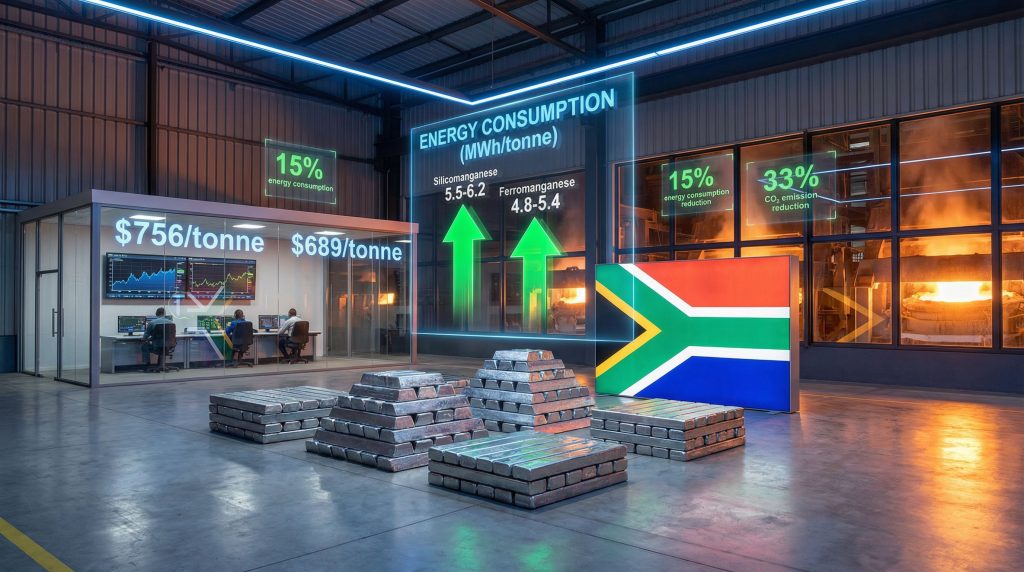
Electricity tariff disparities create fundamental shifts in global ferroalloy manufacturing patterns. South African manganese producers currently face electricity costs ranging from $634 per tonne for ferrochrome to $756 per tonne for silicomanganese, compared to global benchmarks of $147-420 per tonne across ferroalloy categories.
Energy Consumption Requirements by Ferroalloy Type:
- Ferrochrome production: 4.2-4.8 MWh per tonne
- Ferromanganese smelting: 4.8-5.4 MWh per tonne
- Silicomanganese processing: 5.5-6.2 MWh per tonne
These consumption levels reflect the electrochemical nature of ferroalloy production, where electric arc furnaces operate continuously at temperatures exceeding 1,600°C. The process cannot be interrupted without significant equipment damage, creating inflexible energy demand patterns that expose producers to sustained high-cost electricity exposure. Furthermore, the tariff impact on markets has intensified pressure on global manufacturing networks.
Technology Integration Challenges
Advanced preheating technologies developed through European research initiatives demonstrate potential energy consumption reductions of 15% through ore preheating to 800-900°C temperatures. These systems utilise industrial off-gas and thermal solar integration to reduce primary smelting energy requirements while achieving 33% CO2 emission reductions.
Implementation requires capital investments of $15-25 million per facility with payback periods of 4-7 years under current energy pricing structures. However, the technology offers retrofittable solutions that maintain production continuity during installation, reducing operational risk for existing smelting operations. Moreover, these improvements contribute to broader decarbonisation benefits across the mining sector.
Regulatory Framework Inconsistencies Create Sectoral Disparities
Recent policy developments reveal systematic inconsistencies in electricity tariff relief for manganese ferroalloys allocation across ferroalloy subsectors. Ferrochrome producers have received interim tariff reductions to 87 cents per kWh, with target rates of 62 cents per kWh under discussion for long-term viability frameworks.
This relief structure includes exemptions from "take-or-pay" obligations that typically require 70% of contracted electricity consumption regardless of market conditions. Such flexibility acknowledges the cyclical nature of commodity production where maintaining contracted consumption becomes economically unfeasible during demand downturns. Additionally, the energy security challenges facing many nations have highlighted the importance of domestic processing capabilities.
Policy Gap Analysis
Despite silicomanganese smelting requiring 30% higher energy consumption than ferrochrome production, manganese producers have not received equivalent tariff relief consideration. This disparity suggests policy frameworks operate on sector-specific rather than energy-intensity-normalised criteria.
Key differentiation factors include:
- Market concentration differences between ferrochrome and manganese producer groups
- Historical export value perceptions favouring stainless steel production chains
- Employment impact distribution across different regional constituencies
- Political engagement capacity variations between industry associations
The regulatory inconsistency creates competitive distortions within the broader ferroalloy sector. Consequently, this potentially forces closure of facilities with higher energy intensity while preserving operations with relatively lower consumption profiles.
Economic Multiplier Effects Extend Beyond Direct Operations
Ferroalloy plant closures generate cascading economic impacts extending far beyond direct employment. A typical manganese smelting facility employing 600 direct workers supports approximately 7,000 total livelihoods through supply chain integration and regional economic dependencies.
Economic Impact Assessment Framework:
| Impact Category | Direct Effects | Multiplier Effects | Total Economic Value |
|---|---|---|---|
| Employment Impact | 600 positions | 6,400 dependent roles | 7,000 livelihoods at risk |
| Regional GDP | R2.1 billion annual | R8.3 billion supply chain | R10.4 billion total contribution |
| Export Generation | $180 million direct | $320 million downstream | $500 million annual revenue |
Irreversible Capacity Loss Dynamics
Plant closures represent irreversible beneficiation capacity elimination rather than temporary production suspension. Manganese smelting infrastructure requires continuous maintenance and specialised operational knowledge that deteriorates rapidly during shutdown periods. Reports indicate that the last remaining manganese smelter in South Africa is warning of 600 jobs at risk as the budget looms without power tariff relief.
Critical factors in capacity loss include:
- Electric furnace refractory deterioration during extended shutdowns
- Specialised workforce migration to alternative employment sectors
- Supply chain partner reallocation to international competitors
- Market share capture by global competitors during production gaps
Once lost, rebuilding manganese beneficiation capacity requires R5 billion capital asset replacement plus 2-3 years recommissioning timelines, making closure effectively permanent under most scenarios.
International Strategic Resource Competition Intensifies
Global ferroalloy supply chain regionalisation accelerates as nations prioritise domestic processing capacity for strategic minerals. The United States Department of Energy has allocated $166 million toward domestic battery-grade manganese production, signalling recognition of supply chain vulnerability risks. In addition, the tariff economic implications are reshaping international trade relationships.
Meanwhile, European Union safeguard measures implemented in November 2025 establish tariff-rate quotas on ferroalloy imports, reshaping global trade flows and creating preferential access conditions for domestic and allied producers. The iron ore tariff effects demonstrate how trade policy changes ripple through interconnected commodity markets.
Competitive Positioning Shifts
International competitive dynamics reveal:
- China maintains integrated energy-mining operations providing sustained cost leadership
- Norway leverages hydroelectric advantages for premium alloy production targeting European markets
- Australia focuses on high-grade concentrate exports rather than energy-intensive smelting operations
- South Africa risks conversion from value-added ferroalloy exports to raw material dependency
These positioning shifts reflect rational responses to energy cost structures and regulatory environments. Countries with energy advantages concentrate smelting capacity while resource-rich nations with energy disadvantages retreat toward raw material export models.
Advanced Manufacturing Technologies Offer Efficiency Pathways
Emerging ferroalloy production technologies address energy consumption challenges through integrated process optimisation and alternative energy source utilisation. European research initiatives demonstrate commercial viability for retrofit applications that maintain existing operational frameworks.
Thermal Integration Systems
Process optimisation technologies include:
- Industrial off-gas capture systems utilising CO and CO2 waste streams for ore preheating
- Solar thermal integration providing supplementary heat input during daylight operations
- Waste heat recovery mechanisms capturing sensible heat from furnace operations
- Alternative reducing agent integration reducing carbon dependency and associated energy requirements
These systems achieve measurable performance improvements while maintaining compatibility with existing smelting infrastructure. Energy consumption reductions of 15% provide meaningful cost relief under current tariff structures while supporting environmental compliance objectives.
Investment Economics Assessment
Technology upgrade investments demonstrate attractive returns under energy cost scenarios exceeding current South African levels. Capital requirements of $15-25 million per facility generate payback periods of 4-7 years through electricity cost savings alone, excluding potential carbon credit monetisation and operational efficiency improvements.
However, investment attractiveness depends critically on regulatory certainty regarding long-term electricity tariff relief for manganese ferroalloys structures. Without confidence in sustained energy cost relief, technology upgrade investments face uncertain return profiles that discourage capital allocation.
The next major ASX story will hit our subscribers first
Policy Framework Integration Requirements
Effective electricity tariff relief requires coordination across multiple policy domains to ensure sustainable competitive positioning. Isolated tariff adjustments without broader industrial policy alignment create temporary relief rather than structural competitiveness restoration.
Integrated Policy Approach
Essential coordination elements include:
- Energy-intensive industry tariff schedules linked to export performance metrics
- Tax revenue protection through maintained production volume incentives
- Investment climate preservation supporting future capacity expansion
- Environmental compliance integration promoting efficiency improvements
Regulatory harmonisation requirements:
- Uniform energy-intensity criteria application across ferroalloy subsectors
- Flexible take-or-pay obligations accommodating commodity cycle volatility
- Performance-based tariff adjustment mechanisms rewarding efficiency investments
- Long-term contract frameworks providing investment planning certainty
This integrated approach transforms electricity pricing from cost subsidy toward strategic industrial investment supporting broader economic development objectives. Furthermore, temporary tariff relief measures for ferrochrome producers demonstrate that targeted interventions can provide immediate relief while longer-term frameworks are developed.
Investment Risk Assessment Framework
Ferroalloy sector investment attractiveness depends on policy certainty rather than temporary relief measures. Long-term competitive advantage requires structural energy cost solutions aligned with international benchmarks and transparent regulatory frameworks.
Primary risk factors include:
| Risk Category | Probability Level | Impact Severity | Mitigation Strategies |
|---|---|---|---|
| Energy Cost Escalation | High | Severe | Policy advocacy, efficiency investments |
| Regulatory Framework Changes | Medium | Moderate | Stakeholder engagement, compliance preparation |
| Global Demand Pattern Shifts | Low | High | Product diversification, contract hedging |
Long-term Viability Indicators
Investment decision factors prioritise:
- Policy framework predictability over temporary tariff concessions
- Technology upgrade incentive availability supporting efficiency improvements
- Market access certainty through trade agreement stability
- Regulatory compliance cost predictability enabling accurate financial modelling
Sustainable investment attraction requires demonstration that energy cost relief represents structural competitive advantage restoration rather than temporary market intervention subject to reversal.
Implementation Timeline and Stakeholder Expectations
Policy resolution timelines significantly influence industry planning and investment allocation decisions. Extended uncertainty periods encourage capacity relocation to jurisdictions with established competitive frameworks rather than awaiting domestic policy clarification.
Near-term Implementation Pathway (2026-2027)
Critical policy milestones include:
- Budget announcement outcomes determining manganese sector inclusion in relief frameworks
- Energy-intensity criteria standardisation across ferroalloy subsectors
- Industry consultation processes establishing long-term tariff adjustment mechanisms
- Technology upgrade incentive programme design and implementation
Medium-term Framework Development (2027-2029)
Structural reform priorities encompass:
- Regional energy market integration enabling competitive electricity procurement
- Export performance-linked tariff structures rewarding beneficiation activities
- Carbon pricing integration providing efficiency investment incentives
- Strategic resource processing policy alignment across mineral sectors
Long-term Competitive Positioning (2029-2032)
Sustainable competitiveness requires:
- Full energy market liberalisation providing industrial user choice options
- Technology innovation support maintaining global manufacturing competitiveness
- Trade policy integration supporting value-added export promotion
- Investment climate certainty enabling major capacity expansion decisions
Strategic Considerations for Industry Stakeholders
The electricity tariff relief for manganese ferroalloys question extends beyond immediate cost considerations toward fundamental questions of industrial policy priority and long-term competitive positioning. South Africa's strategic resource endowment creates unique opportunities for value-added manufacturing that risk permanent loss through inadequate energy policy frameworks.
Critical evaluation factors include:
- Whether energy cost relief represents strategic industrial investment or market intervention
- How policy frameworks balance immediate fiscal constraints with long-term economic development
- What mechanisms ensure sustainable competitive advantage rather than temporary reprieve
- How regulatory certainty influences private sector investment confidence and capacity expansion
The resolution of these questions will determine whether South Africa maintains its position as a global ferroalloy producer or transitions toward raw material export dependency. This will fundamentally alter the nation's position in global mineral value chains.
Disclaimer: This analysis includes forward-looking assessments of policy outcomes and market dynamics. Actual results may vary significantly from projections due to regulatory changes, global economic conditions, and technological developments. Investment decisions should incorporate comprehensive due diligence and professional consultation.
Ready to Capitalise on Strategic Resource Policy Shifts?
Discovery Alert's proprietary Discovery IQ model delivers real-time alerts on significant ASX mineral discoveries, instantly empowering subscribers to identify actionable opportunities ahead of the broader market. Begin your 14-day free trial today and secure your market-leading advantage in the evolving commodities landscape.