
June 13, 2026
Critical Infrastructure Dependencies Reshaping Industrial Supply Networks
Maritime chokepoints represent fundamental vulnerabilities in global commodity flows, with specialised cargo streams particularly susceptible to transit disruptions. The concentration of industrial sulphur production within hydrocarbon-processing regions creates structural dependencies that extend far beyond traditional energy security concerns. When sulphur vessel transits Strait of Hormuz face restrictions, the cascading effects ripple through fertiliser manufacturing, metal processing, and agricultural supply chains worldwide.
Understanding how industries adapt to such disruptions reveals the underlying fragility of just-in-time supply models and the premium placed on geographical diversification. Furthermore, the current situation demonstrates how geopolitical tensions can transform global trade patterns within weeks, forcing fundamental reassessments of sourcing strategies across multiple sectors.
When big ASX news breaks, our subscribers know first
Geographic Concentration and Transit Vulnerabilities in Global Sulphur Markets
Strategic Importance of Middle Eastern Production Infrastructure
The Middle East's dominance in sulphur production stems from the region's massive hydrocarbon processing infrastructure, where sulphur emerges as a byproduct of crude oil refining and natural gas sweetening operations. Major production facilities in the UAE's Ruwais complex, Saudi Arabia's Jubail industrial area, and Iran's Assaluyeh gas processing centre collectively represent critical nodes in the global sulphur supply network.
These facilities benefit from economies of scale and integrated logistics systems that have evolved over decades to handle granular sulphur exports efficiently. The specialised port infrastructure required for bulk sulphur handling includes covered storage areas, pneumatic loading systems, and dedicated berths capable of accommodating vessels ranging from 20,000 to 60,000-tonne capacity.
The 21-Mile Maritime Bottleneck
The Strait of Hormuz, measuring just 21 nautical miles at its narrowest point between Oman and Iran, serves as the primary transit route for sulphur exports from the Persian Gulf region. This geographical constraint creates an unavoidable dependency for sulphur importers across Asia, Africa, and Europe who rely on Middle Eastern production.
According to shipping intelligence data, the strait typically handles significant volumes of specialised chemical tankers and bulk carriers transporting granular sulphur to fertiliser manufacturing hubs in India, China, and East Africa. In addition, oil price dynamics significantly influence these shipping patterns, creating additional complexity for strategic planning.
Economic Significance of Transit Dependencies
The economic implications of Hormuz disruptions extend beyond immediate shipping costs. Sulphur pricing structures incorporate geographical risk premiums that reflect the vulnerability of concentrated production sources. However, US tariff pressures and broader trade war impact considerations are reshaping global commodity flows even further.
Route Comparison Analysis:
| Route Option | Additional Distance | Time Penalty | Cost Impact |
|---|---|---|---|
| Cape of Good Hope | 6,000+ nautical miles | 18-25 days | $45-65/tonne freight premium |
| Red Sea alternative | Variable | 5-8 days | $15-25/tonne premium |
| Trans-Pacific routing | 8,000+ nautical miles | 20-30 days | $50-75/tonne premium |
Consequently, war risk insurance coverage adds another layer of cost complexity, with premiums fluctuating based on regional security assessments and vessel operator risk tolerance.
Current Market Disruption and Vessel Positioning Analysis
Stranded Cargo Assessment
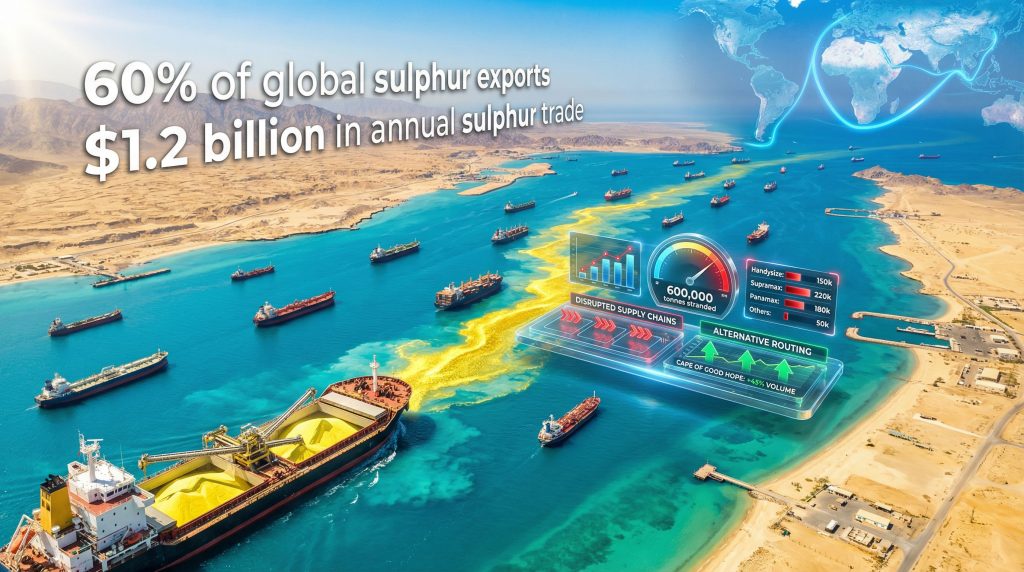
Recent maritime intelligence indicates approximately 600,000 tonnes of granular sulphur currently held aboard vessels in the Persian Gulf region, representing a significant portion of typical monthly export volumes. Furthermore, Argus Media reporting from April 2026 shows approximately 14 vessels with sulphur cargoes visible on Automatic Identification System tracking.
However, market sources suggest the actual number may reach 25 vessels when accounting for those operating with disabled transponders for security reasons. The MV Valsamitis, carrying 34,000 tonnes of granular sulphur loaded at the UAE's Ruwais port, represents one of the few vessels to successfully complete sulphur vessel transits Strait of Hormuz in recent weeks.
Strategic Anchorage and Operational Considerations
Vessel positioning at Fujairah anchorage demonstrates strategic decision-making by operators seeking to minimise operational costs whilst maintaining readiness for eventual transit opportunities. Fujairah's status as a major bunkering hub provides essential refuelling services, allowing stranded vessels to maintain operational capability without costly diversions to alternative ports.
Fleet Composition and Cargo Distribution:
- Handysize vessels (20-35kt capacity): Primarily serving East African and Southeast Asian fertiliser importers
- Supramax vessels (35-50kt capacity): Focused on major Asian markets including China and India
- Panamax vessels (50kt+ capacity): Targeting European fertiliser production facilities
The concentration of waiting vessels reflects market expectations regarding eventual resolution of transit restrictions, as operators calculate the costs of extended anchorage against alternative routing expenses.
Unverified Iranian Movements
Market reports suggest Iranian vessels may be utilising alternative routing strategies, with unconfirmed movements of 20,000-25,000 tonnes to East Africa and 50,000 tonnes toward China. However, these movements remain difficult to verify independently due to limited tracking visibility and security considerations affecting Iranian-flagged vessels.
Alternative Routing Strategies and Economic Viability
Cape of Good Hope Economic Modelling
The traditional alternative route around Africa's southern cape presents significant economic challenges for sulphur shipments. Break-even analysis suggests that delivered sulphur prices must exceed certain thresholds to justify the additional costs associated with extended transit times and increased fuel consumption.
Cost Components for Cape Routing:
- Additional voyage time: 18-25 days depending on vessel type and weather conditions
- Fuel consumption increase: Estimated $35,000-50,000 per voyage for typical sulphur carriers
- Insurance adjustments: War risk and extended voyage coverage
- Opportunity costs: Delayed cargo delivery and vessel utilisation impacts
Seasonal Weather Considerations
Southern Ocean transit conditions vary significantly throughout the year, with April through September traditionally presenting challenging weather patterns for commercial shipping. Nevertheless, modern vessels equipped with advanced weather routing systems can mitigate some seasonal risks through optimised voyage planning.
Regional Supply Substitution Patterns
The disruption has accelerated existing trends toward supply diversification, with non-Middle Eastern producers experiencing increased demand. Moreover, European supply strategies are evolving to address these vulnerabilities.
Alternative Supply Sources:
- Canadian sulphur exports: Western Canadian production from oil sands and natural gas processing
- Australian mining operations: Byproduct recovery from base metal smelting and coal processing
- European refinery output: Increased utilisation of existing sulphur recovery capacity
- Latin American sources: Chilean and Peruvian copper smelter production
Each alternative source presents distinct quality specifications, logistics requirements, and pricing structures that importing regions must evaluate against traditional Middle Eastern suppliers.
Fertiliser Industry Adaptation Strategies
Input Substitution Technologies
Fertiliser manufacturers are implementing various technological adaptations to address sulphur supply constraints. These innovations represent part of broader industry innovation trends transforming global supply chains.
Sulphuric Acid Production Alternatives:
- Pyrite Roasting Systems: Conversion of iron pyrite (FeS₂) to sulphur dioxide for acid production
- Spent Catalyst Recovery: Enhanced processing of petroleum refinery waste catalysts
- Elemental Recovery Enhancement: Optimisation of existing sulphur recovery units in refineries and gas plants
- Alternative Acidulation Processes: Utilisation of nitric acid blends for phosphate rock processing
Strategic Inventory Management Transformation
The crisis has prompted fundamental changes in fertiliser industry inventory practices. According to Reuters analysis, major fertiliser producers are implementing extended reserve policies.
"Major fertiliser producers are implementing extended reserve policies, moving from traditional 30-day sulphur stockpiles to 90-day strategic reserves, fundamentally altering working capital requirements and storage infrastructure needs."
Inventory Strategy Components:
- Geographic diversification: Distribution of stocks across multiple storage locations
- Quality grade flexibility: Acceptance of 98.5% purity sulphur versus traditional 99.5% specifications
- Seasonal timing adjustments: Front-loading production schedules to capture peak agricultural application windows
- Contract restructuring: Integration of force majeure clauses addressing critical shipping lane disruptions
Production Scheduling and Grade Flexibility
Manufacturers are demonstrating increased willingness to adjust product specifications and sourcing standards to maintain operational continuity. This includes acceptance of alternative sulphur grades and modified production scheduling to align with available feedstock supplies.
Long-Term Market Structure Evolution
Supply Chain Resilience Investment Priorities
The current disruption is accelerating long-term structural changes in global sulphur markets. Consequently, sulphur vessel transits Strait of Hormuz dependencies are driving strategic infrastructure development.
Infrastructure Development Initiatives:
| Investment Category | Planned Capacity | Timeline | Strategic Rationale |
|---|---|---|---|
| Alternative storage facilities | 890,000 tonnes | 2026-2028 | Geographic risk mitigation |
| Recovery technology upgrades | 450,000 tonnes/year | 2027-2029 | Input diversification |
| Transportation alternatives | Multiple projects | 2026-2030 | Route redundancy |
Risk Premium Integration in Pricing Models
Market participants are incorporating geopolitical risk assessments into long-term pricing structures, with volatility premiums becoming standard components of sulphur supply agreements. This represents a fundamental shift from traditional cost-plus pricing models toward risk-adjusted commodity pricing.
Emerging Contract Structures:
- Geographic diversification requirements: Minimum percentages from non-chokepoint dependent sources
- Alternative supply activation clauses: Pre-negotiated access to substitute sources during disruptions
- Dynamic pricing mechanisms: Real-time adjustments based on geopolitical risk indicators
- Force majeure expansions: Broader definitions encompassing critical infrastructure disruptions
Regional Production Capacity Development
The crisis is stimulating investment in sulphur production capacity outside traditional Middle Eastern sources:
Planned Capacity Expansions:
- North America: Enhanced oil sands and shale gas processing capacity
- Australia: Expanded base metal smelting and LNG processing operations
- Europe: Refinery optimisation and circular economy initiatives
- Africa: Copper mining sector sulphur recovery enhancement
These developments represent strategic responses to supply security concerns rather than purely economic optimisation.
The next major ASX story will hit our subscribers first
Industrial Sector Vulnerability Assessment
Fertiliser Manufacturing Impact Analysis
Phosphate fertiliser production faces the most immediate vulnerability due to direct sulphuric acid requirements for rock acidulation processes. Capacity utilisation reductions of 20-35% have been reported across affected regions, with manufacturers prioritising existing inventory allocation to maintain critical production lines.
Production Adjustment Strategies:
- NPK blend reformulation: Modified nutrient ratios to accommodate available feedstock
- Regional demand prioritisation: Focus on peak agricultural application timing
- Alternative feedstock integration: Increased utilisation of organic and recycled nutrient sources
- Seasonal production shifting: Front-loading manufacturing to capture spring application windows
Copper Mining and Smelting Dependencies
Copper smelting operations require substantial sulphuric acid volumes for leaching operations, particularly in Chilean and Peruvian mining operations. The acid shortage is forcing operational adjustments including:
- Ore grade optimisation: Processing higher-grade materials to maximise acid efficiency
- Leaching cycle modifications: Extended processing times to compensate for reduced acid availability
- Alternative extraction methods: Increased utilisation of flotation versus leaching processes
- Acid recycling enhancement: Improved recovery and reuse systems
Chemical Industry Supply Chain Disruptions
Downstream chemical production faces cascading effects from sulphuric acid shortages:
Affected Industries:
- TiO₂ production: Titanium dioxide manufacturing requiring substantial acid volumes
- Alumina refining: Bauxite processing utilising sulphuric acid in purification stages
- Steel processing: Pickling operations for surface treatment applications
- Battery manufacturing: Lithium processing and electrolyte production
Spot pricing for sulphuric acid has increased substantially in key Asian markets, creating arbitrage opportunities for producers with available capacity.
Emerging Trade Pattern Transformations
Alternative Corridor Development
The current crisis is accelerating development of alternative trade routes and partnerships. As a result, sulphur vessel transits Strait of Hormuz remain critical, but new pathways are emerging.
Strategic Route Development:
- Red Sea alternatives: Increased utilisation of Suez Canal routing for European markets
- Trans-Pacific expansion: Direct Middle East to West Coast shipping via Pacific routing
- Overland connectivity: Enhanced rail and pipeline discussions for Central Asian markets
- Southern corridor activation: Mediterranean and Black Sea routing development
Bilateral Supply Framework Evolution
Government-to-government agreements are becoming more prominent in securing critical material flows:
Partnership Structures:
- Strategic material agreements: Government-backed supply security arrangements
- Cross-industry collaboration: Direct mining-to-fertiliser manufacturer partnerships
- Technology sharing initiatives: Joint development of sulphur recovery optimisation
- Emergency allocation protocols: Crisis response mechanisms for critical supply maintenance
Market Integration and Arbitrage Opportunities
Price differentials between regions are creating significant arbitrage opportunities for traders with access to alternative supply sources or transportation networks. European acid producers are capturing premium margins by redirecting production to high-demand Asian markets.
Investment Opportunities in Supply Chain Disruption
Infrastructure Development Priorities
The crisis has highlighted critical infrastructure gaps that present investment opportunities:
High-Priority Developments:
- Specialised storage terminals: Enhanced capacity for granular sulphur storage across key ports
- Chemical tanker assets: Vessels capable of alternative routing and specialised cargo handling
- Processing facility upgrades: Enhanced sulphur recovery at existing refineries and smelters
- Digital logistics platforms: Real-time cargo tracking and alternative routing optimisation systems
Technology Innovation Acceleration
Supply chain vulnerabilities are driving increased investment in alternative production technologies:
Innovation Focus Areas:
- Waste stream recovery: Synthetic sulphur production from industrial waste processing
- Predictive analytics: Geopolitical risk assessment tools for commodity trading
- Alternative feedstock development: Non-traditional sulphur sources for industrial applications
- Process optimisation: Enhanced efficiency in existing sulphur recovery operations
Market Intelligence and Risk Management
The crisis has demonstrated the value of sophisticated supply chain monitoring and risk management systems. Investment in real-time market intelligence, alternative sourcing strategies, and flexible logistics networks represents crucial competitive advantages for industry participants.
Disclaimer: This analysis incorporates market data and industry reporting current as of April 2026. Commodity markets are subject to rapid changes based on geopolitical developments, weather conditions, and economic factors. Readers should consult current market data and professional advisors before making investment or operational decisions. Supply chain disruptions and alternative routing strategies involve complex risk factors that require careful evaluation specific to individual circumstances.
Looking to Capitalise on Supply Chain Disruptions in Commodity Markets?
Discovery Alert's proprietary Discovery IQ model delivers real-time alerts on significant ASX mineral discoveries, instantly empowering subscribers to identify actionable opportunities ahead of the broader market during times of supply chain volatility. Explore historic discoveries that have generated substantial returns and begin your 14-day free trial today to secure your market-leading advantage.