August 9, 2026
Understanding Critical Infrastructure in Contemporary Mineral Markets
European industrial sovereignty faces unprecedented challenges as global supply chains shift toward strategic resource consolidation. Within this evolving landscape, processing infrastructure emerges as the definitive bottleneck determining whether nations achieve genuine autonomy over critical materials or remain dependent on geographically concentrated production centers.
Romania's rare earth processing facility represents more than a single industrial project; it embodies a fundamental test of whether European policy frameworks can successfully diversify away from Asian-dominated supply chains while maintaining commercial viability. The intersection of state strategic planning and private sector execution creates unique governance dynamics that influence both operational success and geopolitical outcomes.
The mineral processing sector demonstrates how technical capabilities, regulatory environments, and ownership structures collectively determine whether strategic resource projects achieve their intended policy objectives. Furthermore, understanding these interconnected factors provides insight into the broader transformation of critical minerals energy security across Western industrial economies.
When big ASX news breaks, our subscribers know first
Evaluating Romania's Position Within Global Rare Earth Infrastructure
Romania's rare earth processing facility development leverages the country's existing nuclear sector expertise to address a critical gap in European mineral processing capabilities. With China maintaining dominance over approximately 80% of global rare earth refining operations, European policymakers have identified downstream processing as the primary intervention point for achieving supply chain independence.
The Feldioara facility builds upon Romania's established uranium concentrate processing infrastructure through Nuclearelectrica's subsidiary operations. This foundation provides immediate access to specialised metallurgical knowledge, regulatory compliance systems, and trained technical personnel that would otherwise require years to develop independently.
In addition, Romania's geographic positioning within EU regulatory frameworks creates additional competitive advantages for rapid facility deployment compared to jurisdictions requiring extensive new permitting processes. The nuclear industry experience also provides familiarity with radioactive materials handling, safety protocols, and waste management systems relevant to certain rare earth processing operations.
Strategic Timing and Market Context
The facility's development timeline aligns with broader European policy initiatives addressing critical mineral vulnerabilities. The EU's Critical Raw Materials Act and associated funding mechanisms provide both regulatory support and potential financing for projects that strengthen European processing capabilities.
Romania's approach differs from purely extractive mining projects by focusing on midstream processing capacity that can serve multiple upstream sources. This positioning allows the facility to process concentrates from various deposits while building European technical expertise in rare earth separation and purification methodologies.
Consequently, the strategic value extends beyond simple capacity addition to include technology development, workforce training, and supply chain resilience for European manufacturers requiring rare earth materials for defence, electrification, and advanced manufacturing applications.
Technical Architecture of the Feldioara Processing Model
The proposed Feldioara facility represents a hybrid infrastructure model that adapts existing uranium processing capabilities for rare earth concentrate refining. This approach significantly reduces development timelines and capital requirements compared to greenfield rare earth processing ventures.
| Facility Specification | Details |
|---|---|
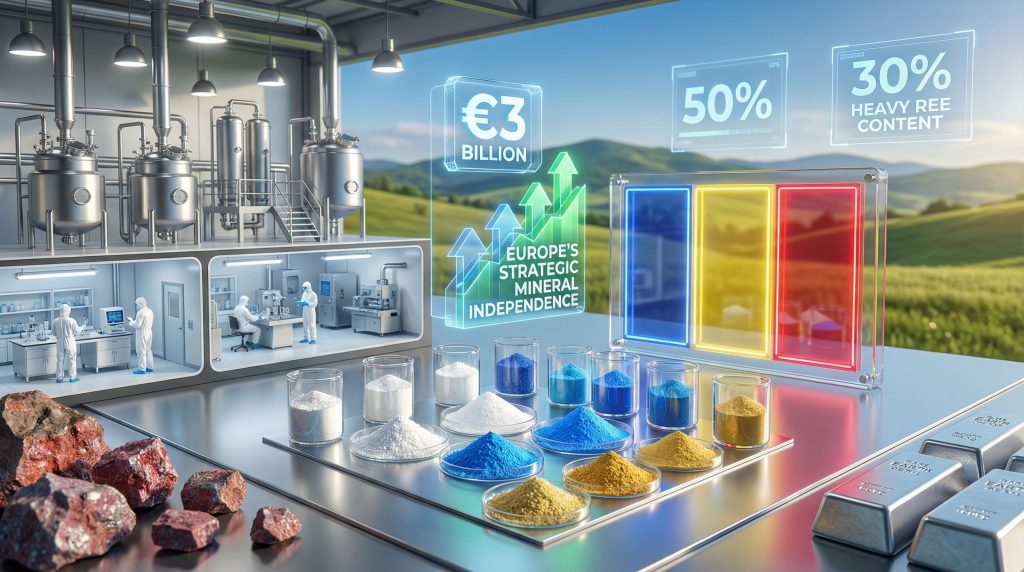
| Processing Capacity | Up to 50% of Tanbreez project output |
| Infrastructure Base | Adapted uranium concentrate facility |
| Ownership Structure | 50/50 state-private partnership |
| Target Markets | Defence, electrification, manufacturing |
| Supply Chain Model | Integrated Western-aligned system |
Public-Private Partnership Dynamics
The joint venture between state-owned FPCU and Critical Metals Corp creates a governance framework designed to balance commercial viability with strategic national interests. However, this structure provides several operational advantages:
- Risk Distribution: Shared capital expenditure and operational responsibilities reduce individual partner exposure
- Regulatory Alignment: State ownership facilitates compliance with EU strategic autonomy requirements
- Commercial Flexibility: Private sector participation brings rare earth market expertise and technology access
- Financial Leverage: Combined access to EU funding mechanisms and private capital markets
Nevertheless, the partnership structure also creates complexity around decision-making authority, operational control, and strategic direction that must be carefully managed through formal governance agreements.
Infrastructure Adaptation Requirements
Converting uranium processing infrastructure for rare earth applications involves significant technical modifications beyond simple equipment changes. The facility must develop specialised extraction and purification capabilities suitable for the unique characteristics of rare earth concentrates.
Key technical considerations include:
- Chemical separation processes for individual rare earth elements
- Solvent extraction systems for heavy versus light rare earth separation
- Waste management protocols for processing residues
- Quality control systems for end-user specifications
- Environmental compliance for different regulatory frameworks
Supply Chain Integration Between Greenland and Romania
The Tanbreez deposit in Greenland critical minerals provides the primary raw material source for Romania's rare earth processing facility. This supply relationship creates an integrated Western supply chain alternative to Chinese-controlled processing routes.
Tanbreez Deposit Characteristics
The Tanbreez resource represents one of the world's largest heavy and medium rare earth deposits, with geological characteristics that provide specific advantages for European processing applications:
| Deposit Feature | Specification |
|---|---|
| Resource Type | Eudialyte-hosted mineralisation |
| Heavy REE Content | Approximately 30% of total inventory |
| Radioactivity Level | Low compared to standard deposits |
| Processing Profile | Unique extraction requirements |
| Strategic Location | Greenland political alignment |
Processing Technology Challenges
Eudialyte-type rare earth deposits present distinct processing challenges compared to conventional bastnäsite or monazite ores. The complex silicate mineralogy requires specialised extraction techniques and separation chemistry to achieve commercial recovery rates.
For instance, the Feldioara facility must develop processing methodologies specifically adapted for eudialyte concentrates while maintaining cost competitiveness against established Chinese operations. This technological development represents both a technical risk and an opportunity for European processing innovation.
Supply Chain Coordination
Successful integration between Tanbreez mining operations and Feldioara processing requires careful coordination of production timelines, transport logistics, and quality specifications. The facility's design capacity to process up to 50% of Tanbreez output creates substantial supply chain interdependence.
Key coordination factors include:
- Mining production scheduling alignment with processing capacity
- Concentrate transport logistics from Greenland to Romania
- Quality control specifications throughout the supply chain
- Inventory management for seasonal shipping constraints
- Market allocation for processed rare earth products
Ownership Structure and Control Analysis
Critical Metals Corp operates as a publicly traded entity with a complex ownership structure that has attracted scrutiny regarding ultimate beneficial control and transparency. Furthermore, the company's governance arrangements directly impact the strategic credibility of Romania's rare earth processing facility.
Shareholder Composition
Critical Metals' ownership structure reflects a combination of strategic, institutional, and retail investors:
| Shareholder Category | Approximate Ownership | Strategic Influence |
|---|---|---|
| European Lithium | ~50% | Primary control |
| Institutional Investors | ~10% | Limited influence |
| Retail and Insiders | ~40% | Minimal influence |
Institutional Investor Participation
Major institutional investors hold positions in Critical Metals Corp, including:
- BlackRock
- Driehaus Capital Management
- Morgan Stanley
- Nuveen
- State Street
- Geode Capital
- AQR
- Vanguard
Despite this institutional participation, European Lithium's majority ownership position provides substantial control over strategic decisions and operational direction.
Transparency and Governance Concerns
Romanian media investigations have identified potential transparency issues regarding ultimate beneficial ownership through European Lithium's corporate structure. These concerns centre on whether the project's strategic European infrastructure positioning aligns with actual ownership and control arrangements.
The governance questions become particularly relevant given the project's framing as strategic European infrastructure and its potential access to EU funding mechanisms designed to enhance European industrial sovereignty.
Government Strategic Interest
The U.S. government has expressed potential interest in acquiring a minority stake through Defense Production Act-related investment mechanisms, though no transaction has been finalised. This interest reflects the strategic importance of rare earth processing capacity for Western defence and industrial applications.
EU Critical Materials Strategy Integration
Romania's rare earth processing facility aligns with broader European Union initiatives to reduce critical mineral dependencies and enhance supply chain resilience. The project's development occurs within a supportive regulatory environment designed to encourage European processing capacity.
Regulatory Framework Support
The EU's Critical Raw Materials Act provides both policy direction and potential funding mechanisms for projects that strengthen European processing capabilities. This regulatory environment offers several advantages:
- Streamlined permitting processes for strategic projects
- Access to EU funding and financing mechanisms
- Coordination with other European critical mineral initiatives
- Alignment with European industrial strategy objectives
Strategic Autonomy Objectives
The facility contributes to European strategic autonomy goals by creating processing capacity within EU jurisdiction. However, this positioning reduces dependence on Chinese processing infrastructure and enhances European negotiating leverage in critical mineral markets.
Key strategic benefits include:
- Reduced supply chain vulnerability to geopolitical disruptions
- Enhanced European technical expertise in rare earth processing
- Strengthened industrial base for defence and technology applications
- Increased leverage in international critical mineral negotiations
Competitive Positioning
Romania's facility represents one component of a broader European strategy to develop distributed processing capabilities across multiple member states. Success at Feldioara could catalyse additional processing investments throughout the EU, creating a network of facilities capable of supporting regional industrial requirements.
This mirrors trends in mining industry evolution where distributed processing networks enhance supply chain resilience.
The next major ASX story will hit our subscribers first
Investment Framework and Market Dynamics
The financial structure of Romania's rare earth processing facility reflects the complex intersection of strategic policy objectives and commercial viability requirements. Understanding the investment dynamics provides insight into project sustainability and market positioning.
Capital Structure and Financing
The project's financing model combines public strategic support with private sector investment, creating a risk-sharing framework that addresses both commercial and policy objectives:
- State Investment: Through FPCU's 50% partnership participation
- Private Capital: Via Critical Metals Corp's technology and market expertise
- Potential EU Funding: Through critical materials strategic programmes
- Institutional Support: From U.S. Defense Production Act mechanisms
Market Positioning Strategy
The facility's commercial success depends on competitive positioning against established Chinese processing operations while serving European and Western markets willing to pay premiums for supply chain security.
Key market factors include:
- Price competitiveness with Chinese processed materials
- Quality specifications meeting end-user requirements
- Supply reliability and delivery performance
- Customer willingness to pay security premiums
- Long-term contract arrangements with strategic buyers
Revenue and Profitability Scenarios
Scenario A: Strategic Premium Market
- Focus on defence and critical technology applications
- Premium pricing for supply chain security
- Long-term government and strategic buyer contracts
Scenario B: Commercial Market Competition
- Direct price competition with Chinese processors
- Focus on cost optimisation and operational efficiency
- Broad industrial and commercial customer base
Scenario C: Hybrid Positioning
- Combination of strategic and commercial market segments
- Flexible production allocation based on market conditions
- Balanced revenue streams from multiple customer categories
Development Timeline and Implementation Milestones
The progression from initial agreements to operational facility involves multiple development phases, each with distinct technical, regulatory, and commercial requirements. For instance, the investing guide 2025 outlines similar infrastructure project considerations.
Near-Term Development Activities
-
Joint Venture Formalisation
- Finalisation of partnership terms and governance structure
- Capital contribution schedules and operational responsibilities
- Technology licensing and intellectual property arrangements
-
Technical Design and Engineering
- Processing facility design for eudialyte concentrate handling
- Equipment procurement and installation planning
- Environmental and safety system integration
-
Regulatory Approval Process
- EU and Romanian permitting requirements
- Environmental impact assessments
- Safety and operational compliance certifications
Long-Term Operational Targets
The facility aims to process up to 50% of Tanbreez project output on a long-term offtake basis, creating stable supply relationships that support both Romanian processing objectives and Greenland mining development.
Operational milestones include:
- Initial processing capacity commissioning
- Production ramp-up to designed throughput levels
- Quality certification for end-user specifications
- Long-term supply contract implementation
- Technology optimisation and efficiency improvements
Critical Path Dependencies
Project success depends on coordination across multiple parallel development tracks:
- Tanbreez mine development and production scheduling
- Romanian facility construction and commissioning
- Market development and customer contract negotiations
- Technology development and process optimisation
- Regulatory compliance and operational certification
Risk Assessment and Mitigation Strategies
Romania's rare earth processing facility faces multiple categories of risk that could impact technical performance, commercial viability, and strategic objectives. Understanding these risks and mitigation approaches provides insight into project sustainability.
Technical Processing Risks
Challenge: Eudialyte Processing Complexity
Eudialyte-hosted rare earth deposits require specialised processing technologies that differ significantly from conventional rare earth ore types. The complex silicate mineralogy presents unique extraction and separation challenges.
Mitigation Strategies:
- Partnership with established metallurgical engineering firms
- Pilot-scale testing and process optimisation
- Technology licensing from proven processing operations
- Phased production ramp-up with technical validation milestones
Market and Commercial Risks
Challenge: Competitive Positioning Against Chinese Processors
Chinese rare earth processing operations benefit from established infrastructure, optimised processes, and integrated supply chains that provide significant cost advantages.
Mitigation Approaches:
- Focus on strategic market segments willing to pay security premiums
- Long-term contract arrangements with government and defence buyers
- Operational efficiency optimisation through technology advancement
- EU policy support for European processing capacity
Geopolitical and Policy Risks
Challenge: Changing Political Priorities
The project's strategic value depends on sustained European commitment to supply chain diversification and continued geopolitical tensions that justify processing premiums.
Risk Management:
- Diversified customer base across multiple European countries
- Commercial viability independent of strategic subsidies
- Flexible production capacity for different market segments
- Strong regulatory alignment with EU strategic objectives
Financial and Ownership Risks
Challenge: Governance and Control Transparency
Questions regarding ultimate beneficial ownership through European Lithium could impact project credibility and access to government support.
Mitigation Measures:
- Enhanced corporate governance and transparency reporting
- Clear documentation of ownership and control structures
- Compliance with EU beneficial ownership disclosure requirements
- Independent oversight and strategic advisory mechanisms
Strategic Implications for European Critical Mineral Independence
Romania's rare earth processing facility represents a crucial test case for European capabilities to develop integrated critical mineral supply chains outside Chinese control. The project's success or failure will influence broader European strategy and investment in critical materials infrastructure.
This development contributes to the broader European CRM facility network and strategic independence goals.
Technology Development and Knowledge Transfer
The facility creates opportunities for European technical expertise development in rare earth processing technologies. Successful operation could establish Romania as a centre of excellence for critical mineral processing within the EU.
Knowledge transfer benefits include:
- Development of European rare earth processing expertise
- Training programmes for specialised technical personnel
- Research and development partnerships with European universities
- Technology innovation in critical mineral processing methods
- Industrial base strengthening for European manufacturing
Supply Chain Network Effects
Success at Feldioara could catalyse additional processing investments across Europe, creating a distributed network of facilities capable of supporting regional industrial requirements. This network approach provides greater resilience than single-facility dependence.
Potential network benefits include:
- Multiple processing locations reducing geographic concentration risk
- Specialised facilities for different rare earth elements or applications
- Shared technology development and best practices
- Enhanced negotiating leverage with global suppliers
- Regional supply chain optimisation and cost reduction
Policy and Regulatory Precedents
The governance structure and financing model developed for Romania's facility will establish precedents for future European critical mineral projects. The balance between strategic objectives and commercial viability creates a template for similar initiatives.
Key precedent areas include:
- Public-private partnership structures for strategic infrastructure
- EU funding mechanisms for critical mineral processing
- Beneficial ownership and transparency requirements
- Strategic buyer commitments and pricing arrangements
- Technology development and intellectual property management
As noted by industry analysts, "This joint venture creates a fully integrated mine-to-processing supply chain for long-term security for European manufacturing."
Disclaimer: This analysis is based on publicly available information as of December 2025. Rare earth processing projects involve significant technical, commercial, and geopolitical risks. Investment decisions should be made based on comprehensive due diligence and professional advice. Market conditions, regulatory frameworks, and project developments may change materially from current assessments.
Seeking Opportunities in Critical Minerals Infrastructure?
Discovery Alert's proprietary Discovery IQ model delivers real-time alerts on significant ASX mineral discoveries, instantly empowering subscribers to identify actionable opportunities ahead of the broader market. Understand why historic discoveries can generate substantial returns by visiting Discovery Alert's dedicated discoveries page, showcasing how major mineral discoveries have delivered exceptional outcomes for investors who positioned themselves early.