
August 8, 2026
Understanding Critical Infrastructure Vulnerabilities in Modern Refining Operations
Modern petroleum processing facilities represent some of the world's most complex industrial operations, where sophisticated engineering systems process millions of barrels of crude oil daily into essential energy products. Saudi Arabia's SATORP Refinery Shut Down After Attack demonstrates how these facilities operate through interconnected networks of processing units, utilities, and control systems that, while designed for maximum efficiency, create specific operational vulnerabilities during crisis situations.
The engineering principles underlying large-scale refining operations reveal why these facilities face unique risks during security incidents. Unlike simpler industrial processes, refining involves multiple interconnected processing trains that share critical infrastructure components, creating cascade failure potential that can shut down entire facilities even when damage affects only specific units.
When big ASX news breaks, our subscribers know first
How Dual-Train Processing Systems Create Operational Dependencies
Large refineries utilise dual-train configurations to maximise processing capacity while providing operational redundancy. These systems typically feature two parallel processing lines that can operate independently but share essential utilities, safety systems, and control infrastructure.
Key Vulnerability Factors in Dual-Train Systems:
• Shared utility networks connecting both processing trains
• Integrated safety shutdown systems that affect entire facilities
• Common control room operations managing multiple processing units
• Interconnected product storage and distribution systems
The SATORP facility demonstrates these vulnerabilities through its sophisticated processing architecture. When one processing train experiences damage or operational disruption, safety protocols typically require evaluation of the entire facility's operational status, often leading to precautionary shutdowns that affect both processing lines.
SATORP Facility Technical Specifications
| Parameter | Details |
|---|---|
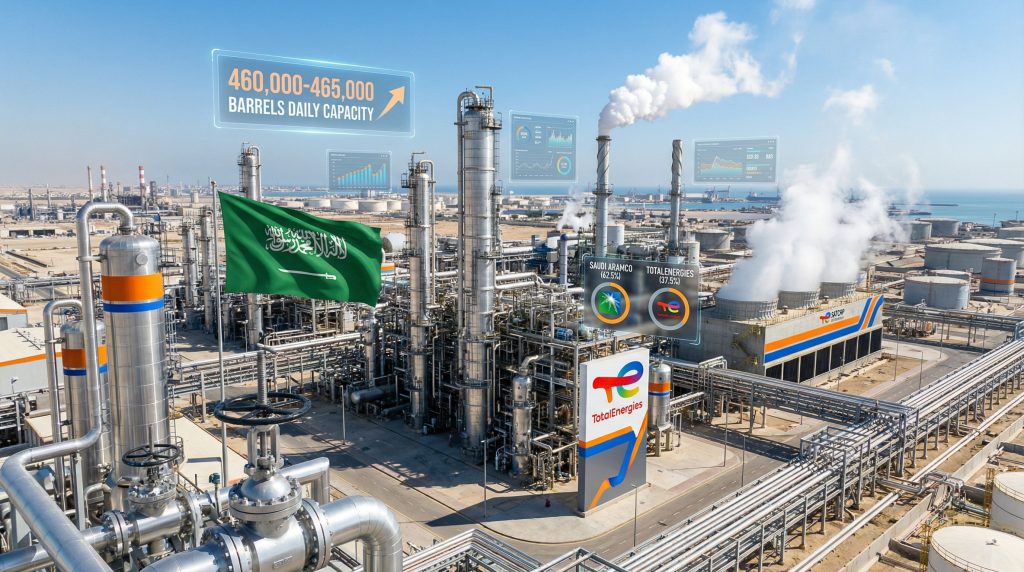
| Processing Capacity | 460,000-465,000 barrels per day |
| Configuration | Dual-train processing system |
| Ownership Structure | Saudi Aramco (62.5%), TotalEnergies (37.5%) |
| Location | Jubail Industrial City, Saudi Arabia |
| Processing Type | Integrated refining and petrochemicals |
This facility represents a critical node in global petroleum supply chains, processing crude oil into refined products for both domestic Saudi consumption and international export markets. Furthermore, the joint venture complexities between Saudi Aramco and TotalEnergies add additional complexity to crisis management protocols.
Regional Energy Infrastructure Interdependencies
The coordinated nature of attacks on Saudi energy infrastructure reveals the interconnected vulnerabilities within regional petroleum systems. Multiple facilities experienced disruptions simultaneously, creating cumulative impacts far exceeding the sum of individual facility outages.
Coordinated Infrastructure Targeting Assessment:
• SATORP refinery – Processing disruption affecting 460,000 bpd capacity
• East-West Pipeline – Transportation bottleneck affecting 700,000 bpd capacity
• Manifa production field – Upstream disruption reducing crude availability
• Khurais production complex – Additional upstream capacity limitations
The strategic targeting pattern demonstrates sophisticated understanding of Saudi Arabia's energy infrastructure interdependencies. However, by attacking both upstream production facilities and downstream processing capacity simultaneously, the coordinated strikes created multiplier effects throughout the regional energy system. These incidents highlight the importance of Saudi Energy Exploration Impact on global markets.
Cumulative Impact Analysis:
The combined capacity reductions from multiple facility attacks resulted in approximately 1.3 million barrels per day of disrupted Saudi energy production and processing capability. This figure represents roughly 1.3% of global daily oil production, highlighting how concentrated regional infrastructure creates systemic vulnerabilities in international energy markets.
Market Psychology and Geopolitical Risk Pricing
Energy commodity markets demonstrated characteristic volatility patterns following the infrastructure attacks, with prices initially spiking on supply disruption fears before experiencing sharp corrections as traders reassessed actual supply impacts versus perceived risks.
Price Movement Analysis:
WTI crude oil exhibited extreme volatility during the crisis period, reaching weekly highs of $117.73 before declining sharply to $91.05. This $26.68 trading range within a single week illustrates the challenge energy markets face when pricing geopolitical risk premiums during fast-moving crisis situations.
The initial price surge reflected traders' attempts to price worst-case supply disruption scenarios, while the subsequent decline indicated profit-taking behaviour as immediate supply impacts failed to materialise at expected levels. For instance, this pattern reveals how energy markets struggle to differentiate between perceived risks and actual supply fundamentals during geopolitical crises.
Market Psychology During Crisis Events:
• Fear-driven premium phase – Initial spike pricing worst-case scenarios
• Reality assessment period – Evaluation of actual versus perceived impacts
• Profit-taking correction – Liquidation of risk premium positions
• Volatility persistence – Continued uncertainty driving price swings
This volatility pattern demonstrates how geopolitical events can create temporary disconnects between physical supply realities and financial market pricing, with energy traders often overcompensating for potential supply risks before correcting toward fundamental supply-demand balance.
Infrastructure Protection Protocols in Critical Energy Facilities
Modern refining facilities implement comprehensive security architectures designed to protect against various threat vectors while maintaining operational efficiency. These systems typically integrate physical security measures with operational continuity planning and emergency response capabilities.
Multi-Layer Security Framework Components:
• Perimeter surveillance systems with advanced detection technologies
• Access control protocols managing personnel and vehicle entry
• Emergency response coordination with national security agencies
• Operational continuity planning for various disruption scenarios
The effectiveness of these security measures depends largely on coordination between facility operators, local security forces, and national infrastructure protection agencies. In Saudi Arabia's case, critical energy infrastructure receives enhanced protection due to its strategic importance to both domestic energy security and international petroleum markets.
"TotalEnergies confirmed no casualties occurred during the SATORP facility incident, demonstrating the effectiveness of modern safety and emergency response systems even during security events."
However, the successful targeting of multiple facilities simultaneously suggests that coordinated attacks can overwhelm individual facility protection measures. Consequently, this highlights the need for enhanced regional security coordination and intelligence sharing between energy infrastructure operators, as discussed in The Wall Street Journal's analysis of the incident.
Crisis Response and Recovery Measures
Saudi Arabia's SATORP Refinery Shut Down After Attack required immediate implementation of established emergency protocols. The response demonstrated how modern industrial facilities prioritise personnel safety whilst assessing infrastructure damage and planning operational recovery.
Emergency response teams conducted systematic facility inspections to determine the extent of damage and evaluate restart requirements. Furthermore, the coordinated nature of multiple facility attacks necessitated enhanced security assessments before resuming normal operations.
Joint Venture Crisis Management Complexities
International joint ventures like SATORP face unique challenges during crisis management situations, requiring coordination between multiple corporate entities, national interests, and regulatory frameworks. The Saudi Aramco-TotalEnergies partnership exemplifies these complexities.
Joint Venture Crisis Management Challenges:
• Dual governance structures requiring coordinated decision-making
• Multiple stakeholder communication across different corporate cultures
• Insurance and liability coordination between international partners
• Diplomatic considerations affecting crisis response strategies
TotalEnergies' response to the SATORP incident followed established crisis management protocols, including comprehensive safety assessments, stakeholder communications, and operational impact evaluations. The French energy company's approach demonstrates how international partners must balance corporate responsibilities with diplomatic considerations during geopolitical crises.
Crisis Response Protocol Implementation:
- Immediate safety assessment of personnel and facility status
- Stakeholder notification including shareholders and regulatory authorities
- Operational impact evaluation for business continuity planning
- Insurance claim preparation for potential damage recovery
These protocols reflect standard industry practices for international energy joint ventures operating in geopolitically sensitive regions. Additionally, crisis management must address both operational and diplomatic considerations simultaneously, as reported by Reuters in their comprehensive coverage of the incident.
The next major ASX story will hit our subscribers first
Long-Term Infrastructure Resilience and Investment Implications
The coordinated attacks on Saudi energy infrastructure will likely influence future investment strategies in critical energy facilities, with enhanced focus on geographic diversification, security technologies, and operational redundancy measures.
Strategic Resilience Enhancement Areas:
• Geographic diversification of processing capacity to reduce concentration risk
• Advanced threat detection systems utilising artificial intelligence and automation
• Distributed processing architectures minimising single-point-of-failure risks
• Enhanced cybersecurity measures protecting control systems and data networks
Energy companies operating in the Middle East may accelerate investments in protective technologies and operational redundancy following these incidents. The demonstration of coordinated attack capabilities against multiple facilities simultaneously highlights vulnerabilities in concentrated infrastructure arrangements, which connects to broader energy security insights.
Investment Strategy Implications:
Saudi Arabia's SATORP Refinery Shut Down After Attack and broader Saudi infrastructure attacks will influence how investors evaluate energy projects in geopolitically sensitive regions. Enhanced due diligence requirements may include comprehensive security assessments, emergency response capability evaluations, and geopolitical risk premium calculations.
Risk assessment frameworks for energy infrastructure investments will likely incorporate lessons learned from these coordinated attacks. In particular, facilities located in concentrated industrial clusters that could face similar coordinated targeting strategies require enhanced attention.
Global Supply Chain Resilience Assessment
The SATORP shutdown and broader Saudi infrastructure disruptions demonstrate the interconnected nature of global energy supply chains, where localised incidents can create widespread market effects through supply chain interdependencies and market psychology factors.
Supply Chain Vulnerability Analysis:
• Concentration risk in critical processing regions
• Transportation bottlenecks affecting product distribution
• Alternative supply route limitations during crisis situations
• Strategic reserve adequacy for emergency supply situations
Countries with strategic petroleum reserves may need to evaluate release mechanisms and coordination protocols for future supply disruptions. The rapid price volatility following the Saudi attacks suggests that even temporary supply concerns can create disproportionate market impacts requiring policy interventions.
Alternative Infrastructure Development Priorities:
Energy companies will likely prioritise development of alternative transportation routes, processing facilities in different geographic regions, and supply chain resilience strategies to reduce dependence on concentrated infrastructure clusters vulnerable to coordinated attacks.
Technical Innovation and Security Technology Integration
The sophistication of coordinated attacks on energy infrastructure accelerates development and deployment of advanced security technologies, including automated threat detection, artificial intelligence-powered surveillance systems, and integrated emergency response capabilities.
Emerging Security Technology Applications:
• AI-powered perimeter monitoring with predictive threat assessment
• Automated emergency response systems reducing human error during crises
• Integrated facility communication networks enabling coordinated defence strategies
• Advanced cybersecurity protocols protecting industrial control systems
These technological innovations represent significant capital investment opportunities for energy infrastructure operators seeking to enhance facility protection capabilities whilst maintaining operational efficiency during normal operations. Moreover, developments in this field are increasingly showcased at events like those featured in innovation expo insights.
The integration of advanced security technologies with existing refining operations requires careful engineering to avoid creating new operational vulnerabilities whilst enhancing protection against external threats.
Future Energy Market Volatility and Risk Management
Saudi Arabia's SATORP Refinery Shut Down After Attack incident and coordinated Saudi infrastructure attacks establish new precedents for energy market volatility during geopolitical crises, with implications for commodity trading strategies, risk management protocols, and price discovery mechanisms in petroleum markets.
Market Structure Evolution Factors:
• Increased volatility expectations during geopolitical tensions
• Enhanced risk premium calculations for energy infrastructure investments
• Accelerated diversification strategies across supply chains and processing capacity
• Policy coordination requirements for strategic reserve management
Energy market participants will likely adjust trading strategies and risk management frameworks to account for demonstrated capabilities of coordinated infrastructure attacks. The extreme price volatility observed during this crisis provides new data points for volatility modelling and option pricing in energy derivatives markets.
The long-term implications extend beyond immediate supply disruptions to include structural changes in how energy markets price geopolitical risks and how infrastructure operators invest in protective capabilities for critical facilities worldwide.
Disclaimer: This analysis is for informational purposes only and should not be considered as investment advice. Energy market investments carry significant risks, and past performance does not guarantee future results. Readers should conduct their own research and consult with qualified financial advisors before making investment decisions.
Looking for Opportunities in Energy Infrastructure Investments?
Discovery Alert's proprietary Discovery IQ model delivers real-time alerts on significant mineral discoveries, instantly empowering subscribers to identify actionable opportunities ahead of the broader market. Understand why major mineral discoveries can lead to significant market returns by exploring Discovery Alert's dedicated discoveries page, showcasing historic examples of exceptional outcomes, and begin your 14-day free trial today to secure your market-leading advantage.